Quick wins for a faster PC:
Scan for outdated or missing drivers - takes under a minuteDriver Scan →Clear out junk files and repair common Windows errorsFree Scan →Fix the driver behind crashes, sound loss and screen glitchesFind Drivers →Short answer: A nitrogen generator can reduce deliveries and cylinder change-outs when a construction operation has steady, recurring demand and already has suitable compressed air, power, space, and maintenance capacity. Cylinders avoid generator capital and installation, and are often simpler for low or intermittent demand, but they require replenishment, storage, movement, and change-outs. Neither option is automatically cheaper or safer. Decide from your actual purity, flow, pressure, duty cycle, site conditions, delivered-gas charges, equipment costs, and safety controls.
What the two supply methods actually provide
Nitrogen cylinders: delivered gas in finite containers
A cylinder supplier fills and delivers a pressurized vessel. Your equipment draws down that finite inventory until the cylinder is empty or reaches the change-out point. A cylinder program therefore depends on ordering, delivery timing, rental terms, storage capacity, a compatible regulator, and a safe method for moving and securing vessels.
As an Amazon Associate I earn from qualifying purchases.
This model requires no nitrogen-generator purchase, but the gas bill is only one part of the cost. Include cylinder rental, delivery charges, labor for receiving and changing cylinders, inventory space, and the consequences of a delayed or missed delivery. A low-use operation may accept those recurring costs because it avoids installing and maintaining another machine.
On-site nitrogen generators: gas made from compressed air
A generator separates nitrogen from compressed air at the point of use. It needs an appropriately sized compressed-air source, treatment and filtration specified by the selected system, electrical power where required, installation space, maintenance, and a plan for periods when the generator is offline. The output is not an unlimited free supply: production is constrained by the generator’s rated flow, inlet-air quality, pressure, operating hours, and the nitrogen purity selected.
#1 Best Overall

- PRECISION CONTROL: Our nitrogen regulator is engineered for a maximum working input of 3000 PSI and a finely adjustable output of 0-600 PSI. The gauges are clearly marked with higher ranges (4000 PSI input / 800 PSI output) to provide a clear visual safety buffer, promoting informed and confident handle during all your pressure control tasks
- SUPERIOR LEGIBILITY & PROTECTION: This nitrogen regulator features two easy-to-read gauges provide clear, accurate pressure readings at a glance. Each gauge is shielded by a rugged rubber boot, offering superior protection against impacts, scratches, and everyday job site wear and tear. For your safety, a built-in relief valve automatically activates near 600 PSI to prevent over-pressurization, ensuring safe procedure and protecting your equipment
- UNIVERSAL FITTINGS: Features standard CGA580 inlet and 1/4" SAE male flare outlet connections for broad compatibility. Quickly connect to a wide range of systems and tools without the need for extra adapters, getting you to work faster and more efficiently
- WIDE APPLICATION: The nitrogen regulator is suitable for a multitude of tasks including HVAC system purging, brazing, soldering, leakage tests, and pressure testing. A trusted and robust tool that delivers professional results, making it the excellent choice for both technicians and skilled DIY enthusiasts
- INDUSTRIAL-GRADE CONSTRUCTION: Our nitrogen regulators are crafted from solid brass with a precision-machined piston and diaphragm for long-lasting performance. The large T-style handle allows for smooth, precise adjustments, ensuring steady pressure control and outstanding on-the-job longevity
Atlas Copco describes two approaches: pressure swing adsorption (PSA) and membrane separation. The company’s technical guidance presents PSA as the usual choice when higher purity is required and membrane systems as simpler options for lower-purity applications. Those are supplier-level descriptions, not a substitute for the performance data of the model you are evaluating. Review the specified purity, flow, outlet pressure, recovery, inlet-air requirements, and duty cycle against your process before purchasing.
Applications cited by manufacturers include food packaging, laser cutting, chemical blanketing, and laboratory mass spectrometry. They demonstrate different use cases rather than a universal generator specification. A construction fabricator using nitrogen for laser cutting, for example, must use the laser manufacturer’s gas specification and the generator’s certified output data rather than selecting a unit from the application name alone.
Generator versus cylinders: the comparison that matters on a construction site
| Decision factor | On-site generator | Nitrogen cylinders |
|---|---|---|
| Supply source | Nitrogen separated from compressed air at the facility | Finite quantity of delivered nitrogen in each cylinder |
| Up-front spending | Generator, installation, compressed-air equipment or upgrades, and commissioning | Usually no generator capital; account for regulator, restraints or cart, rental terms, and initial delivery |
| Recurring spending | Electricity or other operating energy, maintenance, replacement parts, and backup supply | Gas charges, cylinder rental, deliveries, handling labor, and emergency orders |
| Purity and pressure | Must be selected and verified for the process; PSA and membrane suitability varies by model | Specified by the gas supplier and cylinder product; regulator and downstream equipment must match |
| Continuity risk | Depends on compressor and generator uptime, maintenance, power, and contingency supply | Depends on delivery schedule, inventory, supplier availability, and timely change-out |
| Space and movement | Permanent or semi-permanent equipment plus air treatment and service access | Storage area, separation and restraint, transport route, and room for full and empty cylinders |
| Mobility | Best suited to a stable location with utilities and a defined installation | Can follow changing work areas when transport and site rules permit, but every move adds handling controls |
| Safety profile | Nitrogen release can displace oxygen; compressed-air and electrical hazards also require controls | The same nitrogen asphyxiation hazard, plus cylinder inspection, storage, handling, and regulator controls |
The cited sources establish why purity, capacity, configuration, logistics, and cost assumptions belong in the comparison. They do not establish a universal flow threshold, payback period, or current local price at which one method always wins.
Is a nitrogen generator cheaper than cylinders?
Use a site-specific total-cost model
Compare the costs over the same period and operating schedule. For cylinders, add:
- Gas charges for the number and size of cylinders actually consumed.
- Rental or demurrage charges, if applicable.
- Delivery, hazardous-gas or fuel surcharges, and minimum-order fees in your supplier agreement.
- Receiving, moving, connecting, disconnecting, and returning cylinders.
- Extra inventory or expedited delivery needed to protect production from a stockout.
For a generator, add:
- Purchase price, freight, installation, commissioning, and any building or utility work.
- Compressor capacity and air treatment, including upgrades if existing plant air cannot meet the generator’s inlet specification.
- Electricity and other operating energy for the compressor and generator over the intended duty cycle.
- Routine maintenance, filters, adsorbent or membrane service, calibration, and replacement parts.
- Operator training, service contracts, downtime, and a backup cylinder or other contingency supply.
Calculate cost per usable unit of nitrogen only after you have verified the generator’s rated flow at the required purity and pressure. A low nominal price per hour is not meaningful if the unit cannot meet peak demand or if compressor energy dominates the operating cost. Conversely, a cylinder price comparison that ignores delivery and labor can make delivered gas look cheaper than it is.
What the published examples do—and do not—prove
Parker Hannifin’s January 2014 LC-MS white paper presents a historical example of 52 cylinders at $60 each compared with approximately $20 per week for in-house generation. Those figures belong to that laboratory application, date, assumptions, and local purchasing conditions. They are not a current quote, a percentage saving, or a payback promise for a construction business. Use the example to identify the inputs a real calculation needs, not as your expected result: Parker’s LC-MS Nitrogen White Paper.
Rank #2

- CGA580 Inlet Connection, 1/4" SAE Male Flare Outlet Connection and Easy to Read 2 Inch Gauges with Protective Rubber Gauge Boots
- PRESSURE- Input: 0-4000PSI. Output: adjustable - 0-450PSI. The display show 600PSI that you can rate them at 450PSI, but they are able to go up to 600PSI
- Great for HVAC Purging / Inertization / Pressure Tests / Leakage Tests / Brazing / Soldering
- Large brass Tee Handle with stainless steel pressure adjusting screw and regulator bushing that prevents galling
- Sturdy brass piston designed diaphragm, self re-seating relief valve (not designed to protect downstream system)
Atlas Copco’s current US product page advertises “up to 80% lower cost” for on-site nitrogen compared with bottled supply. That is the manufacturer’s marketing claim, and the page does not establish that saving for every user, purity, flow, energy tariff, or region. Treat it as a claim to test with your quotations and operating data, not as a guaranteed result: Atlas Copco Nitrogen Generator | US On-Site Systems.
When the generator investment is more likely to work
An on-site system has a stronger economic case when demand is frequent and predictable, deliveries are expensive or disruptive, the facility can use existing compressed-air capacity, and the equipment can run for enough hours each year to spread capital and maintenance over substantial production. A fixed fabrication shop or a permanent project facility may fit this pattern.
Cylinders remain financially practical when demand is low, sporadic, seasonal, or spread across temporary locations; when a site lacks reliable power or compressed air; or when the cost of installing, servicing, and protecting a generator exceeds the avoided delivery expense. These are decision conditions, not universal break-even rules. Obtain current supplier quotes and generator proposals for your location.
Are nitrogen generators safer than cylinders?
The hazard common to both systems
Nitrogen is not breathable at elevated concentrations. It can displace oxygen and create a hazardous atmosphere without providing a detectable warning. OSHA describes nitrogen as a simple asphyxiant and warns that improper use can injure or kill workers. In its October 29, 2020 interpretation, OSHA states: “Nitrogen has an inherent hazard of being a simple asphyxiant, and if not used properly in certain workplace applications, workers may be injured or killed.” Read the complete interpretation and apply the requirements relevant to your workplace: OSHA, “OSHA standards applicable to medical and safety uses of pure nitrogen gas” (October 29, 2020).
OSHA’s January 25, 1995 interpretation says: “Inert gases, such as argon, nitrogen and helium, have the potential to create a hazardous atmosphere (less than 19.5% oxygen) and, where that potential exists, are considered by OSHA as hazardous chemicals presenting an acute health hazard and covered by the standard.” The 19.5% figure and its context come from that interpretation; consult the current regulation and your jurisdiction before applying it to a particular space: OSHA, “Guidance on whether an inert gas in the non-compressed state represent hazardous chemicals under the Hazard Communication Standard” (January 25, 1995).
The Tool Desk
Outbyte Driver Updater FREEScan for outdated or missing drivers - takes under a minuteDriver Scan →Outbyte PC Repair FREERepair Windows errors before they cause bigger problemsFix Now →A generator changes how gas arrives; it does not make a nitrogen release harmless. A ruptured line, leaking fitting, vented process, or poorly ventilated equipment room can still reduce oxygen. Include the generator, compressor, storage receiver, distribution piping, and points of use in the site risk assessment. Follow the equipment manual, safety data, ventilation design, oxygen-monitoring decisions, emergency plan, and applicable workplace rules.
Rank #3

- DOT-3AA Approved: Each cylinder is stamped with U.S. DOT markings, ensuring full compliance with strict gas storage and transportation standards. Note!!!: Cylinder ships empty; please consult local gas suppliers for filling
- Premium Steel Construction: Made from high-strength alloy steel with thick walls for maximum durability, built to withstand tough usage environments. Suitable for industrial manufacturing, welding, HVAC, hydroponic, and beverage applications
- High Compatibility: Features a female-threaded CGA-580 valve for seamless connection to standard nitrogen regulators (2015 PSI service pressure / 3359 PSI test pressure)
- Professional Glossy Red Finish: The durable red coating ensures long-lasting aesthetics while protecting against daily wear. Each unit is stamped with a fresh production date for long-term use. Dimensions: 7" diameter x 23" height(including valve)
- One-Year Warranty: Enjoy 12 months of quality assurance with our professional customer service team ready to address any issues within 12 hours. Contact us through Amazon for full support and assistance
Additional cylinder controls
Cylinders add mechanical and logistical hazards: heavy vessels must be secured, moved with suitable equipment, protected from damage, and connected to correctly rated regulators and fittings. OSHA identifies compressed-gas requirements governing cylinder inspection, handling, storage, and use in covered workplaces. Workers must be informed about the hazards and safe use of the gas and equipment. Requirements depend on the workplace and jurisdiction, so your safety program must use the applicable rules rather than a generic internet checklist: OSHA, “Storage and use of compressed gas cylinders; whether cylinder is considered an oxidizing compressed gas or oxygen cylinder” (May 23, 2008).
Controls for a generator installation
- Locate the generator and compressor where ventilation, service access, drainage, noise, and environmental conditions meet the manufacturer’s requirements.
- Protect piping and hoses from vehicle impact, sharp edges, heat, and unauthorized modification.
- Identify nitrogen outlets and isolation valves so an emergency responder can shut down the source.
- Determine whether an oxygen monitor, alarm, or restricted-access control is required by the risk assessment and local rules.
- Train operators on normal operation, alarms, shutdown, lockout procedures, and what to do if a leak or loss of ventilation is suspected.
- Maintain a documented inspection and service schedule for the compressor, filters, generator, and distribution system.
PSA versus membrane nitrogen generators
PSA systems
Pressure swing adsorption uses adsorbent material and alternating pressure cycles to separate nitrogen from compressed air. Atlas Copco’s technical guide positions PSA for applications requiring higher purity. The usable flow, purity, pressure, recovery, and air consumption still depend on the selected model and operating point. Ask the supplier for performance data at your required purity rather than relying on the maximum flow printed in a brochure: Atlas Copco Canada, “PSA nitrogen generator: how pressure swing adsorption works”.
Membrane systems
Membrane generators pass compressed air through a membrane that separates gases at different rates. The same Atlas Copco guide describes membrane systems as simpler options for lower-purity requirements. Their simplicity does not remove the need to verify flow, pressure, inlet-air quality, temperature, moisture control, and maintenance for your process.
Do these 3 things before closing this tab:
1Clear out junk files and repair common Windows errors2Scan for outdated or missing drivers - takes under a minute3Repair Windows errors before they cause bigger problemsHow to choose between them
Start with the process specification, not the technology label:
- Write down the minimum nitrogen purity at the point of use, including any tolerance or quality-monitoring requirement.
- Record normal and peak flow, outlet pressure, operating hours, and whether multiple users can run simultaneously.
- Ask each supplier to state the inlet-air pressure, quality, and volume required to deliver that output.
- Compare the quoted energy, maintenance, service interval, footprint, noise, and expected availability at your operating conditions.
- Reject any proposal that states only a best-case purity or flow without conditions.
How to size the supply before requesting quotes
1. Measure real demand
List every nitrogen-consuming tool or process, its operating hours, and its normal and peak draw. Separate continuous users from intermittent bursts. Record simultaneous operation; adding nameplate flows without considering duty cycle can oversize a generator, while averaging away short peaks can undersize it.
2. Define the gas specification at the tool
Capture purity, pressure, flow, connection, and allowable variation at the point of use. The required specification may differ between a laser-cutting machine, a chemical-blanketing operation, and laboratory equipment. A generator that meets purity but not pressure, or pressure but not peak flow, is not a usable substitute for cylinders.
Rank #4

- LIGHTWEIGHT & CORROSION-RESISTANT. Crafted from high-strength 6061-T6 aluminum alloy, these nitrogen tanks are rust-free and easy to handle, ideal for both professional and personal use.
- BUILT FOR HIGH PRESSURE. Engineered to perform, each cylinder supports up to 2216 PSI/153 BAR service pressure and is hydrostatically tested to 3694 PSI/254.7 BAR for reliable durability.
- PROTECTIVE FINISH. The sleek aluminum alloy coating adds a striking look while delivering extra resistance to corrosion, scratches, and everyday wear.
- CERTIFIED SAFE. Each tank is stamped with required DOT and TC compliance markings and features a CGA-approved 580 valve with female threads for nitrogen regulators.
- BRAND NEW, NEVER RECONDITIONED. Kegco only offers brand-new aluminum nitrogen tanks, never refurbished, ensuring you get uncompromised quality from the start. Ships empty (no gas).
3. Check site utilities and environment
Confirm available electrical capacity, compressed-air flow and pressure, air dryness and filtration, ambient temperature, drainage, floor loading, ventilation, and service access. If the existing compressor cannot meet the generator’s inlet requirement while serving other tools, include a dedicated compressor or upgrade in the project cost.
Windows Errors? Fix Them Before They Spread
Repair common Windows errors and clear accumulated junk for a smoother, more stable PC - no reinstall needed.Free scan · no reinstallCrashes, No Sound, or Screen Glitches?
Random freezes, missing sound and display glitches usually trace back to one bad driver. Find and replace yours safely.Free scan · under a minute4. Set continuity and backup requirements
Decide how much interruption the operation can tolerate. A planned maintenance shutdown may be acceptable for one process but not for a production line. Price a backup cylinder bank or other contingency supply if a generator failure, power outage, compressor fault, or service delay could stop work.
5. Obtain comparable proposals
Require each quote to state the same purity, flow, outlet pressure, operating hours, inlet-air assumptions, installation scope, warranty, maintenance intervals, consumables, service response, and exclusions. Request a written statement of expected performance at your measured peak demand.
Installation and operation checklist for an on-site generator
- Approve the process specification. Have the equipment owner or process engineer confirm purity, pressure, flow, and acceptable quality before buying.
- Verify compressed-air capacity. Confirm the compressor, receiver, dryers, filters, and distribution can supply the generator and other users at the same time.
- Design the location. Provide ventilation, clearance, drainage, protection from impact and weather, access for maintenance, and safe routing for nitrogen piping.
- Install isolation and indication. Label inlet, product, exhaust, drains, valves, alarms, and emergency shutdown points.
- Commission under load. Test purity, flow, pressure, alarms, and recovery while representative users operate. Record baseline readings.
- Document routine care. Set inspection, filter, drain, calibration, and service intervals from the manufacturer’s manual and operating hours.
- Train operators. Cover startup, normal shutdown, alarm response, leak reporting, ventilation failures, and emergency isolation.
- Keep contingency supply ready. Store and connect backup cylinders only under the applicable cylinder controls, and test the changeover plan before an outage occurs.
Managing a cylinder-based supply safely and reliably
- Specify the gas correctly. Match the supplier’s purity and pressure to the process and verify the regulator, hose, fittings, and downstream equipment are rated for nitrogen service.
- Plan inventory from consumption. Use actual daily or weekly use, delivery lead time, holidays, and expected peaks to set a reorder point. Do not wait for the last cylinder.
- Control storage. Use the designated, ventilated area and the restraints, separation, access, signage, inspection, and handling practices required for your workplace.
- Control movement. Use a rated cart or other approved handling method; do not improvise lifting or transport methods. Keep cylinders secured during storage and use.
- Make change-outs repeatable. Train authorized workers on isolation, regulator connection, leak checks, labeling, and return of empties according to the supplier’s instructions and site procedures.
- Prepare for a delayed delivery. Identify an approved alternate source or a verified backup quantity before the primary inventory is exhausted.
Do not select a generic regulator or cart solely because it is advertised for nitrogen. Verify cylinder connection, pressure rating, intended gas service, and compatibility with the supplier’s vessel and your equipment.
Which option fits common construction scenarios?
| Situation | Likely starting point | What to verify before deciding |
|---|---|---|
| Permanent fabrication facility with steady nitrogen demand | Evaluate an on-site generator first | Measured peak flow, purity, compressor capacity, installation cost, maintenance capability, and backup plan |
| Short project, temporary workshop, or changing site location | Evaluate cylinders first | Delivery access, storage and restraint area, transport controls, supplier lead time, and total rental and delivery cost |
| Low or occasional consumption | Cylinders often avoid idle equipment | Minimum delivery charges, rental terms, stockout exposure, and whether demand could become regular |
| High-purity process with strict quality requirements | Compare a properly specified PSA system with qualified cylinder gas | Purity at peak flow, monitoring, pressure stability, validation, maintenance, and contingency supply |
| Lower-purity process where simplicity matters | Compare a membrane system with delivered gas | Required purity tolerance, inlet-air quality, flow, pressure, energy, and lifecycle service |
| Site with unreliable power or inadequate compressed air | Cylinders may be simpler until utilities improve | Cost of electrical and compressor upgrades, outage frequency, and whether a generator can meet demand during other equipment use |
This table is a screening framework, not a specification. The process owner still has to approve the gas requirement and the safety professional has to approve the installation and handling controls.
Common mistakes and how to correct them
Using a claimed savings percentage as a business case
A headline such as “up to 80% lower cost” does not reveal the local gas price, utilization, electricity rate, installation cost, maintenance, or backup requirement. Replace the claim with a side-by-side calculation using supplier quotations and measured demand.
Best Value
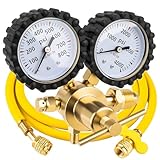
- HVAC Essential: Siasky Nitrogen Regulator is a must-have for HVAC professionals, ensuring accurate pressure testing and leak detection in AC systems
- Precise Regulation: Equipped with 0-800 PSI Delivery Pressure and a 5FT Hose, this regulator provides precise control for all your nitrogen testing needs
- Reliable Performance: The CGA580 Inlet and 1/4-Inch Male Flare Outlet Connection ensure a secure fit, while the durable construction guarantees long-lasting use in any HVAC setting
- Leak Detection Made Easy: Easily monitor pressures with the 0-800 PSI low pressure gauge and 0-4000 PSI high pressure gauge, making leak detection and troubleshooting a breeze.NOTE: The gauge shows 800 PSI that you can rate them at 600 PSl, but they are able to go up to 600 PSI
- Versatile Kit: Whether you're working with nitrogen tanks, pressure tests, or AC systems, the Siasky Nitrogen Regulator is the ultimate solution for all your HVAC needs. Get yours today and experience top-tier performance
Sizing for average flow only
Intermittent equipment can create peaks that exceed the average. Record simultaneous demand and ask for performance at the required purity and pressure during those peaks. If peaks are brief, investigate an appropriately designed receiver or backup arrangement with the supplier rather than assuming the generator can absorb them.
Assuming a generator eliminates cylinders
Maintenance, power loss, compressor failure, or an unexpected demand increase can interrupt production. Decide whether a backup cylinder bank is necessary and include its storage, inspection, and handling requirements in the installation plan.
Treating nitrogen as harmless because it is inert
“Inert” describes chemical reactivity, not breathable air. Nitrogen can displace oxygen. Apply hazard communication, ventilation, access control, monitoring decisions, training, and emergency procedures to either supply method.
Free tools Windows power users keep installed
One-click scans. No signup required.
Ignoring the air system
A generator is only as dependable as the compressed air feeding it. Moisture, oil, insufficient pressure, inadequate flow, or competing plant demand can reduce output or damage equipment. Make air quality and capacity an explicit line item in the design review.
Comparing unlike quotations
One proposal may include installation and maintenance while another lists only the generator cabinet. Normalize scope, purity, flow, pressure, warranty, service, consumables, energy assumptions, and backup before comparing totals.
A practical decision sequence
- Confirm the process. Obtain written purity, flow, pressure, duty-cycle, and quality requirements from each nitrogen-consuming machine or operation.
- Characterize demand. Measure normal and peak use, operating hours, simultaneous users, seasonality, and growth plans.
- Map the site. Check power, compressed air, ventilation, floor space, access, noise, environmental exposure, delivery routes, and cylinder storage options.
- Price both complete systems. Include all recurring and one-time costs, labor, maintenance, downtime exposure, and contingency supply.
- Review safety. Address oxygen-displacement risk for both methods; add cylinder-specific controls where cylinders remain part of the system.
- Choose based on evidence. Select the option that meets the process specification with acceptable lifecycle cost, continuity, site practicality, and documented controls—not the option with the lowest headline price.
Bottom line
For recurring nitrogen demand at a stable, utility-equipped construction or fabrication facility, an appropriately sized generator can reduce dependence on deliveries and manual cylinder change-outs. Its economics depend on utilization and the full cost of compressed air, power, installation, maintenance, and backup. Cylinders can be the better fit for low, intermittent, temporary, or utility-constrained work, provided delivery planning and compressed-gas controls are robust. In both cases, nitrogen can create an oxygen-deficient atmosphere; safety obligations remain even when the supply is produced on site.
Quick Recap
Product prices and availability are accurate as of the date/time indicated and are subject to change. Any price and availability information displayed on Amazon at the time of purchase will apply.
Recommended Free Tools

