Do these 3 things before closing this tab:
1Clear out junk files and repair common Windows errors2Scan for outdated or missing drivers - takes under a minute3Repair Windows errors before they cause bigger problemsSome links on this page are affiliate links: if you buy through them we may earn a commission, at no extra cost to you.
A good mobile tool cabinet is not just a box on wheels. It is a storage cabinet, a work surface, a machine stand, and sometimes the heaviest moving object in the garage. The right plan starts with weight, drawer layout, caster capacity, and the way you actually work.
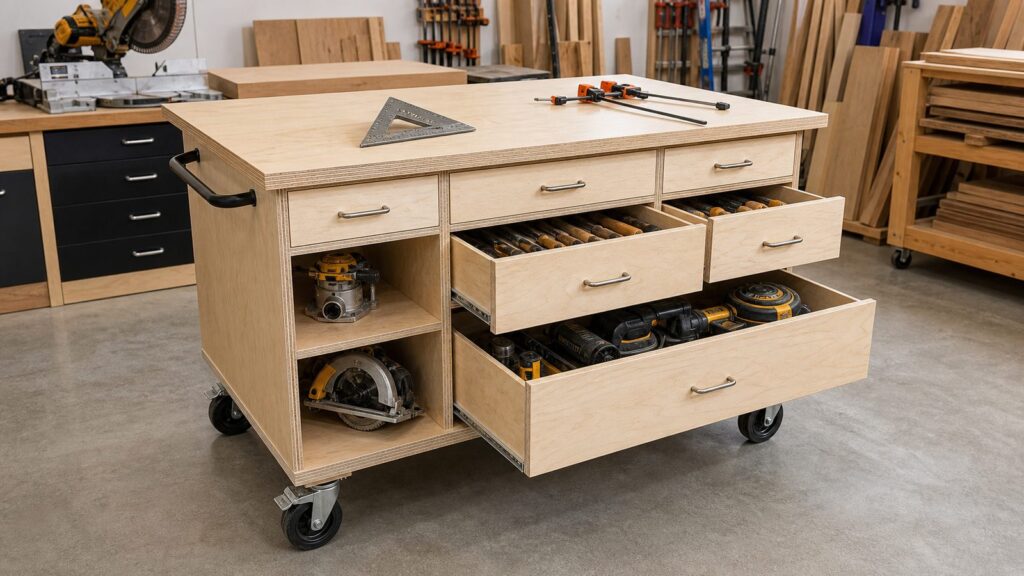
For most home shops, the best mobile woodworking tool cabinet is built from 3/4-inch plywood for the main case, 1/2-inch plywood for drawer boxes, 1/4-inch plywood or hardboard for drawer bottoms and backs, full-extension ball-bearing slides, and 4-inch or 5-inch casters sized for the loaded cabinet, not the empty one. A practical finished size is about 48 inches wide, 24 inches deep, and 34 to 37 inches tall including the top and casters.
As an Amazon Associate I earn from qualifying purchases.
In 2026, plan on roughly $275 to $900 for most DIY builds. A budget cabinet can come in around $275 to $450. A stronger, better-finished cabinet with 6 to 10 drawers usually lands around $450 to $700. A heavy-duty version with premium plywood, heavy slides, large casters, latches, liners, and a hardwood or butcher-block top can reach $700 to $1,200 or more.
On our job sites, storage fails for predictable reasons: overloaded drawers, undersized casters, screws pulling out of weak mounting blocks, and cabinets that roll fine empty but twist once loaded with tools. This plan is designed to avoid those problems.
#1 Best Overall

- [Rotate 360 degrees] Smooth & Silent & Sturdy. The total locking brake locks both the wheel and the swivel.
- [Multiple uses] can be installed in hand trailers, workbenches, tables, beds, wardrobes, building scaffolding, etc.
- [Double bearing] high-quality high carbon steel material and steel ball, the long service life of rolling contact. There is almost no resistance to taxiing.
- [Quiet wheel] Made of polyurethane material to reduce tire noise, tread width 1 2/11", wear-resistant.
- [Heavy-Duty] The load weight of each wheel can reach 400LBS, the mounting surface size is 3.7 x 2.5", the screw hole size is 0.32 x 0.46".
Start With the Cabinet Size and Loaded Weight
A useful mobile cabinet has to fit the room, the tools, and the floor. Before cutting plywood, make a simple tool inventory and drawer map. Do not design around generic drawer sizes first. Lay out the tools that need homes: circular saws, routers, sanders, chisels, drill batteries, bits, clamps, fasteners, layout tools, planes, PPE, and finishing supplies.
For a homeowner garage or small woodworking shop, this is a strong all-purpose cabinet size:
What’s actually slowing this PC down?
Pick the symptom - the matching free tool is one click away.
- Overall width: 48 inches
- Overall depth: 24 inches
- Overall height: 34 to 37 inches including casters and top
- Carcass material: 3/4-inch plywood
- Drawer box material: 1/2-inch plywood
- Drawer bottoms: 1/4-inch plywood or hardboard for light drawers, 1/2-inch plywood for heavy drawers
- Top: two layers of 3/4-inch plywood, MDF over plywood, or butcher block
- Slides: 22-inch full-extension side-mount ball-bearing slides
- Casters: 4-inch minimum; 5-inch or 6-inch if the slab has joints, cracks, or rough patches
A 48-by-24-inch cabinet gives you a usable top without becoming hard to steer through a garage. It is deep enough for 22-inch slides, yet shallow enough that tools do not disappear into the back. If you want the cabinet to tuck under a wall-mounted bench, verify the finished height with the caster and top included.
Weight planning matters more than most woodworking plans admit. A 3/4-inch plywood cabinet with drawers, slides, hardware, and a double-layer top can weigh 180 to 275 pounds before tools. Add a benchtop planer, router, circular saws, drills, fasteners, clamps, and hand tools, and a loaded cabinet can easily reach 400 to 800 pounds.
That number affects the carcass, drawer slides, caster selection, and how you fasten the caster plates. Build for the loaded cabinet from the start.
Recommended Layout for a 48-Inch Mobile Tool Cabinet
This plan uses two vertical drawer banks with a center divider. It is easier to build than a complicated asymmetrical cabinet, and it keeps drawer spans reasonable. Wide drawers look attractive, but a 40-inch-wide drawer full of tools can rack, sag, and overload slides quickly.
Quick wins for a faster PC:
Clear out junk files and repair common Windows errorsFree Scan →Fix the driver behind crashes, sound loss and screen glitchesFind Drivers →Use this layout as a base:
- Outside cabinet size: 48 inches wide by 24 inches deep by 30 inches high before top and casters
- Finished height: about 36 inches with a 1-1/2-inch top and 4-1/2-inch caster height
- Left bank: four or five drawers for hand tools, bits, sanding supplies, and layout tools
- Right bank: three or four deeper drawers for saws, routers, nailers, and power tools
- Bottom drawers: deepest and strongest, reserved for the heaviest tools
- Top surface: replaceable work layer screwed from below or through oversized holes
Keep heavy tools in the bottom third of the cabinet. Put medium-use tools between knee and waist height. Put light, less-used items in the upper drawers. This is not just convenience. It lowers the center of gravity and reduces tip risk when a loaded drawer is pulled all the way open.
Leave consistent reveals around drawer fronts. A 1/8-inch reveal is typical for shop furniture. Use spacer blocks during slide installation so errors do not compound from drawer to drawer. A mobile cabinet gets bumped, rolled, and loaded unevenly; tight, furniture-grade gaps are not worth fighting in a garage shop.
Material Choices: Plywood, MDF, and the Work Top
For the carcass, 3/4-inch plywood is the practical choice. It holds fasteners better than MDF, resists edge damage better, and handles rolling stress well when the joinery is sound. MDF can be useful for a sacrificial top layer or painted drawer fronts, but it is heavy, weaker at screw edges, and less forgiving around garage moisture.
In 2026, plywood pricing is still moving. The U.S. Producer Price Index for plywood was 290.979 in June 2026, up from 272.226 in February 2026, so local sheet prices can change month to month. For planning, use current U.S. retail ranges rather than old cut-list assumptions.
Windows Errors? Fix Them Before They Spread
Repair common Windows errors and clear accumulated junk for a smoother, more stable PC - no reinstall needed.Free scan · no reinstallCrashes, No Sound, or Screen Glitches?
Random freezes, missing sound and display glitches usually trace back to one bad driver. Find and replace yours safely.Free scan · under a minute| Material | Typical 2026 Cost | Best Use | Tradeoff |
|---|---|---|---|
| 3/4-inch MDF | $35-$55 per sheet | Painted panels, sacrificial tops, low-cost builds | Heavy and vulnerable to moisture at edges |
| 3/4-inch B/C softwood plywood | $50-$70 per sheet | Budget carcass and shop-grade storage | More voids, more sanding, less refined drawer fronts |
| 3/4-inch cabinet or birch plywood | $80-$125+ per sheet | Mid-range carcass, drawer fronts, cleaner finish | Higher upfront cost |
| 3/4-inch Baltic birch or premium birch | About $97-$122 per 4×8 sheet; some 25-sq-ft packs around $149 | Premium drawers, durable edges, high-end shop cabinets | Can be expensive and locally variable |
A strong mid-range cabinet typically needs two to three sheets of 3/4-inch plywood and one to two sheets of 1/2-inch plywood, depending on the number of drawers. Add 1/4-inch plywood or hardboard for backs and drawer bottoms unless your drawers will carry heavy mechanics tools or boxes of fasteners.
Best Top Construction
If the cabinet doubles as an assembly table or tool stand, do not rely on a single thin panel. Use one of these top assemblies:
Rank #2

- Heavy Duty Casters - Premium Materials and Greater Durability: Precision ball double bearings for smooth swiveling and rolling. 3″caster wheels are made from solid polyurethane with strong weight capacity. Each caster can carry 250Lbs.
- Caster Wheels - No Noise Casters: Black caster bracket plated finish is attractive and durable, not easy to rust. The Non-Marking castor offers floor protection and quiet rolling operation. Applications include: Furniture, shelves, workbench, material handling carts, stock carts, food processing equipment, bakery racks, conveyors, laboratory equipment, retail displays, store fixtures, and more.
- Locking Casters - Flat bottom with double brakes, strong safety: Casters total lock brake locks the wheel and swivel simultaneously. Making sure the wheels and the caster raceway are unable to move. The brake is easily operated with foot action.
- Easy Installation -Casters contains two types of installation screw kits for convenience attaching caster wheels to any surface, such as wood, steel, plastic. Includes: 16 x Pointed Screws (with 16 Washers), 16 x Flat Head Screws (with 16 Nuts).
- What You Get - 3″casters set of 4 in the box, matching screws, iron washers and friendly customer service. You can return the defective products for exchanging or refund at any time (no man-made damage).
- Durable shop top: two layers of 3/4-inch plywood laminated together
- Replaceable work top: 3/4-inch plywood base with 1/2-inch MDF screwed on top
- Premium top: butcher block or hardwood slab fastened to allow seasonal movement
- Machine-stand top: torsion-box top or reinforced plywood top with internal ribs
We prefer a replaceable top layer for working cabinets. Glue, finish, saw marks, and fastener holes are part of shop life. A sacrificial layer lets you renew the surface without rebuilding the cabinet.
Hardware and Load Math
Hardware is where many cabinets get underbuilt. Drawer slides and casters need real capacity planning. Do not add up tool weight after the build and hope the hardware keeps up.
Drawer Slide Capacity
Common 22-inch full-extension ball-bearing drawer slides are often rated around 100 pounds per pair. That is enough for many woodworking drawers, but not every drawer. A shallow drawer with chisels, squares, marking tools, and sandpaper may only carry 20 to 40 pounds. A deep drawer loaded with routers, circular saws, batteries, fasteners, or metal accessories can climb past 75 pounds quickly.
Use 100-pound full-extension slides for normal woodworking drawers. Upgrade to 150-pound or 250-pound slides for deep power-tool drawers, fastener drawers, or any drawer wider than about 30 inches. If a drawer will be opened often while loaded, the stronger slide is usually worth the money.
Drawer slides also deflect before they technically fail. A pair of 100-pound slides carrying 95 pounds may still operate, but the drawer can feel sloppy, sag at full extension, or rub the drawer front below it. For a professional-feeling cabinet, keep regular drawers well below their maximum rating.
Caster Capacity
Caster ratings should be based on loaded weight. If the cabinet might weigh 650 pounds loaded, do not buy a 600-pound caster set. Rolling shock, uneven slabs, expansion joints, and small debris all increase stress.
Oversize total caster capacity by at least 25 to 50 percent. For a 650-pound loaded cabinet, a 1,000-pound total caster capacity is a reasonable minimum. For an 800-pound cabinet, look at caster sets rated around 1,100 to 1,800 pounds total.
Typical 2026 caster pricing runs from about $35 for a 4-pack of 4-inch industrial casters rated around 600 pounds total to $80-$95 or more for heavier 6-inch sets. Individual 4-inch or 5-inch polyurethane casters can run about $17-$23 each, and dual-locking sets commonly start around $67 and go up from there.
For steering, two fixed casters and two locking swivel casters are the best setup for most narrow garages. The cabinet tracks straight and parks securely. Four swivel casters make sideways positioning easier, but the cabinet can wander unless the casters are high quality and at least two are dual-locking.
Do not attach casters with wood screws alone. Bolt them through blocking or doubled plywood pads using washers and lock nuts. A loaded cabinet hitting a slab joint can rip screws out of plywood.
Cut List for the Base Cabinet
This cut list assumes a 48-inch-wide, 24-inch-deep, 30-inch-tall plywood carcass before top and casters. Adjust drawer heights to match your tool inventory.
| Part | Material | Quantity | Size |
|---|---|---|---|
| Side panels | 3/4-inch plywood | 2 | 30 in. x 23-1/4 in. |
| Bottom panel | 3/4-inch plywood | 1 | 46-1/2 in. x 23-1/4 in. |
| Top stretchers | 3/4-inch plywood | 2 | 46-1/2 in. x 4 in. |
| Center divider | 3/4-inch plywood | 1 | 29-1/4 in. x 23-1/4 in. |
| Back panel | 1/4-inch plywood or hardboard | 1 | 48 in. x 30 in. |
| Caster pads | 3/4-inch plywood | 4 | 6 in. x 8 in. |
| Top base | 3/4-inch plywood | 1 | 50 in. x 26 in. |
| Replaceable top layer | 1/2-inch MDF or plywood | 1 | 50 in. x 26 in. |
The 23-1/4-inch carcass depth allows for a 1/4-inch back while keeping the cabinet close to 24 inches overall. The 50-by-26-inch top gives a 1-inch overhang on each side and front/back, which is enough for clamping without making the cabinet awkward to steer.
Rank #3

- INCLUDES: (4) Double Locking Swivel Workbench Wheel Casters with Red Polyurethane Tires
- DOUBLE LOCKING: Each wheel has a separate brake with simultaneous braking action (wheel and swivel) to stop and prevent your furniture, chair or device from moving
- 360 DEGREE ROTATION: Multi-directional casters provide you with optimal maneuverability, allowing you to transport your object in the direction you desire with minimal effort and noise
- PREMIUM: Heavy duty casters made with solid plated steel with a 160lb capacity per wheel. Paired with polyurethane tires that are durable and do not flatten when sitting for extended periods, ball bearings ensure smooth turning and swiveling
- VERSATILE: Casters possess a universal design that can not only be used for a wide range of furniture items, but workbenches, dollies, carts, workshop machinery, equipment stands and more – Used for both indoor and outdoor applications
Drawer Planning and Cut Guidelines
Drawer sizing depends on your slides. Side-mount ball-bearing slides usually require 1/2 inch of clearance per side, or 1 inch total. Always check the slide manufacturer’s instructions before cutting drawer boxes.
For two equal drawer banks inside a 48-inch cabinet with 3/4-inch sides and a 3/4-inch center divider, each opening is roughly 22-7/8 inches wide before slide clearance. With typical side-mount slides, drawer boxes would be about 21-7/8 inches wide. Depth is commonly 21 to 22 inches for 22-inch slides, depending on the slide and back clearance.
The Tool Desk
Outbyte PC Repair FREEClear out junk files and repair common Windows errorsFree Scan →Outbyte Driver Updater FREEFix the driver behind crashes, sound loss and screen glitchesFind Drivers →A practical drawer stack might look like this:
- Top drawers: 3 inches deep for pencils, tapes, squares, bits, blades, and small layout tools
- Middle drawers: 4 to 6 inches deep for chisels, planes, sanders, jigs, PPE, batteries, and chargers
- Lower drawers: 8 to 10 inches deep for routers, saws, nailers, fasteners, and boxed tools
Build drawer boxes from 1/2-inch plywood with glued and screwed rabbets, dados, pocket screws, or locking rabbets. For light drawers, a 1/4-inch bottom captured in grooves is fine. For heavy drawers, use a 1/2-inch bottom glued and screwed to the underside or captured in a deeper groove.
Install removable dividers or trays instead of locking every tool into a permanent layout. Tool collections change. A drawer that can evolve will stay useful longer.
Step-by-Step Build Sequence
1. Inventory Tools and Draw the Drawer Map
Measure your largest tools first. Add finger clearance so you can actually lift them out. A router that is 11 inches wide should not live in an 11-1/4-inch space. Add at least 1 inch of practical clearance around awkward tools and more if cords or dust ports stick out.
2. Break Down Plywood Accurately
Use a track saw, table saw, or circular saw with a straightedge. Mark factory edges and keep paired panels together. The side panels need to match. The drawer openings need to be square. A cabinet on wheels magnifies small alignment errors because it moves and flexes more than a fixed wall cabinet.
Recommended Free Tools
3. Assemble the Carcass
Use glue and screws, dados, rabbets, pocket screws, or confirmat-style cabinet screws. A simple strong method is 3/4-inch plywood sides with the bottom captured between them, top stretchers tying the cabinet together, and a full back panel to resist racking.
Check both diagonals before the glue sets. If the diagonals match, the box is square. If they do not, clamp across the longer diagonal until the cabinet pulls into square.
4. Add the Center Divider and Slide Supports
The center divider should be square to the bottom and flush with the front opening. If your slide layout needs additional support strips, install them now. Consistent spacer blocks are the easiest way to keep paired slides aligned.
5. Reinforce the Base for Casters
Add doubled 3/4-inch plywood pads or solid blocking where each caster mounts. Through-bolt the caster plates with washers and lock nuts. If the caster plate is 4 inches by 4-1/2 inches, a 6-by-8-inch pad gives enough bearing area and edge distance.
6. Build and Fit Drawer Boxes
Build one test drawer before cutting every drawer part. Install the slides, fit the drawer, and confirm the reveal and movement. Once that setup works, batch the remaining drawer boxes.
Leave a slight reveal around drawer fronts, commonly 1/8 inch. Use shims or playing cards to hold consistent gaps while fastening fronts from inside the drawer box.
Rank #4

- STURDY HEAVY DUTY CASTERS - Silent industrial caster wheels are designed with heavy-duty construction with a load capacaity of up to 1200 lbs. Sturdy steel frames and thick urethane caster bodies distribute the pressure efficiently and ensure that the wheels are evenly loaded during the carrying process, making the transportation of heavy loads more efficient.
- OMNI-DIRECTIONAL FLEXIBLE ROTATION - The structure of double ball bearings drives the rotation of the top plate, which can realize 360° omni-directional flexible rotation of the casters, and the built-in precision ball and steel ball enhance the smoothness and stability of rotation, which brings convenience to the handling work, especially in the confined space or in the scenario of frequent steering, which saves a lot of time and energy.
- DOUBLE SAFETY BRAKE - This casters set of 4 heavy duty has a double-locking braking system, which can activate two locking mechanisms at the same time with a simple foot movement, realizing quick braking for rotation and movement, and the precise positioning function enhances the stability of heavy loads' movement and avoids accidents.
- QUIET AND NON-ABRASIVE - The surface of the castor wheels is made of polyurethane and rubber material, smooth and soft, which effectively reduces friction when in contact with the floor, absorbing and blocking the noise generated by rolling, ensuring a quiet lifting process and at the same time reducing the wear and tear on the floor, protecting the integrity of the floor.
- WIDE APPLICATION SCENARIOS - Each set of swivel casters contains four 3 inch caster wheels, 16 bolts, 16 nuts, 16 spacers and 1 double-ended wrench, which can be mounted on carts, cabinets, tables, furniture and other items in a variety of scenarios for easy mobility.
7. Add the Top
Fasten the structural top securely, then add the replaceable top layer. If the top is plywood or MDF, screws are fine. If the top is hardwood or butcher block, allow for seasonal wood movement with elongated holes or figure-eight fasteners.
8. Sand, Seal, and Finish
Seal all faces and edges, especially bottom edges and drawer fronts. Garages see humidity swings, wet tires, slab moisture, and seasonal temperature changes. Bare plywood edges absorb moisture faster than faces.
Free tools Windows power users keep installed
One-click scans. No signup required.
For a working cabinet, painted plywood, water-based polyurethane, oil-based polyurethane, or hardwax oil can all work. The priority is sealed edges, a cleanable surface, and a top you are willing to use without treating it like furniture.
2026 Cost Breakdown
The final cost depends on plywood grade, drawer count, slide quality, caster rating, and the top. The hardware can cost as much as the wood on a drawer-heavy cabinet.
| Build Level | Typical 2026 Cost | What It Usually Includes |
|---|---|---|
| Budget | $275-$450 | 2-3 sheets construction-grade plywood or MDF, simple plywood drawers, basic slides, lower-cost 4-inch casters, screws, glue, and paint or polyurethane |
| Mid-range | $450-$700 | Birch or better cabinet plywood, 6-10 full-extension 100-pound slides, 4-inch or 5-inch casters rated 600-1,100+ pounds total, edge banding, quality pulls, and replaceable work surface |
| Heavy-duty | $700-$1,200+ | Premium Baltic birch or prefinished plywood, heavy-duty slides, 1,100-1,800 pound caster capacity, hardwood or butcher-block top, liners, latches, locks, dust-sealed drawers, and upgraded finish |
Drawer slides add up quickly. A 10-drawer cabinet needs 10 pairs. Common 22-inch full-extension 100-pound slides are often economical per pair, but soft-close, undermount, or heavy-duty slides can double or triple that line item.
Do not forget the smaller items: edge banding, drawer pulls, screws, glue, sandpaper, finish, drawer liners, bolts, washers, lock nuts, magnets, and latches can add $75 to $200.
Garage Readiness: Floor, Power, Dust, and Fire Separation
A mobile cabinet is furniture, so building the cabinet itself usually does not require a building permit. The garage work around it can be a different matter. Added electrical circuits, fixed dust collection, structural changes, attached wall cabinets, garage conversion work, or blocked required egress may require local review.
Before building, check these practical conditions:
- Floor slope: Garages often slope toward the vehicle door. Use locking casters and avoid parking the cabinet where it can drift.
- Floor condition: Expansion joints and rough slabs favor 5-inch or 6-inch wheels over small hard casters.
- Outlets: Do not rely on cords stretched across walking paths. If you need new circuits, use a licensed electrician.
- Lighting: A work-height cabinet becomes much more useful with bright task lighting over the work zone.
- Clearances: Keep room for vehicle doors, water heaters, panels, steps, and required exits.
- Dust control: Store sanding and cutting tools where dust collection is easy to connect and empty.
Attached garages also have fire-separation rules. The 2024 IRC includes dwelling/garage separation requirements, and local IRC-based handouts commonly call out 1/2-inch gypsum on the garage side, with stricter ceiling protection where habitable rooms are above. Do not compromise rated walls or ceilings with cabinet anchoring, duct penetrations, or unsealed openings.
Openings between the garage and living space are regulated as well. IRC-based guidance commonly requires a solid wood door at least 1-3/8 inches thick, a solid or honeycomb steel door at least 1-3/8 inches thick, or a 20-minute-rated door. These doors are typically required to be self-closing and self-latching, and they may not open into a sleeping room. Local amendments vary, so check with your building department before changing garage doors, walls, ceilings, or penetrations.
Wood dust deserves respect. OSHA identifies woodworking machine guarding and dust collection as workplace safety concerns, and NFPA 660 has consolidated combustible-dust safety guidance. For a homeowner, that means basic but disciplined habits: connect dust collection when cutting and sanding, empty collectors before they are packed full, keep fine dust off motors and outlets, and avoid storing oily rags in drawers.
Quick wins for a faster PC:
Fix the driver behind crashes, sound loss and screen glitchesFind Drivers →Repair Windows errors before they cause bigger problemsFix Now →Anti-Tip, Drawer Latches, and Shop Durability
A mobile cabinet is most vulnerable when drawers are open. Heavy drawers act like levers. If several are open at once, especially near the top, the cabinet can tip forward.
Use these details to make the cabinet behave better:
Best Value

- The wheels made of the popular Non-Marking polyurethane rubber type,absorbs shock and vibrations. Ball bearing and dual locking bring a max loading capacity and safety
- Swivel casters rotate 360 degrees which makes turning the mating equipment possible, Is good for transporting light furniture and displays quietly and safely
- Steel structures body is extremely hard wearing and resistant to dirt, 1500 lbs capacity for the pack of 4, Bearing Heavy Duty
- The wheels can be used for a multitude of applications Including: Flight Cases, Instrument Cases, Display / Exhibition Equipment,Tool Boxes, Light Machinery, Equipment Stands, Mobile Workstations, Cabinets, Stands, Amps, Electrical Enclosures, Furniture etc
- Wheel material:polyvinyl chloride,Bearing:Steel ball double bearing,Wheel Diameter:2.95 inch,Wheel width:1.26 inch,Height of installation:4.25 inch, Installation size:2.52x3.7 inch,Installation hole distance:1.77x2.95 inch,Installation hole dimensions:0.31x0.46 inch,Single wheel load:350 lbs,Thickness of steel plate:0.12 inch
- Put the heaviest drawers at the bottom.
- Use a wider or deeper footprint if storing very heavy tools.
- Add positive drawer latches or rare-earth magnets if the cabinet will roll across uneven floors.
- Use non-slip drawer liners to keep tools from sliding into the drawer fronts.
- Round over exposed plywood edges with a 1/8-inch roundover bit or sanding block.
- Use replaceable drawer labels so the system stays organized after the tool layout changes.
If the cabinet will carry a benchtop planer, drill press, miter saw, or other vibrating tool, upgrade the top and caster capacity. Also consider a lower machine shelf instead of placing all weight high on the cabinet.
Wood Cabinet vs Steel Rolling Cabinet
A shop-built wood cabinet is not always cheaper than buying steel storage. It depends on what you value.
What’s actually slowing this PC down?
Pick the symptom - the matching free tool is one click away.
| Option | Best For | Limitations |
|---|---|---|
| DIY wood mobile cabinet | Custom drawer sizes, integrated work surface, woodworking tools, shop-specific layout | Takes time, requires accurate building, can cost $450-$900 for a good version |
| Steel rolling tool cabinet | Mechanics tools, high drawer density, locks, fast setup | Fixed drawer sizes, less useful as a woodworking bench, can be hard to modify |
| Hybrid approach | Wood top or side storage added to a steel base | May still lack the exact drawer and workflow layout you want |
For woodworking, a custom wood cabinet usually wins when the top surface matters, when tools have irregular shapes, or when you want integrated trays, bit storage, sanding drawers, and machine-specific storage. Steel often wins for socket sets, wrenches, mechanics tools, and lockable dense storage.
When to DIY vs When to Hire a Pro
Build this cabinet yourself if you have basic cutting tools, a way to break down plywood accurately, and a weekend or two to work. A straightforward version usually takes 12 to 20 hours for an experienced DIYer. A polished 10-drawer cabinet with edge banding, finish, latches, and dividers can take 25 to 40 hours.
DIY makes sense when:
- You want custom drawer sizes for your exact tools.
- You already own a saw, drill, clamps, square, and sander.
- You are comfortable installing drawer slides accurately.
- You value a built-in work surface as much as storage.
- You can tolerate a shop-grade finish instead of factory perfection.
Hire a carpenter, cabinetmaker, or contractor when the cabinet is part of a larger garage upgrade, when you need electrical work, when built-ins are being attached to walls, or when the cabinet will support heavy equipment. Also bring in a pro if you need dust collection ducting, garage fire-separation repairs, new circuits, or changes near rated walls and ceilings.
A pro-built custom cabinet will cost more than a DIY build, but it can make sense when the cabinet is one piece of a safer, cleaner, more efficient shop. On our projects, the best results usually come from planning the whole work zone: storage, lighting, power, dust collection, clearances, and the floor path the cabinet will actually travel.
The Tool Desk
Outbyte Driver Updater FREEScan for outdated or missing drivers - takes under a minuteDriver Scan →Outbyte PC Repair FREERepair Windows errors before they cause bigger problemsFix Now →Final Build Notes
The best mobile woodworking tool cabinet is built around real use. Start with the tools. Size the drawers around those tools. Put weight low. Buy slides and casters with margin. Through-bolt the caster plates. Seal the plywood. Make the top replaceable.
If you follow one rule, make it this: design for the cabinet fully loaded. An empty cabinet can hide weak decisions. A loaded cabinet tells the truth every time it crosses a garage slab joint.
Frequently Asked Questions
How much does it cost to build a mobile tool cabinet in 2026?
Most DIY mobile woodworking tool cabinets cost about $275 to $900 in materials in 2026. Budget builds are usually $275-$450, mid-range builds are $450-$700, and heavy-duty cabinets with premium plywood, stronger slides, large casters, and a hardwood or butcher-block top can reach $700-$1,200 or more.
What plywood should I use for a rolling tool cabinet?
Use 3/4-inch plywood for the carcass, 1/2-inch plywood for drawer boxes, and 1/4-inch plywood or hardboard for light drawer bottoms and backs. Upgrade heavy drawer bottoms to 1/2-inch plywood. Cabinet-grade birch plywood is a strong mid-range choice; Baltic birch is excellent but more expensive.
Free tools Windows power users keep installed
One-click scans. No signup required.
How much weight can a DIY mobile tool cabinet hold?
A well-built cabinet can handle several hundred pounds, but the real limit depends on joinery, drawer slides, caster rating, and how the load is distributed. Many loaded cabinets reach 400-800 pounds. Size casters and drawer slides for the loaded weight, not the empty cabinet.
What size casters are best for a mobile woodworking cabinet?
Use 4-inch casters at minimum. Choose 5-inch or 6-inch casters if the garage floor has expansion joints, cracks, slope, or rough concrete. Oversize total caster capacity by at least 25 to 50 percent beyond the expected loaded cabinet weight.
Do I need a permit to build a tool cabinet in my garage?
A freestanding mobile cabinet usually does not require a permit because it is furniture. Permits or code review may apply if you add electrical circuits, install fixed dust collection, alter garage walls or ceilings, attach built-ins, convert garage use, or block required egress.
Are wooden tool cabinets better than steel rolling cabinets?
Wood cabinets are better when you want custom drawer sizes, woodworking-specific storage, and a usable work surface. Steel rolling cabinets are often better for mechanics tools, lockable dense storage, and fast setup. For many shops, the best choice depends on whether the cabinet is mainly storage or part of the workbench system.
Quick Recap
Product prices and availability are accurate as of the date/time indicated and are subject to change. Any price and availability information displayed on Amazon at the time of purchase will apply.

