Some links on this page are affiliate links: if you buy through them we may earn a commission, at no extra cost to you.
A crooked log can absolutely be milled into usable lumber, but the goal is not to make the log straight. The goal is to read the sweep, taper, knots, cracks, and internal stress before the first cut, then choose the product that gives the best return: shorter dimensional boards, slabs, blocking, trim, shelves, rustic siding, mantels, or furniture stock.
On our job sites, the first question is never, “Can we cut boards out of this?” Usually we can. The better question is, “What should this log become?” A 12-foot log with a hard sweep may make disappointing 12-foot boards, but it may make excellent 4-foot shelving stock, 6-foot stair-tread blanks, 8-foot rustic boards, or live-edge slabs. Trying to force long straight lumber out of a curved tree is where most of the waste happens.
As an Amazon Associate I earn from qualifying purchases.
The Tool Desk
Outbyte PC Repair FREEClear out junk files and repair common Windows errorsFree Scan →Outbyte Driver Updater FREEScan for outdated or missing drivers - takes under a minuteDriver Scan →There is one major construction warning up front: freshly milled lumber from your own tree is not automatically framing lumber. For permitted structural work in the United States, sawn lumber used to support loads generally needs a grade mark from an approved grading or inspection agency, or it needs to be accepted by the building official through another approved path, such as engineering or local approval. Ungraded site-milled wood is usually best used for nonstructural work unless your local authority approves otherwise.
What Makes a Log “Crooked”?
A crooked log is not just a log that looks bent. Several conditions can affect how it mills and how the boards behave afterward:
Popular on Amazon

- 【Power】❶SM-32 sawmill adopts electric starting ZONSEN 420cc 15HP 4-stroke single cylinder air-cooled OHV gasoline engine. ❷It can be set up in minutes and stored directly in your garage or workshop.Can withstand heavy work and long hours even in remote areas.
- 【Capacity】❶Can handle logs with a maximum diameter of 32 inch and a length of 9.9 ft. ❷3 ft 1 in track width,13 ft track length,can cut out boards with a maximum width of 26.5 inch and a maximum thickness of 7 inch. ❸Additional sawmill bed extensions are available, providing enhanced flexibility.Easily convert rough logs into beautiful slabs.
- 【Efficient&Convenient】❶You can control the cutting speed by pushing handle, speed up or slow down at any time. Compared to traditional chain saw machine, the time is cut in half. ❷Precision ruler provide different measurement units for precise cutting, reduce the waste of raw materials. ❸The saw blade made of carbonized steel is very strong, rotation speed can be as high as 787’’ per second, reducing wood chips while ensuring smooth cutting.
- 【Safe】The emergency stop button is located very close to the operator.When encountering emergency or equipment malfunctions, the machine can be quickly stopped to protect the safety of the equipment and operators.
- 【Application】Can handle cedar,walnut,oak and other logs.You can mill lumber in remote areas, homes, forests, or where the tree falls.Very suitable for carpentry, homeowners, builders,arborists,woodworkers,arborists and sawyers.
- Sweep: a gradual curve along the length of the log.
- Crook: a sharper bend or offset, often near a limb, storm break, or leaning section.
- Taper: a large difference between butt diameter and top diameter.
- Reaction wood: wood grown under tension or compression because the tree leaned or fought gravity.
- Internal stress: stored movement that can release during sawing, causing boards to bow, twist, pinch the blade, or open cracks.
- Knots and limb wood: branch areas that reduce clear board yield but can add character for slabs and rustic finish work.
These defects do not make the log useless. They change the cutting plan. A straight, clean, uniform log is usually cut for maximum board-foot yield. A crooked log is cut for best usable yield, which is different. Best usable yield may mean fewer total board feet but more boards that actually dry flat enough to use.
Start With the End Use Before You Start the Saw
Before loading the log on a mill, decide what you are trying to make. A sawyer cannot cut one log optimally for every possible product. The setup for 1-inch wall cladding is different from the setup for 2-inch furniture slabs, 4/4 trim stock, 6×6 landscape timbers, or short blocking.
Do these 3 things before closing this tab:
1Clear out junk files and repair common Windows errors2Fix the driver behind crashes, sound loss and screen glitches3Repair Windows errors before they cause bigger problemsFor a homeowner, the best uses for crooked-log lumber are usually:
- Floating shelves, mantels, and fireplace surrounds.
- Wall paneling, rustic ceiling boards, and accent siding.
- Furniture parts, bench tops, table slabs, and cabinet accents.
- Short blocking, shop lumber, jigs, cribbing, and utility boards.
- Garden structures, raised-bed trim, and landscape features where the species and local rules allow.
- Decorative exposed beams that are not carrying structural loads.
For construction work, we separate the material early into three piles: possible code-eligible structural candidates, nonstructural finish stock, and firewood or waste. That prevents wishful thinking later. A beautiful board is not automatically a joist. A heavy slab is not automatically a beam. A straight-looking piece is not automatically graded lumber.
Inspect and Mark the Log Before Milling
A few minutes of layout can save hours of milling time. We mark the log with lumber crayon or chalk before it goes on the mill. At minimum, mark:
- The pith, or center of the tree.
- The direction and severity of the sweep.
- Large knots and limb pockets.
- Visible cracks, checks, rot, shake, or insect damage.
- Possible metal-risk areas, especially on yard trees and fence-row trees.
- Desired cut lengths: 4 feet, 6 feet, 8 feet, 10 feet, or 12 feet.
Metal detection deserves special attention. Urban trees and old farm trees often contain nails, screws, wire, bullets, hooks, clothesline hardware, fence staples, or old lag bolts. One blade strike can stop production immediately. Many portable sawyers bill damaged blades separately, and current charges commonly run about $25 to $150 per blade depending on the blade, mill, and damage. Even if no one gets hurt, metal can turn an affordable log into an expensive one.
Also look at access. A portable bandsaw mill still needs level setup room, safe log handling, a place for slabs and boards, and a way to move wet lumber. Fresh-cut hardwood is heavy. A green 2-inch-thick slab can easily require two or more people or machinery, depending on species and size.
Should You Mill the Crooked Log Whole or Cut It Shorter?
Most crooked logs produce better lumber when bucked into shorter, straighter sections before milling. This is one of the biggest differences between cutting for fantasy yield and cutting for actual usable boards.
Say you have a 12-foot log with 8 inches of sweep from end to end. If you mill it full length, many boards will contain that curve, and some may dry with serious side bend. If you cut that same log into two 6-foot sections, each section may have only 2 to 4 inches of sweep. Cut into three 4-foot sections, the usable yield may improve again. You may give up long boards, but you gain boards that can be flattened, edged, dried, and used.
Use these practical length targets:
- 4-foot stock: shelves, short furniture parts, blocking, cabinet parts, small slabs.
- 6-foot stock: mantels, bench parts, short trim runs, rustic wall boards.
- 8-foot stock: common interior trim lengths, siding accents, table stock, utility boards.
- 10- to 12-foot stock: only worth chasing if the log is mild enough that the boards can dry and straighten acceptably.
End seal the log soon after bucking, especially with hardwoods and valuable slabs. Wax-based end sealer, anchor seal, or a similar product slows moisture loss through the end grain and reduces end checking. Paint is better than nothing in a pinch, but proper end sealer is more reliable.
Quick wins for a faster PC:
Scan for outdated or missing drivers - takes under a minuteDriver Scan →Clear out junk files and repair common Windows errorsFree Scan →Fix the driver behind crashes, sound loss and screen glitchesFind Drivers →How to Set Up a Crooked Log on the Mill
The first job is to create a stable reference face. A crooked log rarely sits naturally in the exact position you need, so shimming and clamping matter. The log must be supported so it cannot roll, rock, or spring during the cut.
Also popular on Amazon

- 【Power】❶SM-36 sawmill adopts electric starting Zonsen 750cc 25HP dual cylinder(90° V Type),4 stroke, forced air cooling gasoline engine. ❷This is a reliable, high-performing engine, 6.3 gal fuel tank size, provide long-term and efficient work.
- 【Capacity】❶Can handle logs with a maximum diameter of 36in and a cutting length of 16.2 ft. ❷20ft track length and 3 ft 10 in track width, can cut out boards with a maximum width of 36 in and a maximum thickness of 7 in. ❸Easily convert rough logs into beautiful slabs. Additional sawmill bed extensions are available, providing enhanced flexibility.
- 【Efficient&Convenient】You can manually control the saw head to fully control the cutting process for maximum safety and desired results.Compared to traditional chain saw machine, the time is cut in half.You can get more done in less time and in less space.
- 【Safe】The emergency stop button is located very close to the operator.When encountering emergency or equipment malfunctions, the machine can be quickly stopped to protect the safety of the equipment and operators.
- 【Application】Can handle cedar,walnut,oak and other logs.You can mill lumber in remote areas, homes, forests, or where the tree falls.Very suitable for carpentry, homeowners, builders,arborists,woodworkers,arborists and sawyers.
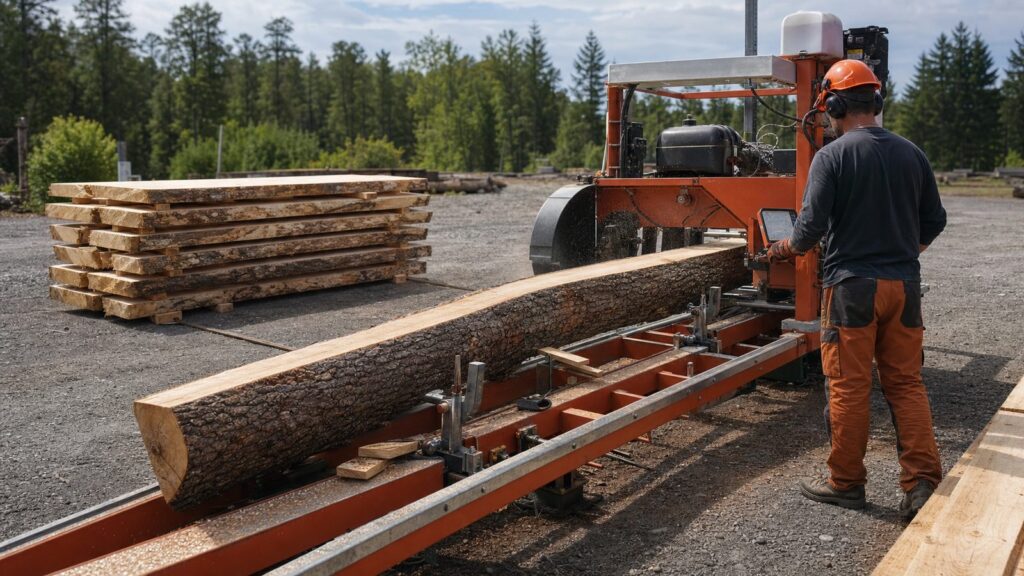
For a portable bandsaw mill, the typical sequence is:
- Load the log with the best cutting face exposed.
- Shim low points so the log is stable along the bed.
- Clamp without forcing the log unnaturally straight.
- Make a light first slab cut to create a flat reference face.
- Rotate the log or cant, then re-shim and re-clamp.
- Cut from the soundest, straightest faces as the cant develops.
Do not clamp a bent log into a straight position and assume the boards will stay that way. Wood has memory and stress. If you force the log straight, cut boards from it, and then release them, those boards can spring, bow, twist, or cup. The mill may show you a straight cut, but the drying stack will show you the truth.
With a chainsaw mill, the same principle applies, but the first reference surface often comes from a ladder, rail, or guide plank attached above the log. Chainsaw mills are slower, wider in kerf, and more physically demanding than bandsaw mills, but they can work well for large slabs, remote logs, or one-off projects where moving the log is harder than bringing the mill to the log.
Orient the Curve Intentionally
How the sweep sits relative to the saw line changes the kind of defect you get in the boards. A common mistake is setting the curve at roughly 45 degrees to the saw cut. That can put stress and grain direction into the boards in a way that encourages side bend during drying.
Instead, orient the sweep deliberately. Put the curve up and down if bow is easier to remove for the intended product. Put the curve left and right if you are cutting slabs where the live edge and grain flow are the feature. The right answer depends on what you are making.
For straight dimensional boards, we usually prefer cutting shorter sections first, then orienting each section so the saw is working with the most stable face available. For live-edge slabs, preserving the natural curve may be the point. For rustic wall boards, some sweep may be acceptable if the boards can be ripped, trimmed, or installed in shorter lengths.
Recommended Cutting Strategies
For Short Dimensional Boards
Buck the log into the longest straight sections you can realistically use. If the project needs 6-foot shelf stock, do not mill the entire crooked 12-foot log hoping to get perfect 12-foot boards. Cut the log to 6-foot or slightly longer lengths first, allowing extra for end checks and trimming. For finished 6-foot boards, milling at 6 feet 6 inches is often more practical than exactly 6 feet.
What’s actually slowing this PC down?
Pick the symptom - the matching free tool is one click away.
Saw thicker than final size. If you need finished 3/4-inch boards, rough cut around 1 inch. If you need finished 1-1/2-inch stock, rough cut around 1-3/4 inches or 2 inches depending on species, drying method, and how much flattening you expect. Crooked logs move more, so extra thickness is cheap insurance.
For Live-Edge Slabs
A crooked log can be excellent slab material because the curve becomes visual character instead of waste. Slabs are commonly cut 2 inches to 3 inches thick for furniture tops, mantels, benches, and counters. Thicker slabs take longer to dry, cost more to kiln dry, and require more flattening, but they give you more room to correct movement.
Keep in mind that a wide slab may need router-sled flattening, CNC flattening, or a wide planer. Those services are usually separate from milling and drying. Wide slab flattening can cost significantly more than ordinary planing because the equipment and handling are specialized.
Also popular on Amazon

- 【Power】❶SM-22 sawmill adopts recoil starting DUCAR 274cc 8.1HP 4-stroke single cylinder air-cooled OHV gasoline engine. ❷It can be set up in minutes and stored directly in your garage or workshop.Can withstand heavy work and long hours even in remote areas.
- 【Capacity】❶Can handle logs with a maximum diameter of 22 inch and a length of 10.4 ft. ❷2 ft 2 in track width,13 ft track length,can cut out boards with a maximum width of 18 inch and a maximum thickness of 6 inch. ❸Additional sawmill bed extensions are available, providing enhanced flexibility.Easily convert rough logs into beautiful slabs.
- 【Efficient&Convenient】❶You can control the cutting speed by pushing handle, speed up or slow down at any time. Compared to traditional chain saw machine, the time is cut in half. ❷Precision ruler provide different measurement units for precise cutting, reduce the waste of raw materials. ❸The saw blade made of carbonized steel is very strong, rotation speed can be as high as 787’’ per second, reducing wood chips while ensuring smooth cutting.
- 【Safe】The emergency stop button is located very close to the operator.When encountering emergency or equipment malfunctions, the machine can be quickly stopped to protect the safety of the equipment and operators.
- 【Application】Can handle cedar,walnut,oak and other logs.You can mill lumber in remote areas, homes, forests, or where the tree falls.Very suitable for carpentry, homeowners, builders,arborists,woodworkers,arborists and sawyers.
For Blocking and Utility Lumber
If the log has heavy sweep, knots, and stress, blocking may be the highest-value use. Short pieces do not need the same straightness as long boards. On a construction site, rough blocking, shop fixtures, stickers, temporary cribbing, and utility lumber can justify milling a log that would not be worth turning into finish boards.
Free tools Windows power users keep installed
One-click scans. No signup required.
Still, do not use ungraded rough lumber for structural load paths unless it is approved for that use. Temporary shop blocking is one thing. Permanent joists, rafters, beams, deck framing, and load-bearing posts are another.
Cost to Mill a Crooked Log in 2026
portable sawmill pricing varies by region, access, species, log condition, and whether the sawyer charges by the board foot, hour, or day. Crooked logs often push the job toward hourly billing because yield is unpredictable and setup takes longer.
| Service or Cost Item | Typical 2026 US Range | What Changes the Price |
|---|---|---|
| Portable sawmill cutting by board foot | $0.25 to $0.50 per board foot | Log size, species, desired thickness, production speed, and waste |
| Portable sawmill hourly rate | $50 to $150 per hour | Crooked logs, short logs, difficult handling, and uncertain yield |
| Portable sawmill day rate | $400 to $800 per day | Travel, setup, helper labor, equipment size, and total volume |
| Blade damage fee | $25 to $150 per damaged blade | Metal strikes, dirty bark, embedded stone, wire, nails, and bullets |
| Specialty or vacuum kiln drying | $1.50 to $4.00 per board foot | Thickness, species, starting moisture, minimum batch size, and schedule |
| Older commercial/dehumidification kiln references | $0.10 to $0.35 per board foot | Large batches, local availability, simpler drying schedules |
| DIY chainsaw mill attachment | A few hundred dollars and up; a 36-inch Alaskan-style mill around $330 | Does not include saw, ripping chain, bar, rails, wedges, PPE, fuel, or sharpening |
| Portable bandsaw mill purchase | Under $1,000 to over $30,000 | Hobby versus hydraulic production mill, capacity, power, and automation |
The sawmill bill is only part of the real cost. Include travel, minimum charges, loading help, stickers, end sealer, drying space, kiln drying if needed, planing, jointing, sanding, waste, and your own time. A crooked log that looks free can become expensive if it produces only a small amount of stable, usable material.
A simple example: if a sawyer charges $100 per hour and spends 4 hours setting up, detecting metal, milling, rotating, and stacking, the cutting cost is $400 before blade damage, travel, or drying. If the log yields 250 usable board feet, milling alone is $1.60 per usable board foot. If only 100 board feet are good enough after drying and trimming, the effective cost is $4.00 per usable board foot before finishing. That math is why product planning matters.
Recommended Free Tools
Drying Rough-Cut Lumber Correctly
Freshly sawn lumber is green. It is not ready for cabinets, trim, interior paneling, flooring, or most construction use. It must be stacked, stickered, weighted, protected, and dried to the right moisture content for the final location.
A good air-drying stack starts with a flat foundation. Use blocks, timbers, or a rack that keeps the bottom course off the ground and level. Place stickers between each layer, usually 3/4 inch to 1 inch thick, and align them vertically from bottom to top so the weight transfers straight through the stack. Sticker spacing is commonly about 16 inches to 24 inches apart, with stickers close to the ends to reduce end checking.
Weight the top of the stack. Concrete blocks, heavy timbers, or a strapped-down roof panel can help reduce cupping and twist. Cover the top so it sheds rain, but leave the sides open for airflow. Do not wrap the stack tight in plastic. Trapped moisture encourages mold, stain, and slow drying.
Air drying commonly brings lumber to roughly 15% to 20% moisture content depending on climate, season, air movement, species, and thickness. That may be acceptable for some exterior or utility uses, but it is too wet for most interior finish work. Interior furniture, trim, flooring, and cabinet stock usually need kiln drying closer to 6% to 8% moisture content before final milling and installation.
The old rule of thumb is about one year per inch of thickness for air drying, but that is only a rough guide. A 1-inch board may dry faster in a warm, dry, breezy location and slower in a humid climate. A 2-inch slab can take much longer, especially if it is dense hardwood. Use a moisture meter rather than guessing.
Can You Use Your Own Milled Lumber for Framing?
Sometimes, but do not assume. In permitted residential construction, model codes generally require sawn lumber used for load-supporting purposes to carry a grade mark from an approved or accredited grading and inspection agency, or to be otherwise accepted by the building official. Grade marks identify items such as species group, grade, moisture condition, and the inspection agency.
That matters for joists, rafters, beams, headers, load-bearing studs, posts, deck framing, and other structural members. A board can look strong and still have hidden defects, slope of grain, excessive knots, reaction wood, shake, or drying defects that reduce capacity. Crooked logs are more likely to contain reaction wood and stress, so the structural question deserves extra caution.
Possible paths include buying grade-marked lumber for structural work, having lumber inspected and graded through an approved agency where available, using an engineer to specify and approve the material, or obtaining acceptance from the local building official. The right path depends on the jurisdiction and the project.
Outdated Drivers Are Slowing You Down
One free scan finds every outdated or missing driver and matches the right update for your exact hardware.Free scan · exact hardware matchWindows Errors? Fix Them Before They Spread
Repair common Windows errors and clear accumulated junk for a smoother, more stable PC - no reinstall needed.Free scan · no reinstallAlso popular on Amazon
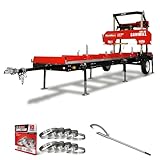
- 【Power】❶SM-36 sawmill adopts electric starting Zonsen 750cc 25HP dual cylinder(90° V Type),4 stroke, forced air cooling gasoline engine. ❷This is a reliable, high-performing engine, 6.3 gal fuel tank size, provide long-term and efficient work.
- 【Capacity】❶Can handle logs with a maximum diameter of 36in and a cutting length of 16.2 ft. ❷20ft track length and 3 ft 10 in track width, can cut out boards with a maximum width of 36 in and a maximum thickness of 7 in. ❸Easily convert rough logs into beautiful slabs. Additional sawmill bed extensions are available, providing enhanced flexibility.
- 【Efficient&Convenient】❶You can control the cutting speed by pushing handle, speed up or slow down at any time. Compared to traditional chain saw machine, the time is cut in half. ❷Precision ruler provide different measurement units for precise cutting, reduce the waste of raw materials. ❸The saw blade made of carbonized steel is very strong, rotation speed can be as high as 787’’ per second, reducing wood chips while ensuring smooth cutting.
- 【Safe】The emergency stop button is located very close to the operator.When encountering emergency or equipment malfunctions, the machine can be quickly stopped to protect the safety of the equipment and operators.
- 【Application】Can handle cedar,walnut,oak and other logs.You can mill lumber in remote areas, homes, forests, or where the tree falls.Very suitable for carpentry, homeowners, builders,arborists,woodworkers,arborists and sawyers. 【Include】sawmill(20ft) + 10x blades + log hook + trailer combo
Exterior work adds another layer. Decks, ground-contact posts, sill plates, and other moisture-exposed assemblies often require preservative-treated wood or naturally durable species where permitted by code. Untreated site-milled lumber should not be substituted where the code, plans, or manufacturer details require treated material.
When to DIY and When to Hire a Pro
DIY milling makes sense when the log is accessible, the project is small, the lumber is nonstructural, and you already understand the tool risks. A chainsaw mill can be practical for one or two slabs, remote logs, or hobby work. Expect slow progress, a rougher surface, more kerf waste, frequent sharpening, and significant physical effort. The mill attachment may cost a few hundred dollars, but the full setup includes a large chainsaw, ripping chain, long bar, guide rails, wedges, cant hooks, PPE, fuel, oil, files, spare chains, stickers, and drying space.
Hire a portable sawyer when you have several logs, want consistent boards, need better yield, or are dealing with valuable hardwood. A bandsaw mill has a thinner kerf than a chainsaw mill, produces smoother boards, and is usually much faster. For crooked logs, a good sawyer also brings judgment: where to buck, how to orient the sweep, when to rotate, and when to stop chasing low-value boards.
Bring in a professional or engineer when the wood might be used structurally, when the log is large enough to be dangerous, when equipment access is poor, when metal contamination is likely, or when the finished piece must land within tight tolerances. A homeowner can accept a little twist in a rustic shelf. A stair tread, beam, or deck member has a different risk profile.
Safety Rules That Matter Around Crooked Logs
Sawmilling is not casual carpentry. Logs roll, slabs fall, blades break, chains kick, and internal stress can pinch the blade suddenly. Crooked logs increase those risks because they do not sit flat and they release stress unpredictably.
Use the right PPE: eye protection, hearing protection, gloves when handling rough material, steel-toe boots, chainsaw chaps for chainsaw work, and a helmet with face shield when appropriate. Keep bystanders away from the cutting area. Use cant hooks, peaveys, machinery, or winches instead of trying to muscle large logs by hand.
Keep the blade sharp. Dull blades wander, heat up, slow the cut, and make the operator push harder. That is especially bad in a crooked log where the blade may already be fighting changing grain direction, knots, bark, and stress.
Watch the kerf. If the cut starts closing, stop and wedge safely. If the board starts lifting or moving as stress releases, slow down. A sawyer who pauses to re-shim or rotate the cant is not wasting time; that is how you avoid bad boards and unsafe cuts.
What’s actually slowing this PC down?
Pick the symptom - the matching free tool is one click away.
Common Mistakes With Crooked Logs
The most common mistake is trying to mill the entire crooked log at full length. Long boards are tempting, but unusable long boards are just expensive firewood. Shorter, straighter sections usually produce better material.
The second mistake is forcing the log straight with clamps. Clamps are for stability, not for pretending the tree grew differently. If you bend the log straight and saw it, the boards may move as soon as they are released or as they dry.
Skipping metal detection is another expensive error. Yard trees, storm-damaged trees, and fence-line trees are high risk. Even one nail can ruin a blade and delay the job.
Poor drying ruins good sawing. Boards stacked on uneven ground, with misaligned stickers, no top weight, direct sun exposure, or no rain protection can cup, twist, mold, stain, and check. The drying stack is part of the milling job, not an afterthought.
Also popular on Amazon

- 🌲【What is Chainsaw Mill?】MATERIAL- Made of Quality aluminum alloy + steel - sturdy&durable. The chainsaw mill can be in combination with the saw mill, creates a straight and level first cut along a log. ADJUSTABLE - Chain saw mill is suitable for chainsaws with a bar length between 14" and 36", planking milling height & width are adjustable,mill slabs between 1/2" to 12" thick. This is A Flexible Guide System.
- 🌲【Unique patented design】 Zozen chainsaw mill is Unique on the market. We have almost completely subverted the traditional chainsaw mill in structure. We use the spliced construction, so it to be used as 3 sizes and can be used independently, which means that when you only need to cut small size wood, you don't need to use a large sawmill. This move takes portability to the next level. Of course when you assemble it to a complete sawmill, it can cut any size from 14"-36".
- 🌲【Other advantages】 ①Sleek look with visual appeal.②Comfortable Handle-The handle can be pulled or pushed for better force, and can be slid to adjust the position at any time.③Detailed instruction manual for quick and easy installation.④Giveaway-We're gift 4pc Felling Wedges that perfectly matched sawmill.⑤The scale adopts dual system (metric system + imperial system).
- 🌲【Advanced Splicing Method】Splicing accessories can be purchased in the market, which is Convenient for longer size extensions .We use state-of-the-art connection methods, Aluminum Profile + Straight Line Connector, These Straight Line Connector and Aluminum Profile are all used internationally. You can buy it in the store.(We will reflect their model in the manual.)
- 🌲【Wide Application】Using together with chainsaw to convert rough logs into beautiful slabs. Cut cedar, walnut and oak into high quality lumber. Lightweight and portable design makes this lumber cutting chainsaw guide easy to transport to remote areas, or you can mill your own lumber at home or in forest. or mill lumber where the tree falls. Perfect for homeowners, builders,arborists ,woodworkers, arborists and sawyers.
The final mistake is using green or ungraded lumber where it does not belong. Wet lumber shrinks. Ungraded lumber may not pass inspection. A board that is fine for a mantel may be wrong for a floor joist.
Practical Step-by-Step Plan
- Choose the product: decide whether the log is best for slabs, short boards, trim, blocking, or firewood.
- Measure the sweep: note how far the log bends over its length and whether shorter sections would improve yield.
- Mark defects: identify pith, knots, cracks, rot, metal-risk areas, and desired cut lengths.
- Buck if needed: cut the log into practical lengths such as 4 feet, 6 feet, or 8 feet rather than chasing poor 12-foot boards.
- Seal the ends: apply end sealer soon after bucking, especially on hardwoods.
- Detect metal: scan yard and urban logs carefully before sawing.
- Set the first face: shim and clamp the log securely, then make a stable reference cut.
- Rotate and re-reference: do not rely on the original log shape after the first cuts.
- Saw oversized: leave extra thickness for drying movement, flattening, jointing, and planing.
- Stack immediately: sticker on a level base, align stickers vertically, weight the top, and roof the stack.
- Measure moisture: use a meter before final milling or installation.
- Confirm code use: before using any site-milled lumber structurally, verify grading, engineering, or building-official acceptance.
Bottom Line
A crooked log is worth milling when you match the cut to the tree. Do not judge success by the longest board you can force out of it. Judge success by the amount of stable, dry, useful lumber you have at the end.
For most homeowners, the best return comes from shorter boards, slabs, mantels, shelves, trim, rustic wall material, and other nonstructural uses. For permitted structural work, use grade-marked lumber or get the proper approval before relying on site-milled material. A crooked log can become something valuable, but only when the milling plan respects the curve instead of fighting it.
Frequently Asked Questions
Can you mill a crooked log into usable lumber?
Yes. A crooked log can produce usable boards, slabs, trim, blocking, shelves, mantels, and furniture stock. The key is cutting for the log’s shape instead of forcing it into long straight boards.
The Tool Desk
Outbyte PC Repair FREEClear out junk files and repair common Windows errorsFree Scan →Outbyte Driver Updater FREEScan for outdated or missing drivers - takes under a minuteDriver Scan →Is it better to mill a crooked log whole or cut it shorter first?
Most crooked logs yield better usable lumber when cut into shorter, straighter sections first. A crooked 12-foot log may make poor 12-foot boards but good 4-foot, 6-foot, or 8-foot stock.
How much does it cost to have a log milled in 2026?
Portable sawmill services commonly run $0.25 to $0.50 per board foot, $50 to $150 per hour, or $400 to $800 per day. Crooked logs often cost more per usable board foot because setup, shimming, rotation, and waste take more time.
Can I use lumber from my own tree for framing?
Only if it meets the required approval path for your project. Permitted structural work generally requires grade-marked lumber from an approved agency, engineering approval, or acceptance by the local building official.
How dry should milled lumber be before indoor use?
Air drying often brings lumber to about 15% to 20% moisture content depending on climate. Interior finish, furniture, cabinets, and trim usually need kiln drying closer to 6% to 8% before final milling and installation.
What is the biggest mistake when milling a crooked log?
The biggest mistake is trying to mill the full crooked length into long straight boards. Bucking the log into shorter sections usually produces more stable, useful lumber.
Quick Recap
Product prices and availability are accurate as of the date/time indicated and are subject to change. Any price and availability information displayed on Amazon at the time of purchase will apply.

