Some links on this page are affiliate links: if you buy through them we may earn a commission, at no extra cost to you.
A good lumber storage rack is not just a shop-organizing project. It is a small structural storage system that may hold several hundred pounds above your head, beside your car, or next to a walking path. The best plan starts with weight, anchoring, and access before it gets to the cut list.
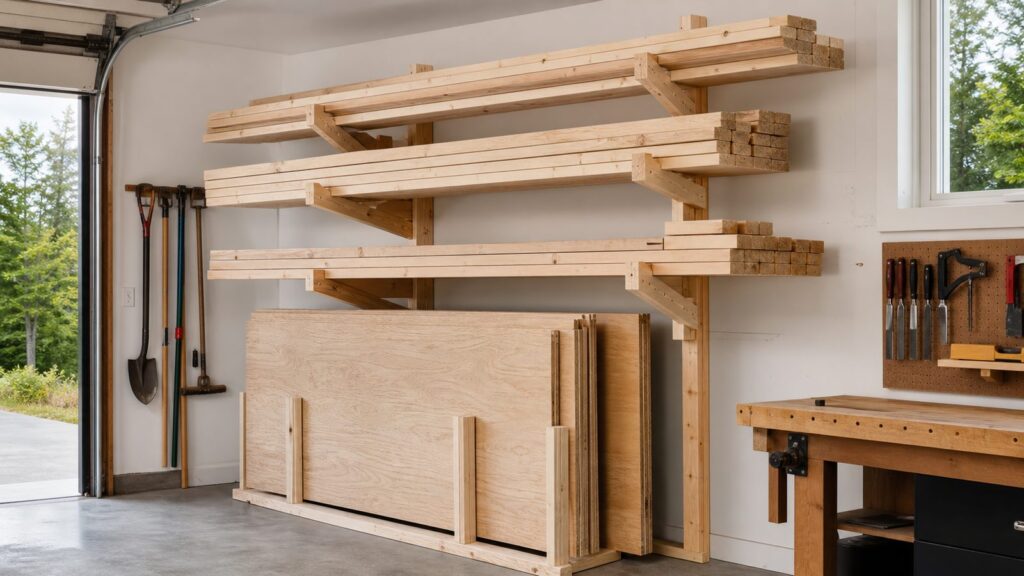
For most homeowners, the most useful setup is an 8-ft wall-mounted rack for long boards plus a separate vertical bay or mobile cart for plywood and sheet goods. Long boards store best horizontally on shallow arms. Plywood stores better vertically with its bottom edge fully supported and the rack restrained from tipping.
As an Amazon Associate I earn from qualifying purchases.
Do these 3 things before closing this tab:
1Repair Windows errors before they cause bigger problems2Scan for outdated or missing drivers - takes under a minute3Clear out junk files and repair common Windows errorsThe plan below is sized for a typical garage or basement shop wall: 8 ft long, 72 to 84 in tall, with three or four vertical 2×4 standards fastened into wall studs. Use 12 to 16 in deep arms for common boards, slope each arm slightly upward or add a front stop, and keep the heaviest material low. If you need to store slabs, large hardwood loads, masonry-wall racks, or anything in a seismic area, treat this as a carpentry or engineering question, not just a weekend storage project.
Start With Capacity, Not the Cut List
On our job sites, we do not build storage until we know what it has to carry. Lumber weight surprises people because the rack looks empty until it is suddenly overloaded. Ten 2x4x8 studs can weigh roughly 90 to 120 lb depending on moisture. Ten 3/4-in 4×8 plywood sheets can exceed 600 lb. A mixed pile of framing lumber, hardwood offcuts, trim, and sheet goods can easily pass 1,000 lb if everything ends up on one wall.
#1 Best Overall

- Storage Master – These high-impact lumber storage racks are designed to store long objects such as lumbers, pipes, or skiing equipment to create more space in your house or even outdoor workspaces.
- Premium Heavy-duty Support – These wood organizer racks are made of scratch-resistant materials, each shelf can hold up to 330 lb overall, which can store all those heavy and large items with these durable racks for your everyday work.
- Ultimate Space Saving – Effectively utilize your space and eliminate garage room clutter with these metal racks. Utilize every wall space in garage and workshop rooms to maximize conveniences. Keeping your space well-organized and everything comes handy.
- Easy Installation – This lumber storage rack includes all the necessary parts and clear step-by-step instructions to make assembly a snap. The intuitive design and hassle-free setup get your organizer up and ready to use in no time.
- Customization – Standard mounting hardware included in the package to make installation process as convenient as possible. Every customer can feel welcomed to contact us in any minutes regarding to any product services.
Before buying material, make a simple load worksheet. List what you actually store, estimate the weight, and divide the total across the number of uprights or studs supporting the rack.
| Material Stored | Typical Quantity | Planning Weight | Storage Recommendation |
|---|---|---|---|
| 2x4x8 studs | 10 boards | 90-120 lb | Middle or lower horizontal arms |
| 1x trim and molding | 20-30 pieces | 40-100 lb | Upper shallow arms with front stops |
| 3/4-in plywood | 10 sheets | 600+ lb | Vertical sheet bay, not a high shelf |
| Hardwood boards | 50-100 board ft | 175-450 lb | Lower arms, stickers if air drying |
| Cutoffs | 1-3 bins | 50-200 lb | Separate bins or cubbies |
For a homeowner rack, a practical target is 400 to 800 lb total on a wall-mounted board rack, depending on wall framing, fasteners, arm depth, and workmanship. That is not a universal rating. It is a planning range. The actual capacity depends on the wall, the fasteners, the number of studs hit, and the leverage created by the rack arms.
Here is the simple math: if your rack carries 600 lb and is fastened to four wall studs, each stud line is sharing about 150 lb before you account for leverage, impact, uneven loading, or someone pulling on a board. If the same 600 lb is hung from only two studs, the demand doubles. If the arms are 20 in deep instead of 12 in deep, the fasteners and ledgers see more prying force. This is why shallow arms, more uprights, and real structural screws matter.
Recommended Design: 8-Ft Wall Rack Plus Sheet-Goods Bay
The most reliable layout for a small shop is two systems: one rack for long boards and one bay for sheet goods. Trying to make one rack do everything usually creates bad access and heavy material stored too high.
Wall-Mounted Board Rack
Build the main rack 96 in long and 72 to 84 in high. Use three vertical standards minimum, or four if your wall stud layout allows it. Each standard is a straight 2×4 mounted vertically, fastened into framing. Horizontal or slightly angled arms project 12 to 16 in from the wall. Space arm levels 14 to 18 in apart vertically so you can reach boards without fighting the rack.
For most garages, 12 in arms are enough for trim, 1x boards, and a reasonable stack of 2x4s. Use 16 in arms if you routinely store 2x10s, 2x12s, or wider hardwood. Avoid 20 in arms unless you add strong diagonal bracing or use rated steel brackets with verified anchorage. Longer arms are not just more shelf space; they are longer levers pulling on the wall.
Quick wins for a faster PC:
Repair Windows errors before they cause bigger problemsFix Now →Fix the driver behind crashes, sound loss and screen glitchesFind Drivers →Clear out junk files and repair common Windows errorsFree Scan →Vertical Sheet-Goods Bay
Sheet goods should be stored low, vertical, and supported along the bottom edge. A basic bay can be 16 to 24 in deep and 50 to 60 in wide, with a 2×4 curb at the floor and a top restraint to prevent tipping. If you build a mobile cart, use four heavy-duty locking casters and size the caster rating for the loaded cart, not the empty cart. A cart holding eight sheets of 3/4-in plywood can be carrying 500 lb or more before you count the cart itself.
Keep the plywood lean modest: roughly 5 to 10 degrees from vertical is enough. Too steep wastes floor space and makes the first sheet hard to pull. Too upright increases tip risk. The bottom needs continuous support so panel edges do not crush, delaminate, or absorb moisture from concrete.
Rank #2

- Perfect for storage: Store all your building supplies without taking up too much space in your Garage, basement, shed or outdoor workspace. This is a very strong storage solution for lumber, firewood, gutters, sheet metal, PVC, pipes, Ladders, skis, snowboards, golf clubs, construction Tools, old rugs and more!
- Wall mounted: our storage saver is easy to install on the walls of your garage or workshop to increase your storage space. Keep your workbench area well organized with this great space-saver for your home or business. Dimensions are 41” height x (up to) 72” wide x 12 ½” shelf depth.
- Weight capacity of 660 lbs. : quality industrial storage equipment holds a significant amount of weight, which is why each shelf holds up to 100 lbs. – that’s a 600-pound weight capacity for all six shelves! Store all those heavy boards or logs with the assurance that your organizer can handle the weight.
- 12 levels of storage: configure the portamate PBR-001 wood organizer to fit your storage needs. Use the first few Tiers as a wood and pipe rack and add wooden boards to the others to instantly increase shelf space!
Materials and 2026 Cost Planning
Retail lumber pricing is calmer than the 2021 spike years, but it still moves by region, species, grade, treatment, store inventory, and freight. In 2026, common 2x4x8 pricing at big-box stores is often about $4 to $8 per board, with sampled online listings around $4.15 to $5.13 for common 8-ft 2×4 studs. Plywood and sheathing pricing varies far more. Lowe’s listings commonly show panels around $30, but the broad range can run from about $4.74 to $90 depending on thickness, grade, species, treatment, and panel type. Cabinet-grade 3/4-in hardwood plywood can cost much more than sheathing.
Benchmark lumber data also remains volatile. Trading Economics showed lumber around $615 per 1,000 board feet on July 31, 2026, down about 11.6% year over year. NAHB reported framing lumber prices up 1.4% week over week on July 24, 2026, 3.1% higher than one month prior, and 0.3% lower than one year prior. Those numbers explain why a rack plan should include a price check before shopping, not a fixed national bill of materials.
| Rack Type | Typical 2026 Material Cost | Best Use | Watchouts |
|---|---|---|---|
| Budget 8-ft wood wall rack | $55-$120 | Construction lumber, trim, light hardwood storage | Must hit studs and use structural fasteners |
| Heavy-duty wood rack with sheet bay | $125-$275 | Mixed garage storage with plywood | Needs more floor space and stronger anchoring |
| Steel-bracket hybrid rack | $100-$300+ | Clean install with rated brackets | Bracket rating only matters if wall anchorage is correct |
| Mobile lumber or plywood cart | $150-$350 | Flexible shop layout, sheet goods, cutoffs | Limited by caster rating and floor condition |
| Professional custom storage build | $500-$1,500+ | Heavy loads, finished garages, difficult walls | Cost rises with anchoring, finish, and permit needs |
For a dry interior shop, use untreated kiln-dried framing lumber. Pressure-treated lumber and exterior-rated fasteners add cost and are usually unnecessary indoors unless the rack contacts damp concrete or lives in a wet outbuilding. If there is any chance of moisture, isolate wood from concrete with a sill gasket, plastic spacer, or treated bottom runner.
Cut List for an 8-Ft Wall-Mounted Lumber Rack
This cut list builds a strong residential rack with four vertical standards, four storage levels, and shallow arms. Adjust the spacing to match your wall studs. Do not force the rack layout to a drawing if the studs are somewhere else.
Materials
- Eight to fourteen kiln-dried 2x4x8 studs, depending on arm count and bracing
- One 2x6x8 ledger or two 2x4x8 ledgers for heavier racks
- Structural wood screws or lag screws, 3/8 in by 4 in or approved structural screws of similar capacity
- Washers for lag screws where required by the fastener manufacturer
- 3 in construction screws for rack assembly, not drywall screws
- Optional 1/2-in or 3/4-in plywood gussets for arm bracing
- Optional labels for load limits and material categories
Typical Cuts
- Four vertical standards: 2x4s cut to 72 or 84 in
- Two ledgers: 2×4 or 2×6 cut to 96 in
- Sixteen arms: 2x4s cut to 12 to 16 in
- Sixteen diagonal braces: 2x4s cut with 45-degree ends, sized to fit under each arm
- Sixteen front stops: 2×4 blocks or 1x blocks, 2 to 3 in tall
The diagonal brace is what turns a simple arm into a bracket. A bare 2×4 screwed through its end grain into a vertical standard is not the same thing as a braced support. For a rack that may hold real construction lumber, use a triangular bracket shape: vertical standard, horizontal arm, and diagonal brace. Plywood gussets on both sides of the joint can also work well if they are glued and screwed properly.
Step-by-Step Build Plan
1. Locate and Mark the Studs
Use a stud finder, then verify with a small pilot hole or trim nail where appropriate. Mark the centerline of every stud you plan to use. In most garages, studs are 16 in on center, but older houses, remodels, and garage fire-rated assemblies can vary. Do not rely on drywall alone. A fully loaded rack must be connected to framing.
Free tools Windows power users keep installed
One-click scans. No signup required.
2. Set the Lower Ledger
Install the lower ledger level at about 30 to 36 in above the floor. This height keeps heavy boards low while leaving room for bins or short cutoffs below. Fasten the ledger into every stud it crosses using structural screws or lag screws. Pre-drill for lag screws to avoid splitting. Keep the ledger flat to the wall.
3. Install Vertical Standards
Place the vertical 2×4 standards over stud lines whenever possible. Fasten each standard through the ledger and into framing. Add a top ledger at 72 to 84 in high to tie the standards together. The rack should feel like part of the wall before the arms go on.
Rank #3

- Storage Master – These high-impact lumber storage racks are designed to store long objects such as lumbers, pipes, or skiing equipment to create more space in your house or even outdoor workspaces.
- Premium Heavy-duty Support – These wood organizer racks are made of scratch-resistant materials, each shelf can hold up to 330 lb overall, which can store all those heavy and large items with these durable racks for your everyday work.
- Ultimate Space Saving – Effectively utilize your space and eliminate garage room clutter with these metal racks. Utilize every wall space in garage and workshop rooms to maximize conveniences. Keeping your space well-organized and everything comes handy.
- Easy Installation – This lumber storage racks includes all the necessary parts and clear step-by-step instructions to make assembly a snap. The intuitive design and hassle-free setup get your organizer up and ready to use in no time.
- Customization – Standard mounting hardware included in the package to make installation process as convenient as possible. Every customer can feel welcomed to contact us in any minutes regarding to any product services.
4. Build and Attach the Arms
Cut arms to 12 to 16 in. Install them with a slight upward pitch, about 1/4 in to 1/2 in rise from back to front, or keep them level and add a front stop. Add diagonal braces beneath each arm. Use screws through the brace into the arm and standard, not just toe screws. If you use plywood gussets, install one on each side of the bracket where possible.
5. Add Stops and Labels
Add a 2 to 3 in stop at the front of each arm. This is cheap insurance for dowels, pipe clamps, warped trim, and round stock. Label each level with a target load such as “trim only,” “2x material,” or “hardwood under 150 lb.” Labels prevent one bay from becoming the place where every heavy board lands.
The Tool Desk
Outbyte Driver Updater FREEFix the driver behind crashes, sound loss and screen glitchesFind Drivers →Outbyte PC Repair FREEClear out junk files and repair common Windows errorsFree Scan →6. Load the Rack Gradually
Do not fill the rack all at once and walk away. Load the lowest heavy material first, then step back and watch for movement, creaking, wall deflection, or arm sag. Recheck fasteners after the first week and again after the first seasonal humidity swing.
Fasteners, Brackets, and Wall Anchorage
The most common failure we see in homeowner storage is not bad lumber. It is bad fastening. Drywall screws are not structural fasteners. They are brittle, small, and not designed for cantilevered storage loads. Use structural wood screws, lag screws, or manufacturer-rated bracket fasteners sized for the rack.
If you choose steel shelf brackets, read the rating carefully. Some 20-in heavy-duty bracket packs are marketed around 500 lb ratings, and some individual or pair brackets advertise 500 to 1,000 lb capacities. Those ratings depend on correct installation into suitable structure. A 500 lb bracket screwed into drywall is not a 500 lb rack.
For wood-framed walls, hit the center of studs. For masonry or concrete walls, use anchors designed for the substrate and load, and consider hiring a carpenter or contractor. Hollow block, old brick, cracked concrete, and unknown garage walls are not places to guess. For finished walls with fire-rated garage separation, avoid unnecessary penetrations and preserve required protection around living spaces.
Safe Lumber Storage Rules Worth Borrowing From Job Sites
Residential garages are not OSHA-regulated job sites, but OSHA’s construction storage principles are useful because they are based on preventing falling, rolling, and unstable material. Used lumber should have nails removed before stacking. Lumber should be stacked on level, solidly supported sills. Stacks should be stable and self-supporting. OSHA also limits lumber piles to 20 ft high, or 16 ft when handled manually. Your garage rack will be far shorter than that, but the underlying rule applies: stable, level, supported, and manageable by hand.
Keep heavy material below waist height whenever possible. Plywood, slabs, treated lumber, and dense hardwood should not live on the top level. Store long boards with enough support points to prevent sagging. For 8-ft boards, three supports are better than two. For 10-ft to 12-ft boards, use at least four supports or keep the rack length closer to the material length.
Rank #4

- Heavy-Duty & Durable:The Asxevn Lumber Rack is constructed with reinforced, heavy-gauge steel, offering a solid 220 lb capacity per tier to reliably support your heaviest lumber, tools, and equipment. The rust-resistant powder-coated finish withstands harsh garage, warehouse, or outdoor conditions, ensuring long-lasting performance.
- Quick & Easy Installation:Everything you need for setup is included. With all hardware and a clear guide, simply align, secure to wall studs, and you're done. It’s a straightforward, tool-free process that instantly organizes your space with minimal effort.
- Maximizes Garage & Workshop Space:More than just a lumber rack—it’s a versatile storage solution. Perfectly organize pipes, ladders, skis, toolboxes, and other bulky items. The wall-mounted design keeps everything visible and within reach, freeing up floor space while improving safety and workflow efficiency. The ultimate choice for garage organization.
- Secure & Stable Design:Built with a reinforced triangular structure, this heavy-duty rack stays sturdy and reliable even at full load. Each tier features a non-slip lip or safety stop to prevent lumber and tools from accidentally sliding off, giving you peace of mind and a safer storage environment.
- Reliable Customer Support:We stand behind the quality of our products and your satisfaction. Our professional customer service team is available 24/7 to answer your questions and provide support—you can count on us for outstanding service.
Separate lumber by use and moisture. Construction lumber, hardwood, sheet goods, trim, and cutoffs should not all be buried together. Wet framing lumber stored tight against finish-grade hardwood can create staining, cupping, mold, and frustration later. Leave airflow around boards and avoid storing lumber directly on concrete.
Independent reader supportYour contribution helps us test, update, and keep practical guides available for everyone.Permits, Fire Separation, and Code Questions
Most simple garage shelving does not require a permit, but storage racks can become a code question depending on your city, the building type, and how the rack is attached. The issues are usually whether the rack is a fixture attached to the structure, whether it is tall or heavily loaded, whether it obstructs egress, and whether it affects garage fire separation between the garage and living space.
Crashes, No Sound, or Screen Glitches?
Random freezes, missing sound and display glitches usually trace back to one bad driver. Find and replace yours safely.Free scan · under a minuteWindows Errors? Fix Them Before They Spread
Repair common Windows errors and clear accumulated junk for a smoother, more stable PC - no reinstall needed.Free scan · no reinstallDo not block electrical panels, water heaters, appliance service access, windows needed for light or ventilation, attic access, garage doors, or walking paths. Keep stored lumber away from ignition sources and appliances. If your local jurisdiction classifies storage racks, display shelving, or high-piled combustible storage in a way that triggers anchorage review, follow that rule. This is more common in commercial or large storage conditions, but local rules vary.
In earthquake-prone regions, freestanding racks and tall sheet-goods carts deserve anti-tip restraint. A vertical plywood bay loaded with several sheets has a high center of gravity when pulled or bumped. Anchor it to framing or use a wide base with locking casters and a top restraint.
Common Mistakes to Avoid
The first mistake is copying a photo without calculating weight. A rack that looks fine with ten pine boards may not be fine with ten sheets of 3/4-in plywood. The second mistake is using drywall screws. The third is making the arms too deep. A 24-in arm looks useful until you remember that every extra inch increases leverage against the fasteners.
Another common problem is mixing short cutoffs with long stock. When you pull one 10-ft board, a loose 18-in cutoff can slide off the back or front. Store cutoffs in bins, cubbies, or a vertical compartment. Keep round material, dowels, and molding behind a lip.
Recommended Free Tools
Do not build a tall freestanding rack without anti-tip anchoring. Do not store sheet goods flat on a high shelf where they are hard to remove. Do not place lumber tight against damp masonry or directly on a slab. Do not overload one level because it is convenient. A rack should make the safer choice the easy choice.
When to DIY and When to Hire a Pro
A DIY lumber rack is reasonable if you have wood-framed walls, clear stud locations, moderate storage loads, basic carpentry tools, and the discipline to keep the rack within its intended capacity. Most capable homeowners can build the 8-ft wall rack in 4 to 6 hours, not counting shopping and cleanup. Add another 3 to 5 hours for a sheet-goods cart or vertical plywood bay.
Best Value

- 【Perfect for Storage】 Ideal for shed, workshop, garage, outdoor workspace or any area where long items need to be stored neatly; This is a very strong storage solution for lumber, firewood, sheet metal, PVC, pipes, ladders, skis, snowboards, golf clubs and more!
- 【Weight Capacity of 1200 LBS】YYR lumber storage rack wall mounted is made of powder-coated 1⅙” (3 cm) steel tube construction。After many tests, each shelf can hold up to 200 lbs, which means a total weight capacity of 1200 lbs.
- 【No Assembly Required】Wood storage racks arrives fully assembled. This industrial-grade design is also one of the reasons it can hold a lot of weight.
- 【Fast & Simple Installation】YYR lumber shelf comes with mounting screws and instructions so you can have it on your wall in 15 minutes.
- 【Free Up Valuable Floor Space】YYR wall mounted storage rack will make full use of wall space to increase your storage space. Keep your garage or shed tidy and clutter-free by utilizing unused garage wall space.
Hire a carpenter or contractor when the wall is masonry, the garage is finished and fire-rated, the rack will hold heavy hardwood slabs, the rack must be freestanding and tall, or you need seismic anchoring. Also bring in help if you are modifying framing, drilling into structural concrete, working around electrical panels, or trying to integrate storage into an engineered garage system.
For Bettesworth Construction, our contractor rule is simple: if failure would damage a vehicle, injure someone, or compromise the building envelope, the rack deserves professional planning. A few hundred dollars of carpentry is cheaper than rebuilding a garage wall or dealing with a rack collapse.
Maintenance Checklist
Inspect the rack twice a year. Look for loose fasteners, bent screws, cracked braces, sagging arms, crushed drywall, and boards that have shifted forward. Remove bent or suspect fasteners and replace them with proper structural hardware. Check that stops are still tight and that sheet goods cannot tip.
Cull scrap at the same time. Most shops do not have a storage shortage as much as a decision shortage. Keep useful offcuts by size and species. Discard unusable split, twisted, wet, or nail-filled pieces according to your local waste rules. Pull nails from used lumber before stacking it, and mark reclaimed boards so nobody runs a saw blade through hidden metal.
A lumber rack should save time, protect material, and keep the shop safer. If it becomes a mystery pile, it has stopped doing its job. Build it with real load planning, keep the heavy material low, and give plywood its own supported bay. That combination solves the storage problem for most garages without turning a simple woodworking plan into a risky wall full of lumber.
Frequently Asked Questions
How much weight can a DIY lumber storage rack hold?
It depends on the wall, fasteners, arm depth, and number of supports. A practical planning range for a homeowner wall rack is often 400 to 800 lb total, but only when it is fastened into studs with structural screws or lag screws and loaded evenly.
What’s actually slowing this PC down?
Pick the symptom - the matching free tool is one click away.
What is the best way to store lumber in a garage?
Store long boards horizontally on shallow supported arms, keep heavy material low, separate sheet goods into a vertical bay, and leave airflow around the lumber. Avoid storing boards directly on concrete or tight against damp walls.
Can I build a lumber rack with 2x4s?
Yes. Kiln-dried 2x4s work well for a garage rack if the arms are braced, the vertical standards are tied into wall studs, and structural fasteners are used. Do not rely on drywall screws or end-grain screws alone for load-bearing arms.
Do I need a permit for a garage lumber storage rack?
Usually not for simple residential shelving, but local rules vary. A permit or review may be required if the rack is large, heavily loaded, attached to structural elements, affects garage fire separation, obstructs egress, or falls under local storage-rack rules.
How do I store plywood sheets safely?
Store plywood vertically in a low bay with full bottom-edge support and an anti-tip restraint. Avoid storing multiple 3/4-in sheets on a high shelf; ten sheets can exceed 600 lb and are awkward to remove overhead.
How far apart should lumber rack arms be?
For 8-ft boards, three support points are a good minimum, with arms roughly 32 to 48 in apart depending on lumber size and weight. For longer or heavier stock, add more supports and keep the load lower on the rack.
Quick Recap
Product prices and availability are accurate as of the date/time indicated and are subject to change. Any price and availability information displayed on Amazon at the time of purchase will apply.

