The headline is accurate only if “built” means assembled at the railway. At Hatsushima Station in Wakayama Prefecture, Japan, workers installed a small reinforced-concrete waiting-room building during an overnight railway work window of roughly six hours. The structural components had already been 3D-printed, reinforced and prepared at a factory over about seven days.
What was built at Hatsushima Station?
West Japan Railway Company (JR West), JR West Innovation and construction-technology company Serendix replaced the deteriorating wooden station building at Hatsushima Station in Arida, Wakayama Prefecture. The original building dated from 1948.
As an Amazon Associate I earn from qualifying purchases.
The replacement is not a large terminal. It is a single-storey, reinforced-concrete waiting room measuring 9.9 square metres—about 106 square feet—with approximate dimensions of 6.3 metres wide, 2.1 metres deep and 2.6 metres high. It contains a two-person bench, a ticket machine and a simple IC-card gate. Raised motifs representing locally associated mandarins and scabbardfish decorate the exterior.
The Tool Desk
Outbyte Driver Updater FREEScan for outdated or missing drivers - takes under a minuteDriver Scan →Outbyte PC Repair FREEClear out junk files and repair common Windows errorsFree Scan →Hatsushima is an unstaffed rural station on the JR Kisei Main Line. Its modest scale is important: the project demonstrates a possible solution for small railway buildings, not a ready-made replacement for major stations with platforms, bridges, lifts, tunnels or extensive passenger facilities.
#1 Best Overall

- Up to 16 Colors: Bring your designs to life with vibrant multi-color/multi-material printing capabilities, perfect for showcasing your creativity. Note: Connecting Bambu Lab AMS is required.
- 500mm/s and 20000 mm/s² Acceleration True High Speed: Don't wait around for your masterpieces. Lightning-fast printing speed lets you focus on creating, not waiting.
- Enclosed Design: Fully enclosed body improves print performance for advanced filaments. Automatic Bed Leveling: Say hello to high-quality, successful prints. Auto bed leveling makes 3D printing such an easy thing.
- Set Up in 15 Minutes: Spend more time printing and less time setting up. User-friendly design ensures a hassle-free assembly experience for all skill levels.
- Supported Filament: Ideal: PLA, PETG, TPU, PVA, PET ABS, ASA; Capable : PA, PC; Not Recommended: Carbon/Glass Fiber Reinforced Polymer.
The wider project team included Neuob architectural office, KAP structural-design office and additional construction and 3D-printing partners. The companies described it as the world’s first railway station building constructed using construction 3D-printing technology. That is a claim made by the participating organisations, rather than an independently verified global census of railway projects.
What “less than six hours” really means
The station was not printed from raw material beside the tracks in six hours. The claim refers to the on-site overnight railway work period.
Serendix produced four main structural pieces away from the station in approximately seven days. The pieces were then reinforced with steel and filled with concrete before being transported to Hatsushima. After the final train departed at 11:57 p.m. on March 25, 2025, the railway work area could be secured and the installation could begin. The structural work was completed on March 26.
Recommended Free Tools
Serendix says the main assembly took about two hours, including approximately 45 minutes of truck changes. The broader overnight window also had to accommodate foundation-related work, crane operations, railway safety procedures and site preparation. In other words, the important achievement was compressing disruptive trackside work—not eliminating the factory, transport or finishing stages.
Rank #2

- One-Click Automatic Printing: Experience hassle-free 3D printing with the Adventurer 5M Series. Enjoy automatic bed leveling for flawless first layers, ensuring consistent adhesion and saving time with no manual adjustments required.
- 12X Ultra Fast Printing: Featuring a CoreXY structure with 600mm/s travel speed and 20000mm/s² acceleration, the AD5M maximizes efficiency, reduces production cycles, and ensures high precision, making it ideal for rapid prototyping and mass production.
- Smart and Efficient Design: Quick 3-second nozzle changes, a high-flow 32mm³/s nozzle, and fast 35-second warm-up to 200°C deliver stable high-speed printing. Its dual-sided PEI platform and versatile options provide easy removal and adaptability for various creative projects.
- Superior Print Quality & Adaptability: Combines a 280°C direct drive extruder with dual-fan cooling and vibration compensation. Includes a standard 0.4mm nozzle and accepts optional sizes from 0.25mm to 0.8mm to fit various printing needs.
- Real-Time App Monitoring: Monitor print progress, adjust settings, and receive instant status alerts remotely with the Flash Studio. Smart mobile control ensures a seamless, effortless printing experience anytime, anywhere.
The building opened to passengers from the first train on July 22, 2025, after interior work and railway-equipment installation had been completed.
How the 3D-printed structure was made
- Design and engineering: Architects and structural engineers designed a compact waiting room suited to the station site and its railway constraints.
- Factory printing: A construction 3D printer deposited specialised mortar through a nozzle mounted on a robotic arm.
- Reinforcement: Steel reinforcement was installed inside the printed elements, which were then filled with concrete. The result was a structural component, not an unreinforced printed shell.
- Transport: Four completed pieces were delivered to the station by truck.
- Railway isolation: Work began after the final train had left and the area was safe for construction activity.
- Crane installation: A crane lifted the pieces from the trucks into position, where they were assembled with the foundation and other required connections.
- Finishing and equipment: Interior work, passenger equipment and other services were installed after the overnight structural operation.
- Opening: Passenger use began on July 22, 2025.
ABB’s later account identifies the robotic system as an ABB IRB 6700 paired with two-component, or 2K, nozzle technology supplied by Vertico. ABB says this arrangement enabled greater geometric flexibility and reduced layer spreading compared with an earlier single-component nozzle. Those performance comparisons are vendor-reported claims, not independent laboratory measurements of the Hatsushima building.
Why this matters to railway construction
Railway projects face a constraint that ordinary building sites do not: work beside the track must fit around train movements and strict safety procedures. A station may have only a short overnight period in which workers can occupy the railway environment.
Factory production changes that equation. Much of the labour-intensive structural work takes place away from the railway, while the site operation is reduced to delivery, lifting, connection and finishing. That can offer several advantages:
Rank #3
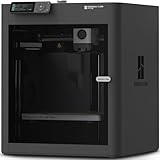
- Up to 16 Colors: Bring your designs to life with vibrant multi-color/multi-material printing capabilities, perfect for showcasing your creativity. Note: Connecting Bambu Lab AMS is required.
- 500mm/s and 20000 mm/s² Acceleration True High Speed: Don't wait around for your masterpieces. Lightning-fast printing speed lets you focus on creating, not waiting.
- Enclosed Design: Fully enclosed body improves print performance for advanced filaments. Automatic Bed Leveling: Say hello to high-quality, successful prints. Auto bed leveling makes 3D printing such an easy thing.
- Set Up in 15 Minutes: Spend more time printing and less time setting up. User-friendly design ensures a hassle-free assembly experience for all skill levels.
- Supported Filament: Ideal: PLA, PETG, TPU, PVA, PET ABS, ASA; Capable : PA, PC; Not Recommended: Carbon/Glass Fiber Reinforced Polymer.
- Less time spent working beside an active railway.
- Reduced disruption to train services.
- Less on-site formwork and wet construction.
- More controlled factory production.
- Potentially fewer workers required at the trackside.
- Repeatable production of compact, customised buildings.
- Freedom to incorporate curves and local decorative features without extensive bespoke formwork.
JR West and Serendix said conventional reinforced-concrete station construction could require one to two months for the structural shell. ABB separately reported that a comparable wooden replacement could take around two months and cost up to twice as much as the concrete structure. That comparison comes from ABB’s customer account and should not be treated as an independently audited cost study.
Was it cheaper?
The project partners presented the method as a way to reduce construction and maintenance burdens, but no complete public price for the Hatsushima building is given in the available official material. It would therefore be misleading to quote a definitive yen or dollar saving.
There are also several possible cost baselines: a conventional reinforced-concrete building, a timber replacement, a prefabricated steel shelter or a modular building. The answer may change depending on the site, access, foundation requirements and specification.
PC Slower Than It Used to Be?
A free scan shows the junk files, broken settings and background clutter dragging Windows down - then fixes them in one click.Free scan · Windows 10 & 11Outdated Drivers Are Slowing You Down
One free scan finds every outdated or missing driver and matches the right update for your exact hardware.Free scan · exact hardware match3D printing is not automatically cheaper. A meaningful comparison would need to include design and structural engineering, printer and operator costs, reinforcement, concrete filling, transport, crane hire, foundations, railway possessions, finishing, equipment, inspections and long-term maintenance.
Rank #4

- High-Speed Precision: The Bambu Lab P2S 3D printer prints up to 600 mm/s while maintaining exceptional accuracy. With the PMSM Servo Extruder and Active Flowrate Compensation, every layer of your printed object stays sharp and smooth, delivering flawless corners and consistent results.
- Ready to Print in 15 Minutes: Set up your P2S FDM 3D printer and start printing in just 15 minutes. With AI failure detection, quick-swap nozzles, and automatic calibration, this 3D printer makes professional-grade 3D printing effortless, even for beginners.
- Effortless Multi-Color Printing: The AMS 2 Pro enables seamless multi-color/multi-material 3D printing. It features built-in filament drying at up to 65 °C, keeping every spool ready for flawless prints. (Note: The P2S 3D printer does not support multi-color printing; Combo version required.)
- Smart Airflow for Any Filament: The Adaptive Airflow System automatically balances cooling and heat retention—keeping overhangs crisp with cool air, or maintaining a 50 °C chamber for engineering-grade materials. A carbon filter ensures clean, safe air while you print.
- Limitless Creativity, Seamless Workflow: Explore over one million 3D models on MakerWorld and bring them to life with a smooth, unified workflow using Bambu Studio, Bambu Handy, and your FDM 3D printer, from design to finished print.
Does it solve the problem of ageing rural stations?
It addresses one part of the problem particularly well: the need to replace small buildings while keeping railway disruption and trackside labour to a minimum. Reinforced concrete may also provide durability and corrosion-resistance advantages over a deteriorating wooden structure.
However, the system does not remove the need for conventional construction expertise. Foundations, soil conditions, drainage, utilities, electrical systems, weatherproofing, accessibility, fire safety, permits, inspections and railway approvals remain essential. The structure must also be transported and lifted, so roads, overhead lines, crane positioning and site access can determine whether the method is practical.
The building’s earthquake performance should likewise be described carefully. The project uses steel reinforcement and concrete filling, and some coverage reports a claim of earthquake resistance comparable to reinforced-concrete houses. That is a statement about the design and construction system, not a guarantee that the building cannot be damaged. The available project releases are not a complete independent seismic test report or a basis for assigning a particular Japanese code category.
Free tools Windows power users keep installed
One-click scans. No signup required.
Why the small size matters
A 9.9-square-metre waiting room is a favourable case for prefabricated installation. Four components can be transported and lifted comparatively easily, and the building has limited internal services.
Best Value

- 600mm/s Speed & CoreXY Structure — Powered by an all-metal CoreXY frame and 20,000mm/s² acceleration, Adventurer 5M Pro reaches speeds up to 600mm/s. Integrated vibration compensation algorithms eliminate ghosting and ringing for smooth, high-precision surface finishes.
- 3-Second Quick-Swap Nozzle & Auto Leveling — Features a tool-free, quick-release nozzle mechanism for effortless 3-second replacements across multiple sizes (0.25/0.4/0.6/0.8mm). One-click full auto-leveling ensures precise bed calibration and a perfect first layer every time.
- Dual Filtration System & Quiet Enclosure — Built with an integrated dual filtration system and a fully enclosed chamber to ensure a clean printing environment and thermal stability. Powered by low-noise motion control, it operates quietly under 50dB for seamless home, office, or classroom use.
- 280°C High-Temp Extruder & Broad Material Compatibility — With a 280°C max nozzle temperature and a 110°C heated bed, it reliably prints engineering materials like ABS, ASA, and PETG-CF, as well as standard PLA and PETG.
- Smart Camera & Mobile Control — Features a built-in camera for real-time monitoring and time-lapse video creation. Monitor progress, adjust settings, and receive instant status alerts via Flash Studio. Integrated with filament detection, power loss recovery, and a 4.3-inch touchscreen for effortless operation.
The case is much less straightforward for a multi-storey station, a major interchange or a facility requiring lifts, extensive accessibility infrastructure, staffed areas, toilets, retail space, large passenger flows or connections to bridges and tunnels. In those settings, the structural shell may not be the dominant source of cost or construction time.
Ridership figures in published accounts also vary. Some early reports cite approximately 530 daily users, while ABB later cites around 270 people per day. The figures may reflect different periods or counting methods, so they should not be presented as a single definitive current number. “Lightly used rural station” is the safer description.
How it compares with other construction methods
| Method | Potential strengths | Limitations |
|---|---|---|
| 3D-printed reinforced concrete | Custom forms, factory production and compressed trackside installation. | Requires specialist equipment, reinforcement, transport, cranes and approvals. |
| Prefabricated steel shelter | Lightweight, established and potentially quick to install. | May require corrosion protection and additional architectural treatment. |
| Precast concrete or modular construction | Factory-controlled quality and strong logistics advantages. | Standardised systems may offer less geometric freedom. |
| Conventional reinforced concrete | Familiar to designers and regulators, with broad structural flexibility. | Formwork, reinforcement, pouring and curing can extend trackside work. |
| Timber | Suitable for rural character and potentially easy to modify. | May bring greater weathering and maintenance demands. |
Is this now a standard way to build stations?
No. Hatsushima is best understood as a completed pilot and proof of concept. JR West and its partners said they would assess construction and maintenance effects before considering wider deployment. There is no verified evidence in the cited sources of a nationwide rollout by August 2026.
What’s actually slowing this PC down?
Pick the symptom - the matching free tool is one click away.
Serendix has continued experimenting with railway-related applications. A later Tokyo Metropolitan Government project tested a 3D-printed section of a station platform modelled on Sugamo-Shinden Station. That indicates ongoing development, but it does not show that the Hatsushima method has become standard practice.
The real lesson from Hatsushima
The significant achievement is not that a complete railway station appeared from a printer in six hours. It is that a small, customised reinforced-concrete building was manufactured largely away from the railway and installed during one tightly constrained overnight work period.
For ageing rural stations, that distinction matters. The approach could be valuable where short railway possessions, labour shortages and difficult maintenance make conventional construction expensive or disruptive. But it will succeed only where the foundations, logistics, regulations, finishing work and long-term costs also make sense.
For now, Hatsushima demonstrates a promising construction strategy for small railway buildings—not a universal replacement for conventional station construction.
Quick Recap
Product prices and availability are accurate as of the date/time indicated and are subject to change. Any price and availability information displayed on Amazon at the time of purchase will apply.

