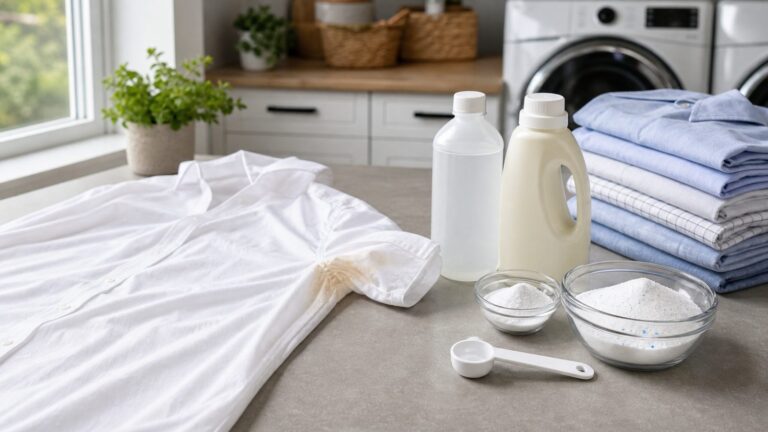
Salt and vinegar do not reliably set dye after a garment has already been dyed, and they will not fix dye transfer that has stained another item. To prevent bleeding, follow the care label, wash new or known-bleeding clothes separately or with like colors, and use cooler water when the label allows. If color has transferred, separate the garments promptly and treat the affected item according to its fabric and care instructions before applying heat.
First, distinguish dye bleeding from crocking
Bleeding is dye that leaches out in water or another solvent. Crocking is color transferred by rubbing, such as dye rubbing off onto another garment or upholstery. Either can discolor other items; removing the transferred color is not guaranteed and treatment can damage the affected fabric. Iowa State University Extension’s AnswerLine explains the distinction and the limits of common fixes.
As an Amazon Associate I earn from qualifying purchases.
Do salt or vinegar set dye after the fact?
No reliable after-the-fact fix comes from adding household salt or vinegar to a wash. These substances can have specific roles during some dyeing processes, but that does not mean they fix dye once dyeing is complete or prevent later bleeding and crocking. Iowa State Extension’s Marlene Geiger calls the belief a myth: “A common myth is that washing the product in vinegar or salt ‘fixes’ the color and prevents it from crocking or bleeding.” Apparent improvement may simply be loose dye washing away; it is not proof that the color has been fixed. Read the AnswerLine explanation.
Free tools Windows power users keep installed
One-click scans. No signup required.
How to reduce bleeding before and during a wash
Check the garment before washing
- Read the care label first, including water temperature and any restrictions on washing or bleaching.
- On a hidden area, press a damp white cloth against the fabric. If color transfers, wash the garment separately for its first washes.
- Sort whites, lights, and darks separately. Wash known or suspected bleeders with similar colors rather than with pale items.
- Choose cooler water if the care label permits it. Do not override a garment’s care instructions in an attempt to prevent dye loss.
Color-catcher sheets may trap some loose dye in shared wash water, but Iowa State Extension says they are not fully reliable. They are not a substitute for separating colors and washing a likely bleeder separately. Iowa State Extension’s guidance discusses both sorting and color-catching products.
#1 Best Overall

- What You'll Get: One 72 count value size carton of Shout Color Catchers. Carton made of 100% Recycled Paperboard
- Locks in Dyes: formulated to maintain original coloring of all clothes, and prevent color runs
- Time Saver: reduce the amount of time it takes to get through laundry with dye-trapping sheets, saving your from sorting each load out
- Quick & Easy To Use: works on all machine-washable whites and colored fabrics, and works in all water temperatures and in HE and standard washers
- Wash Fewer Loads: Shout saves you time and money by reducing the need for sorting and allowing mixes washes, so you avoid doing multiple loads!
What to do when dye has transferred to another garment
- Separate the items promptly. Do not put the stained garment in the dryer while the transfer remains; heat can make removal harder.
- Check the affected item’s label and fiber content. Account for trims, elastic, and other components as well as the main fabric. A method suitable for a bleachable white may be unsafe for wool, silk, elastane, or colored fabric.
- Test a hidden spot. Before using a treatment, check its effect on an inconspicuous area and follow the product directions for the item.
- Use only a treatment suitable for that garment. Whirlpool describes oxygen-bleach soaking for eligible items. Clorox gives directions for diluted bleach on eligible whites and a color-removal approach for certain colored items; its guidance stresses fiber suitability and warns that a color remover may strip the garment’s original color.
- Air-dry and inspect. Avoid dryer heat until you can see whether the transfer is gone. Repeat a treatment only if the garment and product directions allow it.
These are conditional manufacturer directions, not universal stain-removal guarantees. See Whirlpool’s color-bleed guidance and Clorox’s instructions and cautions.
Setting color in fabric you have just dyed
A dye fixative is intended for the dyeing process; it is different from a stain remover for color already transferred onto another garment. Rit recommends using its ColorStay Dye Fixative immediately after dyeing and before rinsing and laundering, following the current package directions. The product page lists cotton, linen, ramie, rayon, and blends containing these fibers as suitable. Do not assume compatibility with other fibers or treat it as a rescue product for a garment that has already bled in an ordinary wash. Check Rit’s ColorStay product page for current directions and listed fibers.
Rank #2

- What You'll Get: Two 72 Count Value Size Boxes of Shout Color Catchers
- Locks in Dyes: formulated to maintain original coloring of all clothes, and prevent color runs
- Time Saver: reduce the amount of time it takes to get through laundry with dye-trapping sheets, saving your from sorting each load out
- Quick & Easy To Use: works on all machine-washable whites and colored fabrics, and works in all water temperatures and in HE and standard washers
- Wash Fewer Loads: Shout saves you time and money by reducing the need for sorting and allowing mixes washes, so you avoid doing multiple loads!
Rit’s FAQ gives broader process guidance for several fibers, but product suitability should not be extended beyond the product page’s stated list. Iowa State Extension also discusses Retayne and Rit ColorStay for reducing bleeding in cotton, while noting that the method depends on adequate water, treatment temperature, and washer type. The extension says these fixatives do not work on polyester or acrylic, and Retayne does not work in energy-efficient front-loading machines that do not supply enough water. For any fixative, follow the maker’s current instructions and do not assume a method applies to every washer or fabric. Rit’s FAQ and Iowa State Extension provide further details.
Recommended Free Tools
Quick Recap
Best Value
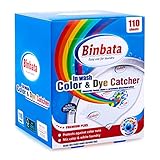
- KEEP YOUR CLOTHS SAFE: Binbata color catcher sheets take new-generation nano adsorption technology, timely lock and absorb the free colored particles in the water and fluorescent ingredient (harmful for people) in detergent, prevent dye particles from running or bleeding onto other clothes, maintain original colors of clothes.
- HIGH-DENSITY RHOMBUS MESH STRUCTURE: Specially formulated non woven fabric & Unique 3D rhombus texture. Higher density and thicker than other ordinary color blocker, greatly increased the absorption area, faster and more effective to lock color.
- TIME SAVING: You don't need to sort dark and light clothes any more, which reduce the cost and protect the environment when saving water and electricity. It is convenient to use and portable. Especially suitable for families, students living in dormitory, people at busy work and people on the journey. Make washing easier and safer.
- USING METHOD: All you need to do is put the dye catching sheet in the washing machine together with detergent and clothes, and turn on the washing machine as usual. Discard the sheet after using and you can see the color has been absorbed by it. And it's strong enough, so you don't have to worry about it generating crumbs or being shredded by the washing machine.
- ENVIRONMENTAL CERTIFICATION: Binbata has obtained relevant authority certification, committed to producing safe, durable and sustainable products. At the same time, we passed the professional test of harmful substances. We guarantee that our dye trapping sheets do not contain harmful chemicals and additives. Fragrance free and safe enough for any group even babies and pregnant women.
Rank #4

- USAGE: Place the dye trapping sheet with detergent & clothes in washer. Run as usual, Discard the paper after use. It's sturdy enough so you don't have to worry about it getting crumbs or being shredded by the washing
- KEEP COLORS VIBRANT: Don't let color bleed ruin your favorite clothes! Our color absorber laundry sheets can absorb loose dyes in the wash, preventing them from staining other fabrics and keeping your colors looking fresh and bright
- SPECIAL PORE TEXTURE: The high-density diamond mesh structure increases the absorption area, which can better absorb the loose dyes in wash, preventing the dyes from running on or seeping into other clothes. Color locking is faster and more effective
- ALL CONDITION USE: Compatible with all washing machines, suitable for all water temperatures, safe for all washable, non-fading fabrics, allowing you to wash while ensuring they stay bright and color-free
- SAFE AND GENTLE: Our color absorber sheets are free from harsh chemicals, fragrances, and dyes, making them safe for sensitive skin and allergies
Rank #3
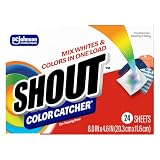
- What You'll Get: One 24 Count box of Shout Color Catchers
- Locks in Dyes: formulated to maintain original coloring of all clothes, and prevent color runs
- Time Saver: reduce the amount of time it takes to get through laundry with dye-trapping sheets, saving you from sorting each load out
- Quick & Easy To Use: works on all machine-washable whites and colored fabrics, and works in all water temperatures and in HE and standard washers
- Wash Fewer Loads: Shout saves you time and money by reducing the need for sorting and allowing mixed washes, so you avoid doing multiple loads!
Choose a response by the problem, not just the product name
| Situation | What to do | Key limitation |
|---|---|---|
| Preventing transfer in a regular wash | Follow the care label, sort by color, separate likely bleeders, and use cooler water when allowed. | Color-catcher sheets may help but are not fully reliable. |
| Fresh dye transfer onto another item | Keep it out of the dryer, check fiber and label, test discreetly, and use only a suitable stain treatment. | Bleach or color remover can damage fibers or strip original color; removal is not assured. |
| Fabric just dyed at home | Use a fixative only at the stage and on the fibers specified by its maker. | A dye fixative is not a general-purpose remedy for an already-stained garment. |
Product prices and availability are accurate as of the date/time indicated and are subject to change. Any price and availability information displayed on Amazon at the time of purchase will apply.