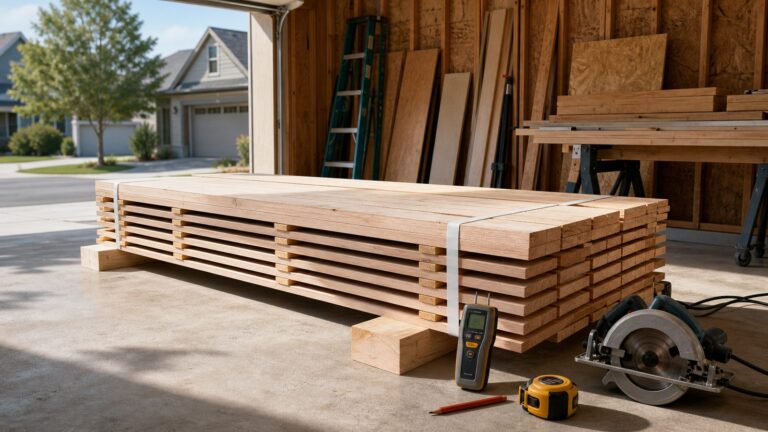
To season firewood, cut it to the length your stove or fireplace needs, split it soon after cutting, then stack it off the ground with room for air to move through. Cover the top against rain and snow, but leave the sides open. There is no reliable universal drying time by species: use a moisture meter on the freshly split interior of several pieces and aim for less than 20% moisture before burning.
What “seasoning” firewood means
Seasoning is drying freshly cut wood so it burns efficiently and more cleanly. Freshly cut wood can contain 100% or more moisture content; Cornell Cooperative Extension explains that at 100%, water accounts for half the wood’s weight. Wet wood gives up heat to evaporate that water, produces more smoke and contributes to creosote buildup in a chimney. Cornell recommends burning wood below 20% moisture. Cornell Cooperative Extension
As an Amazon Associate I earn from qualifying purchases.
This article covers firewood, not drying lumber for construction or woodworking. Lumber drying has different requirements and should not be judged by firewood moisture guidance.
How long different firewood takes to season
Use timing as a planning estimate, not proof that a stack is ready. Extension guidance ranges from six months to more than a year, depending on wood, weather and storage. Cornell says green wood takes at least six months to fall below 20%, and damp or shady conditions can make it take longer. Illinois Extension gives six to nine months as a typical minimum. West Virginia University Extension says six months to more than a year depending on weather, wood type and storage.
#1 Best Overall

- ✅【Accurate & Trusted Measures, Identify Moisture Level】With accurate & trusted performance, Mecurate moisture meter can detect moisture content from wood to building material. A reliable must-have tool for home owners, woodworkers, painters & architects to detect moisture level and spot hidden damage, which would save potential expensive repairs.
- ✅【2 Mode 8 Scale,Guaranteed Accuracy】With 0.1% resolution, the moisture meter has 2 mode : wood and building material. Wood mode has 8 calibrated scales for different wood types with full list on manual. Integrated with "Self-Testing" Aid on protective cap, users can calibrate the tool before use.
- ✅【3 Colored Indicators, Fast Spot Problem】Integrated with 3 colored indicators, together with intuitive on-screen icons for low/medium/high moisture content. Fast and accurately identify the dampness.
- ✅【Multi Function Easy Use】Integrated with temperature detection in °C/°F, one button click to know ambient temperature. Hold button to freeze the reading plus low battery icon to remind battery replacement. Comes with a jumbo smart backlit display, gives extended visibility suited to any ambient brightness. Side covered with anti-slip material, provides comfort firm grip.
- ✅【Packed for Convenience】Comes with a water resistant carry pouch. A "Wood Type Quick-Search Index Table" printed on back of the device, help adjust setup quick-and-easy.A full wood list on user manual to help quick identify correct scale.
| Guidance or observation | What it means |
|---|---|
| At least six months | Cornell Cooperative Extension’s general minimum for green firewood to fall below 20%; damp or shady storage can extend it. Source |
| Six to nine months | Illinois Extension’s typical minimum to get below 20%; it is not a guarantee for every species or site. Source |
| Six months to more than a year | West Virginia University Extension’s range, which varies with weather, wood type and storage. Source |
Why species-specific calendars can mislead
Species matters, but the label “hardwood” or “softwood” does not determine a dependable drying calendar by itself. Piece size, whether the wood was split, when it was cut, local weather and airflow all affect drying. Some hardwoods take longer, according to Cornell; measure the actual wood rather than assuming a species is ready after a set number of months.
A regional example: Interior Alaska
A University of Alaska Fairbanks Cooperative Extension publication, new in November 2025, reports drying observations from a study conducted in Interior Alaska in 2022 and 2023. The table shows days for samples to reach 20% moisture, depending on harvest timing:
Rank #2

- HUMIDITY SENSOR: Our handy meter tool can quickly determine what level of remediation is needed to keep your family safe from black mold. High levels of dampness that go untreated are the leading cause of harmful fungus growth in the home.
- WATER LEAK DETECTOR: Finding the moisture content in your wood or drywall is the first step in early prevention. Continuously check and test suspicious water stains around the house so you can determine whether the area is wet or has already dried. Low, medium and high moisture tones and on-screen icons, Reading HOLD button
- MOISTURE READER: The mold test features large 0.3" high digits in a backlit LCD for quick and easy detecting. Our mildew scanner includes extra 8mm stainless steel pins, a protective cap that doubles as a calibration checker, and a “9V” battery.
- MOLD TESTER: For an accurate test read, stick the stainless steel pins into the surface of what you're measuring. The gauge has a broad range of 5 - 50% for wood and 1.5 - 33% for building materials such as concrete and drywall.
- GENERAL TOOLS: We're a recognized leader in designing and developing specialized precision tools dedicated to delivering exceptional customer service. We encourage artisans and DIYers to work smarter, measure better, and repair more productively.
| Species | Before snowmelt | After green-up | Midsummer | After freeze-up |
|---|---|---|---|---|
| Paper birch (Betula neoalaskana) | 102 days | 67 days | 316 days | 382 days |
| White spruce (Picea glauca) | 126 days | 63 days | 298 days | 292 days |
These are study observations for two species in one region, not drying promises for other climates or stacks. The publication notes that year-to-year weather changes drying periods and that early drying conditions were especially influential. University of Alaska Fairbanks Cooperative Extension Service
How to stack wood so it dries
- Cut to your appliance’s usable length. Do this before stacking so you do not have to recut seasoned wood.
- Split the wood promptly. Split pieces dry faster than rounds because more surface is exposed to air.
- Raise the stack off the ground. Use a rack, pallets or another stable support to limit ground moisture.
- Leave gaps for airflow. Stack loosely rather than packing pieces tightly together, and avoid placing the pile directly against a building.
- Cover only the top. A roof or cover sheds rain and snow while open sides let air circulate. Wrapping the whole stack can restrict airflow.
- Choose a suitable location. Cornell suggests keeping a small distance from the home, with 30 feet adequate, because woodpiles can shelter rodents and insects. Follow local fire and storage rules.
For pest prevention, West Virginia University Extension recommends buying firewood locally; check local transport restrictions because rules vary by jurisdiction. WVU Extension
Rank #3

- FIND HIDDEN WALL MOISTURE EARLY — Check suspicious drywall and building surfaces after a leak, water stain, or other moisture concern. Detect abnormal moisture before a small issue develops into more extensive damage and costly repairs
- CHECK BEFORE YOU REPAIR — Don't rely on a wall looking or feeling dry. Use the moisture meter to check questionable areas before painting, repairing, or covering the surface, helping you make decisions based on actual moisture readings.
- CHECK FIREWOOD BEFORE YOU BURN — Test firewood before placing it in your fireplace or wood stove. Knowing the moisture level of your firewood helps you choose wood that is ready for burning and avoid relying on appearance alone.
- PIN-TYPE TESTING FOR DIRECT MEASUREMENTS — The contact pins penetrate the material to measure moisture inside wood and building materials. This makes it useful for checking areas where surface conditions may not tell the whole story.
- ONE TOOL FOR TWO IMPORTANT HOME CHECKS — Keep it ready for two practical jobs: checking walls for hidden moisture and checking firewood before burning. A simple way to make informed decisions before a moisture problem becomes expensive or wood goes into the fireplace.
How to check whether firewood is ready
Use a meter on a freshly split face
A firewood moisture meter is a practical way to check readiness. Split a few representative pieces and press the meter’s probes into the newly exposed interior, not just the weathered outer surface. University of Alaska Fairbanks Cooperative Extension advises testing wood that is freshly split and not frozen. A shallow reading on an intact piece may miss wetter wood deeper inside, so test more than one piece from the stack.
The target is below 20% moisture. The University of Alaska Fairbanks publication says, “Burning wood with a moisture content between 10% and 20% is the most efficient way to heat while limiting pollution.” The publication
Rank #4

- Easy to Read with Large LCD Screen: This wood moisture meter is easy to get an accurate reading from the surface of materials and displays accurate moisture readings on the 2.25" big screen. Use this handheld meter to check the moisture content in firewood or drywall, it can stand up on the table, the moisture content is displayed with a bar graph and percentage (_%RH) on the screen. Date Hold and Max/Min function is used to freezes readings, useful for writing down data
- Tricolor Backlight Display, Easy to Use: TopTes Moisture Meter TS-630 features an HD tri-color backlight to easily know if the wood/wall humidity is Dry, Moist, or Wet. Green backlight for Low moisture, orange backlight for middle moisture, and red moisture for high moisture. After selecting the mode, and putting pins into the firewood, easy and quick to get a visible alert from the clear screen
- Seven Calibration Scales, Two Material Mode: It is designed with built-in characteristic parameters of 7 calibration scales for wood and building material, ranging from 0.0% to 57%. This humidity meter is perfect for woodworking, water damage restoration, building construction, and home renovation. Easily Check and test suspicious water leaks around the wall/floor so you can quickly determine what level of remediation is needed
- Pin Type & Battery Operated: TopTes TS-630 moisture meter is a pin-type moisture meter and operates on batteries. With a high precision multi-material sensor, DON’T need calibration. It’ll support an accurate reading after inserting the stainless steel pins into the surface of the wood or building materials. It will auto shut off after 10 minutes of non-use to help save energy. A low-battery indicator will appear on the screen when the battery is running out
- What's in the Box: One TS-630 Moisture Meter, three AAA Batteries, one User Manual, one Carry Pouch, one Pair of Test Pins, one Mini Wrench
Do not rely on cracks or sound alone
Checks at the ends of logs and a crisp sound when pieces are knocked together can be clues, but they do not establish that the interior is dry enough. UAF cautions that end checking can appear before moisture falls to 20%; use a meter and freshly split samples for a more direct check. Cornell Cooperative Extension
Do these 3 things before closing this tab:
1Repair Windows errors before they cause bigger problems2Fix the driver behind crashes, sound loss and screen glitches3Clear out junk files and repair common Windows errorsChoosing among types of firewood
Dryness determines whether wood is ready to burn; species influences other trade-offs. Denser, heavier woods generally provide more heat per volume, but can be harder to split or slower to ignite. West Virginia University Extension contrasts oak and hickory with lighter yellow poplar: oak and hickory are heavier and have higher heating values. Consider your available storage, splitting effort, ease of starting, smoke and sparks as well as heat output.
Illinois Extension’s heat values below are figures from its Illinois firewood table, expressed in millions of BTUs per cord. They are locally scoped comparisons, not universal rankings; actual useful heat also depends on proper drying and burning conditions. Illinois Extension
| Illinois-listed wood | Million BTUs per cord |
|---|---|
| Red or black oak | 24.4 |
| White or bur oak | 26.5 |
| Shagbark hickory | 28.6 |
| Hard maple | 23.7 |
| Silver maple | 19.5 |
| Sycamore | 20.7 |
| Osage orange | 30.7 |
| Black locust | 28.1 |
| Green ash | 23 |
| Black walnut | 22.3 |
Burning wood safely in your appliance
Use dry firewood that meets your stove or fireplace manufacturer’s requirements. University of New Hampshire Extension notes that newer catalytic stoves require dry wood and that green wood may damage a catalytic combustor. Follow the operating and maintenance instructions for your specific appliance. UNH Extension
Quick Recap
Product prices and availability are accurate as of the date/time indicated and are subject to change. Any price and availability information displayed on Amazon at the time of purchase will apply.
The Tool Desk
Outbyte Driver Updater FREEFix the driver behind crashes, sound loss and screen glitchesFind Drivers →Outbyte PC Repair FREERepair Windows errors before they cause bigger problemsFix Now →