Crashes, No Sound, or Screen Glitches?
Random freezes, missing sound and display glitches usually trace back to one bad driver. Find and replace yours safely.Free scan · under a minutePC Slower Than It Used to Be?
A free scan shows the junk files, broken settings and background clutter dragging Windows down - then fixes them in one click.Free scan · Windows 10 & 11Some links on this page are affiliate links: if you buy through them we may earn a commission, at no extra cost to you.
For most repeat-flowering bush roses, prune in early spring after the worst hard-freeze risk has passed and before vigorous new growth begins. Remove dead, diseased, damaged, weak, crossing, and inward-growing wood; keep a balanced framework of strong canes; and make each cut about 5 mm (1/4 inch) above an outward-facing bud. But do not prune every rose the same way: once-blooming roses, ramblers, climbers, shrub roses, and rugosas may need a different timing or a lighter touch.
Before you make the first cut: identify the rose
“Prune roses in spring” is useful advice for many modern bush roses, but it is not a complete rule. The right method depends mainly on what kind of rose you have and whether it flowers on new or older wood.
As an Amazon Associate I earn from qualifying purchases.
What’s actually slowing this PC down?
Pick the symptom - the matching free tool is one click away.
| Rose type | General pruning approach | Usual timing |
|---|---|---|
| Hybrid tea and grandiflora | Remove weak and damaged wood, open the center, retain several strong canes, and shorten the framework substantially. | Early spring, before strong new growth. |
| Floribunda | Prune similarly to a hybrid tea, but usually leave a somewhat broader, larger framework. | Early spring. |
| Modern shrub rose | Use gradual renewal pruning rather than automatically cutting the plant down hard. Remove roughly one-third of the oldest canes when appropriate. | Early spring. |
| Repeat-flowering climber | Preserve the main structural canes and shorten side shoots. Train main canes horizontally or diagonally where possible. | Usually during the dormant or early-growth period. |
| Once-blooming rambler or old garden rose | Preserve young replacement canes and prune out old flowered wood after the plant finishes blooming. | After flowering, not routinely in early spring. |
| Miniature or patio rose | Thin and shape proportionately; remove dead, diseased, weak, and crossing growth without applying hybrid-tea dimensions automatically. | Early spring in climates where spring pruning is appropriate. |
If the label is missing, look at the plant’s habit. A compact, multi-stemmed bush can usually receive cautious spring thinning and shortening. A long, arching plant growing against a support may be a climber or rambler, so prune conservatively until you know whether it blooms on new or old wood. In the UK, February and March are commonly used as a starting point for an unknown rose; gardeners elsewhere should translate that guidance to their own dormant-season and frost conditions.
When to prune roses
For many modern repeat-flowering roses, the main structural pruning session is in early spring. The best date varies with climate rather than the calendar alone:
Popular on Amazon

- CLEAN CUTS FOR LIVE GROWTH: Bypass blade design is ideal for pruning delicate flower stems and green growth, helping reduce crushing and plant damage while cutting stems and small branches up to 5/8” in diameter
- BLADES STAY SHARP: Precision-ground steel blades are engineered to stay sharp through heavy use, & all-steel construction provides lasting durability, delivering consistent cutting performance for regular garden maintenance & detailed pruning tasks
- SMART BLADE FEATURES: Blade coating helps reduce friction for smoother cuts, minimizes sap buildup & gumming, and enhances resistance to rust for longer-lasting performance in outdoor conditions; sap groove keeps the blades from sticking during use
- COMFORTABLE, CONTROLLED GRIP: Ergonomic, non‑slip handle enhances control and reduces hand fatigue during repetitive cuts; easy‑open safety lock secures the blade for safe transport and compact storage
- INCLUDES: (1) Fiskars Bypass Pruning Shears designed for everyday gardening and plant care and backed by a Lifetime Warranty. Product care tips: Wipe pruners clean after each use to prevent sap build-up and lightly oil blade for longer product life
- Prune after the normal risk of a hard freeze has passed, if possible.
- Prune before strong new growth gets fully underway.
- In some regions, blooming forsythia is used as a seasonal signal.
- In Oregon’s Willamette Valley, a typical window is mid-February to early March; colder parts of Central Oregon are pruned later.
- Missouri guidance describes pruning as buds begin to swell.
These are regional examples, not universal dates. Pruning too early can expose tender new growth to frost damage. Heavy pruning too late can remove developing flower buds and delay or reduce flowering for that season. If a hard freeze is forecast immediately after your planned work, waiting is usually the safer choice.
Tools and protective equipment
Use tools that match the cane thickness:
- Sharp bypass pruning shears for small and medium canes. Their scissor-like action makes a cleaner cut than a tool that crushes the stem.
- Loppers for larger canes that are beyond comfortable hand-pruner capacity.
- A pruning saw for substantial, old, or awkwardly positioned wood.
- Thorn-resistant gardening gloves and long sleeves, especially when working on mature bushes or climbers.
Clean tools before pruning and between visibly diseased plants. If you use a commercial cleaning or disinfecting product, follow its label for the correct chemistry, concentration, and contact time rather than guessing. Sanitation helps avoid spreading problems between plants, but pruning and clean tools do not guarantee that a rose will remain disease-free.
The Tool Desk
Outbyte PC Repair FREERepair Windows errors before they cause bigger problemsFix Now →Outbyte Driver Updater FREEScan for outdated or missing drivers - takes under a minuteDriver Scan →For the clean angled cuts described below, choose bypass pruning shears rather than dull or crushing-style cutters. Gloves are not a substitute for careful handling: keep your free hand away from the cane being cut and watch for hidden thorns.
How to prune an established modern bush rose
1. Remove dead wood first
Start with canes that are clearly dead, dry, shriveled, blackened, or badly damaged. Follow each cane down until you reach healthy live tissue. A healthy rose cane generally has pale or white pith when cut; dead tissue may be brown or dark.
Cut a dead cane back to healthy wood. If the entire cane is dead or seriously diseased, remove it at its base rather than leaving a long stub. Take the removed material out of the bed.
2. Cut out diseased and damaged growth
Remove diseased sections and canes broken by weather, animals, or previous work. Make the cut below the affected area in healthy tissue. Do not leave infected leaves and prunings under the plant, where they can contribute to continuing disease pressure.
Recommended Free Tools
3. Eliminate weak, crossing, and inward-growing canes
Next, thin the plant. Remove:
- Very thin, spindly, or poorly developed shoots;
- Canes that rub against one another;
- Growth crossing through the center of the plant;
- Stems growing inward toward the middle;
- Badly placed shoots that make the framework crowded or unbalanced.
The goal is an open center with major stems spaced around the plant. Better light and air movement can reduce the conditions that favor some diseases, but an open shape is not a complete disease-control program.
Also popular on Amazon

- DUAL CUTTING POWER: VERSATILE PRUNING COMBO --- With both Pruning Shears and Pruning Snip, this combo delivers unmatched versatility. Whether you're delicately trimming flowers and shrubs, tackling thicker tree branches, or tending to your vegetable and fruit garden, our combo pack excels in all areas. They're also perfect for landscaping projects and maintaining the health and appearance of indoor plants. With this pack, you have a versatile tool that simplifies your gardening tasks.
- ULTRA SHARP --- Much less effort to cut branches with our combo pack. Our pruning shears are crafted from premium Stainless Steel, and the pruning snip features a stainless steel blade with a titanium coating. Our garden scissors and garden clippers boast exceptional durability and sharpness. A perfect pruning shears for gardening and a must-have garden tool, hedge clippers pruners for gardening.
- RUST PROOF STAINLESS STEEL GARDENING SHEARS --- Our branch cutter tree pruner combo is built to last.
- SENIORS AND ARTHRITIS FRIENDLY --- Our pruners for gardening have comfortable handles that are easy to grip. With a non-slip texture for enhanced control, you can confidently prune in wet conditions. You can work longer without any hand fatigue.
- SAFETY LOCK PREVENTS ACCIDENTS --- Both of our pruning shears and pruning snips come with a built-in safety lock that securely holds the blades closed when not in use, preventing any accidental openings that could lead to injuries. This feature is designed for easy, one-handed activation, offering convenience and peace of mind whether you're storing the combo or carrying them in your pocket or toolkit. Trust in the safety and simplicity of our combo pack for all your gardening needs.
4. Select the permanent framework
For a vigorous modern ever-blooming bush rose, retain approximately three to five strong, healthy canes, provided the plant has enough vigor to support that framework. Remove extra weak or poorly placed growth.
Some extension guidance shortens vigorous bushes to approximately 18 to 24 inches. That measurement is a useful example for certain modern bush roses, not a universal target. The final height should reflect the cultivar, the amount of winter damage, the plant’s age and vigor, and local growing conditions. Hybrid teas commonly tolerate the hardest pruning. Floribundas are often left somewhat larger because they naturally form broader plants and flower in clusters.
5. Shorten the remaining canes
Reduce the selected canes to several strong buds—often about three to five outward-facing buds on a vigorous modern bush rose. Do not force every plant into the same number of buds or the same height. A weak, newly planted, or recently stressed rose should generally retain more framework and foliage than a vigorous established plant.
6. Make each cut correctly
Position the cut approximately 5 mm (1/4 inch) above a healthy bud, preferably one facing outward. Make a clean, slightly sloping cut downward and away from the bud.
This positioning does three things:
- It leaves little unnecessary stub to die back.
- It encourages new growth away from the center of the plant.
- It helps prevent water from collecting directly on the bud or cut surface.
Avoid cutting so close that you damage the bud, but do not leave a long stub above it. Keep the shears sharp and let them cut rather than crush the cane.
7. Remove rootstock suckers at their origin
On grafted roses, vigorous shoots may emerge from below the graft union or from the rootstock. These suckers can look different from the desired rose and may grow rapidly.
Trace the sucker to where it originates. Remove it at that point—often at the root or rootstock—not merely at soil level. Cutting it off at the surface can encourage it to return. Avoid damaging the graft union or main roots while exposing the sucker’s origin.
Also popular on Amazon
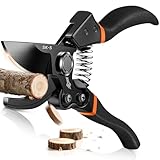
- LONG-LASTING SHARPNESS: Japanese SK5 bypass blade with titanium coating is tested through 5,000 cuts to maintain a sharp edge and deliver clean, consistent cuts on live stems and branches
- BUILT FOR 5X DURABILITY: Heavy-duty 3-layer titanium-coated SK5 blade resists wear and corrosion, while anodized aluminum handles and high-hardness screws reinforce the pruner. Repeated cutting tests show up to 5X the durability of standard pruners
- POWERFUL 4X LEVER CUTTING: The optimized lever-action design multiplies cutting force up to 4X, making thicker branches easier to prune with less hand effort. Cuts branches up to 3/4" with smooth, controlled power for everyday garden pruning
- ARTHRITIS & SENIORS FRIENDLY: Ergonomic non-slip rubber handles cushion pressure and provide a secure, comfortable grip, helping reduce hand and wrist fatigue. A comfortable hand pruner for seniors, arthritis and longer pruning sessions
- ONE-HAND SAFETY LOCK: The easy-access safety lock opens and closes with one hand for faster trimming, then securely holds the blades closed for safer carrying and storage
8. Clear away the debris
Collect removed canes, fallen diseased leaves, and other pruning debris from around the plant. Dispose of diseased material according to local guidance rather than leaving it in the rose bed. Clean your tools before moving to another plant if disease is suspected.
How the method changes for different roses
Hybrid tea, grandiflora, and floribunda roses
These are generally repeat-flowering modern roses that bloom well on current-season growth and tolerate more substantial early-spring pruning. Remove dead, diseased, damaged, weak, crossing, and inward-growing canes. Preserve several vigorous canes and shorten them to outward-facing buds.
Hybrid teas are often pruned most severely to maintain a relatively narrow, upright framework. Floribundas naturally make broader plants and carry clusters of flowers, so leaving them somewhat larger usually suits their habit better.
Modern shrub roses
Do not automatically cut a modern shrub rose back as if it were a hybrid tea. Many respond better to gradual renewal pruning. Remove approximately one-third of the oldest canes when the plant is established and congested, while retaining enough mature wood to support flowering.
A young shrub rose may need little more than the removal of damaged, dead, or badly placed growth. Excessive pruning can reduce its natural shape and remove more flowering wood than necessary.
Repeat-flowering climbing roses
A climber is not a tall bush. Keep the main structural canes that form the plant’s framework, removing only those that are dead, badly damaged, weak, or unproductive. Prune side shoots, or laterals, back to a few buds as appropriate.
Where the support allows it, train the main canes horizontally or diagonally instead of leaving every cane straight upright. This positioning can encourage more flowering side shoots along the length of the climber. Tie canes loosely enough to allow growth and inspect older ties so they do not constrict stems.
Also popular on Amazon

- SECURE & EASY TO LOCK: Our garden shears have a safety locking mechanism to keep the sharp blades securely closed when not in use, and can effectively reduce accidental injuries. It's a perfect design.
- WIDELY USED: Our pruning shears set include 3 different blades for a variety of general pruning work. Perfect for trimming flowers, plants, bonsai, hydroponics, herbs, light branches and so on. It's also a perfect gift for freind.
- ERGONOMICALLY DESIGNED RUBBER GRIP: Our pruning shears are made of high-purity PP+TPR plastic, has strong toughness and strength. The handle part is ergonomic in design and non-slip.
- ATTENTION: The blades of gardening scissors are very sharp, should be placed where children can not reach.
- TRUSTWORTHY MERCHANT: We stand behind the quality of everything we sell, if you are not satisfied with the product, please feel free to contact us.
For larger old canes, hand pruners may not be enough. Garden loppers or a pruning saw are better suited to substantial wood, provided you can make the cut safely without twisting or splitting the cane.
Do these 3 things before closing this tab:
1Fix the driver behind crashes, sound loss and screen glitches2Clear out junk files and repair common Windows errors3Scan for outdated or missing drivers - takes under a minuteOnce-blooming ramblers and old garden roses
Many once-blooming ramblers and old garden roses flower on older wood. An aggressive early-spring cut can remove the stems that would have produced this year’s flowers.
Instead, wait until flowering has finished. Then remove old flowered canes and excessive woody growth while preserving healthy young replacement canes. If you are uncertain whether the plant is a once-bloomer, observe when it flowers before committing to severe pruning.
Miniature and patio roses
Miniature and patio roses still benefit from the removal of dead, diseased, weak, and crossing growth. Their compact habit calls for proportionate thinning and shaping, not an automatic reduction to the same height used for a large hybrid tea.
Deadheading is not the same as annual pruning
Annual structural pruning establishes the plant’s framework, removes problem wood, and is usually concentrated in the dormant or early-growth season. Deadheading is lighter, in-season pruning that removes spent flowers.
For a repeat-flowering rose, cut a faded flower stem back to a strong outward-facing bud, often above a leaf with five or seven leaflets. This encourages another flowering cycle while maintaining a useful leaf area. On a weak or newly planted rose, leave more foliage rather than cutting back aggressively after every flower.
Do not deadhead automatically when you want rose hips. Rugosas and other roses valued for their hips can be left to develop fruit. Once-blooming roses also should not be treated like repeat bloomers simply because their flowers have faded.
Common rose-pruning mistakes
- Using a calendar date without considering weather: Local frost timing and the plant’s growth stage matter more than a universal date.
- Pruning every rose severely: Climbers, ramblers, shrub roses, and once-blooming old garden roses may flower on different wood.
- Cutting far above the bud: Long stubs can die back and leave an untidy, vulnerable end.
- Choosing an inward-facing bud by default: An outward-facing bud generally helps maintain an open center.
- Leaving dead stubs: Trace the cane farther down and cut back to healthy tissue or remove the entire cane at its origin.
- Cutting suckers at soil level: Trace them to the rootstock and remove them at the point of origin.
- Using dull or crushing tools: These can split or damage canes instead of producing a clean wound.
- Pruning heavily too late: You may remove developing flower buds and reduce current-season bloom.
- Leaving diseased debris in the bed: Collect prunings and fallen infected material after the work.
- Assuming pruning alone prevents disease: Airflow and sanitation may reduce disease pressure, but roses can still develop disease because of weather, cultivar susceptibility, and other growing conditions.
Aftercare following pruning
After pruning, keep the rose in conditions that support recovery and new growth:
Also popular on Amazon

- What Makes VT-C800 Unique? Ever-Sharp Teflon-Coated SK5 Blades | Jam-Proof Sealed Spring | Ambidextrous Thumb Lock | Backed by Lifetime Support
- 【UPGRADED SK5 BLADE FOR 3X LASTING SHARPNESS】Built with an ultra-sharp SK5 steel blade and Teflon non-stick coating, the C800 is designed for cleaner cuts, smoother slicing, and less sticking during repeated garden scissors. The hard SK5 blade helps maintain a sharp cutting edge, while the low-friction coating helps reduce sap and resin buildup on roses, stems, shrubs, vines, and small branches
- 【SEALED JAM-PROOF SPRING, NO MID-CUT JAMS】Say goodbye to exposed springs that catch leaves, dirt, and garden debris. Unlike ordinary plant shears and garden shears, the C800 uses a sealed Jam-Proof Spring system that helps block moisture and debris, resist rust and wear, and keep the blade snapping back smoothly. Less cleaning, more reliable blade return — for backyard gardens, flower beds, shrubs, and damp outdoor conditions
- 【EASY THUMB-ACTIVATED SAFETY LOCK】These garden clippers feature a simple one-handed thumb glide lock that works smoothly for both left- and right-handed gardeners, even when wearing thick gardening gloves. It delivers quick, secure locking during storage or transport, helping prevent accidental openings and making the gardening shears safer and easier to carry between pruning tasks
- 【ERGONOMIC DESIGN FOR WEAK HANDS】Designed for comfort during longer backyard pruning sessions, the C800 features curved non-slip grips that help improve control and reduce hand fatigue. Smooth blade return and a comfortable handle shape make pruning easier for seniors, regular growers, and women gardeners
- Maintain adequate sunlight and avoid creating unnecessary shade around the plant.
- Water appropriately for the soil, weather, and plant’s stage of growth; avoid routinely keeping the soil saturated.
- Feed in spring only when appropriate for the rose, soil, and local growing conditions. If you use a commercial product, follow its label for rate and timing.
- Apply suitable compost or mulch according to local practice, keeping organic material away from direct contact with the base of the canes.
- Continue checking for disease, pests, and new suckers rather than assuming the annual pruning solved every maintenance problem.
Optional rose fertilizer or compost mulch can be useful after pruning when it suits the plant and soil, but neither is automatically required for every rose. Product labels and local horticultural guidance should determine the amount and application method.
Quick wins for a faster PC:
Fix the driver behind crashes, sound loss and screen glitchesFind Drivers →Clear out junk files and repair common Windows errorsFree Scan →Scan for outdated or missing drivers - takes under a minuteDriver Scan →A quick decision checklist
- Is it a modern repeat-flowering bush rose? Prune in early spring after severe-freeze risk, remove problem wood, open the center, retain strong canes, and shorten moderately or substantially according to vigor and type.
- Is it a modern shrub rose? Prefer gradual renewal over a hard haircut.
- Is it a climber? Preserve the main canes and prune the laterals; do not reduce it like a bush.
- Is it a once-blooming rambler or old garden rose? Wait until after flowering.
- Are you unsure? Remove only dead, diseased, damaged, and clearly misplaced growth until you can identify the flowering habit.
- Are the tools clean and sharp? If not, stop and prepare them before cutting.
- Is a hard freeze imminent? Delay pruning tender new growth where practical.
Frequently Asked Questions
Can I prune roses in autumn?
Light removal of dead, damaged, or diseased growth may be appropriate, but avoid heavy structural pruning late in the season unless local guidance specifically recommends it. For many repeat-flowering bush roses, the principal pruning is done in early spring. Once-blooming roses and ramblers are generally pruned after flowering.
How many canes should a rose bush have?
A vigorous modern bush rose is often maintained with roughly three to five strong canes, but this is not a universal number. The cultivar, age, winter damage, and plant vigor should determine how much framework remains.
What happens if I cut a rose too hard?
A vigorous modern bush rose may recover, but severe pruning can reduce the plant’s flowering wood, delay growth, weaken a stressed or young plant, or spoil the natural form of a shrub or climber. Once-blooming roses can lose an entire season’s flowers if older flowering wood is removed at the wrong time.
Should every rose be cut back to 18 inches?
No. Approximately 18 to 24 inches is a guideline sometimes used for vigorous modern bush roses, not a universal height. Shrub roses, floribundas, miniatures, climbers, ramblers, and once-blooming roses may need different treatment.
How do I know whether a rose cane is dead?
Dead cane tissue is often brown, black, dry, or shriveled. Cut back until the interior pith is pale or white and the tissue appears healthy. If the entire cane is dead, remove it at the base.
The Bottom Line
The right way to prune a rose is to match the cut to the rose’s flowering habit. Prune most modern repeat-flowering bush roses in early spring, remove problem wood first, keep the center open, preserve a balanced set of strong canes, and cut just above outward-facing buds. Treat climbers, ramblers, shrub roses, and once-blooming roses more conservatively, and prune once-bloomers after flowering when they have finished producing flowers.
Quick Recap
Product prices and availability are accurate as of the date/time indicated and are subject to change. Any price and availability information displayed on Amazon at the time of purchase will apply.

