Free tools Windows power users keep installed
One-click scans. No signup required.
A successful community-garden plan is a site map, a soil decision, a crop list, a season record, and a rotation plan that fit your actual plot. Start by confirming sunlight, water, dimensions, rules, and access. Then draw reachable beds and paths, test the soil before adding amendments, choose crops that match the available space, record planting and harvest windows, and track plant families for future rotation. Because no location, frost dates, plot dimensions, or crop preferences are specified here, this framework deliberately stops short of prescribing varieties or calendar dates.
Begin with the conditions you cannot change
Before buying seed or moving soil, make a one-page site brief. Walk the plot at different times of day if possible and record what the garden organization and the site actually allow.
As an Amazon Associate I earn from qualifying purchases.
- Dimensions and boundaries: Measure the usable length and width, note posts, fences, trees, drains, and any permanent fixtures, and confirm which edges belong to your allotment.
- Sun exposure: Mark areas that receive direct light and those shaded by buildings, fences, or neighboring crops. The amount and timing of light will determine where sun-demanding and shade-tolerant crops can go.
- Water access: Identify the nearest tap, hose route, watering restrictions, and whether a full bed can be reached without dragging a hose through another plot.
- Rules: Ask the garden coordinator about approved structures, bed edging, compost and manure, trellises, path materials, tool storage, pest controls, and required clearances.
- Access needs: Decide how far you can comfortably reach, whether a path must accommodate a wheelchair or other mobility aid, and where tools or containers can be placed without blocking circulation.
- Personal priorities: List the foods you will actually eat, how much time you can maintain the plot, and whether continuous small harvests or a few larger harvests suit your household.
These notes prevent a common planning error: choosing a crop list first and discovering later that the plot cannot supply the light, water, support, or access those plants require.
Draw beds and paths before preparing soil
Put the plan on paper or in a simple grid using measured dimensions. Draw paths first, then fit growing areas into the remaining space. Permanent beds and clearly marked walking routes reduce accidental compaction because you do not need to step onto growing soil to weed or harvest.
#1 Best Overall

- Large capacity: Provide enough growth space for deep-rooted plants like potatoes, tomatoes, broccoli, etc. Tall enough to keep pets away from the garden planter and give you easy access!
- Stable and Solid Construction: Double card frames on the two sides of the sheet make the raised garden kits more durable and stable, and 4 reinforcing rods make the whole raised garden bed more stable. Never worry about its distortion or collapse and it presents a much more beautiful design.
- Open bottom: Sits on the ground garden bed, provide good drainage, keep weeds away from soil, defense against pests, and protect your plants. An open base design supports soil drainage, It is more conducive to the healthy growth of plants and balances soil moisture. Planter raised beds will be the best choice for your garden planting.
- Environment-Friendly: Built with an open bottom so it keeps the plants away from root rotting and water built up.
- Easy to assemble: We come with nuts, bolts, washers and instructions so that you can easily assemble without any experience.
Set a reachable bed width
For a raised ground bed, University of Minnesota Extension guidance sets a maximum width of 2.5 feet when the bed can be reached from one side and up to 5 feet when it can be reached from both sides. Treat those as upper limits, not targets: a shorter reach, a back injury, or a mobility aid calls for a narrower bed. Containerized beds should be sized by the same reach test; you should be able to reach the center without leaning on the soil.
Leave enough path width for the way you will carry compost, turn a wheelbarrow, pull a hose, and pass another gardener. The exact width is a local design decision because community-garden rules and accessibility needs differ.
Choose between a raised ground bed and a containerized bed
| Consideration | Raised ground bed | Containerized bed with sides |
|---|---|---|
| Soil and compaction | Mounded soil remains open to the ground, with paths between permanent beds helping protect it from foot traffic. | Useful where existing topsoil is limited or compacted because new soil is held above the original surface. |
| Reach and accessibility | Width is controlled by one-sided or two-sided access; the Extension limits above apply to raised ground beds. | Set width by arm reach and choose a height that makes sowing and harvesting comfortable. |
| Construction | Needs shaped soil and defined paths rather than an enclosing frame. | Needs approved boards or another permitted edging material; boards six feet or shorter are less likely to warp or break than longer boards, according to the Extension guidance. |
| Watering | Usually holds moisture more like surrounding ground. | Can dry faster, so check the garden’s water access and your ability to water consistently before building. |
Do not build first and ask permission later. Some gardens prohibit permanent structures, restrict lumber or treated materials, or require a specified path surface.
Rank #2
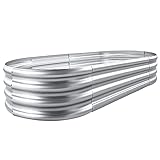
- Each raised metal garden bed size: 4×2×1ft ,7.14Cu
- Upgraded quality and structure: raised garden beds outdoor are made of Q195 galvanized metal sheet, double-layer anti-corrosion galvanizing and oval structure design, which is more beautiful, can withstand greater pressure at the interface, is not easy to loose, and the interface will not Deformed and can be reused for many years.
- Easy to set up, this galvanized stock tank only takes about 5 minutes to easily assemble and continue planting plants.
- Open base: This planter raised garden bed metal galvanized is designed with an open base, which can effectively avoid water accumulation and decay, protect the roots of plants, and allow the roots to better absorb nutrients
- Double thickness: The average thickness of this galvanized planter galvanized sheet reaches 0.78mm, and the thickest part can reach 1.56mm, which is extremely stable. Compared with the ordinary rectangular elevated garden bed with a thickness of 0.3mm, it will be the right choice for you. buy it! ! !
Test soil before adding compost or fertilizer
A soil test can report texture, pH, nutrient levels, and organic matter, then provide fertilizer recommendations. Take the sample according to the laboratory’s instructions and use the result—not habit—to decide whether an amendment is needed. A local laboratory may be the appropriate service for your region; a consumer soil-test kit can be a screening option, but it is not automatically equivalent to a laboratory analysis.
Use amendments selectively
For established raised beds, University of Minnesota Extension recommends testing every two to three years. If you are filling a new containerized bed, its general raised-bed mix is roughly one-half to two-thirds topsoil and one-third to one-half plant-based compost. That ratio is a starting framework, not a substitute for a local test or garden rules. Too much compost can create water-retention problems and can push nutrients out of balance.
Treat manure or composted manure as a targeted amendment, not a default ingredient. The raised-bed guidance advises using it sparingly and only when testing indicates a phosphorus need. Follow any site rules about manure sources and handling.
Rank #3

- Large space: 96'(L) x 48 "(W) x 24" (H) metal raised garden bed will provide enough space to grow various vegetables, fruits, flowers.
- Durable material: Outdoor planter box is made of stable thickened galvanized metal, corner and frame are reinforced, strong resistance to high temperature and corrosion, can be uesd for a long time.
- Safety and environmental protection: All parts raised garden beds outdoor of are made of environmentally friendly materials, environmentally friendly coating will not pollute the soil, and it is safer for people and plants.
- Open bottom: Sits on the ground raised beds, provides good drainage, allow the roots get the nutrients to keep moist, make the plants grow better.
- Easy assembly: Without complex professional experience, only need about 15 minutes and you can get your raised bed.
Choose crops by use, space, and support
Start with a “would eat” list rather than a catalog. Rank crops as essential, desirable, or experimental, then check each one against the plot brief.
Recommended Free Tools
- Space: Note the mature spread, root depth, and whether a crop can share a bed without crowding.
- Support: Identify crops that need a trellis, stake, cage, or other structure, and place those structures where they will not violate rules or block paths.
- Height: Keep tall or trellised plants from shading shorter crops where practical. Put the tallest elements where their shadow will interfere least with the rest of the bed, while recognizing that the best orientation depends on the site’s sun path.
- Harvest pattern: Distinguish crops you harvest once from those that provide repeated picking. This helps distribute work and food through the season.
- Family: Record each crop’s plant family now so next year’s rotation is possible.
| Planning group | Questions to answer before assigning a bed | Layout implication |
|---|---|---|
| Low, quick crops | Can you sow more than once, and can you reach the row without disturbing neighboring plants? | Reserve accessible space for successive sowings and easy harvesting. |
| Large or long-season crops | How much horizontal and root space will the mature plant need? | Give each plant its full area instead of filling gaps with too many starts. |
| Trellised crops | Is a support permitted, stable, and reachable for tying and harvesting? | Place the support along an edge or path so it does not consume the center of a narrow bed. |
| Shade-sensitive crops | Will a neighboring tall crop block their available light? | Separate heights deliberately rather than letting the tallest plants determine the entire bed. |
The examples of quick crops suitable for succession planning include lettuce, spinach, peas, beets, and radishes. Their exact sowing dates depend on your local season and frost dates, so write dates only after checking those local conditions.
Turn the crop list into a season record
A crop plan should be a working document, not a one-time sketch. For every planting, record the crop, variety, bed or row, planting date, and expected harvest date or window. Add notes about germination, weather, pest pressure, and what you would change next time.
Rank #4
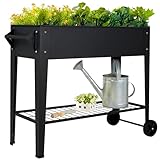
- MOBILE GARDEN ON WHEELS — Two all-terrain wheels and an ergonomic handle let you roll a 200+ lb planted bed wherever sunlight goes. Move your garden across patio, balcony, or backyard in minutes.
- DRAINAGE FOR CONTAINER GROWING — Built-in drainage openings and bottom channels help excess water leave the planting area.
- 32" STANDING HEIGHT — Garden without kneeling or back strain. Five drainage holes and dual cross-channels prevent waterlogging, keeping roots healthy during heavy rain.
- GROW VEGETABLES AND HERBS — Ideal raised bed for tomatoes, herbs, flowers, and greens on patios, balconies, decks, and backyards. Detachable bottom shelf stores tools and supplies.
- ASSEMBLY AND OUTDOOR CARE — Hardware and assembly instructions are included. Protect scratches in the surface coating promptly and follow the care instructions to reduce corrosion during outdoor use.
| Record | What to enter | Why it matters |
|---|---|---|
| Crop and variety | The exact plant and seed or transplant variety | Lets you compare performance without confusing different varieties. |
| Location | Bed number, row, or container | Creates the map needed for maintenance and rotation. |
| Planting date | Date seed was sown or transplant was set out | Shows how timing affected establishment. |
| Expected harvest | A date or window based on the variety and local conditions | Helps schedule succession plantings and avoid gaps. |
| Actual result | First harvest, final harvest, failures, and observations | Improves next year’s choices using your own site evidence. |
Use succession planting to extend harvest
Instead of filling a bed once, reserve part of it for a later sowing of a quick-growing crop. When one planting is harvested or clearly finished, the next entry in your plan can occupy that space. Leave the interval and date blank until you know your local growing window; a generic calendar can put seed in the ground too early or too late.
Independent reader supportYour contribution helps us test, update, and keep practical guides available for everyone.Plan rotation by plant family
At the end of the season, copy each bed’s crop families onto next year’s map. Rotating related crops reduces the chance of repeatedly exposing the same soil area to the same pests and diseases. The University of Minnesota example is tomatoes: wait three years before planting another nightshade in that spot. Nightshades include tomatoes and other related crops, so record the family rather than relying on memory of a single crop name.
Do these 3 things before closing this tab:
1Fix the driver behind crashes, sound loss and screen glitches2Clear out junk files and repair common Windows errors3Scan for outdated or missing drivers - takes under a minuteA small plot may not allow a complete multi-year rotation. In that case, spread different families among available beds, avoid repeating the same susceptible crop in the identical position whenever possible, and keep especially careful records. Diversification is more realistic than pretending a tiny plot can provide a perfect rotation.
Best Value

- 【 Durable and Long-lasting 】The BIRDSINYARD raised garden bed, available in a convenient two-pack, is constructed from thick galvanized steel. It features a rust-resistant and corrosion-resistant coating, ensuring it can withstand humid weather and tough conditions without warping or rusting, even with long-term use.
- 【 Open Bottom Design 】The garden boxes outdoor raised garden box adopts an open bottom design, which can promote good drainage, prevent water accumulation and root rot. The raised beds for gardening allow the root system of plants to fully absorb nutrients from the soil, making them healthier and stronger.
- 【 Variety of Sizes and Colors 】 We offer raised garden beds in various sizes, including 4 x 2 x 1 feet, 4 x 2 x 1.4 feet, 6 x 2 x 1 feet, 6 x 2 x 1.4 feet, 8 x 2 x 1 feet, and 8 x 2 x 1.4 feet to suit your different needs. These planting beds provide ample space for a variety of vegetables, fruits, and flowers, allowing you to beautifully decorate your garden and enjoy the joys of planting and harvesting.
- 【 Safety Edging Design 】Outdoor raised garden beds are designed with safety in mind, featuring black rubber sealing edges on the top. This design not only reinforces the garden bed but also effectively prevents injuries to your family.
- 【 Easy Assembly 】Our metal raised garden bed is simple and easy to install. According to the detailed instructions and installation tools we provide, you can easily assemble your garden box and start planting with just a few simple steps and little time.
Follow an installation sequence
- Confirm the brief: Verify measurements, boundaries, sun, water, access requirements, approved materials, and all garden rules with the organization.
- Mark the footprint: Use temporary stakes or string to test the proposed beds and paths before digging or building.
- Check reach: Stand on each planned path and make sure the center of every bed is accessible. Reduce width where it is not.
- Protect circulation: Define paths so hoses, tools, and people can move without stepping on planted soil.
- Sample the soil: Send a representative sample for testing and wait for the results before choosing lime, fertilizer, compost, or manure.
- Assign crops: Place preferred crops first, then fit secondary and experimental crops around their mature size, support, height, and harvest pattern.
- Write the season plan: Enter each crop, variety, location, planting date, and expected harvest window; mark where a succession planting could follow.
- Save the map: At season’s end, annotate what grew in every bed and transfer plant families to next year’s plan.
Fix common planning problems before they cost a season
The bed is too wide to reach
Do not solve this by walking on the soil. Add a path, split the bed, or reduce its width to your actual reach. The Extension maximums are safety boundaries, not a reason to stretch.
Watering is difficult
Move thirsty crops closer to the approved water route, shorten hose runs, or reduce the area planted until regular watering is realistic. A larger plan that cannot be maintained is less productive than a smaller plan matched to the site’s access.
The soil test does not support your planned amendment
Follow the test recommendation and the garden’s rules. Do not add manure or repeated compost applications simply because a bed looks empty; excess organic matter can hold too much water and unneeded phosphorus can accumulate.
The Tool Desk
Outbyte PC Repair FREEClear out junk files and repair common Windows errorsFree Scan →Outbyte Driver Updater FREEScan for outdated or missing drivers - takes under a minuteDriver Scan →The plot is crowded by midsummer
Use mature dimensions rather than seedling size when redrawing the map. Remove low-priority crops, provide permitted supports, or reserve a separate succession area instead of compressing every plant into one bed.
A rotation seems impossible
Make a family map for the beds you have, move related crops to the best available alternative, and diversify families when a full interval cannot be achieved. Keep the limitation visible in next year’s notes so it informs crop selection.
Keep the plan useful beyond the first season
Store the measured map, soil reports, crop table, and end-of-season notes together. Update the drawing when a path, water point, or rule changes. The most valuable plan is not the prettiest diagram; it is the record that connects a real bed to a reachable layout, a tested soil decision, a realistic harvest schedule, and a deliberate plant-family rotation.
Quick Recap
Product prices and availability are accurate as of the date/time indicated and are subject to change. Any price and availability information displayed on Amazon at the time of purchase will apply.

