The Tool Desk
Outbyte PC Repair FREEClear out junk files and repair common Windows errorsFree Scan →Outbyte Driver Updater FREEFix the driver behind crashes, sound loss and screen glitchesFind Drivers →You can demonstrate how an incandescent light bulb works with a low-voltage battery circuit and a thin filament, but the result is a short-lived science experiment—not a durable lamp or household lighting. Never connect a homemade bulb to a wall socket or household wiring.
What a homemade light-bulb demonstration shows
An incandescent bulb produces light when an electric current heats a thin filament until it glows. In a simple educational demonstration, the filament may be thin wire or pencil lead connected in a battery circuit. The filament can become hot and burn out, so brightness and operating time are not predictable.
In an account of trying different metal wires, the Smithsonian Science Education Center author recalled that some wires glowed brightly but burned out quickly, while others gave a dimmer light for longer. Those are observations from that activity, not guaranteed results for every material or build. The exercise illustrates how filament material affects incandescent lighting. Smithsonian Science Education Center
Battery-powered pencil-lead activity
IEEE REACH describes an activity using pencil lead as the filament. Its listed materials and battery arrangement apply to that specific activity; do not treat them as a general voltage recommendation or combine them with a different bulb design.
Do these 3 things before closing this tab:
1Fix the driver behind crashes, sound loss and screen glitches2Repair Windows errors before they cause bigger problems3Scan for outdated or missing drivers - takes under a minute#1 Best Overall

- Fun and safe: when conducting these experiments, stimulate children's curiosity and Intelligence IQ.
- Note:that the positive and negative poles should not be directly connected, which may cause a short circuit.
- Application: used in electrical experiments in primary and middle schools/home DIY circuit test.
- Kind note: you need 2pcs AA batteries to do experiments this kit.
- Package includes:10pcs 2.5v bulbs,1pcs battery case,1pcs switch button,2pcs wires,2pcs Lamp holder.
Materials listed by IEEE REACH
- Safety glasses and safety gloves
- A glass jar
- A cardboard paper-towel or toilet-paper tube
- Two long wires with alligator clips, or four short wires clipped together
- Eight D batteries
- 0.5 mm pencil lead
- Electrical tape and scissors
IEEE REACH specifies that its D batteries are 1.5 volts each and that eight connected in series provide 12 volts. Its activity directs users to tape the batteries in a line with adjacent positive and negative ends touching. The available activity description does not include all construction steps, so follow the complete instructions on the IEEE REACH activity page rather than improvising missing connections or assembly details. IEEE REACH advises: “When engaging in the IEEE REACH hands-on activities contemplated in the IEEE REACH lesson plans please proceed with caution and use all reasonable safety measures.”
Safety precautions and limits
- Use only a supervised educational battery activity. Never use a wall socket, household current, or household wiring.
- Wear eye protection and have an adult supervise. The Lemelson Center’s separate activity also calls for gloves and warns that filaments get hot. Lemelson Center activity
- Do not touch a filament immediately after power is disconnected; it may remain hot enough to burn.
- Handle the glass jar carefully, and take care with brittle pencil lead, which can snap.
- Do not assume a jar is a vacuum bulb or expect a predictable duration of light. These activities are demonstrations, not certified lighting products.
A separate design: the solar bottle bulb
A “solar bottle bulb” is not an incandescent bulb and does not generate light. In a classroom model described by Science in School, a clear plastic bottle filled with water and a torch demonstrate how light bends as it passes from air into water and spreads through a model room. The practical concept redirects incoming daylight; it does not provide light after dark. Science in School lesson
Rank #2
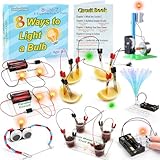
- 8 Circuit Experiments in 7 Packs ( AA batteries are required but not included. ) – Includes 8 fun and educational experiments to teach kids about circuits and electricity. Projects include Series Circuit, Parallel Circuit, Saltwater Power Generation, Fruit Battery, and more.
- Engaging Circuit Book – Comes with a detailed Circuit Book for guided learning. Suitable for ages 8+ with easy-to-follow instructions.
- Promotes Critical Thinking – Encourages problem-solving, creativity, and exploration of how electrical circuits work.
- Ideal for STEM Education – A great tool for learning about electrical engineering, conductivity, and energy. Perfect for young learners to explore science and technology.
- Perfect for Home or Classroom Use – Great for science fairs, school projects, or fun experiments at home. Ideal for teaching basic electrical concepts in an engaging way.
| Approach | What supplies the light | Works in darkness? | What it demonstrates |
|---|---|---|---|
| Battery-powered filament | A heated wire or pencil-lead filament | Only while the battery circuit powers a glowing filament; duration is not established | Incandescence and how filament materials behave |
| Solar bottle model | External daylight redirected through water | No | Refraction and daylight distribution |
The classroom model should not be treated as instructions for installing a bottle in a roof. Building-specific roof work involves sealing and other construction considerations beyond what the lesson establishes.
Independent reader supportYour contribution helps us test, update, and keep practical guides available for everyone.Why Edison is associated with the light bulb
Thomas Edison did not invent the first light bulb. The National Park Service describes his contribution as developing an incandescent light practical enough to burn for hours, through extensive experimentation and work on a broader electric-light system. National Park Service
Quick Recap
Best Value

- Requires 2 AA batteries (not included) to power the circuits.
- Includes 12 packs of circuit kits - circuit cards with components like bulbs, switches, and battery holders.
- Designed for children aged 8+ to learn basic electrical circuits through hands-on assembly.
- Features colorful packaging and clear instructions for easy setup and learning.
- Encourages kids to explore STEM concepts in a fun and interactive way.
Rank #4

- The small ball is a tungsten bulb made of glass, metal, and insulating materials.
- Tips:The positive and negative poles must not be directly connected, otherwise it may cause a short circuit.
- It can be used as a flashlight light source and indicator light of a distribution box.
- Mainly used for electrical experiments in primary and secondary schools.
- The package includes: 10 * 3.8V bulb. 1 * Battery box. 1 * Switch button. 2 * Wires. 2 * Lamp holder.
Rank #3

- Electric Circuit Motor Kit, Educational Montessori Learning Kit for DIY STEM Science Projects
- Electronic Science Kit: This popular and fun electronic science set will inspire and encourage to learn about science. This Montessori learning kit is perfect to bring your own new ideas and inventions to life. Also great for school science STEM toy programs!
- Versatile: The Circuit Motor Kit contains familiar components that can be used in school science, STEM, technology, and design programs, making it easy to meet your project needs and develop your learning skills and hands-on abilities.
- Package includes: 2 leads, 1.5v 10 bulbs, 2 lamp holders, 1 battery box. Packed with complete circuit accessories to make your science project easy to complete
- Uses: Mainly used in primary and secondary electrical laboratories
Product prices and availability are accurate as of the date/time indicated and are subject to change. Any price and availability information displayed on Amazon at the time of purchase will apply.




