What’s actually slowing this PC down?
Pick the symptom - the matching free tool is one click away.
Before excavating anywhere in the United States, contact the applicable 811 or one-call notification center, describe the entire work area accurately, and wait for affected facility operators to respond and mark their lines. Then confirm whether privately owned utilities are excluded, treat paint and flags as estimated—not exact—locations, and expose utilities by safe, locally accepted methods as excavation approaches. Lead times, ticket validity, tolerance zones, and renewal rules vary by state and locality, so the project’s one-call center and governing rules control.
How do I locate underground utilities before digging?
Use this sequence for a planned excavation such as a fence post, deck footing, drainage trench, pool, retaining wall, landscaping project, road cut, or utility installation:
As an Amazon Associate I earn from qualifying purchases.
- Define the dig area. Map the full limits of excavation, including access routes, grading, boring, trenching, staging, and any alternate work areas. A request that covers only the visible hole may not cover the rest of the project.
- Submit a locate request to the applicable 811 or one-call center. The center collects the location and project information, then notifies facility operators that may have underground installations there. PHMSA describes this notification process in its Call Before You Dig guidance.
- Provide a precise, easy-to-find location. Follow the center’s instructions for address, nearest intersection, work limits, marked boundaries, depth or project details, contact information, and the planned start date. Inadequate or ambiguous descriptions can leave part of the work area unprocessed.
- Monitor the request status and wait for responses. Operators may visit and mark facilities with paint or flags. A submitted request is not proof that every facility has been located or that all responses are complete.
- Confirm coverage for private facilities. Public one-call programs generally notify operators of facilities covered by that jurisdiction’s system. Lines installed, owned, or maintained by a property owner or other private party may require a separate private utility locator.
- Read the marks and local instructions before mobilizing equipment. Preserve markings, photograph them, and compare them with site plans and visible clues such as meters, valve boxes, transformers, poles, cleanouts, and service entries.
- Determine exact positions as excavation gets close. Marks are estimated locations. Use safe and acceptable exposure methods required by the project’s rules—often careful hand digging or another approved method—to establish the actual horizontal position and, where necessary, depth before mechanical excavation reaches the facility.
- Stop and resolve uncertainty. If a line is unmarked, a mark is unclear or disturbed, responses conflict, or site conditions do not match the marks, contact the one-call center or affected operator and follow the local process before proceeding.
For employers and construction contractors, OSHA’s excavation standard states: “The estimated location of utility installations, such as sewer, telephone, fuel, electric, water lines, or any other underground installations that reasonably may be expected to be encountered during excavation work, shall be determined prior to opening an excavation.” The requirement appears in 29 CFR 1926.651(b). Homeowners should also follow the same safety sequence, while recognizing that OSHA is a construction-employer standard rather than individualized legal advice.
Do I call 811 before I dig?
Yes. Contact the 811 service or other designated one-call center for the state or locality where the work will occur before excavation. The center routes the request to participating facility operators; it does not itself guarantee that every underground line has been identified. Use the official center’s website or telephone instructions for the project location, because submission channels, required information, emergency procedures, and response tracking differ.
#1 Best Overall
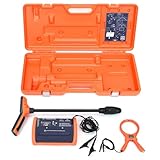
- PROFESSIONAL-GRADE UTILITY LOCATOR – Locate underground electrical lines, telecom cables, irrigation wires, and metallic pipes with precision over 1 mile (1.6 km) and depths up to 20 feet (6 m) with the 551 underground wire locator.
- DUAL FREQUENCIES + INTELLITRACK NOISE REJECTION – Simultaneously transmit two frequencies and eliminate AC interference with proprietary IntelliTrack digital filtering for accurate readings in noisy environments with the 551 cable locator.
- PEAK & NULL RECEIVER MODES – Choose between peak or null response to fine-tune your search and detect anomalies with confidence, even in complex underground environments with 551 buried wire locator.
- FLEXIBLE CONNECTION OPTIONS – Use direct wire connection , inductive clamp, or built-in antenna on 551 wire locator for maximum adaptability on active or inactive systems.
- BUILT FOR THE FIELD – Rugged, IP54-rated, and ergonomically designed with a lightweight receiver and durable case for reliable use in demanding job sites.
What information should be ready?
- Street address, parcel or lot information, and the nearest cross street or other landmarks.
- A clear description of the work and the complete area that could be disturbed.
- Whether work involves digging, trenching, grading, boring, drilling, demolition, or heavy equipment.
- Planned start date and the person who will be available to answer operator questions.
- Any white paint, flags, stakes, or other premarking the local center requires.
Keep the ticket or confirmation number, response status, operator contact information, and expiration or renewal instructions with the job records. Those details are controlling for that jurisdiction and project.
What does an 811 request actually cover?
A one-call ticket normally concerns facilities owned or operated by utilities and other operators that participate in the applicable notification system. It may not cover privately owned facilities on a property. Examples can include a private electric service beyond a utility-owned meter, a private water or sewer line, irrigation piping, a propane line serving an outbuilding, communications cable installed by a property owner, or facilities belonging to a commercial site owner. The exact boundary depends on ownership and state law.
Colorado 811 tells property owners to arrange a private locate after receiving confirmation of the public locate request when private lines need to be found. Its guidance also explains that the public request and a private locate are different services: Colorado 811’s residential digging guidance. Ask the local one-call center what operators and facilities its ticket includes, then hire a qualified private locating provider serving the project area when coverage is incomplete.
The Tool Desk
Outbyte PC Repair FREEClear out junk files and repair common Windows errorsFree Scan →Outbyte Driver Updater FREEScan for outdated or missing drivers - takes under a minuteDriver Scan →Public request, private locator, and detection equipment
| Option | Primary coverage or role | Who establishes the information | Important limitation |
|---|---|---|---|
| 811 or one-call request | Participating, generally public utility facilities in the defined work area | Notified facility operators respond under local procedures | May exclude private lines; a ticket does not prove every facility is marked or clear |
| Private utility locator | Private or otherwise excluded facilities, and supplemental locating requested by the owner | A qualified paid locating provider using appropriate methods | Service scope, methods, and deliverables vary; confirm exactly what will be located |
| Detection equipment | Supplemental searching or locating in circumstances allowed by the applicable rules | The operator or a trained locating professional using the equipment | It may not detect every material or facility and does not automatically establish safe depth or exact position |
Do not treat a consumer cable or pipe detector as a universal clearance device. OSHA’s interpretation of the excavation rule discusses detection equipment and hydro-vacuum excavation as possible acceptable means in particular circumstances, but the regulation does not define every acceptable method. The utility owner must still be contacted within the applicable response time, and the exact location must be established safely as excavation approaches. See OSHA’s interpretation on hydro-vacuum excavation and other acceptable locating means.
Rank #2

- Extended trace range over the Leica DD120 with additional low frequencies (512Hz and 640Hz)
- Kit includes DD130 Locator, DA175 1 Watt Signal transmitter, and carry bag which offers a turn key Package for locating underground utilities
- Safely locate underground power, water, gas, and Cable lines
- Automatic pinpointing at depths up to 33 feet (With Sonde - not included) with power, radio, auto modes
- Health check and start up test each time you turn on the unit to ensure proper functionality
How long before digging should I call 811?
There is no single nationwide lead time. Call as early as the local center permits and follow its stated minimum, status, and start-date rules. Louisiana 811’s locate-request page, for example, asks callers to submit at least two full workdays before excavation and explains its own marking-validity and emergency-request procedures: Louisiana 811 Locate Request. That example must not be applied automatically in another state.
Before each project, verify:
- The minimum notice period, including whether weekends and holidays count.
- How the center defines “workday” and the earliest lawful start time.
- How to check whether every operator has responded.
- How long marks or a ticket remain valid and how to refresh or renew it.
- What qualifies as emergency work and what documentation or call-back procedure applies.
Weather, project delays, changed limits, or disturbed marks can require a new or refreshed request even when the original ticket has not technically expired. Do not rely on an old ticket for a substantially different excavation area.
What do utility marks mean?
Paint, flags, stakes, or other markings indicate an operator’s estimated alignment or facility location. They are not a promise that the line is exactly beneath the center of a stripe, nor do they necessarily show depth, service connections, abandoned facilities, or every privately owned line. Preserve the marks and use the operator’s color and symbol conventions supplied with the response or required locally.
Recommended Free Tools
OSHA’s rule requires more than seeing a mark. The standard says utility owners “shall be contacted within established or customary local response times, advised of the proposed work, and asked to establish the location of the utility underground installations prior to the start of actual excavation.” This text is reproduced in OSHA’s interpretation concerning the utility ‘owner’.
Rank #3

- ACCURATE UNDERGROUND WIRE LOCATOR. Quickly isolate, trace the path and determine the depth of buried conductors (wires or metallic pipes) over distances of 4,000 feet (1.2 km) and depths of 7 feet (2.2 m) with the 501 underground wire locator.
- EASILY LOCATE AND TRACE Electrical lines, Communications cables, Electric dog fence cables, Fish tape and Metallic pipes, Invisible fence wires, Outdoor or Landscape lighting cables with 501 buried wire locator. Trace Electric, Power, Coax, Telephone, and Utility lines with the 501 underground wire locator.
- EFFICIENT: Save yourself hours to trace buried cables, wires, or pipes. With inductive signal detection, this cable and buried wire locator can be used on active or dead systems, making it quick and easy to trace the path and determine the depth of buried wires and trace metallic pipes.
- COMPLETE PORTABLE KIT: 501 buried wire locator comes with a transmitter assembly, receiver assembly, inductive coupler (clamp), built-in inductive antenna, two 8-foot (2.4 m) test leads with heavy-duty alligator clips, and a durable polyethylene case, making it a complete package for all your location needs.
- CONNECTION OPTIONS: Options for direct connection, inductive clamp, and inductive antenna allow active or dead systems location. Transmitter output and receiver sensitivity are fully adjustable for maximum accuracy.
Can I dig within the marked tolerance zone?
A tolerance zone is a locally defined area around a marked facility where extra care and verification are required. It is not a safe-distance guarantee. The width and permitted excavation methods vary by jurisdiction. Colorado 811 describes an 18-inch tolerance zone in its state guidance; that figure is not a national standard. Texas811 states that Texas law has no specific tolerance-zone margin in its one-call statute and recommends hand tools or another acceptable method to determine the exact position in the relevant area. See Texas811’s utility-safety FAQ.
Follow the actual project jurisdiction’s definition, which may prescribe hand exposure, vacuum excavation, mechanized restrictions, offsets, or other controls. Even outside a formally named zone, stop mechanical excavation and expose the facility when the excavation approaches the estimated alignment.
How do I safely expose a utility as excavation approaches?
Plan the exposure
Review the operator marks, ticket sketch, site plans, and the planned trench or footing. Identify where the excavation could intersect the estimated alignment, and brief everyone operating or spotting equipment. Establish a physical exclusion or hand-dig area consistent with local rules.
Use an accepted exposure method
Use the method required or accepted by the governing jurisdiction and facility owner. Careful hand tools are commonly specified for exposing a line, while vacuum or hydro-vacuum excavation may be appropriate when operated by trained personnel under the site’s controls. OSHA’s interpretation notes hydro-vacuum excavation as a possible acceptable means but does not declare one method suitable for every soil, facility, or project.
Rank #4

- COMPACT SONDE AND LINE LOCATOR: Perfect for SeeSnake cameras, remote transmitters, or flushable sondes; targets pipes, cables, and energized lines; use with SeeSnake inspection reels or other sondes
- MULTI-DIRECTIONAL TECHNOLOGY: The antenna detects signals from all directions, maximizing signal strength and eliminating false peaks or nulls, ensuring accurate target location
- ENHANCED DETECTION CAPABILITIES: Features 4 Sonde and 5 Line trace mode frequencies; the digital readout delivers real-time signal strength with no false peaks, ensuring fast, accurate locates
- PRECISE TARGETING: Micro-mapping verifies locate positions with on-screen markers for poles in front of and behind your target; depth calculations automatically display when directly over the target
- ALL-IN-ONE PACKAGE: Includes a carrying case for easy transport and protection, plus surface marker chips, an instructional video, an operator’s manual, and 4 C-cell batteries
Expose enough to establish the line
Do not uncover only a small point and assume the facility continues in a straight line or at a constant depth. Expose sufficient length and width to determine its actual position without damaging the coating, conduit, pipe, cable, or support. Support an exposed facility as required by the operator and site engineer; never use it as a step, handle, or anchor.
Reconcile the finding with the plan
If the exposed facility is not where the mark indicated, or if another facility appears, stop and contact the affected operator or one-call center. Update the work plan, maintain required clearances, and document the confirmed position before resuming excavation.
Independent reader supportYour contribution helps us test, update, and keep practical guides available for everyone.What should I do if a utility was not marked?
Do not assume that an unmarked area is clear. First check the ticket status and whether the request description covered the precise area. Then contact the one-call center or the operator listed on the response and report the missing, faded, damaged, or conflicting mark. Wait for the response required by the local procedure.
Quick wins for a faster PC:
Fix the driver behind crashes, sound loss and screen glitchesFind Drivers →Repair Windows errors before they cause bigger problemsFix Now →Scan for outdated or missing drivers - takes under a minuteDriver Scan →- No response from an operator: Use the center’s status process and contact the operator or center. Do not excavate on the assumption that silence means no facility exists.
- Markings were disturbed: Protect the area, photograph what remains, and request remarking or a new ticket if the local rules require it.
- A line is found outside the marks: Stop work, keep people and equipment clear, and notify the owner. Treat the newly found facility as real until its identity and position are established.
- Exact position cannot be established: Do not proceed with ordinary mechanical excavation. Use an acceptable locating or exposure method under the applicable rule and operator instructions.
OSHA allows an employer to proceed with caution and detection equipment or another acceptable means in certain circumstances when utility companies or owners cannot respond or cannot establish the exact location. That limited provision is not a blanket waiver of the duty to locate; the exact position still must be determined safely as excavation approaches. The governing text is in OSHA §1926.651(b)(3).
Best Value

- Easy to Use
- Left / Right Arrows Guide You To Buried Utility
- Single Frequency Locator
- 1W Transmitter
- 1 Year Warranty
How should contractors document the locate process?
Professional excavators should make the locate process part of the job hazard analysis and daily briefing. Retain:
- The ticket number, request date, work limits, start date, and renewal or expiration information.
- Operator response statuses, mark-out sketches, photographs, and notes about facilities reported as clear or not present.
- Private-locate reports and the provider’s stated scope, methods, and exclusions.
- Records of hand exposure, vacuum excavation, potholes, measurements, and any discrepancies between marks and actual facilities.
- Stop-work communications, remark requests, operator instructions, and changes to the excavation plan.
Assign one competent person or project lead to verify that responses are complete before the crew begins. Recheck marks after rain, grading, paving, traffic, or other activity that could erase or move them.
Homeowner checklist before opening the ground
- Draw the complete project footprint, not just the intended hole.
- Submit the official local 811 request and save the confirmation.
- Wait for every listed operator response and inspect the marks in daylight.
- Ask whether the request excludes private facilities on your property.
- Arrange a qualified private locate if any private line may be present.
- Confirm the local notice period, tolerance-zone rule, and ticket-validity period.
- Hand-expose or use another locally accepted method as the excavation nears a mark.
- Stop and obtain clarification if a mark is missing, unclear, damaged, or inconsistent with what you uncover.
Which rules control my project?
Federal OSHA’s construction excavation standard provides a baseline for covered employers, but state-plan programs, local ordinances, one-call statutes, utility tariffs, permits, and facility-owner requirements may add or modify obligations. The examples from Colorado, Texas, and Louisiana demonstrate why a national article cannot provide one universal lead time, tolerance-zone width, or mark-validity period.
Crashes, No Sound, or Screen Glitches?
Random freezes, missing sound and display glitches usually trace back to one bad driver. Find and replace yours safely.Free scan · under a minuteWindows Errors? Fix Them Before They Spread
Repair common Windows errors and clear accumulated junk for a smoother, more stable PC - no reinstall needed.Free scan · no reinstallBefore scheduling equipment, identify the exact state and municipality, open the current official one-call instructions for that location, and confirm requirements directly with the center. If the work is commercial or performed by employees, have the responsible safety professional or competent person verify the applicable OSHA, state-plan, permit, and owner requirements. When a conflict exists, pause the excavation until the authority having jurisdiction or facility owner resolves it in writing or through the prescribed ticket process.
What if I contact 811 but still cannot identify the line?
Keep the excavation closed or outside the uncertain area, protect people from the hazard, and escalate through the one-call center and facility owner. A private locating provider or an appropriately trained operator using approved detection or vacuum methods may be needed. Detection equipment can supplement—not replace—operator notification, private-line investigation, and safe physical verification. Never infer that a detector’s lack of a signal proves that no utility exists, because performance depends on the facility material, configuration, depth, access, and equipment.
Key takeaway for a safe excavation
811 is the required starting point, not the final clearance. Define the work area accurately, wait for operator responses, investigate private-line coverage, preserve the marks, follow the project jurisdiction’s timing and tolerance-zone rules, and safely expose facilities to establish their exact locations before mechanical excavation reaches them. If anything remains uncertain, stop and resolve it rather than treating an unmarked or unconfirmed area as empty.
Quick Recap
Product prices and availability are accurate as of the date/time indicated and are subject to change. Any price and availability information displayed on Amazon at the time of purchase will apply.
Do these 3 things before closing this tab:
1Repair Windows errors before they cause bigger problems2Fix the driver behind crashes, sound loss and screen glitches3Clear out junk files and repair common Windows errors
