For the common indoor moth orchid (Phalaenopsis), the formula is simple: provide bright filtered light, grow it in an airy orchid medium, water thoroughly only when the roots and medium are nearly dry, keep water out of the crown, and feed lightly. Most failures come from roots being kept wet for too long—not from missing a particular day on the watering calendar.
One important qualification: orchid is a family of plants, not one care category. The instructions below are primarily for the broad-leaved, store-bought Phalaenopsis. If your orchid has canes, pseudobulbs, slipper-shaped flowers, or long bare aerial roots, identify its genus before following this routine.
As an Amazon Associate I earn from qualifying purchases.
The five rules that matter most
- Give it bright, indirect or filtered light.
- Use coarse orchid bark or another airy orchid medium, never ordinary potting soil.
- Water deeply, let the pot drain completely, and wait until the medium is nearly dry before watering again.
- Keep water out of the leaf crown and never leave the inner pot standing in water.
- Feed weakly during active growth and repot when the medium breaks down or drainage worsens.
First, identify your orchid
Most orchids sold in supermarkets, garden centers, and florists are Phalaenopsis, also called moth orchids. They typically have broad, thick, arching leaves, fleshy aerial roots, one central growing point, and tall arching flower spikes. Flowers may be white, pink, purple, yellow, spotted, or striped.
If the label is missing, compare your plant with this table before applying moth-orchid advice. The American Orchid Society’s culture sheets exist because different orchid genera have genuinely different needs.
#1 Best Overall

- ORCHID PLANT FOOD MIST: Miracle-Gro Indoor Plant Food Mist for Orchids contains nutrients for colorful orchid flowers and more blooms (vs unfed when used as directed)
- NUTRIENTS FOR ORCHID PLANTS: This orchid food feeds plants instantly and mimics natural feeding conditions for healthy Orchids
- FOR INDOOR ORCHIDS: Use this plant food for houseplants with indoor orchid plants, including Phalaenopsis (Moth Orchid), Cattleya, Cymbidium (Boat Orchids), Dendrobium, Dendrobium Nobile, Miltonia, Oncidium (Dancing Lady Orchid), and Paphiopedilum
- SIMPLY SPRAY TO FEED: Use this orchid food spray on leaves, roots, and top of the soil once per week, taking care to avoid orchid flowers; reapply mist once per week
- FEED YOUR ORCHID PLANTS: This bundle comes with two 8 fl. oz. bottles of Miracle-Gro Indoor Plant Food Mist for Orchids for more orchid care; for more spectacular results, use with Miracle-Gro Indoor Potting Mix for Orchids
| Orchid | What it often looks like | Why the care differs |
|---|---|---|
| Phalaenopsis | Broad leaves, fleshy roots, arching flower spikes | Usually suited to bright filtered light, warm indoor temperatures, and an airy bark or moss mix. |
| Cattleya | Thick pseudobulbs and large, often fragrant flowers | Generally requires more light than a moth orchid. |
| Dendrobium | Cane-like stems | Care varies substantially between types; some need a cooler or drier rest. |
| Oncidium | Sprays of many small flowers | Usually prefers brighter light and a different watering pattern. |
| Paphiopedilum | Slipper-shaped flowers and often mottled leaves | Often prefers more even moisture and lower light. |
| Vanda | Long, prominent aerial roots; sometimes little or no potting medium | Bare-root or mounted plants dry quickly and need much more frequent watering and humidity. |
When in doubt, find the plant’s genus on its label or ask the seller. Do not assume that a Vanda, Dendrobium, or Paphiopedilum can be managed like a grocery-store Phalaenopsis.
What to do on the first day home
- Remove drainage traps. Take off decorative foil, sealed sleeves, or any outer container that holds water around the nursery pot.
- Check the pot. The inner pot must have drainage holes. A transparent plastic pot is useful because it lets you inspect roots and moisture, but transparency is not essential.
- Look for saturated medium. Check whether the plant is packed in dense sphagnum moss or a concealed plug that remains wet in the center. The surface can look dry while the roots are still saturated.
- Do not repot automatically. A healthy orchid in flower can usually remain undisturbed until it finishes flowering. Repot sooner if the medium is decomposing, waterlogged, foul-smelling, diseased, draining badly, or clearly keeping the roots wet.
- Quarantine the newcomer. Keep it apart from other houseplants while you inspect it for scale, mealybugs, mites, thrips, and rot. Penn State Extension recommends isolating new or returning indoor plants for approximately three weeks.
A flowering plant does not need an emergency repot simply because it came from a store. Unnecessary root disturbance can shorten the current floral display. The exception is a plant already showing a serious drainage or root problem.
Give a Phalaenopsis the right indoor location
Light: bright filtered light, not a dark corner
An east-facing window is usually the easiest placement for a Phalaenopsis. A south- or west-facing window can also work if a sheer curtain protects the leaves from hot, intense direct sun. A dim room may keep the plant alive but often will not provide enough energy for strong growth or new flower spikes.
Use the leaves as a practical guide. Medium grassy-green leaves are generally a better target than very dark green leaves. Very dark leaves can indicate insufficient light; bleached, yellowed, or scorched patches can indicate excessive direct sun. Move the plant gradually when changing light levels. A plant accustomed to a dim store or room can burn if placed suddenly in strong sun.
The American Orchid Society lists approximately 1,000–2,000 foot-candles for Phalaenopsis culture and cites about 1,500 foot-candles as a suggested maximum for the genus. These are useful greenhouse or light-meter figures, not a requirement that a beginner buy specialized equipment. Window position, leaf color, and flowering performance are usually sufficient guides.
When natural light is inadequate, Iowa State Extension recommends high-output fluorescent or LED lighting approximately 6–12 inches above the foliage for at least 14 hours per day. Keep observing the leaves: the exact distance depends on the fixture’s intensity.
Temperature
Typical Phalaenopsis hybrids do well with daytime temperatures around 75–85°F and nights generally above 60°F during routine growth. In autumn, several weeks of cooler nights around 55°F can help initiate a flower spike. This is a flowering cue, not a guarantee. The plant still needs adequate light, healthy roots, water, and nutrition.
Quick wins for a faster PC:
Scan for outdated or missing drivers - takes under a minuteDriver Scan →Repair Windows errors before they cause bigger problemsFix Now →Protect the plant from cold drafts, heating vents, sudden temperature changes, and chilled transport. Temperature stress is one possible cause of buds browning and dropping.
Humidity and air movement
The American Orchid Society gives 50–80% relative humidity as a Phalaenopsis target. In an ordinary home, do not treat that range as a reason to keep the roots wet. Humidity in the air does not replace watering the root system.
Rank #2

- WONDERFULLY ORGANIC - Contains premium organic ingredients that naturally feeds and promotes strong roots, vibrant flowers, and overall better long term plant vigor. Light NPK ratio is ideal to use on all potted indoor and outdoor orchid types.
- FOR VIBRANT, GROWTH & BLOOMS - Made urea free to gently feed your orchid and protect your plants from root burn while encouraging vibrant leaves, spike growth, and stunning blooms and reblooms!
- READY MIXED PLANT MISTER - Already pre-mixed liquid fertilizer in a convenient ready to use spray bottle. Creates a fine mist perfect for gentle weekly feedings that help your plants thrive. Simply grab and spray!
- PERFECT PLANT CARE - Well-balanced mix of all the nutrients your houseplant needs to encourage long term health and vitality. Easy to use spray with no need to poke holes or disrupt the soil in your planter. Perfect for flowers in pots with bark, sphagnum moss, pumice, perlite, and other organic potting mixes.
- FOR ALL ORCHID VARIETIES - Made to use on your phalaenopsis, cattleya, vanda, cymbidium, denbrobium, and other live orchid types grown in and around the house in a pot.
- A humidifier is more effective than routine misting for raising room humidity.
- Misting briefly wets plant surfaces but does not materially raise room humidity for long and does not substitute for root watering.
- A pebble tray can help locally only if the pot sits above the water. The roots must not stand in the tray.
- Gentle air movement helps leaves dry and reduces stagnant, disease-favoring conditions.
- Do not aim a strong fan directly at the plant; excessive airflow can dry it too rapidly.
In practice, good roots, correct watering, and gentle airflow matter more than trying to mist on a rigid daily schedule.
How to water an orchid correctly
There is no universal orchid watering day. Frequency depends on pot size, medium, light, temperature, humidity, airflow, and season. AOS gives examples ranging from every other day in a hot, dry summer climate to approximately every 10 days in a cool greenhouse. Maryland Extension says a normal indoor Phalaenopsis may need water no more than once a week. Those figures are not contradictory: they demonstrate why the plant’s condition is more useful than a calendar.
The Tool Desk
Outbyte PC Repair FREEClear out junk files and repair common Windows errorsFree Scan →Outbyte Driver Updater FREEFix the driver behind crashes, sound loss and screen glitchesFind Drivers →Check before you water
In a transparent pot, recently watered roots are often green or pale green. As they dry, they commonly turn dull silver or silver-white. Roots that have changed to silver-white, together with a medium that is nearly dry, are a useful signal that watering is due. Do not rely on root color alone if the plant is in opaque plastic, dense moss, or a concealed plug; feel and inspect the medium as well.
The sink-watering method
- Inspect first. Check the roots and medium rather than assuming it is Sunday—or any other scheduled day.
- Take the plant to a sink. Keep the foliage and crown supported.
- Wet the medium thoroughly. Allow water to run through the bark or moss until the entire root ball is rehydrated.
- Let it drain completely. Do not return the pot to its decorative container while water is still running out.
- Empty the outer pot or saucer. The inner pot must never sit in standing water.
- Water in the morning. This gives moisture accidentally left near the leaves or crown time to dry.
- Wait before repeating. Water again when the medium is nearly dry, not while it remains saturated.
Keep water out of the central crown—the point where the leaves meet. Water trapped there can encourage crown rot. If water collects in the crown, blot it gently with a paper towel or tissue and improve airflow.
Bark, moss, and watering frequency
| Medium | What to expect | Main risk |
|---|---|---|
| Coarse orchid bark | Drains quickly and leaves air spaces around roots; often a forgiving beginner default. | It may dry rapidly in a hot, dry room. |
| Sphagnum moss | Retains considerably more moisture. | It is easy to water too often, especially when packed tightly or decomposing. |
| Bark–moss blend | A compromise for homes that are especially dry or for plants that need more moisture retention. | Its watering rhythm depends on the blend and how tightly it is packed. |
| Mounted or bare-root culture | Appropriate for some orchids and experienced growers. | It dries rapidly indoors and usually requires frequent watering, higher humidity, and close monitoring. |
Never apply a bark-based watering schedule to a plant sitting in compacted, wet moss. Conversely, a plant in coarse bark may need attention sooner than one in moss. The medium’s condition controls the interval.
What kind of water should you use?
Most drinkable municipal and well water is suitable for most orchids. Avoid water softened with sodium-based systems, which can cause salt accumulation. Rainwater or distilled water may be useful for sensitive orchids or for supplies with high mineral content.
What’s actually slowing this PC down?
Pick the symptom - the matching free tool is one click away.
Regardless of the water source, periodic thorough watering with plain water helps flush fertilizer and mineral buildup from the medium. This is one reason sink watering is more adaptable than giving a small measured amount on a fixed schedule.
What about ice cubes?
Ice irrigation is neither a universal best practice nor something that must always be rejected. A 2017 Ohio State University/University of Georgia study compared three ice cubes weekly with an equivalent volume of room-temperature water for four Phalaenopsis cultivars grown in bark over four to six months. It found no reduction in flower longevity, display life, photosynthetic health, or root and leaf biomass in that tested situation.
That evidence supports ice irrigation as a possible method for the tested Phalaenopsis-in-bark setup. It does not validate ice for every orchid, pot, medium, climate, or long-term growing condition. Thorough sink watering is easier to adjust when conditions change and allows salts to be flushed from the medium. If you use ice, do not treat three cubes weekly as a universal prescription.
Rank #3

- PROFESSIONALLY FORMULATED FOR BLOOMING: Urea-free orchid food containing high-content phosphorus, a powerful blooming agent; endorsed by the American Orchid Society for vibrant, long-lasting blooms
- NUTRIENT-RICH 11-35-15 FORMULA: Balanced ratio of nitrogen, high phosphorus, and potassium; bloom fertilizer for flowers and orchid food for blooming, enhancing color, and maximizing bloom size
- VERSATILE AND EASY-TO-USE: Water-soluble plant food is suitable for every fourth watering schedule; mix one teaspoon per gallon of water to thoroughly soak both the orchid’s root system and foliage; ideal for indoor house plants
- COMPLEMENTS ORCHID PLUS: For routine fertilization, alternate with Better-Gro Orchid Plus plant food as directed; maximizes the potential for healthy growth and abundant blooms in your orchids
- CONVENIENT PACKAGING FOR LONGEVITY: Comes in a handy resealable 16 oz bag to keep the fertilizer fresh and effective for future use
Choose the right pot and potting medium
Phalaenopsis is an epiphytic orchid: its roots need both moisture and air. Ordinary houseplant soil is too dense and can exclude air around the roots, keeping them wet until they rot.
Outdated Drivers Are Slowing You Down
One free scan finds every outdated or missing driver and matches the right update for your exact hardware.Free scan · exact hardware matchPC Slower Than It Used to Be?
A free scan shows the junk files, broken settings and background clutter dragging Windows down - then fixes them in one click.Free scan · Windows 10 & 11Use coarse orchid bark, a bark-based orchid mix, or appropriately managed sphagnum moss. A transparent inner pot helps you monitor root color and moisture, but a nontransparent pot can work if it has excellent drainage and you learn how quickly its medium dries. Side holes can improve airflow.
Choose a container for the root mass, not the leaf span. A slightly cramped pot is generally safer than an oversized pot, which holds too much wet medium around too few roots. The plant must be stable, but it does not need a large pot simply because its leaves are wide.
When to repot a Phalaenopsis
Repotting is governed more by medium and root condition than by an annual deadline. Depending on the medium and growing conditions, published guidance commonly ranges from approximately one to three years.
Repot when:
- bark has broken down into fine, mulch-like material;
- the pot stays wet for too long or drains poorly;
- the plant has outgrown its container;
- roots are dead, diseased, or severely damaged; or
- dense original moss or a concealed plug remains saturated in the center.
Iowa State Extension recommends repotting after flowering as new growth begins. The RHS notes that Phalaenopsis can be repotted when roots are active and green tips are present. If the plant is currently healthy and flowering, wait unless there is a clear root or drainage problem.
Free tools Windows power users keep installed
One-click scans. No signup required.
Repotting, step by step
- Remove the plant and old medium carefully. Do not pull hard on roots stuck to the pot.
- If dry roots are brittle, soak them briefly so they become more flexible.
- With a clean, sterilized tool, cut away soft, hollow, dead, brown, or black roots. Healthy roots are generally firm and plump, although their color varies with hydration and age.
- Clean and sterilize the existing container, or use a clean replacement with drainage holes.
- Use the same pot size unless the root mass genuinely needs more room.
- Spread healthy roots into fresh coarse bark or your chosen airy orchid mix.
- Use a chopstick or pencil to settle bark around the roots without crushing them.
- Keep the crown and growing point above the medium. Do not bury the center of the plant.
- Anchor the orchid if it wobbles. A moving plant can damage new root tips.
- Water thoroughly to settle the new medium, then let the pot drain completely.
Do not cut healthy aerial roots
Aerial roots extending over the rim are normal for an epiphytic Phalaenopsis. Do not cut them, bury them forcibly, or assume they are unhealthy merely because they are outside the pot. They may look silver, green, plump, dry, or slightly flattened depending on hydration and age.
Feed lightly, not aggressively
Different reputable guides describe different fertilizer formulations and schedules: Maryland Extension suggests feeding an actively growing or flowering plant every third or fourth watering according to the product label; the RHS recommends light, regular feeding during growth with a plain-water flush every fourth watering; and Iowa State discusses low-dose feeding, often quarter strength or less, with a monthly plain-water flush. AOS discusses both balanced fertilizers and a high-nitrogen formulation such as 30-10-10 for bark-based media.
For a beginner, the safest synthesis is:
- Use an orchid fertilizer that includes micronutrients.
- Dilute it according to the label; a low dose is preferable to concentrated feeding.
- Feed only when the plant is actively growing and the medium is already moist.
- Flush periodically with plain water to reduce fertilizer and mineral buildup.
- Reduce or stop feeding during cool, dim winter conditions.
Never apply concentrated fertilizer to completely dry roots. Excess fertilizer can cause brown root tips, brown leaf tips, yellowing, and salt buildup. A so-called bloom-booster fertilizer is not required to make a Phalaenopsis flower again; light, temperature, healthy roots, and the plant’s normal growth cycle matter more than a special high-phosphorus product.
After flowering: pruning and reblooming
When the flowers fade, inspect the spike rather than cutting automatically.
Do these 3 things before closing this tab:
1Repair Windows errors before they cause bigger problems2Scan for outdated or missing drivers - takes under a minute3Clear out junk files and repair common Windows errorsRank #4

- Made for Orchids – Specially formulated orchid fertilizer designed to support indoor orchid care and growth.
- Supports Blooming & Flowering – Orchid fertilizer for blooming helps promote vibrant flowers and longer-lasting blooms.
- Encourages Healthy Roots & Growth – Orchid plant food supports strong root systems and overall plant development.
- Liquid Orchid Fertilizer Formula – Fast-absorbing orchid fertilizer liquid for efficient nutrient delivery.
- Made in USA
If the flower spike is still green
On a healthy Phalaenopsis, you can cut approximately ½ inch above the second unused node below the spent flowers. A green spike may branch and produce another flush, although the side branch can be slower or weaker than a new spike emerging from the base.
If the spike is brown or yellow
Cut a completely brown or yellow spike near the base. It is no longer actively supplying a possible side branch.
If the plant is weak
An orchid with few healthy roots, very poor leaves, or major stress may benefit from having a green spike cut at the base so it can direct energy into roots and leaves. Reblooming is possible, not guaranteed. A period without flowers does not necessarily mean the plant is dying.
The second-node rule is primarily a Phalaenopsis instruction. Many other orchid genera flower only once from a particular spike or cane. Identify the genus before pruning.
Recommended Free Tools
Troubleshooting: diagnose the roots before changing the routine
Symptoms overlap. A wrinkled leaf can mean dryness, but it can also mean the roots have rotted and can no longer supply water. A yellow leaf can be natural aging, low light, wet roots, nutrient imbalance, or salt stress. Inspect the roots, medium, light, and recent changes together rather than diagnosing from one symptom or photograph.
| Symptom | Check first | Possible causes | Immediate action |
|---|---|---|---|
| Wrinkled, limp, or leathery leaves | Roots and medium | Medium too dry; root rot; decomposed medium retaining too much water; low humidity or excessive water loss | Do not simply water more. Inspect for firm, functional roots versus brown, shriveled, soft, or hollow roots. |
| One old lower leaf gradually turns yellow | Whether new leaves and roots look healthy | Normal aging is possible | Monitor rather than treating one aging leaf as proof of disease. |
| Several leaves yellow | Roots, light, fertilizer history, and medium moisture | Excess water, root loss, low light, nutrient imbalance, or fertilizer salts | Correct the growing conditions and inspect the root system. |
| Brown, black, soft, hollow, or collapsing roots | Wet or decomposed medium | Root rot | Remove dead roots, sterilize the container, and repot in fresh airy medium. |
| Water sitting in the crown | The central growing point | Crown-rot risk | Blot the water, improve airflow, and keep the crown dry from now on. |
| Buds brown, shrivel, and fall | Recent moves and temperature changes | Bud blast from drafts, temperature fluctuations, unsuitable moisture, low humidity, poor roots, or other stress | Stabilize the plant’s location and inspect roots. Bud blast is a symptom, not proof of one specific mistake. |
| Sticky leaves or brown shell-like bumps | Leaf joints and undersides | Scale or honeydew-producing pests | Isolate the plant, physically remove pests where practical, wash the plant, and repeat treatment according to the product label. |
| White cottony clusters | Leaf axils, crevices, and roots | Mealybugs | Isolate, remove visible insects, sanitize, and repeat appropriate treatment as directed. |
| Stippled or bronzed leaves, sometimes with fine webbing | Leaf undersides | Mites | Isolate and use a correctly labeled treatment; repeat as required. |
| Silvery scratches, distorted flowers, or black specks | Flowers and new growth | Thrips | Isolate and treat repeatedly according to the product label. |
| Small flying insects around wet medium | Moisture level and decaying medium | Fungus gnats | Allow the medium to dry appropriately and address the overly wet conditions. |
| Black spots spreading quickly or water-soaked soft tissue | Lesion texture and speed | Bacterial or fungal disease | Isolate the plant, stop overhead watering, sterilize tools, and remove infected tissue. Use only a product labeled for the diagnosed problem. |
| Rings, mosaic patterns, streaks, or unusual color break | Whether markings persist and spread | Possible virus, but several disorders can look similar | Visual diagnosis is unreliable. Isolate the plant; confirmation requires testing, and orchid viruses cannot be cured. |
| Healthy leaves but no new flower spike | Light first | Insufficient light or lack of a seasonal temperature cue | Move to brighter filtered light and provide stable care; a cooler autumn period may help but does not guarantee flowering. |
How to rescue an orchid with root rot
A plant can look thirsty while sitting in wet medium because damaged roots can no longer absorb water. The recovery sequence is the opposite of keeping it constantly wet:
- Remove the orchid from the saturated or decomposed medium.
- Cut away every soft, hollow, dead, brown, or black root with a clean, sterilized tool.
- Clean and sterilize the container.
- Repot the remaining healthy roots in fresh, airy medium.
- Keep water out of the crown and central growing point.
- Reduce watering frequency until the plant begins producing healthy roots.
- Do not compensate for lost roots by keeping the remaining medium constantly wet.
If the base or crown is dark, mushy, foul-smelling, or collapsing, the problem is more urgent. For suspected bacterial soft rot or black rot, isolate the plant and follow the relevant bacterial-disease or black-rot guidance. Fungicides do not cure bacterial disease, and advanced infection reaching the crown may be fatal.
Pests and disease: isolate first
New orchids can carry pests even when the flowers look perfect. Inspect leaf joints, undersides, roots, flower spikes, and the surface of the potting medium. Common signs include:
- Scale: fixed brown or shell-like bumps, often accompanied by sticky honeydew.
- Mealybugs: white, cottony clusters in leaf joints and crevices.
- Mites: stippled or bronzed leaves and sometimes fine webbing.
- Thrips: silvery scratches, distorted flowers, or black specks.
- Fungus gnats: nuisance adults associated with excessively wet medium.
Begin with isolation, physical removal, washing, sanitation, and repeated treatment according to the product label rather than expecting one application to solve the problem. Disinfect tools between plants, especially when cutting diseased tissue.
Best Value
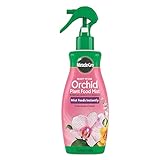
- Mist roots and growing media weekly
- Nutrients are instantly available
- Easy-to-use
- Apply to roots and growing media once a week
Water-soaked lesions, foul odor, rapidly spreading soft tissue, or a dark, mushy crown require prompt action. Stop overhead watering, keep the crown dry, isolate the plant, and use only a fungicide or bactericide appropriate to the confirmed or suspected problem and permitted by its label. Yellow or brown rings, mosaic patterns, streaks, and color break may resemble virus, but appearance alone cannot confirm it. A severely suspect plant should not be propagated or shared.
Indoor and outdoor seasonal care
| Season | What to do |
|---|---|
| Spring | Resume light feeding as active growth begins. Check whether bark has decomposed and whether the plant would benefit from repotting after flowering. |
| Summer | Protect leaves from hot direct midday sun, watch for faster drying, and maintain gentle airflow. Outdoor summering can work if the plant is acclimated gradually and kept out of intense sun. |
| Autumn | Maintain bright light. Cooler nights around 55°F for several weeks may help initiate a spike, provided the plant remains healthy and protected from abrupt chills. |
| Winter | Water less often if drying slows, reduce or stop fertilizer in cool, dim conditions, and protect the plant from cold windows, drafts, and heating vents. |
If you summer an orchid outdoors, acclimate it gradually, protect it from direct midday sun, and bring it indoors before temperatures fall below approximately 50°F. Before bringing it back inside, inspect carefully for insects, slugs, snails, ants, and roaches.
When Phalaenopsis advice does not apply
The routine in this article is a practical starting point for the common indoor moth orchid, not a universal orchid manual. Cattleya, Dendrobium, Oncidium, Paphiopedilum, Vanda, Cymbidium, and terrestrial orchids may require substantially different light levels, temperatures, watering patterns, humidity, or dormancy periods. Use the American Orchid Society’s genus-specific culture sheets or the relevant extension guidance before changing the routine for an unidentified plant.
Frequently Asked Questions
How often should I water my orchid?
Do not use a fixed weekly schedule. Check the roots and medium first, then water thoroughly when a Phalaenopsis’s medium is nearly dry and its hydrated roots have changed to silver-white. Let all excess water drain and wait until it is nearly dry again. The interval varies with pot size, medium, light, temperature, humidity, airflow, and season.
Why are my orchid’s leaves wrinkled if the pot is wet?
Wrinkled leaves can indicate either insufficient water or roots damaged by rot. Inspect the roots before watering more. Brown, soft, hollow, or collapsing roots cannot supply water effectively even when the medium is saturated.
Should I cut my orchid’s flower spike after the flowers fall?
For a healthy Phalaenopsis, leave a green spike in place if you want to try for a side branch and cut about ½ inch above the second unused node. Cut a completely brown or yellow spike near the base. This rule does not apply to every orchid genus.
Can an orchid recover after losing most of its roots?
It may recover if the crown and remaining plant tissue are healthy. Remove dead roots, repot in fresh airy medium, keep the crown dry, and avoid compensating with constant moisture. Recovery is slow and depends on the amount of healthy tissue left.
Quick wins for a faster PC:
Repair Windows errors before they cause bigger problemsFix Now →Fix the driver behind crashes, sound loss and screen glitchesFind Drivers →Clear out junk files and repair common Windows errorsFree Scan →Are ice cubes safe for orchids?
A limited university study found no short-term harm from three ice cubes weekly compared with an equivalent volume of room-temperature water for four Phalaenopsis cultivars grown in bark. That does not make ice a universal method. Thorough sink watering is easier to adapt and flushes salts from the medium.
The Bottom Line
For a store-bought Phalaenopsis, start with bright filtered light, a well-drained bark-based medium, and thorough watering only when the roots and medium are nearly dry. Drain the pot completely, keep water out of the crown, feed lightly during active growth, and inspect the roots whenever leaves wrinkle or yellow. Once the plant is healthy, sufficient light and seasonal temperature changes—not a special bloom-booster—give it the best chance of flowering again.
Quick Recap
Product prices and availability are accurate as of the date/time indicated and are subject to change. Any price and availability information displayed on Amazon at the time of purchase will apply.