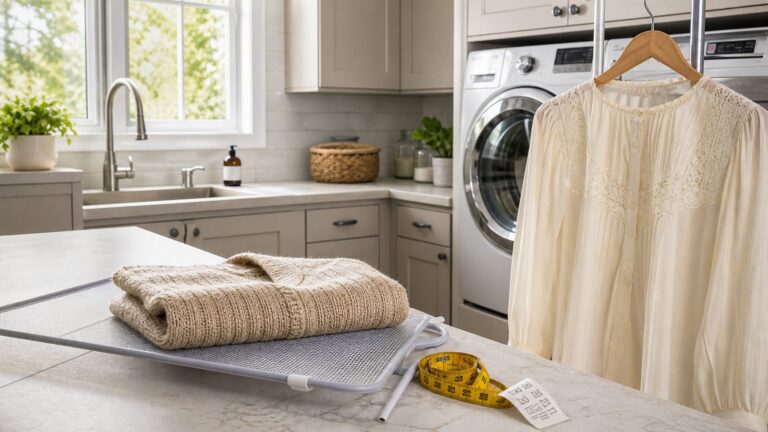
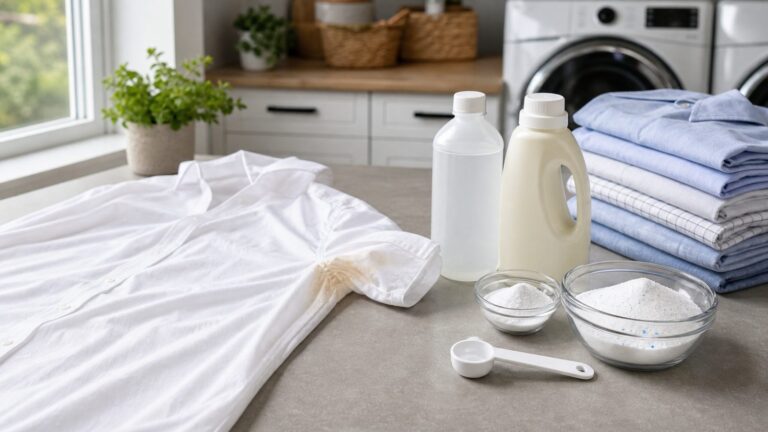
For most washable clothes, the fix is straightforward: separate the item, check its care label, wash it with detergent, optionally use a compatible oxygen-bleach treatment, and dry it completely. A recurring odor means you also need to find the moisture source.
For most washable clothes, the reliable sequence is: separate the garment, check its care label, wash it with detergent using the warmest permitted setting, optionally use a label-approved oxygen-bleach soak, and dry it completely before storage. If the smell returns, treat the dampness source—not just the garment.
As an Amazon Associate I earn from qualifying purchases.
Before washing: separate the clothes and check the label
Move affected clothes away from clean laundry and do not put them in a closet or hamper with dry garments. If there is visible mildew and it is practical to do so, take the item outdoors and gently brush off loose growth there. Avoid vigorous scrubbing, which can spread particles and further damage fibers weakened by mildew.
Next, read both the garment-care label and the instructions for any laundry product you plan to use. “Washable” does not mean every treatment is safe. Cotton and many synthetic fabrics may tolerate a detergent wash and a compatible oxygen-based product, while wool, silk, leather, dry-clean-only garments, and some specialty fabrics need different treatment.
#1 Best Overall

- Oxygen-Powered Stain Removal:Break down tough stains like wine, coffee, grass, sweat, and blood with our powerful sodium percarbonate formula. Acts as a laundry booster that helps whiten whites, brighten colors, and lift deep-set stains with the natural power of oxygen.
- Multipurpose Household Cleaner:Not just for laundry—great for cleaning tile grout, decks, garbage cans, carpets, refrigerators, toilets, countertops, and more. Mix with hot water for a highly effective solution that’s tough on stains and safe on most surfaces.
- Deodorizes at the Source:Eliminates odors from clothes, shoes, and fabrics without masking them. The active oxygen penetrates deep into fibers and surfaces to neutralize bad smells, leaving behind a naturally clean freshness.
- Chlorine-Free Formula:Clean confidently—our powder is free from chlorine and harsh chemicals. It breaks down into oxygen, water, and soda ash after use, making it safe for septic systems and better for the environment.
- Durable Bucket for Long-Term Use:You may use tools such as scissors or pliers to help open the lid more easily, but please exercise caution to avoid injury.Packed in a durable bucket for convenient storage
| Garment or situation | Safer starting point | What to avoid |
|---|---|---|
| Washable cotton, linen, towels, and many colorfast synthetics | Detergent wash at the warmest care-label-approved temperature; consider a compatible oxygen-bleach product | Exceeding the temperature or product directions |
| Athletic or stretchy clothing | Follow the label; use detergent and complete drying; consider a fabric-approved odor product only if needed | Assuming chlorine bleach is safe for spandex or performance finishes |
| Wool, silk, leather, suede, or delicate fibers | Follow the specialist-care instructions or consult a professional cleaner | Home oxygen-bleach soaks, chlorine bleach, hot water, and aggressive scrubbing |
| Dry-clean-only, valuable, or visibly weakened clothing | Take it to a professional cleaner and describe the mildew or musty odor | Experimenting with household chemicals that may set stains or weaken the fabric |
How to remove a musty smell from washable clothes
- Keep the load separate. Wash affected items separately from unaffected clothing, especially when there is visible growth or heavy odor.
- Check pockets and remove anything that could be damaged. Close zippers and follow any special instructions on the label.
- Use ordinary laundry detergent. Select the warmest water setting the care label permits. The goal is to wash away odor residue rather than cover it with fragrance.
- Add an optional oxygen-bleach treatment only when compatible. Use the product’s own directions and confirm that the garment is permitted. Do not assume that all oxygen-bleach powders or liquids have the same concentration, soak time, or fabric restrictions.
- Run the normal wash. If you soaked the clothing, wash it afterward with detergent as directed by the product label. Do not combine separate cleaners unless both labels explicitly allow it.
- Dry the garment completely. Use the care-label-approved dryer setting, line-dry it in a well-ventilated place, or use another permitted method. Do not fold or store it while even slightly damp.
- Inspect before storing. Smell the garment only after it is fully dry. If the odor remains, recheck the label and the moisture source before trying a stronger chemical.
Optional treatment: an oxygen-bleach soak
For a compatible, washable garment, an oxygen-bleach odor remover for laundry can be a useful second step after the care-label check. One manufacturer’s published directions specify one full scoop per gallon of water, a three-to-six-hour soak, and then a normal wash with detergent and the product. Those measurements belong to that product’s instructions; they are not a universal recipe for every oxygen-based laundry additive.
Use a clean container, dissolve the product as directed, fully submerge the garment, and follow the package’s timing and rinsing instructions. Test an inconspicuous area if the label recommends it. Do not use this type of soak on wool, wool blends, silk, silk blends, leather, or dry-clean-only fabrics when the product label excludes them. Also avoid it when the garment-care label prohibits bleaching.
Oxygen bleach is not the same as chlorine bleach. It is generally considered for suitable washable fabrics, but “oxygen bleach” still does not guarantee compatibility with every dye, finish, elastic, or fiber. The product label and garment label control.
When chlorine bleach is appropriate—and when it is not
Chlorine bleach is a limited option for some white or bleach-safe fabrics, not a default mildew treatment. Use it only when the garment-care label and bleach-product label both permit it, and follow the dilution, contact time, ventilation, and rinsing instructions exactly.
Do not use chlorine bleach on materials or colors that the label excludes. Common restrictions include acetate, leather, silk, spandex, wool, mohair, and non-colorfast dyes. Never mix bleach with ammonia, vinegar, or another cleaner: dangerous gases or reactions can result. If you are uncertain about the fiber, colorfastness, or correct dilution, choose a different label-approved method or consult a professional.
Rank #2

- One 5 lb container of OxiClean stain remover and whitener powder to revive brilliant whites
- Oxygen-based, water-activated detergent laundry booster whitens whites 40 percent better than chlorine bleach per load
- Chlorine-free, color-safe clothes whitener revives dingy whites without risking chlorine spills and splatters from laundry bleach on colored clothing
- Mix OxiClean White Revive powder with water as a laundry presoak, or simply pour this laundry detergent booster following label directions in the drum of any HE or standard washer before adding clothes
- White Revive OxiClean powder for laundry is a chlorine bleach alternative that is perfect for t-shirts, sheets, underwear, machine-washable canvas shoes, socks, school uniforms and more, so your whites look their best
What to do with dry-clean-only or valuable garments
Do not put a dry-clean-only coat, suit, silk garment, leather item, heirloom, or expensive piece through a home soak simply because it smells musty. Mildew can weaken fibers, and a treatment that removes odor may still leave stains or permanent structural damage.
Ask a professional cleaner whether the item can be treated, and tell them that it has a mildew or musty odor. For severe visible growth, fragile fabric, or substantial damage, look for a cleaner or textile-restoration specialist experienced with affected garments. A professional cleaner for mildew-damaged clothing is most appropriate when the item is valuable, dry-clean-only, visibly weakened, or outside ordinary home-laundry care.
What’s actually slowing this PC down?
Pick the symptom - the matching free tool is one click away.
Odor, stains, and mold are not the same problem
A garment can smell musty without showing visible mold, particularly after being left damp in a washer, hamper, basement, or closet. Conversely, a garment can lose its odor while retaining a gray, brown, green, or otherwise discolored stain. Washing and deodorizing do not guarantee that a stain will disappear.
Visible mildew may also indicate that the fibers have already been weakened. Do not keep aggressively scrubbing or repeatedly bleaching an item that is thinning, tearing, or losing its finish. Decide whether the garment’s value justifies professional assessment.
Rank #3

- POWERFUL STAIN REMOVAL Activated sodium percarbonate releases oxygen in water to lift tough stains, brighten whites, and refresh fabrics – without chlorine bleach. Safe on colors and tough on everyday messes.
- CHLORINE FREE & UNSCENTED color-safe oxygen bleach powder that boosts your regular detergent to fight stains and odors without added fragrance or chlorine bleach.
- MADE FOR SENSITIVE SKIN Hypoallergenic and fragrance free, with no dyes or harsh chemicals. Rinses completely with no residue left on fabric, making it a safe pick for baby clothes, bedding, and anyone who reacts to conventional laundry products.
- EASY TO USE: Use as a pre-wash treatment or added boost with your laundry detergent. Add one scoop directly to the drum with your detergent (two for heavily soiled loads or hard water). Compatible with HE and standard machines. Septic safe. Not recommended for wool or silk.
- MADE IN THE USA with simple mineral-based ingredients. Cruelty-free, vegan, and packed in resealable, recyclable packaging.
Persistent odor: optional laundry sanitizer or odor eliminator
If a washable item still smells after a correct wash and complete drying, a laundry sanitizer or odor-eliminating additive may be considered as a second-line product—especially for odor-prone athletic or synthetic clothing. Choose only a product whose label permits use on the garment and follow its dosage, temperature, soaking, and rinsing directions.
These products are not interchangeable. Some make claims about odor-causing bacteria; others may address particular odor or mildew-related uses. Do not assume that every laundry sanitizer kills mildew on clothing, and do not use one as a substitute for detergent, thorough drying, or fixing a damp storage area. If you prefer to compare ingredient-screened options, Safer Choice laundry products are a category worth checking through the current EPA-certified product list, while still confirming the individual product’s fabric directions.
The Tool Desk
Outbyte Driver Updater FREEFix the driver behind crashes, sound loss and screen glitchesFind Drivers →Outbyte PC Repair FREEClear out junk files and repair common Windows errorsFree Scan →Why the musty smell keeps coming back
A returning odor usually means that moisture or odor residue remains somewhere in the system. Inspect more than the garment:
- Washer: Look for standing water, residue, a damp gasket, or laundry left sitting in the drum. Follow the washer manufacturer’s cleaning instructions.
- Hamper: Do not leave wet towels, swimsuits, or sweaty athletic wear sealed in a closed hamper. Air them out or wash them promptly.
- Laundry room: Check for leaks, condensation, poor ventilation, and damp floors or walls.
- Closet and basement: Look for high humidity, water intrusion, condensation on cold surfaces, or clothing pressed tightly against a damp wall.
- Drying routine: Make sure thick seams, towels, waistbands, and pockets are fully dry before folding.
Dry wet items promptly and correct the moisture problem. If the closet, laundry room, or building area has persistent dampness or visible mold, cleaning individual garments will not solve the underlying cause. Address leaks and ventilation, reduce excess humidity where appropriate, and obtain qualified building or mold-remediation help for extensive contamination.
Rank #4

- CHLORINE FREE - Concentrated oxygen bleach formula cleans all the way to the fiber, leaving residue-free fabric that is clean, soft, and fresh smelling
- SAFE AND EFFECTIVE - Naturally releases safe peroxide and oxygen to tackle tough stains, whiten whites without the addition of artificial bluing agent for white clothes , and eliminate odors. No harsh chlorine bleach smell.
- COLOR SAFE - Safe for all your color-fast laundry, keeping your clothes looking brand new after every wash great laundry. Excellent bleach for white clothes. More mild than conventional laundry bleach.
- HYPOALLERGENIC - Residue free non chlorine laundry bleach powder, great for those with sensitive skin, containing no perfumes, fillers, or chlorine. Just the sweet smell of clean
- MULTIPURPOSE – Multiuse powder oxygen bleach safely removes soil from anything washable. Excellent bleach for clothes or general household cleaning. Safe for the environment and the septic system.
Troubleshooting common cases
The smell is still there after one wash
Do not immediately switch to stronger chemicals. Confirm that the garment was washed with detergent, that the treatment was permitted, and that it dried completely. If the care label allows it, repeat one label-approved treatment. Then inspect the washer, hamper, and storage area. Results vary with the fiber, how long the garment stayed damp, the amount of visible growth, and whether the odor source remains.
The item has a visible mildew stain
Treat stain removal as a separate problem. Check the care label and use only a compatible stain method. A stain may remain even after the odor is gone, and repeated aggressive treatment can damage a garment that mildew has already weakened.
Do these 3 things before closing this tab:
1Clear out junk files and repair common Windows errors2Scan for outdated or missing drivers - takes under a minute3Repair Windows errors before they cause bigger problemsThe item is a towel
Wash it separately with detergent at the warmest permitted setting, use a compatible oxygen-bleach product according to its label if needed, and dry the towel completely. Do not leave it bunched up in the washer or hamper, where its thick loops can retain moisture.
The item is synthetic athletic wear
Follow the performance-fabric label carefully. Wash with detergent, avoid fabric treatments the manufacturer prohibits, and dry completely. For persistent odor, a laundry sanitizer for odor-prone clothes may be an option only if its label permits the fabric and use case. It is not a replacement for prompt washing and drying.
Best Value

- One 5 lb box of OxiClean Odor Blasters Versatile Odor Eliminator and Stain Remover Powder laundry booster to get out tough stains and stubborn smells
- Oxygen-based, water-activated laundry booster gets out tough dirt, persistent spots and set-in stains, plus eliminates sweat, musty towel and body odors with OxiClean stain remover
- Works with regular detergent as a clothes stain remover and odor neutralizer to get clothes extra clean. For best results, use as a presoak before washing
- This OxiClean powder stain and laundry odor remover can be used as a kitchen cleaner, bathroom cleaner, and fabric odor eliminator for machine-washable fabrics so you are ready for any mess
- Tough on stains yet gentle on fabric, this chlorine-free, color-safe, fabric stain remover formula removes odors and stains to help keep the clothes you love look newer, longer
What not to rely on
- Do not treat fragrance as a solution; it can mask odor while moisture remains.
- Do not assume sunlight, vinegar, baking soda, or a homemade mixture will reliably remove every mildew odor from every fabric.
- Do not use chlorine bleach on every color or fiber.
- Do not use an oxygen-bleach soak on dry-clean-only clothing or excluded fibers such as wool, silk, or leather.
- Do not mix bleach with vinegar, ammonia, or other cleaners.
- Do not promise that one treatment will work for every garment. Persistent odor, visible growth, fiber damage, and a continuing damp source require different decisions.
Quick decision checklist
- Washable and not visibly damaged? Wash with detergent at the warmest permitted setting, optionally use a compatible oxygen-bleach treatment, and dry fully.
- Visible growth indoors? Avoid shaking it indoors; move it outdoors if practical and use appropriate precautions.
- Wool, silk, leather, dry-clean-only, valuable, or weakened? Use a professional cleaner instead of experimenting.
- Odor returns? Inspect the washer, hamper, closet, laundry room, basement, ventilation, leaks, and drying routine.
- Respiratory vulnerability or extensive mold? Avoid substantial cleanup and obtain appropriate help.
Frequently Asked Questions
What is the best way to get a musty smell out of washable clothes?
Wash the garment separately with detergent at the warmest temperature allowed by its care label. If the fabric and product label permit it, use an oxygen-bleach soak before washing. Dry the item completely and inspect the washer, hamper, and storage area if the smell returns.
Does a musty smell always mean the clothes have mold?
Not necessarily. A musty odor can come from clothing left damp in a washer, hamper, closet, or basement. Visible mildew is a stronger warning sign, but odor treatment and mold remediation are not identical problems.
Can I use chlorine bleach on mildew-smelling clothes?
Only if both the garment-care label and bleach-product label permit it. Chlorine bleach is unsuitable for many fibers and colors, including wool, silk, leather, spandex, mohair, acetate, and non-colorfast fabrics. Never mix bleach with vinegar, ammonia, or another cleaner.
How long should clothes soak in oxygen bleach?
Use an oxygen-bleach product only according to its current label and only on permitted washable fabrics. One manufacturer specifies one scoop per gallon of water for a three-to-six-hour soak, followed by a detergent wash, but other products may differ.
How do I treat musty dry-clean-only clothing?
Do not use a home oxygen-bleach soak or chlorine bleach unless the care instructions specifically permit it. Take wool, silk, leather, dry-clean-only, valuable, or structurally weakened garments to a professional cleaner.
Why does the musty smell come back after washing?
Check for dampness in the washer, hamper, closet, basement, and laundry room. Look for leaks, condensation, poor airflow, and clothes that were stored or left in the washer before they were completely dry.
Quick wins for a faster PC:
Fix the driver behind crashes, sound loss and screen glitchesFind Drivers →Repair Windows errors before they cause bigger problemsFix Now →The Bottom Line
Start with the care label, detergent, the warmest permitted wash, and complete drying. Add an oxygen-bleach soak only when both labels allow it; reserve chlorine bleach and home experimentation for clearly suitable fabrics. If the smell returns, find and correct the moisture source or use professional garment care.
Quick Recap
Product prices and availability are accurate as of the date/time indicated and are subject to change. Any price and availability information displayed on Amazon at the time of purchase will apply.