A builder’s speed claim is meaningful only when you know what was measured; a quality claim needs a stated standard and a way to check it. Ask for comparable schedule data, documented workmanship checks, inspection access, customer-service evidence, and the actual warranty terms. No universal homebuyer productivity benchmark is established by the official sources cited here, and the applicable rules vary by country and scheme.
How do I know if a home builder is good?
Do not treat a fast build as proof of good workmanship, or a polished sales claim as evidence of either. Evaluate productivity and quality separately, then compare builders using the same definitions, period, and project type.


As an Amazon Associate I earn from qualifying purchases.
For each claim—such as “faster build,” “on-time delivery,” or “zero defects”—ask the builder to explain what was counted, which homes were included, the measurement period, the comparison group, and the geography. For schedule figures, request the start and finish milestones and ask whether delays, changes, rework, incomplete projects, or cancellations are excluded. An average without those details may conceal a wide spread in actual completion times.
What’s actually slowing this PC down?
Pick the symptom - the matching free tool is one click away.
Ask whether the builder tracks rework and defects alongside build time. A workforce productivity figure alone says nothing about the finished home’s quality. The official sources cited here do not establish a universal productivity benchmark for homebuyers to use across builders, so focus on consistent definitions and evidence for the specific projects being compared.
What should I ask a builder before signing?
Request written answers and supporting documents rather than relying on a verbal assurance or selected testimonials. A useful comparison covers the following:
- Schedule: planned and actual dates for comparable milestones, the definition of “on time,” and how delays or buyer-requested changes are treated.
- Workmanship: the written standard or specification used, who carries out checks, when checks happen, what is sampled, and how failed checks are corrected and recorded.
- Defects and rework: what counts as a defect, the period covered by the figures, how corrective work is tracked, and whether the measure includes all relevant homes.
- Customer outcomes: evidence about finish, the buying experience, aftercare, and complaint handling, with survey timing, response counts, and eligibility limits.
- Protection: the contract, applicable code or scheme, inspection opportunity, warranty provider and terms, and complaint or dispute-resolution route.
If a builder offers only selected customer comments or a headline percentage, ask for the denominator and the full definition behind it. Do not call a claim independently verified unless an independent check has actually been carried out.
How can I check a new-build home’s quality?
Look for a defined standard and assessment method
A credible workmanship claim identifies the standard or specification being applied and explains how work is assessed. Ask who performs the assessment, what parts of the home are checked, how representative the checks are, and what happens when work falls short.
Recommended Free Tools
Singapore’s Building and Construction Authority describes CONQUAS as a system that measures constructed work against defined workmanship standards and specifications, using sampling to represent the overall project. BCA says the system was introduced in 1989. This is a Singapore framework, not a universal consumer certification or a substitute for the standards that apply where you are buying. See BCA’s CONQUAS overview.
Rank #3

- These Quality Checklists are the most extensive and thorough you will find anywhere.
- Custom Builder Ryan Brautovich personally uses these exact checklists on each and every house he builds.
- Gathered over the past 20 years, these checklists ensure your dream home is built to the highest standards and quality possible.
Separate build quality, finish, buying service, and aftercare
Customer feedback can help, but the subject and timing of a survey matter. The New Homes Quality Board (NHQB) explains that the UK Home Builders Federation Customer Satisfaction Survey asks about build quality, finish, buying service, after-move-in service, and whether buyers would recommend their builder. Surveys are sent at eight weeks and nine months after completion; eight-week scores are published quarterly using rolling data. The NHQB page says results are not shown for developers with fewer than 20 responses and under certain other conditions. An undisplayed result does not, by itself, establish good or poor performance. Review the method and limits at NHQB’s survey explanation.
Arrange an inspection and keep a record
Where the applicable scheme or contract allows it, use the opportunity to inspect before completion. The NHQB says eligible developers must give the buyer, or a suitably qualified inspector acting for the buyer, an opportunity for a pre-completion inspection. The right depends on scheme eligibility; check the inspection’s scope and local inspector qualifications. Details are on NHQB’s homebuyer protection page.
Rank #4

- Comprehensive Maintenance Checklist Covers essential monthly and seasonal tasks to keep your home running smoothly all year round.
- Organized by Season Includes clearly labeled sections for Spring, Summer, Autumn, and Winter to simplify home upkeep.
- Easy-to-Use Format Designed for quick reference with large, legible text and a clean layout suitable for any household.
- For Homeowners & Renters Ideal for anyone looking to stay on top of home care—whether you own or rent.
- Durable & Made in the USA Printed on thick 25 mil magnetic material with a glossy laminate for lasting use on your fridge or metal surface.
During an inspection, organize observations by room or location, photograph issues where permitted, and ask for a written response with a correction plan. Notes or a checklist can help track items, but they cannot replace technical judgment where a qualified inspector is needed.
What does a builder’s warranty cover?
Read the actual warranty and contract before relying on a claim that something is “covered.” Check who provides the cover, which parts of the home it applies to, the time limits, exclusions, claim procedure, dispute route, and any deadlines for notifying the builder.
Best Value
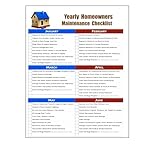
- LAMINATED Home Maintenance Monthly Checklist Log - Laminated for Easy Cleaning - Double Sided!
- EXCELLENT Maintenance Schedule for your House to avoid costly home house repairs!
- LAMINATED 8 1/2 x 11
- PERFECT for New or Experienced Home Owners or Landlords!
- TIPS AND SCHEDULES for Winter, Spring, Summer or Fall!
For U.S. consumers, the Federal Trade Commission says new-home builder warranties commonly cover permanent components, but coverage periods vary. Its examples include typical one-year, two-year, and sometimes ten-year periods; these are not guaranteed terms for every home or warranty. The FTC also distinguishes a builder warranty from a separately purchased home warranty or service contract, and advises making claims in writing and keeping records. See FTC guidance on new-home warranties.
Independent reader supportYour contribution helps us test, update, and keep practical guides available for everyone.Which rules and protections apply where I’m buying?
Standards, consumer protections, and eligibility vary by jurisdiction. Check local building codes, builder registration, the version of any applicable consumer code, your purchase contract, the warranty provider, and the available complaint or dispute-resolution route.
In the UK, the Consumer Code for Home Builders requirements page covers homes reserved from 1 January 2024. It addresses reliable information on completion and handover timing, applicable standards, warranties, and after-sale service. Confirm that the builder and purchase fall under the relevant code and edition before relying on it: Consumer Code requirements.
For a practical reference, NAHB BuilderBooks lists Residential Construction Performance Guidelines, Consumer Reference, Sixth Edition as a 136-page paperback published in July 2023. It is a trade-association reference on quality issues in new homes and remodeling, not a government code or a replacement for local standards: NAHB BuilderBooks listing.
Quick Recap
How to compare builders fairly
- Write down each claim. Record the builder’s wording, project type, measurement period, geography, and comparison group.
- Normalize the definitions. Ask every builder for the same schedule milestones, treatment of changes and delays, and defect or rework definitions.
- Check the quality evidence. Compare the standards used, inspection scope, assessor, sampling approach, and documentation of corrective work.
- Assess service and protection separately. Review survey subjects and response limits, inspection access, warranty terms, aftercare, and complaint procedures.
- Mark what remains unverified. If a figure lacks a denominator, complete period, or clear method, treat it as an unverified claim rather than filling gaps with assumptions.
Product prices and availability are accurate as of the date/time indicated and are subject to change. Any price and availability information displayed on Amazon at the time of purchase will apply.




