Crashes, No Sound, or Screen Glitches?
Random freezes, missing sound and display glitches usually trace back to one bad driver. Find and replace yours safely.Free scan · under a minutePC Slower Than It Used to Be?
A free scan shows the junk files, broken settings and background clutter dragging Windows down - then fixes them in one click.Free scan · Windows 10 & 11Estimate a utility-scale solar farm in two passes: first use a capacity-matched land-density benchmark to screen parcels, then replace that shortcut with a site-specific layout and electrical design. Keep the capacity basis visible at every step. MWDC is the combined nameplate rating of the modules; MWAC is the combined rated output of the inverters. An acreage figure without that distinction can be materially misleading.
This guide answers How to estimate the land and equipment needed for a utility-scale solar farm for ground-mounted photovoltaic (PV) projects. It covers a practical early-stage method, the limits of acreage-per-megawatt rules, the equipment categories that drive a preliminary bill of materials, and the checks needed before a construction estimate is credible.
As an Amazon Associate I earn from qualifying purchases.
Start with the capacity basis: MWAC or MWDC
Write the requested plant size with its suffix before doing any land or equipment arithmetic. The two ratings describe different parts of the plant:
The Tool Desk
Outbyte Driver Updater FREEScan for outdated or missing drivers - takes under a minuteDriver Scan →Outbyte PC Repair FREERepair Windows errors before they cause bigger problemsFix Now →- MWDC is the sum of the PV module nameplate ratings. It describes the direct-current array.
- MWAC is the sum of the inverter ratings. It describes the alternating-current output delivered by the inverter blocks.
The relationship is the inverter loading ratio (ILR), also called the DC-to-AC ratio:
#1 Best Overall
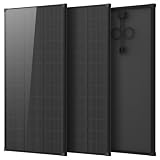
- 【25.6% High-Efficiency & Ultra-Stable Output】AeternaSol 200W solar panel, a premium n type solar panel with 18 BB Full-Welding Silver-Containing Busbars, boasting N-Type A+ Grade Cell, achieves a 25.6% high conversion efficiency. This 200 watt solar panel’s A+ grade monocrystalline silicon effectively reduces microcrack risks, while the 18BB busbars further cut down power loss—ensuring ultra-low degradation and prolonged service life. Note: The 200W rated power is measured under Standard Test Conditions (STC): 1000W/m² irradiance, 25°C, and 1.5 air mass. Real‑world output will vary due to panel angle, operating temperature, shading, wiring loss and connected‑device efficiency.
- 【IP68 Waterproof】Equipped with an exclusive IP68 Waterproof, our solar panels feature advanced potting technology that creates an impermeable seal to prevent water or steam from reaching internal wires. This design minimizes short-circuit risks to the greatest extent, effectively inhibits rust and corrosion, and ensures the solar panel maintains optimal performance even in harsh weather. The junction box’s excellent thermal conductivity enhances heat dissipation, further extending the lifespan of the entire 200 watt solar panel, which is essential for long-term use of solar panels for rv and outdoor applications.
- 【11 AWG 100% Oxygen-Free Copper Wire】Our 200w solar panel comes with 11 AWG 100% Oxygen-Free Copper Wire, which outperforms common copper-clad aluminum cables in conductivity and durability. This extra-thick oxygen-free copper wire can withstand up to 25A current, ensuring efficient power transmission—perfect for rv solar panel and solar panels for camping setups. Beyond the standard insulation layer, the wire is sheathed in a UV-resistant jacket, which significantly extends its lifespan compared to conventional alternatives, providing long-lasting reliability for solar panels for rv and other outdoor uses.
- 【Durable MC4 Connector for Stable Connection】The 200 watt solar panel is fitted with a durable MC4 connector, featuring galvanized copper pins encased in a larger PPO shell that outperforms aluminum-pin connectors with a higher current rating. This robust connector ensures stable power connection for the solar panel charger and compatible devices, while its sturdy PPO shell offers superior compatibility with other connectors on the market. Whether you’re expanding your solar system or replacing parts, this connector makes the 200w solar panel a flexible choice for any setup, including solar panel charger configurations.
- 【Sturdy Aluminum Alloy Frame】Crafted with a more durable aluminum alloy frame, our solar panel is sturdier than steel frames—retaining a sleek shine for years while resisting rust and corrosion. Additional frame sealant prevents air from corroding the monocrystalline cells, protecting the 200w solar panel (200 watt solar panel) from environmental damage, which is crucial for panel solar portatil and solar panels for camping that face frequent outdoor exposure. Pre-drilled holes on the frame ensure effortless installation, making this panel solar portatil easy to set up on RVs, campsites, or rooftops.
ILR = MWDC ÷ MWAC
For a project specified in MWAC, a chosen ILR gives a first-pass DC size:
MWDC = MWAC × ILR
For a project specified in MWDC, the corresponding AC rating is:
MWAC = MWDC ÷ ILR
Those equations are planning relationships, not a substitute for an electrical study. Module technology, clipping strategy, weather, degradation assumptions, interconnection limits and the owner’s production target can all affect the selected ILR. NREL’s 2024 Annual Technology Baseline notes that capacity factor is influenced by the solar profile and by design and operating factors including module technology, bifaciality, tracking, shading, downtime, ILR and inverter losses.
A seven-step land-screening method
-
1. State the target and the comparison basis
Record the target as, for example, “100 MWAC at an assumed ILR of 1.30” or “130 MWDC.” Also record whether the land comparison is for fixed-tilt or tracking arrays, which geography it represents, and when the comparable plants were built. Do not combine a MWDC density from one source with an MWAC target from another unless you convert the basis explicitly.
-
2. Select a comparable density benchmark
Use an empirical power-density or acreage-per-capacity figure from projects with a similar mounting choice, capacity basis, terrain and era. If the benchmark is expressed as power per area, divide the target capacity on the same basis by that density:
screening area = target MW ÷ benchmark MW per acre (or hectare)If it is expressed as acres per megawatt, multiply instead:
Special offer. See more information about Outbyte and uninstall instructions. Please review EULA and Privacy policy.screening area = target MW × benchmark acres per MWLabel the result “screening area.” It is not a permit boundary, a guaranteed yield, or a construction quantity.
-
3. Map gross parcel area against usable area
Draw the parcel boundary in a geographic information system and remove areas that cannot host the selected design. Typical exclusions include steep or irregular terrain, wetlands, flood-prone ground, protected habitat, required setbacks, easements, drainage corridors, cultural resources, buried or overhead utilities, and buffers imposed by zoning or a landowner. A parcel’s gross acreage therefore cannot be treated as array acreage.
-
4. Reserve space for the whole project, not only module rows
The module field is only one part of the site. The layout must also accommodate internal roads, fire access where required, inverter and transformer pads, medium-voltage collection routes, the point of interconnection, construction laydown, fencing, drainage and erosion controls, maintenance access, security clearances and any operations building. The sources do not establish a universal percentage to add for these items, so do not apply a generic “road and balance-of-system” multiplier.
Special offer. See more information about Outbyte and uninstall instructions. Please review EULA and Privacy policy.Rank #2
 SOLPERK Solar Panel 20W 12V Solar Panel Kit+MPPT Controller | MPPT Solar Controller IP67 Waterproof Adjustable Mount Bracket for Boat Car RV Motorcycle Marine Automotive
- 【High Conversion Rate】This 20W solar panel with monocrystalline A+ solar cell has an excellent cell efficiency of 21%-30%. Designed to charge and maintain 12V rechargeable batteries like LiFePO₄, Lithium Ion, AGM, SLA, GEL, EFB, MF, etc. Keep batteries in charged for trailer, tractor, truck, boat, motorcycle, RV, car, lawn mower, water pump, gate opener, electric fence, etc
- 【Built to Last】 Low-iron tempered glass surface and corrosion-resistant aluminum frame, make this solar panel 100% waterproof and rustproof, and provide the prolonged lifespan up to 25 years. This 12V solar panel can withstand all weather conditions such as sandstorm, strong wind, thunderstorm, blizzard, hail, etc. It can withstand up to 2400Pa wind pressure and 5400Pa snow load
- 【Smart MPPT Controller】The charging efficiency of this upgraded 10A controller is 30% higher than other controllers on the market. Its intelligent three-stage charging design effectively prevents the battery from overcharging, over-voltage and short circuit. It takes no power from the battery. You will clearly know the charging status of the battery through the two indicator lights on the controller
- 【360° Adjustable Bracket & Plug-and-Play Installation】Comes with a fully 360° angle adjustable mounting bracket, which allows you to adjust the solar panel to the optimal sun-facing angle for maximum solar energy absorption and higher charging efficiency. Pre-drilled mounting holes and matched screws greatly simplify the installation process, no complicated tools or professional skills are required. All cable connections support plug-and-play, enabling quick and effortless installation and disassembly for both indoor and outdoor scenarios.
- 【Complete Accessories & Reliable After-Sales Service】Our SOLPERK Solar Panel kit includes 1*20W solar panel, 1*smart MPPT charge controller, 1*adjustable mounting bracket, 1*alligator clip, 1*O-ring and a full set of mounting accessories to meet your diverse installation and use needs. We offer 1-year professional after-sales service and lifetime technical support, with 7×24-hour online customer service to respond to your questions and solve problems within 24 hours, bringing you a worry-free shopping and using experience.
-
5. Check resource, terrain and constructability
Screen the solar resource and expected shading, but also examine slope, grading quantities, soil bearing conditions, rock, geotechnical hazards, wind and snow exposure, drainage and erosion risk. Procurement guidance from the U.S. Department of Energy (DOE) also calls out weather, site access, construction logistics, energy demand, existing renewable generation and production requirements. A site with excellent insolation can still fail the screen if foundations, roads or drainage are impractical.
-
6. Screen transmission and interconnection separately
Proximity to a transmission line does not prove that capacity is available. Obtain the utility’s interconnection information, identify the proposed point of interconnection and estimate required studies, upgrades, protection equipment, metering and a switchyard. Interconnection costs and schedule are project-specific and can change both the feasible plant size and the equipment boundary.
-
7. Replace the benchmark with a layout and electrical design
Before treating the acreage or equipment list as a project estimate, have the design team place module tables, tracker rows or fixed-tilt strings, inverter stations, roads, drainage, setbacks and electrical facilities on the actual parcel. The resulting single-line diagram, cable schedule, grading plan and interconnection design should control procurement quantities and the construction estimate.
What the empirical land evidence does—and does not—say
Mark Bolinger and Greta Bolinger’s 2022 study, Land Requirements for Utility-Scale PV: An Empirical Update on Power and Energy Density, analyzed more than 90% of U.S. utility-scale PV plants built through 2019. It found that median density changed substantially over the study period and that fixed-tilt and tracking plants followed different trajectories.
What’s actually slowing this PC down?
Pick the symptom - the matching free tool is one click away.
| Measure | Fixed-tilt plants | Tracking plants | Qualification |
|---|---|---|---|
| Change in median power density, 2011–2019 | 52% increase | 43% increase | Study finding for U.S. utility-scale PV plants built through 2019 |
| Change in median energy density, 2011–2019 | 33% increase | 25% increase | Study finding, not a forecast of future projects |
The direction of change matters: a rule copied from an older project can overstate the acreage needed by a newer design, while a benchmark from a compact, favorable site can understate the land needed on a constrained parcel. The study’s abstract cautions: “Those relying on the earlier benchmarks published nearly a decade ago are, thus, significantly overstating the land requirements of utility-scale PV.” That sentence describes the study’s historical comparison; it is not a universal promise that every new plant will use less land.
Use the figures as a range of evidence, not as a single national rule. Keep the plant vintage, mounting system, MWAC or MWDC basis, and scope boundary beside every number in a spreadsheet or feasibility memo.
Keep three different land numbers separate
Array footprint
This is the area physically occupied by module tables or tracker rows, including the spacing needed for the selected geometry. It is the closest match to a power-density study when the study defines density around the array.
Developable area
This is the portion of the parcel that remains after environmental constraints, setbacks, slope limits, easements, drainage corridors and other exclusions are applied. It is the area from which the layout team can actually select array blocks and facilities.
Full project or site boundary
This includes array blocks plus roads, fencing, inverter and transformer stations, collection systems, the interconnection yard, construction staging, buildings and required buffers. A lease, purchase or permit may need the full boundary even when a density benchmark describes only the array footprint. Never present one of these areas as if it were another.
A DOE benchmark example for checking your arithmetic
DOE’s Solar Photovoltaic System Cost Benchmarks describes an illustrative, not universal, system. It is useful for checking whether a preliminary inventory is internally consistent:
| Item | Illustrative value | What it represents |
|---|---|---|
| Plant AC rating | 76 MWAC | Aggregate inverter output |
| Central inverters | 19 units at 4 MWAC each | 19 × 4 MWAC = 76 MWAC |
| Modules | 167,000 | Module count in the benchmark configuration |
| Mounting | Single-axis trackers | Tracker-based array design |
| Tracker-array occupied land | 155 hectares | Array-area figure for this benchmark scope |
| Inverter loading ratio | 1.34 | DC array rating divided by AC inverter rating |
At an ILR of 1.34, the example implies approximately 101.84 MWDC (76 MWAC × 1.34). That derived value is specific to the benchmark’s assumptions. It does not establish a universal module wattage, module count, tracker spacing, acreage factor or current procurement specification. A project using different module ratings, inverter architecture, row spacing, terrain or interconnection limits will produce different quantities.
Rank #3

- [Industry-Leading 25% Efficiency] 16BB N-Type cells deliver more power from the same sunlight, supporting RV trips, camping, blackout backup, and off-grid use in limited or cloudy conditions.
- [Lightweight & Magnetic Design] Weighing 13.89 lb and folding to 23.72 x 22.99 x 1.97 in, this 200W panel stores at backpack size with a magnetic closure for SUVs, RVs, and campsites.
- [Direct Device Charging] Charge 3 devices with USB-C PD 45W and dual USB-A ports for phones, tablets, laptops, GPS, and cameras.
- [Compatible with Most Power Stations] Compatible with Jackery Explorer 1000 v2, EcoFlow DELTA 3/DELTA 3 Max/RIVER 3 Max, Anker SOLIX S2000, and other models that meet the requirements. MC4 output only; the 4-in-1 adapter is sold separately.
- [UL 61730 Certified] Tested to UL 61730 and listed with CE, RoHS, FCC, CA65, PSE, and ISO 9001 claims. Four kickstands, an accessory pouch, reinforced grommets, and 40°/50°/60° angles help position the panel on RVs, tents, or windy campsites.
Build the preliminary equipment inventory by function
A useful early list names every major category before anyone tries to attach a quantity. The following groups cover the core PV plant and the site work that a construction team must price or coordinate.
Recommended Free Tools
PV modules
Modules establish MWDC. The preliminary count is:
module count = (target MWDC × 1,000,000) ÷ module nameplate watts
Use the actual module data sheet selected for the concept, including dimensions, voltage, current, temperature coefficients and bifacial assumptions where applicable. A residential panel listing is not a proxy for utility-scale procurement; utility projects require matched electrical, structural, warranty and logistics specifications.
Mounting structures, trackers and foundations
Choose fixed-tilt racking or a tracking system, then size tables, piles or other foundations, torque tubes, motors, controls and spare parts around the module dimensions and geotechnical conditions. Tracker rows change with terrain, row-to-row shading limits, backtracking strategy, access aisles and the shape of the parcel. Fixed-tilt foundations and row geometry are likewise site-specific.
Inverters
Inverters establish MWAC. For a preliminary architecture:
Quick wins for a faster PC:
Repair Windows errors before they cause bigger problemsFix Now →Scan for outdated or missing drivers - takes under a minuteDriver Scan →inverter quantity ≈ target MWAC ÷ selected inverter rating
Round to a practicable block configuration and verify that the resulting total AC rating, clipping behavior, redundancy, voltage and maintenance strategy meet the interconnection and production requirements. Central inverters, distributed string inverters and medium-voltage power stations create different pad, cable, spare and service needs.
DC and AC wiring
Include module interconnects, string harnesses, DC combiner equipment where used, homeruns, medium-voltage collection circuits, communication fiber and grounding or bonding conductors. Cable quantities depend on the physical layout and voltage architecture, not just on MW. A preliminary takeoff should therefore come from a block layout with route lengths and conductor selections.
Transformers and medium-voltage equipment
Each inverter block may require a step-up transformer or an integrated medium-voltage power station. The collection system also needs medium-voltage switchgear, sectionalizing equipment, protection and control, metering and communications. Size transformer MVA, voltage class and protection settings from the inverter blocks and utility requirements.
Switchyard and interconnection equipment
The project may need a dedicated switchyard, breakers, disconnects, relays, revenue metering, telecommunications, grounding, a control enclosure and utility-specified protection. The exact boundary depends on the interconnection agreement. Do not assume that the plant’s medium-voltage collection equipment is the same as the utility interconnection facilities.
Site and civil works
Carry site preparation, grading where permitted, pile installation access, internal roads, temporary construction roads, fencing and gates, stormwater drainage, erosion and sediment controls, equipment pads, trenching, foundations, a warehouse or operations-and-maintenance building where required, signage and restoration. These works consume space and can dominate schedule risk even when they do not appear in a module count.
Rank #4

- ⚡ Ultra-Lightweight & Ultra-Portable: 100W Foldable Solar Panel Weighing only 4.1lbs (1.85kg) with a sleek 0.59-inch profile, this solar charger is engineered for ultimate portability. It folds down to a compact 12.99 x 10.43 x 2.17" (330x265x55mm) and includes a premium carry bag, making it effortless to transport during camping, hiking, or road trips. The generous unfolded size of 45.47 x 26.18" ensures maximum power capture while remaining easy to handle.
- 🔌 Universal 3-in-1 Output & Versatile Adapters: Equipped with PD 3.0 45W USB-C, 18W USB-A, and 100W DC outputs, this solar panel powers all your devices simultaneously. The included 4-in-1 charging cable (DC5521, DC7909, Anderson, XT60) provides universal compatibility for most portable power stations, power banks, and smartphones. It is the ultimate solution for off-grid living and emergency power outages.
- ☀️ High-Efficiency Monocrystalline Technology: Built with premium monocrystalline silicon cells and durable E-Film lamination, this panel delivers an impressive 23%+ energy conversion efficiency. This advanced technology ensures faster charging even in low-light conditions, providing reliable performance on overcast days or in harsh outdoor environments.
- 🛡️ IP67 Waterproo f & Dustproof for All-Weather Use: Engineered to meet the IP67 waterproof and dustproof standard, this solar panel is built to withstand the elements. It is fully protected against rain, dust, sand, and extreme temperatures, ensuring uninterrupted power generation during your adventures by the lake, in the desert, or during sudden downpours.
- 🏕️ Rugged & Reliable for Outdoor Emergencies: Designed to thrive in the great outdoors, this foldable solar panel is perfect for camping, fishing, RV travels, and unexpected power outages. Its durable E-FLIM lamination construction guarantees long-term durability, making it an essential and cost-effective power backup solution for your outdoor lifestyle and emergency preparedness kit.
Controls, monitoring and safety systems
Include plant controls, supervisory monitoring, weather stations, irradiance and temperature sensors, tracker controls, communications, cybersecurity provisions, fire detection or suppression required by the design, lighting and emergency access. The specification should identify which items are part of the PV plant, the interconnection scope or the owner’s operations package.
Battery energy storage
A battery energy storage system is optional. Include it only when the project scope, dispatch requirement, interconnection study or commercial arrangement calls for storage. Storage power (MW), energy (MWh), enclosures, inverters, transformers, fire protection and augmentation are separate design quantities; do not fold them into MWAC or MWDC for the PV array. DOE’s benchmark storage example is a separate system and should not be conflated with the PV capacity.
Do these 3 things before closing this tab:
1Fix the driver behind crashes, sound loss and screen glitches2Repair Windows errors before they cause bigger problems3Scan for outdated or missing drivers - takes under a minuteHow to turn the inventory into quantities
Use a block diagram and a quantity worksheet rather than a single multiplier. The following relationships are suitable for screening:
| Equipment or work package | Screening basis | Quantity source for the next design stage |
|---|---|---|
| Modules | MWDC and selected module watts | String layout, module data sheet and spare policy |
| Inverters | MWAC and selected inverter rating | Electrical block design, clipping and interconnection limits |
| Racking or trackers | Module dimensions, table size and site geometry | Row layout, terrain model and foundation design |
| Foundations | Structure type and geotechnical conditions | Geotechnical report and stamped structural design |
| DC cable | String count and route lengths | Detailed string, combiner and trench layout |
| AC collection cable | Inverter blocks, voltage and circuit routes | Single-line diagram, ampacity and voltage-drop study |
| Transformers | Inverter-block MVA and voltage ratio | Equipment schedule and utility fault-duty requirements |
| Switchgear and protection | Collection topology and interconnection requirements | Protection, coordination and interconnection studies |
| Roads, drainage and fencing | Parcel geometry, access standards and hydrology | Civil plan, stormwater design and fire-access review |
For construction pricing, separate owner-furnished equipment from EPC-furnished work, identify long-lead items, and show whether freight, foundations, trenching, testing, commissioning and spares are included. A count without a scope boundary is not a comparable bid quantity.
Fixed tilt versus tracking: compare on more than acres
Tracking can change row spacing, motor and controls requirements, maintenance access, wind loading, grading tolerance and energy production. Fixed tilt can simplify moving parts and controls but has a different orientation and spacing trade-off. The Bolinger study reports different historical power- and energy-density trends for the two configurations, so a fixed-tilt benchmark should not be silently transferred to a tracking layout.
Compare alternatives on a consistent basis:
- Use MWAC or MWDC consistently in both numerator and denominator.
- State whether the area is tracker-array footprint, usable developable area or the full project boundary.
- Compare expected energy, not only nameplate density. NREL identifies bifaciality, tracking, shading, downtime, ILR, inverter losses and module technology as capacity-factor influences.
- Include civil complexity, foundation risk, operations access, spare parts and controls in the cost and schedule comparison.
Neither mounting choice wins on land density alone. The right selection depends on the solar resource, terrain, production target, interconnection, cost and construction constraints.
Free tools Windows power users keep installed
One-click scans. No signup required.
Site-screening checklist for a construction feasibility memo
- Solar resource: long-term irradiance, seasonal profile, shading and soiling assumptions.
- Topography and slope: grading limits, tracker tolerances, cut-and-fill, rock and erosion exposure.
- Weather: wind, snow, hail, temperature and flooding conditions used for structural and electrical design.
- Geotechnical conditions: pile drivability, corrosion, groundwater, bearing capacity and unsuitable soils.
- Parcel control: ownership, lease or purchase rights, parcel size, easements and mineral or access rights.
- Transmission and interconnection: point of interconnection, available capacity, study status, upgrades, protection and schedule.
- Zoning and permits: land-use approvals, setbacks, glare or visual requirements, noise limits and construction-hour rules.
- Environmental and community effects: wildlife, wetlands, cultural resources, drainage, agricultural impacts and host-community needs.
- Access and logistics: public-road capacity, turning radii, bridge limits, laydown areas, module delivery routes and crane access.
- Water and drainage: stormwater outfalls, erosion controls, crossings and maintenance access after construction.
- Operations: security, vegetation management, spare storage, communications and emergency response.
DOE’s large-scale solar siting and Federal Energy Management Program guidance identify these types of resource, topography, transmission, interconnection, land-cost, zoning, wildlife, ownership, access, production and construction considerations. They are screening gates, not optional notes to be added after the layout is complete.
Common estimation errors and how to correct them
Using “acres per MW” without a suffix
Problem: The number could refer to MWAC, MWDC, array footprint or a full site.
Correction: Put the capacity basis and scope in the label, such as “tracker-array hectares per MWAC, U.S. plants built in a stated period.”
Applying a decade-old benchmark as a universal rule
Problem: Module ratings, row geometry, tracker design and plant density evolve.
PC Slower Than It Used to Be?
A free scan shows the junk files, broken settings and background clutter dragging Windows down - then fixes them in one click.Free scan · Windows 10 & 11Crashes, No Sound, or Screen Glitches?
Random freezes, missing sound and display glitches usually trace back to one bad driver. Find and replace yours safely.Free scan · under a minuteCorrection: Use the 2011–2019 empirical findings as historical evidence, then select a comparable project set and run sensitivity cases.
Best Value

- 【Grade A+ Cells, Up to 25.6% Efficiency】200 watt solar panel utilizes advanced N-Type A+ Grade solar cells and utilizes advanced 18 BB Silver-Containing Full Welding Busbars technology(which improves the photoelectric conversion efficiency and ensures a longer service life compared to traditional 10BB/12BB solar cells) with an increased cell efficiency of 25.6% EL tested,outperforming traditional panels.
- 【No energy drains at night】By incorporating reverse current blocking diode technology, photovoltaic systems achieve “lossless” operation during night-time hours, thereby enhancing energy utilisation efficiency while simultaneously improving safety and durability.
- 【IP68 waterproof certification】Exclusive Filled with Polyurethane polymer Junction Box.it prevents water or steam from reaching the wires inside,Rated IP68 for dust and water resistance, 200W solar panel is designed to endure dirt, splashes, and rain effortlessly. Its anti-corrosion aluminum alloy frame ensures decades of reliable outdoor performance. Engineered for extreme conditions, it withstands 2400 Pa wind pressure and 5400 Pa snow loads.
- 【Enhanced MC4 Connector】Crafted from premium galvanised copper for superior conductivity, effectively reducing resistance and heat generation while boosting transmission efficiency. PPO engineering plastic, it offers exceptional heat resistance and anti-ageing properties. Oversized design enhances structural integrity and delivers superior protection ratings, ensuring reliability in demanding outdoor conditions.Standard MC4 interface for plug-and-play functionality and effortless installation.
- 【11 AWG 100% Oxygen-Free Copper Wire】 Crafted from high-purity oxygen-free copper (OFC) with conductivity reaching 99.99%, offers lower resistance and more efficient transmission, and capable of handling currents up to 25 amps. Beyond standard insulation, it features an additional UV-resistant sheath that effectively withstands prolonged sunlight exposure, high-temperature ageing, and moisture corrosion.
Multiplying gross parcel acreage by a density figure
Problem: Constraints, setbacks, roads and electrical facilities make gross acreage unavailable to the array.
Correction: Map developable area first and preserve a separate full-site boundary for permitting and real-estate decisions.
Assuming a nearby transmission line guarantees an interconnection
Problem: Capacity, protection, studies and network upgrades may be unavailable or expensive.
The Tool Desk
Outbyte PC Repair FREERepair Windows errors before they cause bigger problemsFix Now →Outbyte Driver Updater FREEScan for outdated or missing drivers - takes under a minuteDriver Scan →Correction: Obtain utility study information and carry an explicit interconnection scope and schedule.
Counting modules but omitting balance of system
Problem: Roads, drainage, foundations, transformers, switchgear and communications can control cost and schedule.
Correction: Build the equipment inventory by functional category before requesting prices.
Mixing storage into the PV rating
Problem: A battery’s MW and MWh describe a separate system.
Correction: Show storage as an optional, separately sized scope with its own interconnection and fire-safety requirements.
Ranking designs on land density alone
Problem: A compact layout can have different production, clipping, grading or maintenance outcomes.
Correction: Compare energy, cost, constructability, risk and permitting together with land use.
What to hand from screening to detailed design
A construction-ready feasibility package should preserve the assumptions that produced every number. At minimum, deliver:
- A capacity statement showing MWAC, MWDC and the assumed ILR.
- A parcel map distinguishing gross, developable, array and full project areas.
- A benchmark register identifying mounting type, geography, plant vintage, density basis and source attribution.
- A concept layout with module or tracker blocks, roads, drainage, setbacks, inverter stations and the interconnection point.
- A preliminary single-line diagram and equipment schedule covering modules, structures, inverters, wiring, transformers, switchgear, controls and site works.
- A constraints and permitting log covering environmental, zoning, community, ownership and access issues.
- An interconnection risk register listing study status, network upgrades, utility equipment and schedule dependencies.
- Sensitivity cases for ILR, mounting choice, usable-area exclusions, module wattage and plant size.
The detailed engineering team can then convert the concept into stamped civil, structural and electrical documents, a grading and drainage plan, cable schedules, protection studies, procurement specifications and a defensible construction estimate.
National land figures are context, not a project calculator
The DOE-cited Solar Futures Study projects about 5.7 million acres of solar deployment by 2035, equal to 0.3% of the contiguous United States, and up to 10 million acres by 2050, or 0.5%. Those are national deployment projections accessed in 2026. They do not provide an acreage factor for an individual plant and should not be divided by a proposed project capacity to create one.
The decision rule
Use a land-density benchmark to decide whether a parcel deserves study, not to promise that it can host a specified plant. Keep MWAC and MWDC visible, convert the ILR explicitly, distinguish array footprint from the full site, inventory all major equipment and civil works, and verify interconnection and constraints before committing to acreage, quantities or a construction price. Final land and equipment requirements are established only by parcel-specific layout, permitting and electrical engineering.
Quick Recap
Product prices and availability are accurate as of the date/time indicated and are subject to change. Any price and availability information displayed on Amazon at the time of purchase will apply.
Quick wins for a faster PC:
Repair Windows errors before they cause bigger problemsFix Now →Fix the driver behind crashes, sound loss and screen glitchesFind Drivers →Clear out junk files and repair common Windows errorsFree Scan →
