For a row of evenly spaced holes on a drill press, use a fence, a clamped ruler, and a reference hole: align the stock at a ruler mark, drill, then advance it by the same interval for each hole. This indexes each new hole from the last instead of requiring you to measure every position from the end.
Choose a method that suits the job
The best setup depends on your tools, the hole pattern, and how consistently you can register the workpiece. Use the ruler-and-fence method for a drill press and a straightforward row; choose a self-indexing jig for repeated holes with a portable drill or when a fixed spacing guide is more convenient.
- Drill press and fence: A ruler clamped to the fence provides a simple index for a row of holes.
- Portable drill: A self-spacing jig can register in holes already drilled, helping carry the spacing forward.
- Shelf-support holes: A compatible perforated guide and self-centering bit can keep the pattern aligned.
- Centered layout: A sheet marked with equally spaced parallel lines can help lay out a centered pattern without calculating each position.
These are practical setup methods, not controlled tests: the cited instructions do not quantify drilling accuracy or time savings.
Drill a row from a reference hole using a drill press
This method uses the fence to keep the workpiece aligned and a ruler to index the spacing. It is especially useful when the ruler is at least half as long as the workpiece, and you can choose an easy-to-remember ruler mark as your starting point. WOOD Magazine describes it for evenly spaced holes such as those in a shelf standard, with one-inch and half-inch spacing examples. WOOD Magazine’s drill-press method
What’s actually slowing this PC down?
Pick the symptom - the matching free tool is one click away.
#1 Best Overall

- Versatile drilling capabilities. Suitable for straight or angled drilling, drilling on the edge of a board, on walls or on round stock.
- Attaches to all 3/8" and 1/2" cordless drills. It also includes a 3/8" capacity chuck with key.
- Multiple drilling angle settings of 45, 60, 75, and 90 degrees. Each setting locks into place ensuring total accuracy.
- Self-Centerting base to accommodate drilling any round stock up to 3" inches in diameter.
- Portable Drill Press Alternative. Compact and lightweight design allows you to achieve drill press precision anywhere without the bulk of a stationary drill press.
- Set the fence so the holes will be the required distance from the workpiece edge. Keep the workpiece registered against the fence throughout.
- Drill the center hole. If the pattern has an even number of holes, use one of the two holes nearest the center as the starting reference.
- With the bit still in the reference hole, align the workpiece end with a convenient ruler mark and clamp the ruler to the fence.
- Raise the bit, move the workpiece end to the next ruler mark by the required interval, and drill the next hole.
- Continue advancing the workpiece by the same interval for each hole. Turn the standard end for end and repeat from the center to complete the other side.
The reference hole and repeated ruler movement mean you do not have to calculate every hole’s position from an end. Keep the stock firmly against the fence and make each move to the same mark interval.
Use a self-spacing jig with a portable drill
A self-indexing jig transfers spacing from holes already drilled, so it can be useful when you do not have a drill press. WOOD Magazine describes a particular oak jig made with two short quarter-inch dowels and three quarter-inch guide holes on two-inch centers. In that example, the first guide hole sits one inch from the jig’s thick end. Those dimensions describe the example jig; they are not universal specifications. WOOD Magazine’s drill-guide example
Rank #2

- Portable Drilling Solution: The Kreg Drill Guide Pro is a drill guide compatible with 3/18” and ½” cordless drills; with included 3/8” capacity chuck with key
- Precision Angle Drilling Jig: Drill in your perfect angle – quick accurate adjustable angle settings from -45 to 45 degrees without the limitation of positive stops
- Cleaner Drilling Experience: Enjoy cleaner drilling and consistent hole depth thanks to built-in dust collection and an integrated depth stop that keeps your workspace tidy
- Secure & Convenient Operation: Work confidently with non-marring, non-slip feet, a built-in v-groove for secure workpiece hold, and a convenient handle for easy maneuvering
- Premium Kreg Tools: We offer products that help woodworkers close the gap between idea and outcome
- Make or select a jig whose guide holes, dowels, and spacing match the hole pattern you need.
- Mark and drill the first two holes in the workpiece.
- Seat the jig’s dowels in those holes so the guide is registered to the established spacing.
- Drill the next hole through the appropriate guide hole, then step the jig forward one position at a time.
Keep the jig seated consistently and secure the workpiece for drilling. A jig only indexes reliably when its dowels fit the existing holes and its guides suit the bit and intended pattern.
Index repeated holes with a drill-press hinge jig
A hinge attached to a fence can act as a simple indexing stop. Set the distance from the screw in the hinge to the bit to the desired hole spacing; set the bit-to-fence distance to establish the hole’s offset from the edge. WOOD Magazine’s hinge-jig instructions
Do these 3 things before closing this tab:
1Scan for outdated or missing drivers - takes under a minute2Repair Windows errors before they cause bigger problems3Fix the driver behind crashes, sound loss and screen glitchesRank #3
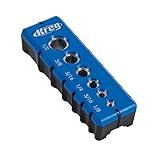
- Premium Home Improvement Tools: Drill guide can create perfectly positioned holes thanks to 6 built-in hole alignment marks
- Sturdy Woodworking Tools: The 6 included hardened-steel drill guides help you make clean, precise holes
- Multiple Drill Guide Sizes: This woodworking tool features guide sizes of 1/8, 3/16, 1/4, 5/16, 3/8, and 1/2 of an inch
- Versatile Carpentry Tools: This drill guide has a GripMaxx surface to prevent slipping; the guide centers itself on 1/2-inch and 3/4-inch material edges
- Premium Kreg Tools: We offer products that help woodworkers close the gap between idea and outcome
- Position the hinge and its screw on the fence, then adjust the setup for both the spacing and the edge offset.
- Drill the first hole.
- Slide the stock until the hinge screw drops into the hole just drilled.
- Drill the next hole, then repeat the index-and-drill sequence.
Check that the workpiece remains against the fence as you slide it. If the screw does not seat in the hole, do not drill the next position until the indexing setup is corrected.
Use a perforated guide for shelf-support holes
For guided shelf-support holes, WOOD Magazine describes quarter-inch perforated hardboard used with a self-centering bit that has a three-eighths-inch retractable sleeve. Its example uses every other guide hole to create two-inch spacing and covers unused holes with tape to reduce the chance of drilling in the wrong position. WOOD Magazine’s perforated-hardboard method
Rank #4

- 【Angle Drill Guide for Straight Holes】The angle drill block for straight holes is a 90 degree drill guide, which is very accurate for the drill block for straight holes
- 【Angle Drill Jig for Angled Holes】This angle drill guide for angle drilling is suitable for both 45 degree drill jig and 30 degree angle drill guide, allowing for easy and precise drilling at 30° and 45° angles.
- 【Euipped with 4 Drill Bits】This drill guide for hand drill includes four sizes of twist drills and four guide hole sizes: 3/8 inch (9.52 mm), 5/16 inch (7.93 mm), 1/4 inch (6.35 mm), and 3/16 inch (4.76 mm)
- 【Multifunctionality】Corner Drill Guide is suitable for construction projects, home improvement, woodworking, etc., meeting the needs of various DIY projects, used for Stairs Handrails, Cable Railings, Decks, and Wood Posts Level design
- 【You Will Get】VASTHOME 30-45-90 Degree Angle Drill Guide Jig *1, Instruction Manual *1. The operation is simple, allowing you to get started quickly, saving time and effort. We also provide 24/7 customer service, so if you have any questions about angle drill jig, feel free to ask. Wishing you a pleasant shopping experience!
This setup is specific to a compatible guide and bit. Confirm the guide-hole size, bit, and desired spacing work together before drilling; do not assume the example applies to other hole diameters or patterns.
Independent reader supportYour contribution helps us test, update, and keep practical guides available for everyone.Lay out equal spacing without calculating every position
If you need to plan a centered row before drilling, a flat, light, sturdy sheet with equally spaced parallel lines can help. Mark the workpiece centerline, align it near the middle of the sheet, and adjust the angle. The intersections of equal numbers of lines on either side of the centerline provide equal spacing. WOOD Magazine’s no-calculation layout method
The Tool Desk
Outbyte Driver Updater FREEFix the driver behind crashes, sound loss and screen glitchesFind Drivers →Outbyte PC Repair FREERepair Windows errors before they cause bigger problemsFix Now →Best Value

- All metal construction and large ½” (13mm) keyed chuck for a heavy-duty professional drilling application
- Infinite angle adjustments between 0° and 60° for drilling. MAKE SURE BOTH KNOB AND HANDLE ARE PROPERLY TIGHTENED BEFORE USE.
- Included optional non-slip base pads prevent movement and protect the workpiece. INSTALLING SLIP PADS HIGHLY RECOMMENDED TO PREVENT MOVEMENT.
- Dual Spring Design Increases balance and control while drilling
- Built in V-groove channel holds and centers round stock for drilling
Keep the spacing consistent
- Use one repeatable reference: Choose a center hole, fence, guide hole, stop, or centerline and keep registering from it.
- Set the edge offset separately: Spacing between holes and distance from the workpiece edge are different dimensions; establish both in the setup.
- Check compatibility: Match the jig or guide, bit, guide-hole diameter, spacing, and stock thickness to the task.
- Secure and register the stock: Clamp where the method requires it, and keep the workpiece against the fence or fully seated in the jig.
- Verify the first few indexes: Before continuing a long row, confirm that the workpiece moves by the intended interval and that the pattern remains aligned.
WOOD Magazine’s drill-press article describes the ruler method as accurate without arithmetic when the ruler is at least half as long as the workpiece. That is practical guidance, not a quantified accuracy guarantee. WOOD Magazine, July 28, 2017
Quick Recap
Product prices and availability are accurate as of the date/time indicated and are subject to change. Any price and availability information displayed on Amazon at the time of purchase will apply.




