The Tool Desk
Outbyte PC Repair FREERepair Windows errors before they cause bigger problemsFix Now →Outbyte Driver Updater FREEFix the driver behind crashes, sound loss and screen glitchesFind Drivers →Some links on this page are affiliate links: if you buy through them we may earn a commission, at no extra cost to you.
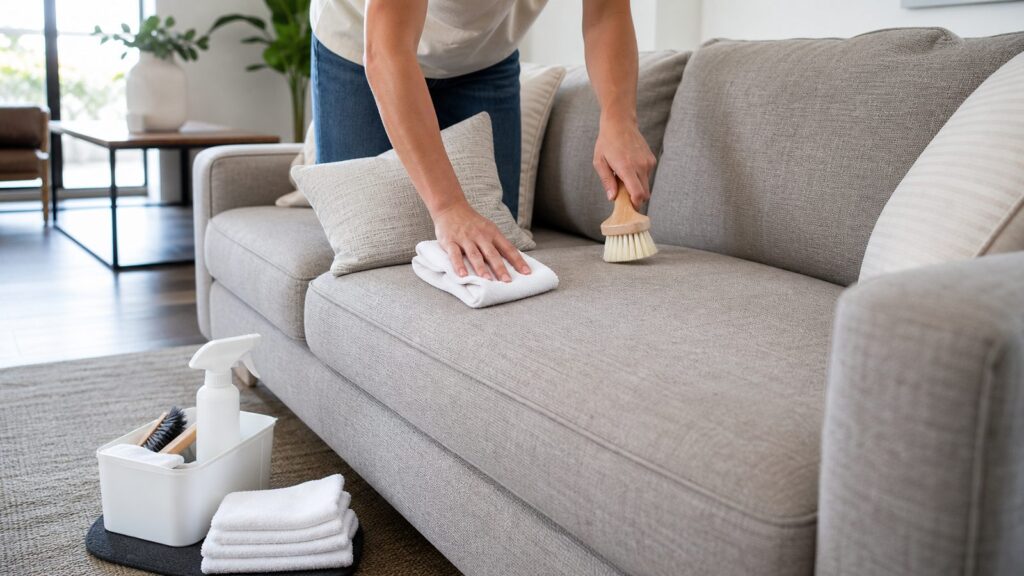
A couch is not one material. It is face fabric or leather, cushion foam, batting, thread, trim, zippers, decking, wood or metal framing, adhesives, and sometimes cardboard or fiberboard inside the arms. That is why the right way to clean a couch starts with identification, not a spray bottle.
For most homeowners, the safe order is simple: read the cleaning code, vacuum thoroughly, test in a hidden spot, use the least aggressive compatible cleaner, control moisture, and dry the couch quickly with airflow. Water-based foam may be fine on many W-coded fabrics. Solvent-only S fabrics need a different approach. X-coded upholstery should not be wet-cleaned at home. Leather needs its own method, and suede, nubuck, aniline, silk, viscose, velvet, and antique upholstery deserve professional judgment.
As an Amazon Associate I earn from qualifying purchases.
What’s actually slowing this PC down?
Pick the symptom - the matching free tool is one click away.
On our job sites, we treat soft goods the same way we treat finished wood, tile, or stone: identify the material before touching it. A bad couch-cleaning job can leave water rings, dye bleed, shrunken cushion covers, crunchy residue, mildew odor, or damaged leather finish. A careful one can add years of service life.
Start With the Couch Cleaning Code
Most upholstered couches have a care tag under a cushion, below the seat deck, or on the underside of the frame. Photograph it before you clean. Also take a quick photo of the whole couch and any stains. That gives you a reference if a mark changes, a dye transfers, or you decide to call a cleaner later.
Popular on Amazon

- EVERY PURCHASE SAVES PETS. Every purchase makes it possible for BISSELL to continue our support of BISSELL Pet Foundation and its mission of saving pets in need.
- SAVE YOUR SANCTUARY: Tackle spills and pet stains while removing dander, dust, and pollen allergens.
- CLEANS MORE THAN CARPET: Spray, scrub, and suction to remove embedded dirt and stains from upholstery, car interiors, pet beds, and more.
- INCLUDES: 4” Tough Stain Tool with removeable lens, HydroRinse self-cleaning hose tool, and 8oz. BISSELL Little Green Formula.
- EASY STORAGE: Conveniently stores in small spaces - perfect for cabinets, closets, and more.
The tag code applies mainly to the face fabric. It does not guarantee that cushion foam, backing, trim, buttons, zippers, adhesives, decking, or frame materials can tolerate the same treatment. You still need a spot test.
| Cleaning code | What it means | Homeowner-safe approach | What to avoid |
|---|---|---|---|
| W | Water-based cleaner is generally allowed | Vacuum, test, then use mild water-based upholstery foam or a low-moisture method | Soaking, heavy steam, laundry detergent, bleach, high heat |
| S | Solvent-based cleaner only | Vacuum and spot test a compatible upholstery solvent, or hire a pro | Water, steam, wet extraction, vinegar mixtures |
| WS or W-S | Water-based foam or mild solvent may be allowed | Choose the gentlest option after testing for dye transfer and texture change | Assuming either method is safe without testing |
| X | Vacuuming or light brushing only | Dry vacuuming with upholstery attachment and soft brushing | Any liquid cleaner, solvent, steam, extraction |
If the tag is missing, assume the couch is sensitive until proven otherwise. That means no machine extraction, no steam wand, and no large wet area. Test a hidden spot first, such as the lower back, rear skirt, or underside of a loose cushion. Press a white towel against the test area after applying the cleaner. If color transfers, the fabric is not colorfast enough for that method.
Free tools Windows power users keep installed
One-click scans. No signup required.
Tools and Supplies That Are Worth Having
You do not need a cabinet full of chemicals. For normal couch cleaning, a small kit is better than an aggressive one.
- Vacuum with upholstery tool and crevice tool
- Soft horsehair-style brush or clean upholstery brush
- White microfiber cloths, at least 6 to 10
- Distilled water for water-safe fabrics
- Mild upholstery cleaner matched to the code
- Spray bottle or foam dispenser
- Leather cleaner and conditioner for protected leather
- Small fan for drying
- Nitrile gloves for solvent products or heavy soil
DIY supplies usually cost about $10 to $40 for cloths, a soft brush, mild upholstery cleaner, distilled water, and a spray bottle. Leather cleaner and conditioner generally add about $15 to $35. A consumer upholstery extractor can cost $100 to $250 or more to buy, while a small rental extractor may run about $30 to $60 per day where available.
Do not treat a carpet cleaner as automatically safe for upholstery. Carpet pile, backing, adhesive, and drying conditions are different. Upholstery also has more seams, cushion cores, buttons, piping, and hidden materials that can hold moisture.
Step-by-Step: How to Clean a Fabric Couch
1. Remove dry soil first
Start with a slow vacuum pass. Remove loose cushions. Vacuum the top, sides, backs, seams, welts, zipper edges, and the deck under the cushions. Use the crevice tool along the arms and back rail. On a heavily used couch, this dry step often removes more abrasive grit than the wet step.
Take your time. A 7-foot sofa should take 10 to 15 minutes to vacuum properly. If pet hair is packed into the weave, use a dry upholstery brush first, then vacuum again.
2. Inspect stains and moisture risks
Before adding cleaner, identify what you are dealing with. Food oil, coffee, wine, ink, mud, blood, milk, urine, and smoke residue do not respond the same way. Also check whether the cushions unzip. If a liquid stain reached the foam core, surface cleaning the fabric may improve appearance while leaving odor inside.
Press a dry white towel onto suspect areas. If the towel picks up brown, yellow, or gray residue, there may be deeper contamination. Pet urine, in particular, can travel through fabric into batting and foam. Once it is in the core, a light surface pass is rarely enough.
3. Test the cleaner
Choose a hidden area and apply a small amount of the cleaner you plan to use. Wait 5 to 10 minutes, then blot with a white towel. Look for dye transfer, fading, browning, texture distortion, shrinkage, or a visible ring after drying. For delicate fabrics, wait until the test spot is fully dry before continuing.
Also popular on Amazon
- StainLift Technology. Lift and remove deep down dirt, stains and odors.
- Eliminate Tough Pet Odors. Formulated with 25% more odor block technology versus our original formula.
- A Lasting Clean. Helps keep your fabric, upholstery and carpet fibers looking cleaner longer.
- Fabric-Safe Brush. Built-in, rinseable brush is specifically designed for fabrics to clean gently on tough stains without saturating.
- Clean Messes On-the-Go. Great for cars and pet messes.
4. Clean panels edge to edge
When hand-cleaning W or WS fabric, use foam rather than liquid whenever possible. Foam reduces overwetting and helps prevent water rings. Apply the foam lightly to a cloth or brush, not directly in a puddle on the couch. Work one panel at a time: cushion top, cushion side, inside arm, outside arm, back panel.
Clean from seam to seam or edge to edge instead of scrubbing a circle in the middle of a cushion. Isolated wet circles often dry with a ring because soil migrates to the edge of the damp area.
5. Blot, do not grind
Use gentle agitation only where the fabric allows it. Blot stains from the outside toward the center. Aggressive scrubbing can fuzz the fabric, distort the nap, or drive soil deeper. Rotate to clean sections of the towel as you work.
6. Rinse lightly if the product requires it
Some upholstery cleaners need a light rinse; others are designed to dry and vacuum out. Follow the label. If rinsing is allowed, use a barely damp white cloth with distilled water. Do not soak the cushion. The goal is to remove residue from the face fabric, not wash the cushion core.
7. Dry with airflow
Speed drying with airflow, not high heat. Open windows if weather allows, run a ceiling fan, or place a small fan across the couch. Cushions should be dry to the touch within a few hours. Avoid sitting on damp cushions because pressure can push moisture deeper and create creases or rings.
If a couch stays damp overnight, especially in humid weather, you have a mold and odor risk. That is no longer just a cleaning problem.
How to Handle Common Couch Stains
Stain removal depends on both the soil and the upholstery code. The first rule is to remove solids gently, blot liquids fast, and avoid heat until the stain is gone. Heat can set protein stains and odors, including urine, blood, milk, and some food spills.
| Stain type | First move | Best next step | When to stop |
|---|---|---|---|
| Coffee or tea | Blot with a dry white towel | Use code-compatible mild cleaner; clean the full panel if rings appear | If dye transfers or browning spreads |
| Grease or food oil | Lift solids with a spoon edge | Use an upholstery cleaner suited for oils and the fabric code | If the fabric is S or X and you only have water-based products |
| Pet urine | Blot immediately and inspect cushion foam | Use enzyme product only if compatible and tested | If urine reached foam, decking, or frame |
| Ink | Do not spread it with water | Call a pro for valuable fabric or leather | If the mark grows or color lifts |
| Blood or milk | Blot with cool water only if W/WS | Use compatible cleaner after testing | Do not use heat or steam |
| Smoke residue | Vacuum thoroughly | Professional cleaning is often more realistic | If odor is in foam or room surfaces |
For pet urine, unzip the cushion if possible and look at the foam. If the foam is stained or smells sharp, the contamination is below the fabric. Surface cleaning may make the top look better while the cushion still smells when the room warms up. Severe urine contamination can require professional treatment, cushion-core replacement, or replacement of the couch.
Quick wins for a faster PC:
Clear out junk files and repair common Windows errorsFree Scan →Fix the driver behind crashes, sound loss and screen glitchesFind Drivers →Can You Steam Clean a Couch?
Sometimes, but steam is overused in homeowner advice. Hot-water extraction can be appropriate for some synthetic W or WS upholstery when the fabric is colorfast and the cushion construction can dry quickly. It can damage S and X fabrics, rayon or viscose, linen blends, silk, jute-backed fabrics, unstable dyes, velvet, and some cushion builds.
The problem is not only heat. It is water volume. Too much moisture can push soil into the cushion, swell wood framing, rust metal parts, loosen adhesives, and leave mildew odor. A consumer extractor can also leave more water behind than a professional machine if the operator makes too many wet passes or does not extract slowly enough.
Also popular on Amazon

- CHEMICAL GUYS LIGHTNING FAST STAIN EXTRACTOR (SPI_191_16) – Professional-strength stain remover formula penetrates deep into carpet, upholstery, and fabric to quickly break down and lift stains, dirt, and odors for a restored, like-new look
- SAFE FOR NATURAL AND SYNTHETIC FIBERS – This car upholstery stain remover works on automotive interiors, home furniture, office chairs, rugs, and mats without causing fading, discoloration, or damage to delicate materials
- REMOVES TOUGH STAINS AND ODORS – A carpet stain remover that targets coffee, soda, wine, food, pet messes, and more while neutralizing lingering smells, leaving a clean, fresh scent behind after each use
- EASY TO USE SPRAY APPLICATION – Spray directly onto the affected area, agitate with a brush to loosen grime, and blot or vacuum away for professional results in minutes; great as an upholstery cleaner for furniture or auto upholstery cleaner
- DETAILER-APPROVED RESULTS AT HOME – Trusted by professional detailers, this upholstery cleaner spray delivers deep cleaning performance, giving any fabric surface a revived look, feel, and smell without harsh chemicals
If you use a small extractor on a W-coded synthetic sofa, keep it conservative. Vacuum first, pretest, use the correct upholstery solution, make light passes, extract thoroughly, and dry with fans. Do not use a steam mop, garment steamer, or carpet wand on a couch. Those tools are too blunt for upholstery seams and cushion construction.
How to Clean a Leather Couch
Leather cleaning is separate from fabric cleaning. Real leather is not vinyl, and not all leather behaves the same. Protected or pigmented leather has a finish coating and is the most forgiving. Semi-aniline has lighter protection. Aniline leather absorbs more readily and can darken. Nubuck and suede have a nap and can be permanently marked by liquids.
For protected leather, vacuum the seams with a soft brush attachment, then wipe the surface with a slightly damp white cloth. Apply a pH-appropriate leather cleaner to a cloth, not directly to the leather. Work in small sections and remove loosened soil with a clean cloth. Let it dry, then apply a compatible conditioner if the leather manufacturer recommends it.
Clean before conditioning. Conditioner over soil traps grime and can darken worn areas. Avoid oils, shoe polish, saddle soap, baby wipes, all-purpose cleaner, disinfectant wipes, bleach, ammonia, alcohol, and vinegar unless the leather manufacturer specifically allows that product. Many household products strip finish or leave residue that attracts more soil.
For aniline, nubuck, suede, cracked leather, color loss, ink, body-oil darkening, or high-value furniture, hire a leather specialist. Leather repair can involve cleaning, degreasing, recoloring, finish repair, and protection. That is a different trade than wiping down a protected leather family-room sofa.
Can You Wash Couch Cushion Covers?
A zipper does not mean a cover is machine washable. Many covers are zippered for manufacturing, cushion insertion, or future upholstery work. They may not be preshrunk. Washing can shrink the fabric, twist the seams, distort piping, fade the panels unevenly, or make the cover impossible to reinstall cleanly.
Windows Errors? Fix Them Before They Spread
Repair common Windows errors and clear accumulated junk for a smoother, more stable PC - no reinstall needed.Free scan · no reinstallCrashes, No Sound, or Screen Glitches?
Random freezes, missing sound and display glitches usually trace back to one bad driver. Find and replace yours safely.Free scan · under a minuteOnly machine-wash cushion covers if the manufacturer label clearly says they are washable. Measure the cover before washing, use the recommended water temperature, skip high heat, and reinstall while slightly damp only if the manufacturer instructs it. If one cover is washed and the others are not, it may age differently from the rest of the couch.
Drying, Mold, and When Cleaning Is Not Enough
Normal cleaning should leave upholstery dry to the touch within a few hours. Deep cushions, humid rooms, heavy application, and poor airflow stretch that timeline. If a couch was soaked by a plumbing leak, storm water, flood water, or firefighting water, treat it as a water-damage item, not a regular cleaning job.
Mold and flood exposure create health and building-condition concerns. Upholstery that has been soaked and cannot be dried quickly may need removal or replacement. Porous materials such as cushion foam, batting, and some fabric backings can be difficult or impossible to fully clean once mold is established.
Do not try to save a couch that smells musty after significant water exposure without understanding where the moisture went. The fabric may dry while the frame, decking, or foam stays damp. If you see visible mold, smell persistent mildew, or know the couch sat wet for more than a short period, call a qualified restoration professional or consider replacement.
Do these 3 things before closing this tab:
1Clear out junk files and repair common Windows errors2Fix the driver behind crashes, sound loss and screen glitches3Repair Windows errors before they cause bigger problemsAlso popular on Amazon
- Upgrade 18Kpa Powerful Suction:The 18Kpa spot cleaner can make residual stains invisible, leaving no dirt in any dead corner. Improve cleaning efficiency by 50% compared with 15Kpa, which can make carpet dry faster without bad smell.
- Pet Pro Solution: Uwant self-developed upgraded pet specific cleaning solution improves cleaning efficiency by 60% compared to regular cleaning solutions, making it the best choice for pet owners. Additionally, this cleaning solution is equipped with a spray bottle that can be sprayed directly onto stains.
- Not Only Carpet Cleaner: Spray, scrub, and suction to remove embedded dirt and stains for furniture, car interior, pets bed and mattress, also you can cleane anywhere just you want on the textile surface.
- 2 in 1 Water Tank: The portable cleaner machine's exclusive water tank design integrates the waste tank and the clean water tank into 2, eliminating the need to frequently clean different water tanks. With one hand, both the waste tank and the clean water tank can be treated simultaneously. Through the exclusive design, the product retains its portability and protects your Waist Health.
- Easy to Store: The small capet cleaner is easy to handle also store, the machines size is perfect for kitchen cabinets, living room closets, just also like sideboard and more.
DIY vs Professional Couch Cleaning
DIY cleaning makes sense for routine maintenance, light soil, fresh spills, and durable W or WS synthetic fabrics. It is also reasonable for protected leather with normal dust and body oils, as long as you use leather-specific products and test first.
Hire a professional for X-coded upholstery, S-coded fabric you are not equipped to handle, suede, nubuck, aniline leather, silk, rayon or viscose, mohair, velvet, linen blends, antiques, unstable dyes, heavy pet urine, smoke odor, mold, flood exposure, or expensive furniture where replacement would hurt. An IICRC-trained upholstery cleaner should inspect fiber type, construction, dyes, soil load, stains, and drying conditions before choosing a method.
| Option | Typical 2026 cost | Best for | Limitations |
|---|---|---|---|
| Basic DIY supplies | $10 to $40 | Vacuuming, light spots, W/WS fabric maintenance | Limited stain and odor correction |
| Leather cleaner and conditioner | $15 to $35 | Protected leather maintenance | Not for suede, nubuck, or damaged aniline leather |
| Extractor rental | $30 to $60 per day | Durable W-coded synthetic upholstery | Risk of overwetting and rings |
| Buy consumer extractor | $100 to $250+ | Homes with pets, kids, frequent spills | Still not safe for all fabrics |
| Professional upholstery cleaning | About $174 per piece nationally; common range $120 to $232 | Annual or 18-month deep cleaning, larger sofas, better drying control | Minimum service fees vary by market |
| Professional leather couch cleaning | Roughly $200 to $500 | Leather cleaning, conditioning, protection, some correction | Color repair and restoration can cost more |
A standard upholstered sofa commonly runs about $100 to $300 nationally. Local 2026 examples show standard sofas around $115 to $370 in Kansas City and $135 to $440 in Washington, DC. Loveseats often fall around $60 to $120, while small chairs can run about $15 to $80 depending on size, fabric, and minimum trip charges. Sectionals and large L- or U-shaped couches commonly land around $185 to $465 or more, with large metro pricing varying sharply by provider and included services.
Add-ons matter. Targeted stain or odor treatment can add about $20 to $100 depending on severity. Fabric protector is usually priced separately and should only be applied after compatible cleaning and full drying. Ask what is included: pre-vacuuming, stain treatment, deodorizing, protector, leather conditioning, drying fans, and return visits are not always part of the base price.
Recommended Free Tools
Routine Maintenance Schedule
For a typical household, vacuum upholstered couches weekly or every other week. High-use homes with pets, children, allergies, or food in the living room should stay closer to weekly. Rotate loose cushions every 1 to 2 weeks so wear and sunlight exposure do not concentrate in one spot.
Blot spills immediately. A fresh spill may take 5 minutes to control; the same spill after 48 hours can become a permanent stain or an odor source. Deep clean most couches every 12 to 18 months. Move faster if the couch sees daily use, smoke, pets, toddlers, or heavy body-oil buildup on arms and headrests.
Keep couches out of direct, harsh sunlight where practical. UV exposure fades fabric and dries leather. Maintain indoor humidity in a normal living range, roughly 30% to 50%, to reduce both excessive dryness and moisture problems. Leave a little air space between the couch and exterior walls, especially in basements or older homes where walls can run cool.
Safety, Labels, and Permit Notes
Most residential couch cleaning does not require a building permit. The permit and code conversation starts when the work becomes something else: reupholstery, commercial furniture compliance, fire or flood restoration, mold remediation, or disposal and replacement after water damage.
Upholstered furniture sold, imported, manufactured, or reupholstered in the United States is subject to federal flammability requirements under 16 CFR Part 1640, which adopts California TB 117-2013 smolder-resistance requirements for covered furniture and requires certification and labeling. That does not change how you blot a coffee spill, but it does matter if a couch is being reupholstered, rebuilt, sold, or specified for a commercial setting.
For cleaning products, EPA Safer Choice can be a useful filter when you want lower-hazard options. It does not mean a product is safe for every couch. The product label still has to match the upholstery code, and the couch still needs a hidden spot test.
Also popular on Amazon

- UNDO TOUGH SPOTS AND STAINS THROUGHOUT YOUR HOME: Shark StainStriker is a portable carpet and upholstery cleaner that delivers powerful tough stain elimination. It’s loaded with a lineup of tools that give you maximum cleaning performance on carpets, rugs, stairs, cars, and more.
- 20X MORE STAIN-REMOVING POWER*: Unlike premixed chemicals that lose strength over time, StainStriker Technology fuses two formulas on contact to unleash powerful OXY stain removal and remove odors at the source.
- FOUR SPECIALIZED TOOLS FOR EVERY MESS: Includes four specially designed tools to easily clean tough spots and stains on carpets, area rugs, upholstery, carpeted stairs, and more.
- REMOVES ODORS INSTEAD OF JUST MASKING THEM: Stubborn, lingering odors like smoke and pet urine aren’t just covered up, they’re trapped and removed.^
- PULLS OUT EMBEDDED MESSES: Ultra-powerful suction digs deep into carpet fibers, giving you a thorough clean across your whole home.
Use ventilation when working with solvents. Wear gloves if the label calls for them. Keep children and pets off the couch until it is fully dry and any product odor has cleared. Never mix cleaning chemicals, especially bleach and ammonia products.
The Bottom Line
The best couch-cleaning method is the one your material can tolerate. Start with the tag, remove dry soil, test first, keep moisture controlled, clean full panels where possible, and dry quickly. Use water-based foam for many W-coded fabrics, solvent-only products for S-coded fabrics, vacuum-only care for X-coded fabrics, and leather-specific care for protected leather.
When the material is delicate, the stain is deep, the couch is expensive, or moisture has reached the cushion core, do not turn the job into an experiment. A professional cleaning bill of $120 to $232 for many pieces is often cheaper than replacing a good sofa or living with a permanent ring in the center cushion.
Frequently Asked Questions
What do W, S, WS, and X mean on a couch cleaning tag?
W means water-based cleaning is generally allowed. S means solvent-based cleaner only. WS or W-S means either mild water-based foam or mild solvent may be allowed after testing. X means vacuum or light brushing only, with no liquid cleaners.
Can I steam clean my couch at home?
Only some W or WS synthetic couches can tolerate hot-water extraction. Avoid steam on S, X, silk, rayon, viscose, linen blends, velvet, unstable dyes, jute-backed fabrics, and delicate cushion constructions. Overwetting is the main risk.
How much does professional couch cleaning cost in 2026?
Professional upholstery cleaning averages about $174 per piece nationally, with a common range of $120 to $232. Standard sofas often run about $100 to $300, while leather couches commonly cost about $200 to $500.
How do I clean a leather couch without damaging it?
Vacuum seams first, wipe protected leather with a slightly damp white cloth, then use a leather-specific cleaner applied to the cloth. Let it dry before conditioning. Do not use oils, saddle soap, baby wipes, vinegar, alcohol, bleach, or all-purpose cleaner.
Can I wash couch cushion covers in the washing machine?
Only if the manufacturer label clearly says the covers are machine washable. A zipper alone does not mean washable. Many covers can shrink, twist, fade, or become difficult to reinstall after washing.
When should a couch be replaced instead of cleaned?
Replacement may be smarter if the couch was soaked by floodwater, stayed wet long enough to smell musty, has visible mold, has urine deep in the foam, or would cost more to restore than its practical value.
Quick Recap
Product prices and availability are accurate as of the date/time indicated and are subject to change. Any price and availability information displayed on Amazon at the time of purchase will apply.
The Tool Desk
Outbyte Driver Updater FREEScan for outdated or missing drivers - takes under a minuteDriver Scan →Outbyte PC Repair FREEClear out junk files and repair common Windows errorsFree Scan →
