Choose an excavator by measuring the site first, then matching those measurements and the planned digging or lifting work to a specific machine’s dimensions, swing envelope, ground requirements and manufacturer limits. Track width alone will not tell you whether a machine fits, and no generic slope angle can establish that it is safe to operate on a particular incline.
Start with the site, not an excavator class
Before comparing machine sizes, map the route in and the places where the excavator will travel, turn, dig and slew. A compact machine may fit through a gate but still lack clearance to rotate its counterweight, reach the work or lift the intended load. Conversely, a machine with more capacity may be unsuitable if the access route, ground or working envelope cannot accommodate it.
As an Amazon Associate I earn from qualifying purchases.
Walk the full route and work area. Record access restrictions, ground conditions and hazards, then compare them with the transport dimensions and operating specifications of individual candidates. The final choice depends on the actual model and configuration, the attachment, the load and the site conditions. Treat the machine as a moving envelope: its position changes as it turns, offsets the boom, reaches into an excavation or moves an attachment.
Quick wins for a faster PC:
Scan for outdated or missing drivers - takes under a minuteDriver Scan →Clear out junk files and repair common Windows errorsFree Scan →Separate the decision into two checks. First, can the machine get to the work area and operate there without running into access or clearance problems? Second, can it perform the required digging, lifting and material handling within its documented limits? A machine that passes only one check is not a suitable match.
#1 Best Overall

- VERSATILE DIGITAL ANGLE GAUGE AND LEVEL: Measure angles, check relative angles with zero calibration feature, or use as a digital level with ease
- HIGH VISIBILITY AND AUTO-ROTATING DISPLAY: Reverse contrast display improves visibility in low light conditions and automatically rotates when upside-down for easy viewing
- STRONG MAGNETIC BASE: Attach to ferromagnetic surfaces like pipe, electrical conduit, miter saw blades for woodworking, vents, ducts, and more for convenient hands-free operation
- V-GROOVE EDGES: Ensure optimal alignment on conduits and pipes for bending and alignment tasks
- WIDE MEASUREMENT RANGE: Measure between 0-90, or 0-180 degrees - useful when accounting for springback when bending conduit
Measure access and the full working envelope
Check the route in transport configuration
Measure the narrowest gates and paths, overhead restrictions, turning areas and any changes in clearance along the access route. Compare those measurements with the machine’s transport width and height in the configuration in which it will travel. Include any relevant transport or unloading constraints in the plan. Do not use a nominal width from a broad product category when a specific machine and configuration can be checked.
Record where the route bends or narrows, not just the entrance opening. A machine may pass through a gate yet be unable to turn into the next path or reach the work position. Check overhead restrictions along the full route as well as at the gate. If the machine will be delivered to the site, make sure the transport and unloading plan also works with the available approach and space.
Check the space needed to work
At the work position, account for the entire machine as it moves—not just the tracks. Check the counterweight and boom envelope through the intended slew, the boom offset, and the distance to walls, barriers, traffic or other obstacles. A machine that can enter a confined area may not have room to rotate or position its attachment safely.
Do these 3 things before closing this tab:
1Fix the driver behind crashes, sound loss and screen glitches2Clear out junk files and repair common Windows errors3Scan for outdated or missing drivers - takes under a minuteSketch the work position and the planned movement if the space is difficult to judge. Include the nearest obstacle in every direction the upper structure or attachment may move. Recheck the envelope for each likely working position: a machine may have sufficient clearance while digging in one direction but not while swinging spoil or a load toward a truck, trench or stockpile.
For confined slewing, the UK Health and Safety Executive recommends minimal tail swing and says to maintain clearance of over 0.5 m between any part of the machine, particularly the ballast, and the nearest obstruction. This is UK guidance; check the rules that apply in your jurisdiction and the selected machine’s operating instructions. The stated clearance is a safety recommendation, not a substitute for checking the full machine envelope and site conditions. UK HSE excavator safety guidance
Choose tail swing for the space and the work
Zero-tail-swing excavators keep the rear of the machine within the track width while rotating. That can reduce the chance of the counterweight striking a wall or traffic barrier in a tight work area. It does not mean the whole machine can operate without clearance: the boom, attachment and other moving parts still need room.
Rank #2
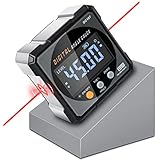
- Nivel Digital Level with Laser - (Class II laser, Output<5mW) L2.4in, W2.4in, H1.2in, portable pocket size with matching belt bag. ±0.2° precise microprocessor with automatic inversion when upside down. 4*90° measurement can be used at many angles and can be zeroed at any angle for comparison.
- Craftsman's Choice - Not only the baseboard, but also the strong magnetic upgrade at the four sides. Never slide on the table saw blade or any metal surface. Magnetic feature and lasers are great advantages for measuring, cutting, leveling in woodworking renovations and building furniture.
- Save time and effort hanging decorations - Dual lasers are great helper for horizontal and symmetrical installation. Furthermore, this digital leveler tool maybe a great gift for father's day, birthdays, Christmas.
- This inclinometer, digital angle finder comes complete with a USB-C charging cable for the internal 340mAH rechargeable battery. It also has dust-proof and IP67 waterproof performance with bright red backlight. Even in garage, with the door open and the sunshine pouring in, you can easily read the display.
- Technical Parameters - Material: aluminum alloy| Measuring range: 4*90°| Resolution: 0.05°| Accuracy: ±0.2°| Repeatability: 0.1°| Power supply: 3.7V lithium battery| Working temperature: 14-122℉
Conventional tail swing needs more space behind the machine. A compact-equipment manufacturer describes conventional tail swing as offering better stability and lifting capacity than zero- or minimal-tail-swing configurations, with the trade-off of requiring more room. Treat that as a selection consideration, not a guarantee about every model. Compare the exact machine’s track width, counterweight envelope, boom offset, lift chart and intended work position. Bobcat excavator specification guide
The Tool Desk
Outbyte Driver Updater FREEScan for outdated or missing drivers - takes under a minuteDriver Scan →Outbyte PC Repair FREERepair Windows errors before they cause bigger problemsFix Now →The useful comparison is not simply “zero tail swing versus conventional.” Ask what the rear of each candidate does during the planned slew, how much room the boom and attachment need, and what the manufacturer’s lift information says for the intended position. Tail-swing type alone does not establish lifting capacity or stability. A conventional-tail-swing machine may be worth considering where space permits and its model-specific performance suits the job; a reduced rear envelope may be more useful where obstacles restrict rotation. Verify both the physical fit and the work capability before deciding.
Assess ground conditions and slope before positioning
Check the route and working pad
A surface that looks firm may not provide adequate support for the excavator in its intended configuration. Assess both the access route and the working pad for soft or rough ground, uneven areas, trenches, openings, overhangs and haul-road condition. Locate buried utilities and account for people and other obstacles before deciding where and how the machine will travel or work.
Hong Kong Labour Department guidance calls for ground leveling, compaction or load-bearing supports as appropriate before moving excavators onto slopes, rough terrain or soft ground. The required preparation depends on the conditions and the machine; do not assume that tracks alone make weak ground suitable. Consider the whole route as well as the spot where digging will take place, since unsuitable ground at an approach or turning point can constrain the plan just as much as the working pad. Hong Kong Labour Department, Code of Practice on Safe Use of Excavators
Ground preparation is a site decision, not a reason to ignore model limits. Identify where the excavator is expected to travel, where it will sit while working, and where any load or spoil movement will occur. If the conditions call for leveling, compaction or load-bearing supports, plan that work before positioning the machine and confirm the arrangement is appropriate for the site and intended operation.
Use the selected machine’s slope limits
Determine the site’s slope angle with a suitable method, such as surveying or angle-measuring equipment. Then consult the exact model’s manual for permitted work and travel angles and its slope-specific precautions. If the manual does not state a limit, ask the manufacturer. A slope measurement by itself does not establish that a machine can safely travel or work there.
Rank #3

- FOUR SIDES STRONG MAGNETIC — Digital laser level has strong magnets on four sides that firmly adsorb on the measuring object, ensuring accuracy and not easily falling off. Three easily operated buttons can activate the built-in red laser line on both sides, hold the measured value, switch the unit of the measured value and zeroing function to realize relative measurement.
- THREE IN ONE — This tool has the functions of digital level, angle finder and laser lines(Class II, Output<5mW). Visible measurement value avoids staring at the bubbles in the traditional tube and quickly obtains the level status. Two built-in laser liners are convenient and effective to carry out the horizontal and symmetrical work of home decoration. The zero button can effectively realize absolute or relative angle measurement.
- PROVIDE ACCURACY & CONVENIENT — 360°/4×90° measure angle, the measured value on the display is automatically adjusted. The hold button can memorize the measured values is convenient for taking measurements in narrow spaces, inverted situations, and curved pipes. Display value flipped automatically when mounted upside down, with ±0.2° accuracy and 0.05° resolution to ensure accurate measurement every time.
- BACKLIGHT LCD DISPLAY — Digital angle finder with an easy-to-read display for clear measurement results in any lighting conditions. IP54. The palm-sized, compact design of the angle gauge is easy to carry with a black belt loop storage bag, no matter whether indoors or outdoors is convenient to use. 400mAh, rechargeable, ultra-long standby time, the power display for easy charging in time.
- PORTABLE & RELIABLE- Lightweight and heavy-duty digital angle finder tool is easy to carry and use, meets most woodworking, operation, home maintenance and decoration needs. Also a great gift for men at festivals. Coobeast tools have quality assurance, feel free to contact us if there are any problems with the product. We provide you with service for the first time.
A digital inclinometer is one possible tool for measuring an angle, but it answers only the measurement question. It does not tell you whether the excavator can work or travel safely on that slope. The machine-specific manual or manufacturer guidance, the ground condition and the planned operation govern the decision. Do not substitute a product description or a general rule of thumb for that assessment.
There is no universal excavator slope angle to use in place of that check. Limits and precautions are machine-specific, and the site assessment must account for the actual terrain and planned operation. The Hong Kong code identifies surveying and angle-measuring equipment as ways to determine inclination and directs users to the machine manufacturer for the allowable angle. Hong Kong Labour Department code, sections 8.5.1–8.5.2
Match machine specifications to the job
Once a candidate can access and operate in the space, compare its specifications with the actual digging, lifting, travel and attachment requirements. Manufacturer specification guides identify many of the same selection variables, but the values must be checked for the exact model and configuration. Yanmar mini excavator buying guide Bobcat excavator specification guide
| Specification | What to verify | Why it matters |
|---|---|---|
| Operating and transport weight | Weight in the intended configuration, plus transport dimensions and access restrictions | Operating weight is relevant to stability and load capacity and should suit the terrain; transport dimensions determine whether the route and delivery plan work. |
| Tail swing and boom offset | Rear swing envelope and boom movement at the planned position | These determine whether the machine can slew and reach without striking nearby obstacles. |
| Rated lift capacity | The model’s lift chart for the planned position and working conditions | Capacity cannot be inferred from machine class or tail-swing type alone; check the manufacturer’s information for the intended lift. |
| Dig depth and reach | Whether the working envelope reaches the excavation without unsafe positioning | These specifications determine whether the machine can perform the planned digging from a suitable position. |
| Digging and arm forces | Model-specific force specifications for the task | They help assess whether the machine is suited to the required excavation work. |
| Unloading height | Whether the machine can place material at the required height | Useful when loading or placing excavated material into a designated area or vehicle. |
| Hydraulic flow | Compatibility with the planned attachment and its requirements | An attachment must match the machine’s hydraulic capability and configuration. |
| Travel speed and undercarriage | Suitability for the planned route, ground and movement between work areas | These affect how the machine travels and works on the site. |
Use the table as a comparison sheet rather than a checklist of specifications to collect without context. Start with the work: how deep and far must the machine dig, what load must it lift, where must material be placed, and which attachment will be used? Then check that the candidate reaches the task from a suitable position and that its rated capacity applies to the planned lift. Manufacturer guides identify operating weight, dimensions, capacity, digging force, dig depth, reach and tail swing as selection variables; the exact values and configuration are what matter.
For a confined site, compare access width and height alongside swing envelope and boom offset. For soft or uneven ground, compare operating weight and undercarriage suitability with the assessed route and working pad. For lifting, check the model’s lift chart at the relevant position rather than relying on a general capacity figure. For attachments, verify hydraulic compatibility rather than assuming that a tool will work because it can physically be fitted.
Do not choose on a single headline specification. A machine may meet the reach requirement but fail the access check; another may fit through the entrance but not provide the lift capacity or attachment compatibility the job requires. Compare the full set of relevant specifications against the measured site and work plan.
Rank #4

- Ultra Small Digital Level Box - Measuring only 35mm in length and width, 20mm in thickness, it's as compact as a half-dollar coin. Carry this convenient tool in your pocket or hang it on your keychain for optimal accessibility. Ideal for magnetic angle finder applications.
- Experience the powerful magnetic convenience of this digital level box. The button side contains powerful magnets, ensuring stable fixing to any metal surface. Perfect for table saw blade angle gauge and other woodworking tasks.
- Enjoy the Clear & Bright Display with backlit feature, providing better visibility in any lighting condition. Whether you're working indoors or outdoors, our digital leveler delivers remarkable precision.
- Embrace the innovative rechargeable technology of our sophisticated digital level box. With a 230mAh Long-Lasting battery and Automatic shutdown after 3 minutes of non-use, this hgh-class tool ensures uninterrupted performance. Convenient Type-C charging adds to its unparalleled convenience. Perfect for woodworkers and professionals seeking a top-tier level.
- With an accuracy of ± 0.2°, it delivers pristine measurements for your projects. Its unique IP67 Water Proof and Dust Proof design ensures reliable performance even in challenging environments. A Prestigious tool for machinists and those in search of unparalleled precision.
Plan visibility, people and operating controls
Check visibility from the operator’s seat and identify where visibility aids may be needed. Plan how people will be kept outside the machine’s operating area, and use a trained marshaller in a safe position where necessary. The UK HSE recommends barriers or exclusion areas, suitable marshalling where needed and trained, competent operators. Apply the local safety requirements as well as the machine manual. UK HSE excavator safety guidance
Visibility and people controls belong in the selection and work plan, not only in the final operating briefing. Consider whether the operator can see the intended work area and whether the site layout makes barriers or exclusion areas practical. Where a marshaller is needed, plan for a trained person to remain in a safe position. Do not treat a compact footprint or guidance feature as a substitute for competent operation and people-management controls.
Some mini excavator models and configurations offer guidance features such as grade indication or operating boundaries. For example, Caterpillar describes Indicate grade guidance and E-Fence on specified mini excavators. These are model-dependent aids that may assist with grade control or limiting movement near obstacles; they do not replace site controls, operator competence or the manual. Check availability for the exact model and configuration rather than assuming the feature is included across a product range. Caterpillar mini excavators
Use a practical shortlist before hiring or buying
- Map the route and work area. Record the narrowest width and height, turning space, overhead restrictions, nearby obstacles, intended digging position and slew clearance. Measure the work area for the full movement of the machine, not only its parked footprint.
- Document ground and slope conditions. Identify soft or rough ground, trenches, openings, overhangs, buried utilities and the intended travel and working slopes. Arrange suitable site assessment and ground preparation. Determine slope inclination using an appropriate method rather than estimating from appearance.
- Write down the work requirements. Specify digging depth and reach, required lift, unloading height, attachment and any hydraulic requirements. Note the position from which the machine must perform the task, because reach and lift information relate to the machine’s working setup.
- Compare candidate configurations. Review transport and operating dimensions, weight, tail swing, boom offset, lift chart, reach, dig depth, digging forces, attachment hydraulics and travel specifications. Compare actual models, not just broad machine classes.
- Verify the exact model’s limits. Check the manufacturer’s manual for slope precautions and operating limits, and consult the manufacturer if relevant information is missing. Use the model-specific lift information for planned lifting work.
- Confirm the site controls and logistics. Plan visibility aids, exclusion areas and marshalling as appropriate, and check transport arrangements and access to local rental or dealer support. Confirm the candidate is available in the configuration and with the attachment needed for the work.
A rental provider or dealer can help identify candidate models, but the site measurements and model-specific documentation should drive the decision. Bring the measured access dimensions, ground and slope information, task requirements and attachment details when requesting options. Ask for specifications covering the candidate configuration, including dimensions, weight, tail swing, lift capacity and reach. Compare their answers against your own site measurements, and consult the manufacturer where limits or specifications are unclear.
The comparison should include the practical support available for the candidate as well as its numbers: current operating documentation and local rental or dealer support are among the relevant selection axes. No current official US retail listing was published for a particular rental price, dealer program or brand recommendation, so request current terms and verify any commercial details directly.
Recommended Free Tools
Common selection mistakes
- Checking only track width: include the counterweight and boom swing envelope, turning room and overhead clearance.
- Assuming zero tail swing solves every clearance problem: it reduces rear overhang, but does not remove the need to check the whole machine’s movement or verify lift performance.
- Choosing by a generic slope claim: measure the slope and use the selected model’s manual or manufacturer limit.
- Judging ground by appearance: assess bearing conditions and provide leveling, compaction or load-bearing supports where appropriate.
- Comparing model families instead of configurations: verify the actual dimensions, lift chart, hydraulics and operating information for the machine and attachment being considered.
- Assuming a slope measurement proves suitability: the angle is one input; the machine-specific permitted angle, precautions, ground and planned operation still need to be checked.
- Ignoring people and visibility: fit and capacity do not replace exclusion controls, a safe marshalling plan or a competent operator.
- Relying on one specification: reach, capacity, weight and access fit must work together. A machine that meets one requirement may fail another.
Sources and scope
The safety recommendations cited here come from UK HSE guidance and the Hong Kong Labour Department’s code, which apply within their respective jurisdictions. Readers elsewhere should check local requirements. Manufacturer features and configurations vary by model and may change; use current documentation for the candidate machine. This is a selection framework, not a recommendation of a particular excavator. No firsthand testing or operating experience is claimed.
Best Value

- High Precision Measurement for Accurate Results: This digital angle finder delivers ultra-accurate readings with full coverage of 4×90°, allowing easy measurement of absolute or relative angles and inclinations in any situation. With an accuracy of ±0.2°, it’s perfect for precise tasks in woodworking, construction, and table saw operations, ensuring reliable results every time.
- LED Display: Equipped with a large, clear LED display, this angle gauge provides real-time data visibility even in daylight. This feature improves work efficiency for both indoor and outdoor tasks, eliminating struggles with hard-to-read measurements under varying light conditions.
- Powerful Magnetic Base: Magnetic design on all four sides for a solid attachment to metal surfaces - allows totally hands-free use and multi-angle alignment without slipping or moving.
- USB Rechargeable and Auto Shut-Off: Built-in rechargeable battery with USB charging capability ensures easy power replenishment on-site. It includes a data hold function and auto-shutoff after 3 minutes, extending battery life and facilitating continuous use during long work sessions, reducing the hassle of frequent battery replacements.
- Strong and Easy to Use Design: rugged outer shell resistant to impact and daily wear - simple operation with intuitive buttons: short press to turn on, long press to turn off, and ZERO button to reset the Angle.
Frequently Asked Questions
How do I choose an excavator for a tight-access job?
Measure the full route and work area, including the narrowest openings, overhead restrictions, turning room and clearance for the counterweight, boom and attachment while slewing. Compare those measurements with the exact machine’s transport dimensions and operating envelope. Then verify that it can meet the digging, lifting and attachment requirements in the manufacturer’s model-specific documentation.
What size mini excavator fits through a gate?
There is no gate width that identifies a suitable machine for every job. Measure the narrowest opening and the rest of the route, including height limits and turns, then compare them with the transport width and height of a specific candidate configuration. Also check whether the machine will have room to turn and work after passing through the gate; fitting through the entrance alone is not enough.
What is the difference between zero-tail-swing and conventional-tail-swing excavators?
A zero-tail-swing excavator keeps its rear within the track width as it rotates, which can help where counterweight clearance is limited. Conventional tail swing requires more room behind the machine; a compact-machine manufacturer describes it as offering better stability and lifting capacity than zero- or minimal-tail-swing configurations. That is a general configuration trade-off, not a guarantee for every model. Check the candidate’s swing envelope, boom offset and lift chart for the intended work.
What’s actually slowing this PC down?
Pick the symptom - the matching free tool is one click away.
Can an excavator work on a slope?
That depends on the exact machine, its manufacturer-stated work and travel limits, the ground and the planned operation. Measure the slope with a suitable method, such as surveying or angle-measuring equipment, then consult the machine’s manual or manufacturer for the permitted angle and precautions. Do not rely on a generic slope rating or assume that measuring the incline establishes suitability.
Which excavator is best for soft or uneven ground?
No single machine is identified as best for soft or uneven ground. Assess the route and working pad, including soft or rough areas, trenches, openings and overhangs, then compare candidate operating weight and undercarriage suitability with the terrain and task. Hong Kong Labour Department guidance calls for leveling, compaction or load-bearing supports as appropriate before moving onto slopes, rough terrain or soft ground. Confirm the specific machine and site arrangements rather than assuming tracks alone make weak ground suitable.
The Bottom Line
Measure the route, working area, ground and slope before choosing a machine. Compare actual configurations for transport dimensions, swing envelope, weight, lift chart, reach, digging requirements and attachment hydraulics, then verify the relevant limits in the selected model’s manual or with its manufacturer. No single machine class, tail-swing type or generic slope claim can replace that site-specific check.
Quick Recap
Product prices and availability are accurate as of the date/time indicated and are subject to change. Any price and availability information displayed on Amazon at the time of purchase will apply.




