What’s actually slowing this PC down?
Pick the symptom - the matching free tool is one click away.
There is no universally best airport pavement material for heavy aircraft. For a U.S. civil airport, evaluate asphalt and concrete as engineered pavement systems against the aircraft fleet and forecast traffic, site conditions, operating needs, construction constraints, maintenance plan, and project economics. Use current FAA design guidance and FAARFIELD where applicable; aircraft weight alone is not enough to choose a material or set pavement thickness.
What airport pavement must do
The FAA’s AC 150/5320-6G, issued June 7, 2021, covers design and evaluation of aircraft pavements at civil airports. It says airport pavements are designed to support aircraft loads and provide a surface that is “firm, stable, smooth, skid resistant, year-round all-weather” and free of debris that could be blown or picked up by propeller wash or jet blast. These performance needs apply to the pavement system, not just its visible surface.
This guidance is specific to the FAA context for civil airports in the United States. Military airfields and airports outside FAA jurisdiction may follow different standards.
How asphalt and concrete differ as design options
Flexible asphalt and rigid concrete are not interchangeable surface products. FAA guidance describes different analytical approaches for their design, so compare complete candidate systems using the same project requirements.
#1 Best Overall

- Parameter: Rocking torque:615000g.mm;Weight of the pendulum: 1500g(3.3lb);Gravity moment of the pendulum: 410mm(16.1inch); Scale distance: 508mm;Forward static pressure from rubber sheet to pavement:2263g(5lb);Distance between rocking center to rubber sheet outer edge:508mm(20inch);Net weight:14kg(30.9lb)
- 【Easy to Set Up, Quick to Calibrate】 This pendulum slip tester requires no complex tools or cumbersome procedures; leveling and calibration can be quickly completed using the leveling screws and built-in spirit level, allowing testing to begin within minutes. It is ideal for both laboratory and field testing scenarios.
- 【Minimal Impact on Traffic During Measurement】 Unlike traditional methods, this tester does not require lane closures or prolonged road occupancy. It can complete on-site testing in a short time with minimal disruption to passing traffic, making it suitable for scenarios where traffic flow must be maintained, such as busy roads, highways, and airport runways.
- 【Stable Data with Excellent Repeatability】 The pendulum friction coefficient tester employs a precision pendulum system, with a rubber pad applying a constant forward static pressure (2263 g / 5 lb) to the road surface, ensuring highly stable and repeatable measurement results. Its robust mechanical structure effectively minimizes external interference, guaranteeing data consistency across different testers and test batches.
- 【Suitable for Indoor and Outdoor Environments】 The skid resistance measuring instrument features a robust and durable design that maintains stable performance under various environmental conditions, ensuring reliable operation whether in indoor laboratories or on outdoor road surfaces and runways. With a net weight of only 14 kg (30.9 lbs), it is easy to transport between different testing locations.
| Candidate | FAA design approach described | What the project team must evaluate |
|---|---|---|
| Flexible asphalt pavement | Layered elastic theory | Whether the structural design, materials, construction controls, operating requirements, maintenance plan, and economics suit the forecast traffic and site. |
| Rigid concrete pavement | Layered elastic and three-dimensional finite element theory | Whether the structural design, jointing and construction approach, operating requirements, maintenance plan, and economics suit the forecast traffic and site. |
Neither label establishes that a pavement will cost less, last longer, or support heavy aircraft better in every case. Those comparisons require project-specific evidence and consistent assumptions.
What to assess before selecting a material
Develop a design brief that describes the actual pavement, aircraft use, and site. These are practical inputs inferred from the FAA design-and-evaluation scope, not a quoted FAA checklist.
Rank #2

- Product Parameters: Rocking torque: 615000g.mm, weight of the pendulum: 1500g (3.3lb), gravity moment of the pendulum: 410mm(16.1inch), scale distance: 508mm, forward static pressure from rubber sheet to pavement:2263g(5lb), distance between rocking center to rubber sheet outer edge: 508mm(20inch), net weight: 14kg (30.9lb)
- Easy Operation: convenient debugging, simple operation, less impact on traffic during measuring, more stable data, and usage in both indoor and outdoor circumstances
- Maintenance of Equipment: Please clean the instrument after use and stored into the case, place it in the room with good ventilation, no acid, no corrosion
- Widely Application: This instrument is used to measuring friction coefficient of road surface, highway pavement, airport runway, marking paint, etc. to determine the friction coefficients of typical road surfaces to provide a basis for various tire compounds
- Tips: Before use, please read the user manual carefully and get familiar with the instrument structure and operation method; Do not depart the instrument at will except the flexible or the removable part
- Aircraft and operations: Identify the design aircraft and fleet mix, gear configurations and loading, departures, traffic growth, and how traffic is distributed across the pavement area.
- Ground and water: Characterize subgrade properties, groundwater, drainage, and the existing pavement if the project is a rehabilitation.
- Weather and function: Account for temperature and freeze-thaw conditions, and specify whether the pavement serves a runway, taxiway, or apron.
- Construction and operations: Establish phasing, available closure windows, material and construction requirements, and the surface characteristics the airport must maintain.
- Maintenance and economics: State maintenance capacity, anticipated rehabilitation approach, local costs, and the period used for lifecycle comparison.
How to make the selection
- Confirm the governing standards. Establish jurisdiction and applicable requirements. For FAA civil-airport projects, consult the current FAA design guidance, including AC 150/5320-6G and associated standards.
- Define design traffic. Document the fleet, forecast operations, aircraft loading and gear configuration, and traffic distribution over the pavement.
- Characterize the site. Provide the subgrade, groundwater, drainage, climate, and existing-pavement information needed for the project.
- Model both candidate systems. Use the applicable current FAA design process and FAARFIELD where appropriate. Do not substitute a generic thickness based only on aircraft weight.
- Check construction requirements and delivery constraints. Coordinate the design with airport project requirements and construction standards, including FAA AC 150/5370-10 where applicable. Compare phasing and closures alongside material and construction choices.
- Compare maintenance and lifecycle economics. Use the same traffic assumptions, analysis period, local prices, closure assumptions, and maintenance and rehabilitation assumptions for each alternative.
- Report pavement strength when required. AC 150/5320-6G points to AC 150/5335-5 for standardized pavement strength reporting; use the current applicable method.
Why a generic cost or thickness answer is unreliable
The FAA’s “Airport Pavement Design & Construction” resource page, last updated October 17, 2024, links design guidance, construction standards, maintenance and evaluation references, and FAARFIELD training. It does not establish a universal lifecycle-cost winner between asphalt and concrete. A defensible comparison needs project quantities, local material and construction prices, traffic, closure needs, maintenance assumptions, and a stated analysis period.
Likewise, no single thickness, asphalt binder or mix, concrete mixture, layer composition, or design life can be selected from the aircraft weight alone. These depend on the site, design traffic, local requirements, and engineering design. The FAA’s full circular and current associated standards are necessary for an actual project design.
Quick Recap
Best Value

- Precision Friction Measurement: Pendulum mass 1500±30g, pendulum center of gravity moment 410±5mm, distance from rubber sheet outer edge to pendulum swing center 20 inches. Test data is accurate with high stability, suitable for both indoor and outdoor use. Applicable for skid resistance testing on high-grade highways, urban roads, and airport runways
- Structural Stability: The main body is constructed from alloy materials, paired with a cast iron base. It incorporates T-shaped feet, leveling screws, and leveling bubble to ensure proper leveling and provide robust support, delivering long-term reliability and vibration resistance
- Portable and Easy to Operate: Weighing only approximately 14 kilograms (30.9 pounds), this tester features a compact design for convenient portability and rapid deployment in both indoor and outdoor environments. Leveling screws and a spirit level ensure quick and stable installation, minimizing traffic disruption during on-site testing
- Instructions for Use: Select five points along the wheel path, 5–10 m apart. Level and zero the pendulum tester, setting sliding length to 126 ± 0.5 mm. Clean and wet the surface before each test. Release the pendulum, record the value, and repeat five times per point (re-wetting each time), ensuring readings vary by ≤3 units. Average the five readings per point, then average all five points for the section’s pendulum value. Divide by 100 to get the friction coefficient
- Maintenance Notes: After use, wipe all components clean and store them in the case. The instrument should be kept in a dry, well-ventilated room. Do not disassemble the instrument except for parts that are permitted to be moved or removed. Calibrate at least once a year; recalibrate immediately if significant damage or changes occur.The rubber plate has a service life of 12 months and must be replaced in a timely manner
Rank #4
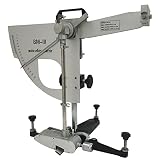
- The skid resistance tester is used to determine friction coefficients of road surface, airport runway, marking paint, etc. And to determine the friction coefficients of typical road surfaces to provide a basis for various tire compounds.
- Rocking torque is 615000g.mm, weight of the pendulum is1500g(3.3lb); gravity moment of the pendulum is 410mm(16.1inch); scale distance is 508mm(20 inch); forward static pressure from rubber sheet to pavement is 2263g(5lb);distance between rocking center to rubber sheet outer edge is 508mm(20inch).
- Pendulum head is comprised of upper lower connector, pendulum rod, spring, lever, lifting handle, hammer shell, slider, rubber piece(76mm*25.4mm*6.35mm), it has specific torque to the swing center, also specific pressure to the pavement.
- Steering system is comprised of fixing handle, pendulum shaft, steering knuckle, bearing, it’s used to keep the pendulum can freely swing within the plain.
- The tester is characterized by convenient debugging, simple operation, less impact on traffic during measuring, more stable data, and usage in both indoor and outdoor circumstances.
Rank #3

- This pendulum friction coefficient tester is a dynamic pendulum impact instrument. Good reliability, wide range of use, wide temperature operating environment, simple operation.
- Usage: Abrasion Tester, Rocking torque is 615000g. mm, Weight of the pendulum is 1500g(3.3lb), Gravity moment of the pendulum is 410mm(16.1inch), Scale distance is 508mm.
- Forward static pressure from rubber sheet to pavement is 2263g(5lb), Distance between rocking center to rubber sheet outer edge is 508mm(20inch).
- The tester is characterized by convenient debugging, simple operation, less impact on traffic during measuring, more stable data and usage in both indoor and outdoor circumstances.
- The skid resistance tester is used to determine friction coefficients of road surface, airport runway, marking paint, etc., and to determine the friction coefficients of typical road surfaces to provide a basis for various tire compounds.
Product prices and availability are accurate as of the date/time indicated and are subject to change. Any price and availability information displayed on Amazon at the time of purchase will apply.




