The Tool Desk
Outbyte Driver Updater FREEFix the driver behind crashes, sound loss and screen glitchesFind Drivers →Outbyte PC Repair FREERepair Windows errors before they cause bigger problemsFix Now →Choose a walk-behind rotary (broadcast) spreader for a large, open lawn where covering ground quickly matters. Choose a drop spreader when you need a narrow, predictable pattern beside sidewalks, driveways, garden beds, or other boundaries. For a very small lawn or an area that a wheeled spreader cannot reach, a handheld rotary spreader can work. In every case, treat the dial as a starting point only: the correct setting depends on the spreader model, the fertilizer product, and the application rate on that product’s label. Calibrate before applying the full lawn.
Start with the shape and constraints of your property
The right spreader is determined less by a “best” model than by how much area you must cover, how close you work to sensitive edges, and how consistently you can move the equipment. The categories below provide a practical first choice.
As an Amazon Associate I earn from qualifying purchases.
| Property or job | Most suitable type | Why it fits | Main caution |
|---|---|---|---|
| Large, open lawn | Walk-behind rotary/broadcast | Throws granules over a wide swath, so you can cover more lawn in fewer passes. | Wind, inconsistent walking speed, and poor overlap can change the pattern, especially at boundaries. |
| Small lawn with sidewalks, beds, or other close edges | Drop spreader | Drops product directly below the hopper in a narrow strip, giving predictable edge control. | Every pass must meet the previous wheel track accurately; gaps and double doses are easy to create. |
| Very small lawn or tight access | Handheld rotary spreader | Light and easy to carry through gates or around small obstacles. | Consistent cranking and deliberate overlap are essential for even coverage. |
| Mixed lawn and garden boundaries | Drop spreader or a rotary unit with a controllable deflector | Lets you contain the pattern near beds, pavement, and other surfaces. | Confirm that the spreader and product label allow the particular fertilizer, seed, or amendment you plan to use. |
A walk-behind broadcaster is generally easier to keep even over a larger lawn than a handheld unit because the walking motion is more consistent and the hopper carries more material. A handheld unit remains useful where a wheeled spreader cannot turn, pass through a gate, or stay level.
Quick wins for a faster PC:
Scan for outdated or missing drivers - takes under a minuteDriver Scan →Clear out junk files and repair common Windows errorsFree Scan →Fix the driver behind crashes, sound loss and screen glitchesFind Drivers →Know what each spreader type actually does
Drop spreaders: controlled and narrow
A drop spreader releases granules straight down between its wheels. The application width is close to the hopper width, so you can stop the material at a lawn edge more reliably than with a broadcast pattern. That control is valuable beside a driveway, sidewalk, pond, planting bed, or property line.
#1 Best Overall

- OPERATION: Adjustable arm support on this seed, salt and fertilizer spreader helps provide maximum comfort
- HAND-HELD SPREADER: Perfect hand-held fertilizer, salt and seed spreader for small yards
- CAPACITY: A seed, fertilizer and salt spreader that holds up to 1,500 sq. ft. of Scotts lawn products for year-round lawn care
- USAGE: These hand spreaders for lawns are great for year-round use to seed, fertilize, salt and ice melt
- COVERAGE: These salt, fertilizer and seed spreaders for lawns are engineered for smooth, even coverage
The trade-off is pass alignment. If the next wheel track is too far from the previous one, an untreated stripe remains. If the tracks overlap too much, that strip receives extra fertilizer. Marking a reference line, using the previous wheel track as your guide, and keeping a steady pace reduce both errors.
Rotary or broadcast spreaders: wide coverage
A rotary spreader uses a spinning mechanism to throw granular material outward. Its wider swath makes it efficient on open turf and large areas, but the pattern is less exact at the edge. Wind can carry granules beyond the intended boundary, and the center of the pattern may receive a different amount from the outer edge.
Use the overlap distance specified in the spreader manual or product instructions rather than assuming that every rotary unit has the same pattern. Walk in straight, repeatable lines and keep your pace steady. Some rotary spreaders have an adjustable or removable deflector that helps keep granules off pavement, beds, or other surfaces; use it according to the equipment instructions.
Handheld rotary spreaders: portable but technique-sensitive
A handheld broadcaster can be convenient for a small patch, a narrow side yard, or a location that is difficult to reach with wheels. Because delivery depends on both your walking speed and your cranking speed, it takes more concentration to maintain a consistent rate. Keep the handle at the height recommended by the manufacturer, turn the crank at a steady rhythm, and make intentional overlapping passes.
Compare the factors that matter before buying
| Decision factor | Drop spreader | Rotary/broadcast spreader | Handheld rotary spreader |
|---|---|---|---|
| Coverage width and speed | Narrower; more passes on a large lawn. | Wider; generally fastest for open areas. | Suitable for very small areas; slower and more dependent on operator technique. |
| Edge precision | High when the wheels are aligned with the boundary. | Lower unless a deflector and careful pattern management are used. | Can be directed by the operator, but the throw pattern is still broad. |
| Risk of skips or overlap | High if wheel tracks do not meet exactly. | High if the overlap pattern or walking speed changes. | High if cranking or walking speed varies. |
| Tight-area maneuverability | Good in narrow strips, provided the wheels fit. | Limited by wheel width and turning space. | Best for steps, gates, and very confined spaces. |
| Wind sensitivity | Lower than a broadcast pattern, although wind can still move granules. | Higher because material travels through the air. | Higher because material is thrown through the air. |
| Calibration compatibility | Calibrate with the exact fertilizer and the spreader’s operating method. | Calibrate with the exact fertilizer, walking pace, and overlap pattern. | Calibrate with a repeatable cranking and walking rhythm. |
Also check practical fit: hopper capacity, wheel width, handle height, turning radius, gate access, and whether the control can be reached while walking. These are equipment-specific details; obtain them from the current manual rather than assuming that one model’s specifications apply to another.
Confirm the fertilizer is compatible
Extension guidance from Penn State, Maryland, North Carolina State, Florida, California, and Washington State focuses on granular fertilizers and similar materials applied with spreaders. That does not mean every lawn spreader is suitable for every garden product. Before loading the hopper, read both documents:
Rank #2

- NO ASSEMBLY REQUIRED: Scotts spreader comes pre-calibrated and ready-to-use; use it year-round including as an ice melt spreader or salt spreader for snow
- CAPACITY: Broadcast spreader holds up to 15,000 sq. ft. of Scotts lawn products, and can be used as a lawn food, salt, ice melt or grass seed spreader
- OPERATION: These fertilizer spreaders for lawns feature a hopper and agitator designed for smooth product funneling and consistent coverage
- SIDE SHIELD: Scotts exclusive EdgeGuard Technology on these broadcast spreaders for lawns keeps lawn product off landscaping, driveways, and sidewalks
- BROADCAST SPREADER: Use the Scotts Turf Builder EdgeGuard DLX Broadcast Lawn Spreader to apply Scotts lawn care products, like grass fertilizer for lawns
- The fertilizer label: It should state whether the product is intended for broadcast or drop application, the target rate, and any restrictions for the crop or site.
- The spreader manual: It should describe compatible material types, operating instructions, and any setting chart supplied for that model.
Do not transfer a dial setting from a different fertilizer, bag size, or spreader. Granule size, density, moisture, and flow characteristics can change the amount released at the same opening. If the label or manual does not address your intended garden amendment, obtain clarification before applying it.
Measure the area and calculate the target amount
Calibration only works when you know the area and the rate you are trying to achieve. Divide an irregular lawn into simple sections and measure each section. For a rectangular section, multiply its length by its width, then add the sections together. Keep the units consistent with the fertilizer label.
Most labels express a rate as a quantity per 1,000 square feet. If you calibrate over 100 square feet, multiply the label rate by 0.1 to find the target quantity for the test area. For example, a label rate of 4 pounds per 1,000 square feet corresponds to 0.4 pound for 100 square feet. Convert pounds to ounces if that makes weighing easier: 0.4 pound is 6.4 ounces.
Use a small scale that can resolve the quantity in your test. A tape measure, stakes, and string or marking flags can define the test strip. These are optional calibration aids, not a special kit that every homeowner must purchase.
Calibrate the spreader instead of trusting the dial
Calibration means matching the quantity delivered over a measured area to the fertilizer’s desired rate. Penn State Extension’s “Calibrating Your Fertilizer Spreader,” updated April 30, 2025, describes several approaches. UF/IFAS gives a clear 100-square-foot example: measure the area, make a controlled pass, collect or account for the material delivered, and weigh it. The exact collection method depends on the spreader design.
PC Slower Than It Used to Be?
A free scan shows the junk files, broken settings and background clutter dragging Windows down - then fixes them in one click.Free scan · Windows 10 & 11Outdated Drivers Are Slowing You Down
One free scan finds every outdated or missing driver and matches the right update for your exact hardware.Free scan · exact hardware matchStep 1: Read both instructions
Record the fertilizer’s target rate and any application restrictions. Find the spreader’s setting chart and operating instructions. If a chart lists a setting for a different product, use it only as an initial reference; it is not proof that the setting will deliver your product’s rate.
Rank #3

- LARGE HOPPER CAPACITY: 130 lb hopper covers up to 1/2 acre or 25,000 sq ft with fewer refills, making this pull-behind spreader ideal for larger lawn projects
- UNIVERSAL TRACTOR COMPATIBILITY: Universal hitch design connects easily to most riding lawn mowers and lawn tractors, including Craftsman, Husqvarna, Cub Cadet, and more
- CONSISTENT WIDE SPREADING: Wide 10 ft to 12 ft spread width helps provide more even fertilizer and seed distribution with fewer passes across the lawn
- VERSATILE ALL-SEASON PERFORMANCE: Ideal for spreading grass seed, fertilizer, lawn treatments, salt, and ice melt to help maintain healthy lawns throughout the year
- DURABLE LONG-LASTING CONSTRUCTION: Built with 1 in steel tubing, enclosed gear house, poly hopper, spreader plate, and 13 in x 4 in pneumatic tires for reliable use
Step 2: Mark a test area
Measure a known area, such as 100 square feet, or a longer test strip whose area you can calculate. Use the same surface and terrain you will encounter on the lawn. A level, mowed section makes it easier to maintain the intended pace.
Step 3: Weigh a known quantity
Put enough of the actual fertilizer into the hopper for the test and weigh it, or weigh the hopper and product together. Note the starting weight. Avoid estimating by volume because two products that fill the same cup can have different weights.
Step 4: Set a starting opening
Choose the manual’s initial setting or a conservative opening if no chart covers your product. Make sure the gate opens and closes smoothly. Start moving before opening the gate and close it before stopping so material does not pile up at the ends.
Do these 3 things before closing this tab:
1Clear out junk files and repair common Windows errors2Fix the driver behind crashes, sound loss and screen glitches3Repair Windows errors before they cause bigger problemsStep 5: Walk or crank as you will during application
Maintain the pace you can repeat over the whole lawn. For a drop spreader, keep the wheel tracks positioned exactly as they will be in the final application. For a rotary spreader, use the same overlap and direction you plan to use. For a handheld unit, keep the crank rhythm and carrying height consistent.
Step 6: Determine how much was delivered
After the test, weigh the remaining product and subtract it from the starting amount. Some calibration methods collect the output on a suitable sheet or tray so it can be weighed directly. Follow the method appropriate for your equipment and avoid spilling granules outside the measured test area.
Step 7: Compare the result with the target
Calculate the actual application rate:
Actual rate = amount applied ÷ test area × 1,000
Use the same units throughout. If the actual rate is below the label rate, open the gate slightly or slow the pace according to the manual. If it is above the label rate, close the gate slightly or correct the pace. Repeat the test until the delivered amount is acceptably close to the target. Record the fertilizer, date, spreader setting, pace, and result for future reference; a new product still requires a new check.
Rank #4
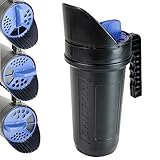
- 64-OUNCE BOTTLE: high-capacity poly bottle with a wide opening and easy screw top, quickly remove the lid to add your preferred seed, salt, fertilizer, etc. and simply screw back into place
- TURF AND SALT: year-round use; for steps, sidewalks and small paths in the winter; grass patches, shaded areas, gardens, and small sections the rest of the year
- 3 OPENINGS IN LID: twist lid to choose small, large and wide openings; each designed to fit different particulates like ice melt, salt, fertilizer, grass seed, sand and most pelletized products
- LARGE HANDLE: easy to grip, scoop and fill; accommodates small and large-sized hands, with or without gloves for use any time of the year
- PORTABLE: keep it on a shelf, in a closet or in the car and pull it out when it’s needed; you can even store it with product inside when not in use
Apply the calibrated amount evenly
Divide the load into two portions
Maryland Extension recommends dividing the total amount needed for the area into two equal portions and applying them in perpendicular directions. Make one pass pattern north–south and the second east–west, or use two other directions at right angles. Each pass then carries half the total rate, reducing the visual effect of a minor overlap error.
Recommended Free Tools
Operate a drop spreader
- Begin with the boundary passes, keeping the wheels at the intended edge without letting the hopper cross onto pavement or a bed.
- Align each following pass wheel track with the previous track. Do not judge spacing by the edge of the fertilizer strip alone.
- Keep the gate closed while turning and open it only after you are moving at the calibrated pace.
- Watch for missed strips around trees, corners, and irregular shapes; finish those areas with a measured amount rather than repeatedly “touching up” by eye.
Operate a rotary or broadcast spreader
- Use the deflector or boundary-control feature if your spreader has one and the manual permits it for the product.
- Keep the spreader away from water, pavement, and beds by the distance required for your pattern and site. Wind can carry granules farther than the apparent edge.
- Walk straight at the calibrated pace. Marking lines or using a fixed landmark helps keep the overlap consistent.
- Follow the manual’s recommended overlap. Do not assume that the outer edge of one pass is receiving the same amount as the center.
- Apply the second half in the perpendicular direction when using the two-pass method.
Operate a handheld rotary spreader
Hold the unit at the specified height, start moving before opening the gate, and turn the crank at a steady rhythm. Work in short, marked lanes so you can maintain overlap. If your pace or cranking changes, stop and recalibrate rather than trying to compensate by eye.
Handle edges, obstacles, and garden boundaries
Edges deserve a separate plan because fertilizer on a sidewalk or bed is wasted and can create an unintended application. A drop spreader offers the most predictable narrow boundary. A rotary spreader can be workable when you leave an appropriate buffer, use a deflector, and account for wind, but the exact buffer depends on the equipment and product pattern.
For trees, islands, and curved beds, divide the lawn into smaller measured sections. Complete one section before moving to the next so you know how much material remains. At gates and narrow passages, verify that the wheels and hopper fit without forcing the spreader sideways; a handheld unit may be safer for a short inaccessible strip.
In a garden, identify the crop or planting bed first. A lawn spreader is not automatically approved for every granular fertilizer, seed, pesticide, or soil amendment. The product label and the equipment manual control that decision.
What’s actually slowing this PC down?
Pick the symptom - the matching free tool is one click away.
Common mistakes and how to correct them
| Symptom | Likely cause | Correction |
|---|---|---|
| Dark green stripes or burned-looking bands | Overlapping passes, an excessive rate, stopping with the gate open, or a rotary pattern concentrated in the center. | Recheck calibration, use the prescribed overlap, close the gate before stopping, and apply in two perpendicular half-rate passes. |
| Pale or untreated stripes | Gaps between drop-spreader wheel tracks or insufficient rotary overlap. | Mark lanes, align wheel tracks, and follow the manual’s overlap distance. |
| Product lands on pavement or in a bed | Broadcasting too close to the boundary, wind, or an unused deflector. | Increase the buffer, use the deflector if available, choose a drop spreader for that edge, and avoid windy conditions. |
| The hopper empties before the measured area is complete | Opening is too large, pace is too slow, or the product flows differently from the calibration material. | Stop, calculate the actual rate from the measured area, and recalibrate with the exact product. |
| The setting works for one bag but not another | Different granule size, density, moisture, or formulation. | Calibrate each product and keep separate notes; never assume a printed number is universal. |
| Handheld coverage varies from pass to pass | Changing crank speed, walking speed, or carrying height. | Use a shorter test strip, establish a repeatable rhythm, and recalibrate. |
Plan for weather and site conditions
Wind is particularly important with rotary and handheld spreaders because the material travels through the air. If the pattern is visibly drifting, postpone the application or use a more controlled method for the boundary. Wet or clumped product can also flow differently from the material used during calibration; break up clumps only if the product instructions allow it, and recalibrate when the material condition changes.
Best Value
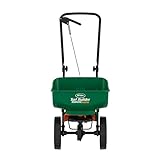
- NO ASSEMBLY REQUIRED: Scotts spreader comes pre-calibrated and ready-to-use with a fold-down handle for easy storage; use it year-round including as an ice melt spreader or salt spreader for snow
- CAPACITY: Broadcast spreader holds up to 5,000 sq. ft. of Scotts lawn products, and can be used as a lawn food, salt, ice melt or grass seed spreader - ideal for treating smaller areas
- OPERATION: These fertilizer spreaders for lawns feature a hopper and agitator designed for smooth product funneling and consistent coverage
- SIDE SHIELD: Scotts exclusive EdgeGuard Technology on these broadcast spreaders for lawns keeps lawn product off landscaping, driveways, and sidewalks
- BROADCAST SPREADER: Use the Scotts Turf Builder EdgeGuard Mini Broadcast Lawn Spreader to apply Scotts lawn care products, like grass fertilizer for lawns
Follow the fertilizer label and local guidance for timing, watering, protection of nearby surfaces, and any restrictions that apply to your location. The spreader choice cannot replace those product-specific instructions.
Care for the spreader after use
Empty unused material back into its labeled container if the product instructions permit it. Brush or rinse residue from the hopper, gate, spinner, and wheels using the cleaning method specified by the manufacturer, then dry the unit before storage. Check that the gate moves freely and that wheels are not obstructed. Residue can change the opening or cause uneven flow the next time you calibrate.
Store the fertilizer separately in its original labeled container, protected as directed on the label. Keep calibration notes with the spreader so the next application starts with the correct product, area, rate, and setting rather than an unverified dial position.
Free tools Windows power users keep installed
One-click scans. No signup required.
A practical buying checklist
- Measure the largest lawn section and estimate how many passes each spreader type would require.
- Identify every boundary where fertilizer must be contained.
- Confirm that the hopper and wheels fit through gates and around obstacles.
- Read the current manual to see how the unit is calibrated and whether a deflector or edge-control feature is included.
- Check that the products you intend to use are permitted by both the fertilizer label and the spreader instructions.
- Prefer a design whose control, handle, and wheels let you maintain a repeatable pace.
- Plan to use a tape measure and a small scale, or another suitable method, for calibration.
- Buy by these operating requirements rather than by a dial number, an unverified setting chart, or a claim that one model is universally best.
Which spreader should you choose?
For a broad, unobstructed lawn, select a walk-behind rotary spreader and commit to calibration, steady pacing, correct overlap, and wind-aware boundary management. For a small lawn or one bordered closely by hardscape and planting beds, select a drop spreader and align every wheel track. For a tiny or hard-to-access area, a handheld rotary spreader is practical only if you can keep your cranking and walking rhythm consistent.
Whichever category fits, the reliable choice is the one you can maneuver accurately and calibrate with the exact fertilizer you will apply. The equipment category determines the pattern; measurement and technique determine whether the lawn receives the rate printed on the label.
Quick Recap
Product prices and availability are accurate as of the date/time indicated and are subject to change. Any price and availability information displayed on Amazon at the time of purchase will apply.

