Crashes, No Sound, or Screen Glitches?
Random freezes, missing sound and display glitches usually trace back to one bad driver. Find and replace yours safely.Free scan · under a minuteWindows Errors? Fix Them Before They Spread
Repair common Windows errors and clear accumulated junk for a smoother, more stable PC - no reinstall needed.Free scan · no reinstallThe most reliable DIY design is a tall, stable scratching post with a broad base, tightly wrapped natural sisal, and a smaller perch on top. For most adult cats, start with a post about 32–36 inches tall, an 18–24-inch-square base made from ¾-inch plywood, and a 16–20-inch perch. Then add a separate horizontal cardboard, carpet, bark, or sisal scratcher so the cat can choose the position and texture it prefers.
Those dimensions are practical starting points, not universal engineering standards. A cat that scratches the sofa usually needs a tall vertical surface; a cat that attacks rugs may prefer a horizontal pad; and an older or arthritic cat may be more comfortable with a low-angle or horizontal scratcher. Current feline-care guidance recommends offering more than one orientation and texture rather than assuming every cat will use a sisal-wrapped tower. See the FelineVMA environmental-needs guidance and its 2025 claw-counseling article.
As an Amazon Associate I earn from qualifying purchases.
This guide explains how to choose the design, build a stable single-post cat tree, anchor it, introduce it without punishment, and replace worn rope or carpet before it becomes dangerous.
Decide what you are building
A scratching post primarily provides a vertical or angled surface for clawing and full-body stretching. A scratching pad is usually horizontal and suits cats that scratch rugs, carpet, or floor mats. A cat tree adds elevated perches, climbing routes, sleeping areas, hiding places, and usually several scratching surfaces. A cat wall replaces floor-mounted furniture with wall-mounted shelves, ramps, boxes, and scratch panels.
#1 Best Overall
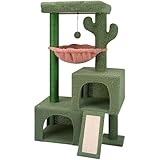
- Dimensions: 12.2x13.8 inch base board, made of high-quality P2 particleboard, featuring a sturdy base
- Multifunctional Activity Center: Multi-level design, spacious cozy condos, perch, and round hammock
- Furniture Protection: 100% sisal-wrapped posts and pad are perfect for scratching, protecting furniture and curtains
- Safe and Reliable: Pet safety is the top priority, with no sharp edges, ensuring cats can play with peace of mind
- Easy to Assemble: Comes with detailed instructions and tools, can be completed in minutes
If the immediate problem is scratching on furniture, begin with a simple, heavy post rather than building a tall multi-level tower. Every extra platform, bracket, hammock, carpet edge, toy, and connection creates another possible point of failure. Once the cat is using the scratching surface reliably, you can expand the design.
| Project | Best use | Main construction trade-off |
|---|---|---|
| Simple scratching post | Redirecting scratching from a sofa corner, chair leg, or doorframe | Fewest failure points; easiest to make stable |
| Single-post tree with perch | Scratching plus a modest elevated lookout | Needs a broad base and may need an anti-tip anchor |
| Multi-level cat tree | Climbing, resting, and multiple cats | More tipping leverage, joints, platforms, fabric edges, and maintenance |
| Wall-mounted cat system | Renters or small rooms where floor space is limited | Every shelf and ramp must be attached to structural framing or an appropriately rated anchor |
| Horizontal scratcher | Rug-scratchers, senior cats, and cats that dislike vertical posts | Does not provide the same full-body vertical stretch |
Match the build to the cat before buying materials
Watch the cat for several days. The existing scratching target is useful design information, not merely bad behavior to suppress.
| What the cat scratches now | First design to try |
|---|---|
| Sofa corner, chair leg, or doorframe | A tall vertical post placed immediately beside that target |
| Rug, carpet, or floor mat | A horizontal cardboard, carpet, or sisal pad |
| Wall or angled furniture edge | An angled board or securely mounted vertical scratch panel |
| Scratches immediately after waking | A scratcher beside the sleeping area |
| Scratches near a window or doorway | A scratcher in that prominent location |
| Avoids tall posts or moves stiffly | A horizontal or low-angle surface with easy access |
Cats commonly use carpet, wood, rope, or cardboard, but individual preferences vary. They may prefer vertical, horizontal, or angled surfaces, and that preference can change with age or joint disease. The Ohio State Indoor Pet Initiative and International Cat Care home-modification guide both support adapting the setup to the individual cat.
Measure the cat’s stretch
Measure from the nose to the end of the body, excluding the tail, and observe the height reached when the cat stretches upright. The finished vertical scratching area should let the cat extend its body and forelegs without crouching. The Wisconsin Humane Society recommends approximately the cat’s fully stretched length plus a few inches; Purina describes a post about as long as the cat from nose to tail and uses a roughly 34-inch example. Current FelineVMA guidance says a vertical option should extend above the cat’s stretched-out vertical height.
- Small cat: approximately 24–30 inches, if that permits a full stretch.
- Average adult cat: approximately 30–36 inches.
- Large, long-bodied, or very active cat: 36 inches or more, with a wider and heavier base.
- Senior or mobility-limited cat: do not automatically make the post taller; provide a horizontal or low-angle alternative.
Three feet is a useful rule of thumb, not a guarantee. An owner-observation study of 4,331 respondents found that cats more often used simple upright posts or cat trees with two or more levels and at least three feet of height. However, it was an internet survey, not a controlled preference trial or a structural load test. The study is available through SAGE Journals.
Choose dimensions for stability
A nominal 4×4 is normally smaller after milling—often about 3½×3½ inches—so measure the lumber you actually buy. A square post of that size is a practical minimum for many adult cats because it gives the cat a useful scratching width and can support a small perch. A round post or log should be measured by its actual diameter.
| Design tier | Base | Main post | Top perch | Suitable starting use |
|---|---|---|---|---|
| Compact single-cat post | 18×18 inches | Approximately 3½×3½ inches actual and 30–34 inches tall | 14–16 inches | One average-sized cat and limited floor space |
| Stable general-purpose post/tree | 24×24 inches | Approximately 3½×3½ inches actual and 32–36 inches tall | 18–20 inches | Most adult cats, energetic cats, or a small two-cat household |
| Large-cat or multi-cat structure | More than 24×24 inches, or a doubled/laminated base | Multiple posts rather than one narrow central support | Larger platforms with more than one route | Large cats, several cats, or vigorous jumping |
The perch should generally be smaller than the base so the center of mass stays over a stable footprint. A heavy or wide base reduces tipping risk, but it does not guarantee stability during jumping, collisions, children climbing on the structure, dogs bumping it, or several cats hanging from an overhanging platform. The Daily Paws plan and Home Depot’s cat-tree guide both emphasize making the base larger than the platform. Treat those dimensions as practical guidance, not tested load ratings.
The Tool Desk
Outbyte Driver Updater FREEFix the driver behind crashes, sound loss and screen glitchesFind Drivers →Outbyte PC Repair FREERepair Windows errors before they cause bigger problemsFix Now →For a multi-cat home, use several scratching stations and, for a tall structure, more than one vertical support. There is no universal one-scratcher-per-cat formula; the right number depends on room layout, cat relationships, and each cat’s preference. Multiple stations reduce the chance that one cat blocks the only preferred surface.
Recommended materials and tools
Structural materials
- One ¾-inch plywood panel for the base and another for the perch.
- One clean, straight, actual 3½×3½-inch post or larger. Untreated, dry, sound lumber is the simplest choice.
- Structural wood screws sized to penetrate well into the post without emerging on the opposite face. As a practical starting point, a single ¾-inch base commonly uses about 2½-inch screws; a 1½-inch laminated base may require about 3-inch screws. Verify the actual thickness, countersink depth, and screw manufacturer’s requirements before cutting.
- Washers if the screw heads could pull through the plywood.
- Wood glue only between structural wood pieces, such as laminated base layers. Glue is not a substitute for screws or brackets.
- An anti-tip strap or steel bracket and appropriate wall fasteners for a tall, narrow, or active-cat structure.
Scratching and covering materials
- Natural sisal rope: commonly ⅜ or ½ inch in diameter for a vertical post.
- Corrugated cardboard: a replaceable horizontal scratching surface.
- Low-pile carpet or rough fabric: useful on platforms and as a secondary scratching texture.
- Known, untreated natural bark or wood: only when the source, dryness, cleanliness, and structural condition are certain.
There is no precise regulatory category called cat-safe rope. Natural sisal is a sensible material when it is tightly installed, all ends are concealed, and the surface is inspected regularly. Do not treat sisal as automatically superior. A FelineVMA literature summary reports that cats aged nine and under preferred rope over carpet and cardboard in the available research, while cats over nine showed a slight preference for carpet over rope. Those are group tendencies, not rules for an individual cat. Offering both rope and carpet or rough fabric is more reliable than choosing one texture for every household. See the FelineVMA scientific-literature summary.
Tools
- Tape measure, pencil, straightedge, and carpenter’s square.
- Circular saw, table saw, or a hardware-store cutting service.
- Drill/driver, drill bits, pilot bit, and countersink bit.
- Clamps for laminating plywood and holding rope or carpet while fastening.
- Sandpaper or a router for rounding exposed edges.
- Scissors or a sharp utility knife for rope and carpet.
- Staple gun or other short fasteners for concealed areas, plus eye protection, hearing protection, and a dust mask when cutting or sanding.
Materials to avoid or control carefully
The safest default is unfinished, sanded wood with the carpet and sisal secured mechanically from concealed faces. If you use adhesive, keep the cat out of the work area, follow the label’s cure time and ventilation requirements, and make sure no glue bead remains exposed. Do not assume hot glue or a product marketed as non-toxic is automatically safe for a chewing cat. Avoid expanding polyurethane construction glues: the ASPCA warns that expanding glue can expand in an animal’s stomach if swallowed.
Do not allow a cat near wet paint, stain, varnish, or adhesive. Fully cured finishes may still be inappropriate on surfaces the cat chews. Paint and varnish formulations can cause gastrointestinal, respiratory, skin, or neurological problems, and old paint may contain lead. The ASPCA home-repair precautions and VCA paint-and-varnish guidance recommend keeping pets away until surfaces are cured and the area is ventilated.
What’s actually slowing this PC down?
Pick the symptom - the matching free tool is one click away.
Rank #2

- Multifunctional Design: Overall size 16.93"L x 13"W x 17.7"H. This cat cat tree is not only a climbing device, but also a comfortable sleeping platform, entertainment and play area, and a claw grinding board. Meet the various needs of cats
- Endless Fun with Spring&Hanging Balls: Watch your kitties go wild with excitement! The cat tree comes with various types of hanging balls and spring balls that provide endless fun and entertainment,keeping your cats engaged and happy for hours
- Cat Scratching Board to Save Furniture: The cat scratching board is covered by natural sisal material which is harmless and also durable, not only satisfies the scratching instincts of felines but also protects the expensive furniture from sharpening claws
- Cozy Top Platform for Relaxation: Our cat tree features a soft and comfortable top platform that provides the perfect spot for your cats to relax and catch some Z's.They'll adore lounging on thiscozy platform day and night
- Easy Assembly & Easy to move on: Easy to assemble, with detailed instructions and tools.Get it done in a few minutes, saving time and effort. And it's lightweight and easy to move.You can effortlessly move it to any corner of your home, ensuring your furry friends always have a new favorite spot
Use carpet only when it has no exposed loops, fringe, loose backing, strong chemical odor, or unraveling edges. Secure it from the underside so staples and tacks cannot contact the cat. Loose fibers and string-like material can be swallowed and cause a potentially life-threatening linear foreign body; see VCA’s guide to foreign-body ingestion in cats.
How much sisal rope do you need?
Estimate rope instead of relying on a package label or an apparently exact online plan:
Approximate rope length = number of wraps × post perimeter
Number of wraps ≈ post height ÷ rope diameter
For an actual 3½×3½-inch square post, the perimeter is about 14 inches:
- A 32-inch post wrapped with ⅜-inch rope needs approximately 100 feet before waste and end allowances.
- A 36-inch post wrapped with ⅜-inch rope needs approximately 112 feet before waste.
- Buy about 20–40 percent extra for tight compression, corner geometry, imperfect wraps, concealed ends, mistakes, and future repairs.
That makes approximately 120–160 feet a sensible purchase range for many 32–36-inch posts. Daily Paws specifies three 50-foot coils—150 feet—for a roughly 31½-inch design. The higher quantity is understandable because mathematical estimates do not account for compression, damaged sections, or replacement material. A larger or rounder post, a thicker rope, or a partially wrapped post changes the calculation. For a round post, use its circumference instead of a square-post perimeter.
Free tools Windows power users keep installed
One-click scans. No signup required.
Cut list for a stable single-post cat tree
This general-purpose version is intended for one average adult cat or a small household that will add other scratching stations:
- One 24×24×¾-inch plywood base.
- Optional: a second 24×24×¾-inch plywood panel to laminate beneath the first for a heavier 1½-inch base.
- One actual 3½×3½-inch post, 32–36 inches long.
- One 18×18×¾-inch plywood top perch, or a circular perch 16–20 inches across.
- Approximately 120–150 feet of ⅜-inch natural sisal rope, depending on the post height and wrapping.
- Enough low-pile carpet to cover the base and perch with several inches of overlap.
- Optional horizontal scratcher: a separate cardboard, carpet, bark, or sisal pad sized to the available floor space.
The 18-inch perch is a practical midpoint between published examples using smaller and larger platforms. Make it larger for a large cat, but compensate with a broader base, a second support, or a wall anchor. Do not interpret this cut list as a certified load specification.
Build the single-post cat tree
1. Plan around the cat and the room
Measure the cat’s stretched body, identify the current scratching target, and choose the orientation and texture before cutting. Also decide whether the structure will be used by one cat or several, whether the cat has arthritis or weakness, and whether the finished tree can be anchored to a stud, masonry, or another structural point.
Do not build a tall tower and then hide it in an unused corner. Cats often scratch after waking and in prominent, socially important locations such as entrances, windows, and rooms where people spend time. The FelineVMA scratching guidance discusses the importance of placement as well as surface design.
2. Cut and sand every part
- Cut the base and perch squarely.
- Cut the post to the required height. Measure the actual post rather than trusting its nominal label.
- Round or thoroughly sand every exposed plywood edge and corner.
- Sand the post ends and remove splinters.
- Inspect the underside of each panel, where a screw tip or staple can otherwise be missed.
Do not leave sharp plywood corners, splintered wood, exposed screw tips, or cut carpet edges that can catch claws.
3. Mark and predrill the base
- Find the center of the base by drawing diagonal lines from corner to corner.
- Center the post on those marks.
- Mark four screw locations around the post, leaving enough material between each hole and the post edge.
- Drill pilot holes through the base and into the post if the post is already positioned.
- Countersink the holes from the underside so the screw heads sit flush and cannot scratch the floor.
A four-screw pattern resists twisting better than a single central screw or a two-screw attachment for a square post. The Daily Paws instructions specifically use predrilling and countersinking; Purina’s simpler log design uses two screws, which is one reason the square-post, four-screw version is the more conservative beginner design.
4. Wrap the post before final assembly
- Start at the bottom of the post.
- Secure the rope end in a concealed area beneath the base or beneath the future top platform.
- Wrap with firm, continuous tension.
- Press every turn tightly against the previous turn. The cat should not be able to reach the wood through a gap.
- At the top, finish beneath the perch or in another location the cat cannot reach.
- If a rope section must be joined, secure both ends where the cat cannot chew them. Do not leave a knot, cut end, or loop in the scratching path.
Use short fasteners only in concealed locations. Every staple or nail must be fully embedded, point away from the cat’s scratching path, and short enough not to pass through the post. Purina advises orienting staples vertically so a claw cannot catch on them; Daily Paws advises covering nails as much as possible. Mechanical fastening is preferable to leaving a bead of adhesive accessible to the cat.
Rank #3
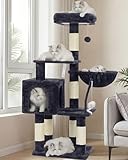
- Ideal design of structure: Structure of the cat tree is designed according the climbing habits of cats. Two jumping platforms not only increase the active space but also help kitties and older cats to climb up and down
- Stability is the Primary Consideration for A Cat Tower: Sturdy cat climbing frame base, sisal wrapped scratch posts and Anti-toppling devices ensures the security of active kittens and cats playing on the activity centre
- Spacious and Removable Top Perch: The well-padded top platform is suitable for kittens. They can lie on the soft place as a bed to sleep, observe and nap
- Lazy Cats Favorite Basket: Cats naturally like the feeling of being wrapped , which makes them feel safe, therefore a comfortable and strong basket are always necessary
- A Cat teasing stick and Plush Ball for Kittens to Play: The extra cat teaser stick increases the interactive fun of cat and its owner. The toy ball with bell do not make too much noise. It can meet the cats' play needs while not disturbing the owner
5. Attach the post to the base
- Place the wrapped post over the pilot holes.
- Drive the structural screws from the underside into the post.
- Confirm that no screw penetrates through the carpeted or scratching side.
- Use a square to check that the post is perpendicular to the base before fully tightening.
- If the base flexes, the post twists, or the tree feels top-heavy, add the laminated base layer or redesign before proceeding.
Do not rely on carpet, hot glue, double-sided tape, or decorative trim to provide structural support.
Quick wins for a faster PC:
Scan for outdated or missing drivers - takes under a minuteDriver Scan →Repair Windows errors before they cause bigger problemsFix Now →Fix the driver behind crashes, sound loss and screen glitchesFind Drivers →6. Attach the top perch
- Center the perch over the post.
- Predrill and countersink the holes from the top or use concealed brackets designed for the connection.
- Drive structural screws through the perch into the post, checking that the screw tips cannot emerge.
- Confirm that the perch is level and does not rotate under hand pressure.
- For an energetic cat, add a second support or concealed triangular gussets rather than depending on a large overhang supported by one small post.
Keep the perch smaller than the base unless the structure is independently supported and anchored. A cat jumping onto the edge creates much more leverage than a cat sitting quietly in the center.
7. Cover the base and perch
- Cut clean, low-pile carpet several inches larger than each panel.
- Fold the carpet over the edges.
- Cut relief notches at the corners so the folds lie flat rather than forming thick, loose ridges.
- Secure the carpet from the underside with short staples or other appropriate fasteners.
- Run your hand over the finished surfaces and check that no staple, tack, screw, fringe, loop, or loose backing is exposed.
Home Depot specifically warns against protruding staples, screws, and other hardware. Never solve an exposed staple by hammering it blindly deeper; its point may have emerged through the opposite surface.
8. Anchor a tall or active-cat structure
Use a wall anchor for any tall, narrow, multi-level, or lively-cat structure unless it is genuinely low, broad, and immovable. Position the tree against a wall and attach an anti-tip strap or steel bracket to a solid upper part. Fasten into a wall stud, masonry, or an anchor rated for the actual wall construction and expected load.
Do not rely on adhesive-only fasteners, and do not assume drywall alone can carry a bracket plus a jumping cat. Home Depot recommends attaching wall-mounted cat-tree brackets to studs. A commercial manufacturer, Mau, gives a conservative recommendation to secure products taller than 20 inches; that is a manufacturer recommendation, not a universal industry threshold. No single height makes anchoring unnecessary in every room or for every cat.
9. Perform a pre-use safety inspection
Before allowing the cat onto the finished structure:
- Push the tree from several directions. It should not rock, twist, lift, or creep.
- Check every platform for flexing and rotation.
- Run a hand over all surfaces to find sharp edges and protruding fasteners.
- Inspect the underside for screw tips and staples.
- Pull firmly on the rope and carpet.
- Remove every loose fiber, dangling end, loop, and fringe.
- Confirm that adhesive is fully cured and that no strong odor or tackiness remains.
- Inspect the wall strap, bracket, and wall connection.
- Place the structure on a level, stable floor rather than a thick or uneven rug.
Do not assign a weight limit unless the design has actually been tested for structural load and dynamic jumping forces. A tree that supports a stationary cat may fail when one or more cats leap, collide, or hang from a platform.
Choose the right surface: sisal, carpet, cardboard, or wood
Sisal rope
- Advantages: good claw penetration, durable for repeated vertical scratching, easy to replace in sections, and often attractive to younger adult cats.
- Trade-offs: laborious to install, unpopular with some cats, and hazardous if it becomes loose or frayed.
Carpet or rough fabric
- Advantages: useful for horizontal scratchers, ramps, and perches; may appeal more to older cats; and can be inexpensive as a clean remnant.
- Trade-offs: may encourage household-carpet scratching in a cat that already prefers carpet, and loops, fringe, backing, or frayed edges can catch claws or be swallowed.
Cardboard
Cardboard is an inexpensive, replaceable horizontal option. It is especially useful when the cat scratches rugs or when a senior cat cannot comfortably pull against a tall post. Put it in a tray or on a stable non-slip board so it does not slide during use, and replace it when it sheds loose pieces.
FelineVMA recommends providing a range of sisal rope, bark or wood, cardboard, and carpet or rough fabric rather than labeling one material universally best.
Do these 3 things before closing this tab:
1Clear out junk files and repair common Windows errors2Scan for outdated or missing drivers - takes under a minute3Repair Windows errors before they cause bigger problemsSpecial designs for different cats
Senior, arthritic, or mobility-limited cats
A tall vertical post can be uncomfortable for a cat with joint pain. Offer a horizontal cardboard or carpet scratcher, a low-angle ramp or scratch board, a low perch, and short steps between platforms. Use a surface that does not slide and avoid requiring a high leap.
A sudden reluctance to use a previously preferred vertical post, a new scratching pattern, stiffness, or difficulty jumping should not automatically be treated as a training problem. Pain or reduced mobility may be involved; a veterinary assessment is appropriate when the change is sudden or accompanied by other symptoms. International Cat Care discusses horizontal scratching and home modifications for cats with mobility problems.
Rank #4

- 【PREMIUM SISAL CAT SCRATCHING POST】This tall cat scratching post is made of 100% natural non-toxic sisal, proper sturdiness satisfies cats’ scratching needs. The cat scratching posts for indoor cats not only helps keeping cat's claws in shape, but also is a great exercise and a good way to reduce stress. A healthy cat is a cat that able to scratch and stretch without worry, and this is the reason why it is important for a cat and a cat owner to have a scratching post.
- 【COMFY STABLE BASE】Although the sisal post’s structure is simple, adult cats can have full stretch and scratch away on it, without this thing turning over! The reinforced base of this scratching post is made of heavy chipboard, which can provide strong stability and hold on up to violent attack. The flannel cover make the tall scratching posts for indoor cats adults also a great place to lay on for rest. Huge fun with the simple structure.
- 【3-in-1 CAT SCRATCHING POST】The cat sisal scratching posts equipped with total 3 stimulating cat toys, one dangling plush ball on the top, one dangling mouse in the middle, one spring plush ball on the base. With all these toys, cats can have more than scratch fun. Cats can jump, sit or lay down to play with this sisal post. Punching, swatting, scratching, no more "cats' rules" in the house. Releasing cats’ nature freely gives you a happy cat and also a happy pet owner.
- 【MINUTES INSTALLTION】With the included Allen key, you only need to screw all the parts of the sisal post together, assemble instruction also included. With just several minutes of simple screw and twist, you will get a 15.7"x 15.7"x 32" size scratching post, which can satisfy cats from new born to adult. Naughty cats can enjoy this brand new toy right away, no need to wait.
- 【FURNITURE SAVER】Cats scratch when they play, especially when they are marking their territory. Without any proper material for our feline friends' claws to scratch on, they will be likely to direct this behavior onto your furniture. ANWA cat scratching post's sisal surface and vertical design would satisfy most kitties. With the ideal 32" height, large cat not only can scratch their claws, but also can stretch their body.
Kittens
A kitten can use a smaller, lower structure, but it still must be stable and free of dangling strings. Most kittens under four months do not respond to catnip, and some adults do not respond either, so catnip is optional rather than a required training tool.
Do not leave toys attached by long strings, yarn, thread, or rope. Use removable toys under supervision instead. Swallowed string can form a dangerous linear foreign body; the VCA foreign-body guide explains why this requires urgent veterinary attention.
Large cats and multi-cat homes
Choose a base larger than 24×24 inches or laminate two plywood layers. Use multiple posts, wider platforms, and more than one scratching station. Anchor the structure, and arrange platforms so one cat cannot block the only route up or down. A single narrow post carrying a large, high perch is more vulnerable to twisting and tipping than a broad-base, multi-support design.
Renters and small rooms
A broad, weighted freestanding post or a flat scratcher beside the sofa is often safer than a tall tower that cannot be secured. A scratch panel can be attached to a sturdy piece of furniture only if that furniture itself cannot tip. Commercial tension or wall systems can work when installed exactly as instructed, but adhesive-only mounts are not appropriate for cat shelves or trees.
Using a branch or salvaged log
Some cats enjoy bark or wood, and Purina’s log-based plan is a useful alternative concept. However, a storm-fallen or salvaged log needs much more screening than many quick DIY instructions suggest. Use it only when you can verify that it is dry, free of rot, pests, mold, pesticide or chemical exposure, and hidden cracks, and that its species and structural condition are suitable. Unknown outdoor wood is not a safer shortcut than clean, sound lumber. A square post is easier to measure, wrap, fasten, and inspect.
Put the scratcher where the cat will use it
Placement is as important as construction. Start with the cat’s behavior:
Recommended Free Tools
- Place the post beside the scratched sofa corner, chair leg, or doorframe.
- Put a scratcher next to the cat’s sleeping area because many cats scratch when they wake and stretch.
- Use prominent areas near windows, entrances, or rooms where people spend time.
- In a multi-cat home, provide stations in more than one room or along important routes.
- Keep a horizontal pad beside a rug or other horizontal target.
Cats may scratch where they can leave a visible and scent mark, so a beautiful post hidden in an unused corner may be less appealing. The Ohio State guidance recommends placing the post near the existing target and moving it gradually—no more than about three inches per day—after the cat is using it consistently.
Independent reader supportYour contribution helps us test, update, and keep practical guides available for everyone.Teach the new habit without punishment
- Put the new scratcher immediately beside the existing target.
- Allow the cat to investigate without being carried to it or having its paws forced onto the surface.
- Drag a toy lightly across the post or scratch it with a fingernail to demonstrate movement.
- Reward investigation and use with treats, play, praise, or the cat’s preferred attention.
- Protect the old target with a fitted cover or physical barrier while the new habit develops.
- Move the scratcher only gradually once use is reliable.
Do not punish, shout at, or physically correct furniture scratching. Current FelineVMA training guidance favors positive reinforcement and environmental modification. Some older advice mentions double-sided tape or other deterrents; physical protection of the furniture may be useful, but it should support—not replace—an appealing, correctly placed scratcher and reward-based learning.
Troubleshooting the finished tree
| Problem | Likely cause | Fix |
|---|---|---|
| Cat ignores the post | Wrong height, texture, orientation, or location | Match the cat’s current target, place the post beside it, and add a horizontal option |
| Cat scratches only the rug | The vertical surface does not match the preferred orientation | Add a stable horizontal cardboard, carpet, or sisal pad |
| Tree wobbles | Undersized base, loose fasteners, flexing plywood, overhanging perch, or uneven floor | Stop use; tighten or replace fasteners, reinforce the base, reduce the overhang, add a second support, move to a level floor, or anchor to the wall |
| Rope pulls loose | Insufficient tension, poor end fastening, post movement, or heavy use | Remove the damaged section, rewrap tightly, and conceal both new ends |
| Senior cat avoids it | Height or joint discomfort | Provide a horizontal or low-angle scratcher, non-slip access, and shorter jumps |
| Cat chews the rope | Fraying, an exposed end, or individual texture preference | Remove the cat’s access, replace the damaged section immediately, and try cardboard or securely attached carpet |
| Carpet catches claws | Loops, fringe, loose backing, or fraying | Replace the carpet with clean low-pile material without exposed loops |
| A staple or screw is visible | Fastener too long, carpet shifted, or hardware loosened | Remove the cat from the structure and repair it before reuse; inspect the opposite face for a hidden point |
| Cat stopped using a tree that once worked | The tree moved or tipped, the surface is worn, the location changed, or the cat is in pain | Stabilize it, renew the surface, return it to a preferred location, and consider veterinary evaluation if the change is sudden |
A falling post can create a lasting negative association. The Wisconsin Humane Society warns that cats may be difficult to persuade to use a post after it falls on them, so solve stability problems before trying more treats or catnip.
Maintenance and replacement
Inspect the structure at least monthly as a baseline, and more often in a multi-cat home or wherever use is heavy. Also inspect after a cat has jumped forcefully onto it, after moving it, or whenever a new noise or wobble appears.
- Pull on the sisal and carpet to find loosened sections.
- Look for long strands, loose loops, exposed backing, frayed edges, and dangling ends.
- Check that staples and screws remain inaccessible.
- Push the tree from multiple directions to detect movement.
- Inspect wall straps, brackets, and anchors.
- Replace worn sections rather than waiting for a scheduled date. There is no universal rope-replacement interval; condition and use determine it.
Replace rope or carpet immediately if the cat can pull out long fibers, chew the material, catch claws in it, or reach the backing or fasteners. Loose fabric, fibers, foam, wicker, and other small components can present choking or internal-injury risks. Mau’s product-safety guidance also emphasizes regular inspection and replacement of damaged components.
Best Value

- ENLARGED HAMMOCK - This cat tree is Equipped with a sturdy and spacious square hammock, this large cat tree tower offers a comfortable resting spot for your adult cat. The hammock design allows large cats to lie down, providing a relaxing space for napping and rejuvenation
- SPACIOUS AND COMFORTABLE CAT CONDO - This cat tower provides a spacious cat condo that allows cats to rest, hide, or play comfortably inside. The cat cave is a safe, private space that meets cats' needs
- SISAL ROPE SCRATCHING POST - The cat tower with 4 scratching posts and a scratching board is meticulously lined with durable natural sisal. The rough texture of sisal provides an ideal surface for your feline friends to scratch
- ENLARGED REMOVABLE TOP PERCH - Up to 70 inches tall cat tree includes the enlarged top platform is detachable for easy cleaning and maintenance. Offers a spacious resting and observation area for cats
- DUAL CLIMBING PATHS FOR VARIED ACTIVITY PLEASURES - This cat climbing tower features two upward climbing routes, integrating activity and rest to meet cats' various needs and enhance enjoyment
Use published DIY plans as references, not certified specifications
Several established DIY guides provide useful starting points. The Wisconsin Humane Society publishes a cat-tested example using a 30-inch, approximately 4-inch post, a 16-inch-square ¾-inch plywood base, and practical training advice. Purina uses an approximately 34-inch post and an 18-inch-square base. Daily Paws describes a roughly 32-inch design with a 24-inch base, two platforms, predrilling, countersinking, and approximately 150 feet of rope. Home Depot covers broader cat-tree formats, including wall-mounted designs and stud attachment. Loctite also publishes a simple 4×4-and-rope concept.
Do not copy every number from an online plan without checking the source and the actual material. The Wisconsin guide appears to contain internally inconsistent hardware wording, referring in different places to ½-inch roofing nails and ¾-inch 16d nails; verify the fastener specification rather than reproducing it. Some Daily Paws versions also display apparent transcription errors, including plywood listed as 2¾ inches thick and rope as 3⅜ inches. Those are not sensible default material dimensions for this project. The plan in this article uses measured, practical dimensions and qualifies them because no universal cat-tree load rating was identified.
When increased scratching needs more than a new tree
Scratching can be normal claw maintenance, stretching, communication, and scent marking. A sudden or excessive change, especially with hiding, aggression, reduced jumping, stiffness, or other behavior changes, can also reflect stress, territorial conflict, or pain. Improve the environment with appropriately placed choices, but consult a veterinarian when the change is abrupt, persistent, or accompanied by signs of illness.
Crashes, No Sound, or Screen Glitches?
Random freezes, missing sound and display glitches usually trace back to one bad driver. Find and replace yours safely.Free scan · under a minuteWindows Errors? Fix Them Before They Spread
Repair common Windows errors and clear accumulated junk for a smoother, more stable PC - no reinstall needed.Free scan · no reinstallSources and further reading
- FelineVMA: Setting Up for Success
- FelineVMA: Training Techniques for Addressing Undesirable Behaviors
- FelineVMA: Living Alongside Cats and Their Claws
- Ohio State Indoor Pet Initiative: Scratching Behavior
- International Cat Care: Home Modifications
- Wisconsin Humane Society: DIY Scratching Post Guide
- Purina: DIY Scratch Post
- Daily Paws: DIY Cat Scratching Post
- Home Depot: DIY Cat Tree
- ASPCA: Adhesive Hazards
- VCA: Foreign-Body Ingestion in Cats
Frequently Asked Questions
How tall should a DIY cat scratching post be?
Make the scratching area at least as tall as the cat’s fully stretched body, with a few extra inches when possible. A useful starting range is 24–30 inches for a small cat, 30–36 inches for an average adult, and 36 inches or more for a large or long-bodied cat. Height alone does not guarantee use; the post must also be stable, correctly oriented, and placed beside a preferred scratching target.
Is sisal rope or carpet better for a cat scratching post?
Neither is universally better. Sisal often works well on vertical posts, while carpet or rough fabric can be useful for horizontal surfaces and older cats. Cats differ considerably, and available research suggests younger cats may favor rope while older cats may show more interest in carpet. Offer more than one texture and replace any material as soon as it loosens or frays.
How much sisal rope is needed for a cat post?
For an actual 3½×3½-inch square post wrapped with ⅜-inch rope, allow approximately 100 feet for a 32-inch post and 112 feet for a 36-inch post before waste. Buy about 20–40 percent extra. In practice, 120–150 feet is a useful purchase range for many posts, but measure your actual post and rope because diameter and coverage change the result.
Does a tall DIY cat tree need to be anchored to the wall?
A tall, narrow, multi-level, or active-cat structure should generally have an anti-tip strap or bracket anchored to a stud, masonry, or an appropriately rated wall anchor. There is no universal height at which anchoring becomes mandatory. A broad heavy base reduces risk but does not eliminate dynamic forces from jumping or collisions, and drywall alone should not be treated as structural support.
Can I use a tree branch or salvaged log?
Possibly, but only when the wood is known to be dry, untreated, free of pests and mold, free of rot and hidden cracks, and structurally sound. Unknown outdoor wood may have chemical exposure or other hazards. Clean, sound lumber is easier to inspect and fasten. Any branch or log must be firmly secured and checked regularly.
What is the best scratcher for an older or arthritic cat?
Provide a horizontal or low-angle scratcher with a non-slip surface, a low perch, and short, easy steps. Do not require a high leap or a forceful vertical stretch. A sudden change from vertical scratching to avoidance may indicate pain and deserves veterinary attention.
How often should sisal rope be replaced?
Replace it based on condition rather than a fixed calendar. Inspect at least monthly and more often with heavy use. Rewrap the section when rope loosens, develops long strands, exposes the post, or lets the cat catch a claw. Conceal and secure both ends of the replacement rope.
Is glue safe to use on a cat tree?
The safest default is sanded wood with mechanically secured rope and carpet. If adhesive is necessary, keep the cat away during application and curing, follow the label, ventilate the area, and leave no cured bead accessible to chewing. Never use expanding polyurethane glue where a cat could ingest it, and do not rely on glue as the sole structural support.
The Tool Desk
Outbyte Driver Updater FREEFix the driver behind crashes, sound loss and screen glitchesFind Drivers →Outbyte PC Repair FREERepair Windows errors before they cause bigger problemsFix Now →How do I stop my cat from scratching the sofa?
Place a stable scratcher directly beside the exact sofa corner, match the sofa-scratching orientation and texture as closely as possible, and reward investigation and use. Protect the sofa with a physical cover while the habit changes. Do not punish or force the cat’s paws onto the post. Move the scratcher only gradually after the cat uses it consistently.
Why did my cat stop using the cat tree?
Check whether the tree wobbled or tipped, the rope became worn, the location changed, or the texture and orientation were wrong. Also consider reduced mobility or pain if the change was sudden. Stabilize and repair the structure, return it to a preferred location, add a horizontal option, and seek veterinary advice when behavior changes come with stiffness or other symptoms.
The Bottom Line
Build for the cat you have, not for a generic tower: measure the full stretch, match the existing scratching orientation and texture, use a broad heavy base, wrap the post tightly, conceal every fastener and rope end, and anchor tall structures. Put the scratcher beside the furniture target and offer a horizontal alternative. Inspect it at least monthly and repair or replace loose rope, frayed carpet, exposed hardware, and unstable platforms immediately.
Quick Recap
Product prices and availability are accurate as of the date/time indicated and are subject to change. Any price and availability information displayed on Amazon at the time of purchase will apply.
Free tools Windows power users keep installed
One-click scans. No signup required.




