Recommended Free Tools
Some links on this page are affiliate links: if you buy through them we may earn a commission, at no extra cost to you.
After World War II, playground design moved beyond the fixed formula of swings, slides and asphalt. Designers, campaigners and municipalities began testing spaces where children could build, rearrange, imagine and play within a richer landscape. The result was not one replacement model but several competing directions: supervised junk or adventure playgrounds, sculptural structures, neighborhood landscapes and, later, playgrounds designed for children with and without disabilities.
Britain provides the clearest thread, with important precedents and comparisons from Copenhagen, Amsterdam-oriented landscape thinking and New York City. The history is best understood as a debate over who controls play, what materials belong in a play space and whether play should happen in a fenced destination or throughout the city.
As an Amazon Associate I earn from qualifying purchases.
Free tools Windows power users keep installed
One-click scans. No signup required.
Why the standard playground came under pressure
The prewar model: organized equipment and the “four S’s”
Early twentieth-century “model playgrounds” were deliberately organized environments. The historical overview from the American Society of Landscape Architects describes separated areas, athletic fields, shelters and amenities, alongside the familiar “four S’s”: swings, seesaws, sandboxes and slides. That model spread through the United States by 1917 and became an international reference point for municipal provision. ASLA’s historical overview records this development.
World War II disrupted the system. In the United States, metal equipment was sold for scrap and manufacturing largely stopped; many playgrounds deteriorated. In Europe, bomb damage produced a different physical context: rubble, vacant lots and bombsites became places where children encountered building materials rather than standardized apparatus. The postwar debate grew from both conditions—the shortage of equipment and a new interest in what children did when adults did not prescribe every movement.
#1 Best Overall
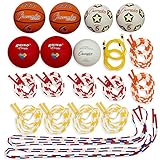
- ALL-IN-ONE EQUIPMENT SET – Includes everything needed for multiple games and activities in one convenient package
- UNLIMITED PLAY OPTIONS – Offers endless combinations of games, drills, and exercises for all ages
- VERSATILE FOR ANY SETTING – Ideal for recess, PE classes, practices, warm-ups, or game time
- INCLUDES POPULAR PLAYGROUND BALLS – (2) size 7 orange rubber basketballs, (2) size 5 white rubber soccer balls, (1) size 5 white rubber volleyball, and (2) 8.5" red rubber playground balls
- COMPLETE WITH ROPES & STORAGE BAG – Comes with multiple jump ropes in various lengths and a 24" x 36" white mesh storage bag for easy transport and organization
Criticism of asphalt and limited activity
The dedicated playground became more firmly established after the war, but its orthodox form was increasingly questioned. The University of London Press chapter “Orthodoxy and adventure” describes criticism of asphalt surfaces and metal equipment, as well as concern that playgrounds offered too little contact with nature. Critics wanted play spaces to address cognitive, emotional and social development alongside physical exercise.
That argument changed the design vocabulary. Sand, mud, water and wood were no longer merely maintenance problems or hazards to remove; they could be materials through which children experimented. The question shifted from “Which apparatus should be installed?” to “What kinds of activity and imagination can this environment permit?”
The criticism also reflected postwar housing conditions. A.W. Cleeve Barr’s 1958 review called “inadequate facilities for children’s play” one of the most miserable features of British postwar housing schemes. The complaint was not simply about a missing slide. It was about whether new neighborhoods gave children any meaningful territory of their own.
What is an adventure playground?
An adventure playground is a supervised play space in which children can build, manipulate loose materials, invent games and alter parts of their environment. It is a tradition, not a single patented design. Some sites occupied bombsites; others were planned within estates or parks. The defining idea is that children have more agency than they do on a fixed set of apparatus, while adults provide supervision, tools, boundaries and support.
The Copenhagen precedent, 1943
The best-documented early precedent opened in Copenhagen in 1943. The London Museum describes it as a junk playground based on landscape architect Carl Theodor Sørensen’s ideas. Children could play freely with inexpensive materials such as wood, tyres and old furniture. Instead of prescribing one correct route through a structure, the site supplied ingredients for construction, role-play and collective invention. The London Museum account identifies this Danish example as a crucial influence.
Rank #2

- Complete Assorted Sports Balls Set: Packed with 2 basketballs, 2 soccer balls, 2 footballs, 2 volleyballs, 2 playground balls, 2 baseballs, pumps, and mesh ball bags-perfect for family fun, team training, or activities
- Official Sizes for Real Feel: these balls for youth and adults come in official sizes; Size 7 Basketball (29.5"), size 5 soccer ball (8.7"), size 9 football (11.2"), size 5 volleyball (8.2"), playground ball (9"), baseball (9" )-giving youth and adults an authentic sports experience
- Easy to Carry and Store: large capacity mesh ball bag (18.2" x 10.3" x 19.7") with straps holds all balls for transport; Comes with pumps and needles for quick inflation anywhere you play
- Strong, Stable, and Game-Ready: these bulk sport balls are made from thick PU with excellent bounce and grip; machine-stitched for shape retention and long-lasting performance across indoor courts, outdoor fields, and playgrounds
- Play Anytime, Anywhere: Whether on sunny fields, gym floors, driveways, or even poolside, this sports balls pack sparks fun, friendly matches, and skill practice. Perfect for training, events, parties, or casual games with friends and family
Marjory Allen and Britain’s bombsites
British landscape architect Marjory Allen, Lady Allen of Hurtwood, encountered the Danish example and campaigned to convert London bombsites into junk playgrounds. One of the first London sites, in North Kensington, opened in 1952, according to the London Museum. Her advocacy helped turn an improvised response to damaged urban land into a recognized form of provision.
Outdated Drivers Are Slowing You Down
One free scan finds every outdated or missing driver and matches the right update for your exact hardware.Free scan · exact hardware matchWindows Errors? Fix Them Before They Spread
Repair common Windows errors and clear accumulated junk for a smoother, more stable PC - no reinstall needed.Free scan · no reinstallIt is misleading to say that Allen “invented” adventure playgrounds. The movement drew on Danish precedent and on a wider network of health, education, planning, political, charitable, church and voluntary organizations. The History Workshop Journal’s study of the Lollard Street project emphasizes this broader setting and the institutional help that made an English movement possible. Its account of Lollard Street describes support from the National Playing Fields Association and a London County Council site made available for a peppercorn rent.
Lollard Adventure Playground, 1954
Lollard Adventure Playground opened in 1954 on the site of a bombed school. The London Museum records a deliberately ordinary inventory: sand, drainpipes, tools and old bricks. The space could serve around 50 children, from toddlers to teenagers. These details matter because they show the model’s practical character. A playground did not need an expensive catalogue of manufactured equipment; it needed materials, supervision and enough room for children to make choices.
The History Workshop Journal describes the exhibition and financial commitment of the National Playing Fields Association, together with the London County Council land arrangement, as something like an official opening for the adventure playground movement in England. The movement gathered momentum through the rest of the 1950s, became a significant part of playground culture in the 1960s and 1970s, and continues in reduced form today. That institutional history prevents a simplistic story in which one designer or one bombsite explains everything.
There was no single postwar replacement
Sculptural structures: MoMA’s “Fantastic Village”
Some designers responded to the limitations of conventional apparatus by inventing new forms rather than supplying loose materials. In 1954, the Museum of Modern Art sponsored a playground design competition. The winning proposal, “Fantastic Village” by Virginia Dortch Dorazio, used seven reinforced-concrete panels with abstract cutouts, ladders and poles. The panels could be arranged into hollow cubes, allowing a designer to configure a varied spatial composition. ASLA documents the competition and the proposal in its history of playground design.
“Fantastic Village” illustrates a key distinction: formal experimentation could expand climbing, hiding and movement without becoming an adventure playground. The structures were designed objects, not a stock of scrap that children could continually rebuild.
Rank #3

- Playground Accessories Included: The playground accessories includes toy telephonex1, steering wheelx1, kids plastic pirate telescopex1(Non-magnifying toy only), 4 safety grab handles and rock climbing holds x10. Surely meet the children’s need for playing outside.
- Safe Material: The outdoor kids play set accessories are made of quality plastic, and round corner design protects kids and prevent them from injury. Our playground equipment will last for a long time with you and your family.
- Suitable for Children: The playground equipment help kids to get exercise and play. The size is suitable for children and they all love the popular bright color toys. Pirate telescope is a toy and does not magnify. The rock wall holds have 5 bright colors like blue, green, red, yellow, and orange.
- Great play set attachments: Perfect as outdoor accessories to add on tree house, play house, jungle gym, swing set, or any play set. It’s the best choice for kids to use in playground or backyards.
- Easy to Install: The pirate plastic ship swing set attachments for backyards is well-made with high quality. All hardware is included to install immediately. Only a few minutes and then you will have fun exploring the world freely.
Everyday landscapes as play equipment
Landscape architect Michael Brown argued for an even broader approach. The University of London Press chapter describes how steps, railings, walls and benches could all support play, and how play opportunities could be a feature of ordinary outdoor space. In this view, a child does not wait until reaching a fenced playground to encounter affordances for movement and imagination.
Marjory Allen praised the Winstanley estate landscape as being conceived around children’s play, with the “total environment” available to them. Planting, paths, level changes and housing courtyards could work together rather than being treated as background around a single equipment zone. Later arguments went further: dedicating isolated playgrounds was not enough if the surrounding neighborhood remained hostile or uninteresting. The wider city had to be considered an environment in which children play.
Adventure, sculpture and neighborhood design compared
| Approach | Historical example | Materials or form | How children shape play | Setting |
|---|---|---|---|---|
| Equipped playground | Early twentieth-century model | Swings, seesaws, sandboxes, slides; often asphalt and metal | Children choose activities, but the main equipment is fixed | Dedicated, organized playground sections |
| Junk or adventure playground | Copenhagen, 1943; Lollard, 1954 | Wood, tyres, old furniture; later sand, drainpipes, tools and bricks | Children build, manipulate materials and invent games under supervision | Bombsites and other supervised sites |
| Experimental play structure | “Fantastic Village,” 1954 | Seven reinforced-concrete panels with cutouts, ladders and poles | Children explore configured forms for climbing, hiding and movement | Designed sculptural installation |
| Play-integrated landscape | Winstanley estate approach | Steps, railings, walls, benches, planting and the wider landscape | Play emerges from ordinary features across the environment | Housing estate and neighborhood landscape |
| Integrated accessible playground | Flushing Meadows Park project, New York City | Municipally commissioned design for children with and without disabilities | Shared play planned around differing abilities | Public park |
The sources do not provide a controlled comparison of safety, developmental outcomes or play quality among these approaches. The table describes design intentions and documented examples, not a performance ranking.
What’s actually slowing this PC down?
Pick the symptom - the matching free tool is one click away.
Inclusion becomes an explicit design question
New York City’s 1960s proposal
New York City’s municipal history adds a later strand to the postwar debate. Mayor John Lindsay’s mid-1960s proposal included adventure playgrounds where children could build, climb and rearrange structures. In a 1965 report, Lindsay remarked, “Today when a park is even halfway decent we are stunned,” a comment that captured the city’s dissatisfaction with the condition of public recreation spaces. The quotation and the municipal timeline appear in the New York City Department of Records and Information Services’ “A Century of Play”.
From disability rights to “A Playground for All Children”
In 1975, New York City’s Board of Estimate set aside $100,000 for the design of an integrated playground serving children with and without disabilities. The project was publicly presented as “A Playground for All Children” in 1976. The resulting playground at Flushing Meadows Park opened in 1984. This sequence shows inclusion moving from a general aspiration to a specific municipal budget, design brief and built project.
Rank #4

- PLAYGROUND BALL 6 PACK SET: Includes 6, 8.5 inch soft nylon bouncy balls with easy grip textured surface great for boys and girls playtime and outdoor games; Rubber balls are also great for pet toys
- MULTI COLORED BOUNCING BALLS: Colorful set includes green, orange, purple, red, royal blue and yellow gym balls for hours of playground fun or gym and recess games; long lasting and durable finish
- SAFE NYLON RUBBER SURFACE: Soft bouncing surface is safe for kids and adults of all ages; Ball safely absorbs hits and bounces off the head and body ensuring hours of safe play exercise and fun
- GREAT FOR KIDS GAMES: Inflatable rubber balls are perfect for school gyms, rec centers and afterschool clubs; Use balls for dodgeball games, kickball, foursquare, keepaway, and classic kids sports
- INDOOR AND OUTDOOR USE: Weatherproof, waterproof sports equipment, rubber balls are perfect for use indoors and out great for gym class or school field days; Floating balls also make great pool toys
The New York example should not be treated as proof that one layout solved accessibility. It demonstrates a change in what public authorities were expected to ask: not merely whether equipment existed, but whether children with different abilities could use a shared environment.
Independent reader supportYour contribution helps us test, update, and keep practical guides available for everyone.How the movement changed London’s playground landscape
Expansion in the 1950s through the 1970s
Adventure playgrounds became a visible part of London’s provision. The London Museum reports about 100 London adventure playgrounds by the late 1970s. Their growth reflected continuing interest in child-directed activity, but also the practical reality that sites required adults, tools, maintenance and organizational support.
The Tool Desk
Outbyte PC Repair FREERepair Windows errors before they cause bigger problemsFix Now →Outbyte Driver Updater FREEFix the driver behind crashes, sound loss and screen glitchesFind Drivers →The 2025 position
The same museum reports more than 70 London adventure playgrounds in 2025. It also notes pressure on staffing and funding, with some sites reducing services or closing. The figure is specific to London and to the museum’s 2025 account; it is not a worldwide total or a measure of how many sites operate under one uniform definition.
Reduced numbers do not erase the design lesson. The adventure playground tradition remains a reminder that a successful play space may depend as much on staffing, governance and local trust as on the physical objects installed there.
What postwar playground history means for design decisions
Ask who controls the environment
Fixed equipment places most control in the designer and manufacturer. Adventure play gives children a supervised capacity to move, combine and transform materials. A neighborhood landscape distributes opportunities across paths, walls, planting and courtyards. These are different relationships between adult authority and children’s agency, not interchangeable styles.
Best Value

- Health & Safety: Soft-touch dodgeball can ensure the safety of the game process, timely hit by the ball will not have a painful feeling. It is made of non-toxic, harmless, and odorless materials, which are more environmentally friendly. If you plan to start a sport, dodgeball is a good choice. While playing, you are also exercising, which can make life healthy and fun.
- Maximum Performance: Easy to inflate.The dodgeball is made with our non-slip texture for easy grip. Soft to the touch and easy to hit, they won't lose their elasticity, feel tingly or break easily like classic playground balls.
- Durable & Reusable: These dodgeballs are made of high-quality rubber material that is not easily worn. The elastic ball can be inflated and adjusted, and the material is light enough that even children can easily grab and throw it, making it an indispensable game for parents and children. With bright colors and suitable sizes, both adults and children can feel the joy of sports.
- Multi-Purpose: Dodgeball is a game that is suitable for many occasions. It can be a game in children's physical education classes, a rivalry game in the gym, an outdoor game at picnics, or a casual game when you are bored at home. As long as you want to exercise and relax, dodgeball is the best choice.
- Dodgeball Set: A set of 6 balls, 1 pump, and 1 mesh storage bag. These bouncing balls are all 8.5 inches in diameter and include blue, yellow, red, purple, green, and orange balls. Please note that due to the different degree of inflation, the ball's size may have a slight error. To ensure the best play experience, we recommend inflating the ball as fully as possible.
Specify materials for more than one kind of activity
The historical examples broaden the material palette from metal and asphalt to wood, sand, mud, water, tyres, old furniture, drainpipes, tools and bricks. The relevant question is not whether a material looks like playground equipment, but whether it can support safe, varied and revisable activity within the site’s management arrangements.
Design beyond the fence
The Winstanley discussion and the wider landscape argument challenge the assumption that play belongs in one isolated rectangle. Routes to school, housing courts, steps, railings, seating and planted areas can all affect whether children encounter playable space in daily life. Treating the neighborhood as part of the play environment also changes how designers think about supervision, sightlines, maintenance and shared use.
Build inclusion into the brief
New York’s 1975 appropriation demonstrates the importance of making inclusion an explicit project requirement. A brief that names children with and without disabilities can shape consultation, circulation, transfer points, sensory variety, staffing and the relationship between different play zones. The historical record establishes the policy milestone; it does not supply a universal technical standard, so contemporary projects still need current accessibility guidance and site-specific design work.
Further reading
For a longer account of the political and design history, the University of Liverpool Repository record for Designed for Play: Children’s Playgrounds and the Politics of Urban Space, 1840–2010 describes coverage of garden gymnasiums, standardization, progressive education, pioneering designers, adventure playgrounds and later debates about health, nature and safety. The repository record is the appropriate reference for the book’s scope.
Taken together, these histories show why “playground design” after 1945 cannot be reduced to a new piece of equipment. It became an argument about agency, materials, landscape, public investment and the right of different children to shape and share urban space.
Do these 3 things before closing this tab:
1Clear out junk files and repair common Windows errors2Scan for outdated or missing drivers - takes under a minute3Repair Windows errors before they cause bigger problemsQuick Recap
Product prices and availability are accurate as of the date/time indicated and are subject to change. Any price and availability information displayed on Amazon at the time of purchase will apply.

