Quick wins for a faster PC:
Repair Windows errors before they cause bigger problemsFix Now →Scan for outdated or missing drivers - takes under a minuteDriver Scan →Flooring can generate electricity from footsteps, but only in small amounts. The leading commercial example, Pavegen, uses electromagnetic generators inside kinetic tiles. Its current materials claim approximately 3–5 joules per step—enough for low-power lighting, sensors and interactive features when many people walk across a busy installation, but nowhere near enough to replace grid power.
Yes—but the electricity is only part of the value
Flooring can generate electricity from footsteps. The best-known commercial example is Pavegen, whose kinetic tiles move slightly when walked on and use that mechanical movement to drive an electromagnetic generator. Pavegen says a typical step produces approximately 3–5 watt-seconds of energy—that is the same as 3–5 joules.

As an Amazon Associate I earn from qualifying purchases.
That is useful for low-power lighting, sensors, displays and interactive installations, especially in busy public spaces. It is not enough to power a building, replace the electrical grid or make an ordinary floor a serious alternative to solar and wind power. The strongest application is a high-traffic walkway that turns footfall into a small amount of local electricity, useful data and a visible sustainability feature.
How footstep-powered flooring works
Commercial kinetic flooring is designed to capture a small portion of the energy that would otherwise be dissipated when a person walks. When someone steps on a Pavegen tile, the surface moves downward by a small distance—approximately up to 10 millimeters, with the company also describing a typical 5–10-millimeter range.
#1 Best Overall

- Smart Thermostat with Full Control: This 15A programmable thermostat with GFCI protection offers a 41°F–98.6°F (5°C–37°C) range, 7-day scheduling, 4 events/day, screen lock, dual-sensor monitoring (air & floor), for efficient, precise heating
- Flexible & Secure Mat Design: Pre-assembled warm mat with cuttable grid (cables cannot be cut) -easily navigate around toilets, cabinets, or corners. Compatible with tile, natural stone, laminate, and wooden floors
- Professional Security Certification: Dual-layer protection with aluminum shield avoids signal interference and ensures heat distribution, plus a grounding wire for leak-proof operation. Low-wattage design (12W/sq.ft.) for energy-efficient homes
- Monitoring System: The installation monitor ensures correct underfloor heating cable function, avoiding extra purchases and re-pouring concrete. This process enhances accuracy and system reliability for both DIY users and professionals
- Ultra-Thin All-In-One Kit: Installs seamlessly under tile or laminate, offering silent operation and anti-crack compatibility. The kit includes the heating mat, thermostat, floor sensor, and guides—no extra parts needed. Ideal for wet/dry rooms, providing seamless warmth
That vertical compression operates a mechanical linkage. The linkage converts the downward movement into rotary motion, which moves magnets relative to copper coils. This is electromagnetic induction: changing the magnetic field around the coils produces an electrical current.
The current commercial Pavegen design should not be confused with every experimental “energy-generating floor.” Pavegen identifies its system as an electromagnetic generator integrated into a composite tile. Other prototypes use piezoelectric materials, triboelectric generators or combinations of several technologies.
How much electricity does one step produce?
Pavegen’s current technical explanation gives an output of approximately 3–5 watt-seconds per step. Since one watt-second equals one joule, that is 3–5 joules per footstep. Another official Pavegen page gives an alternate range of approximately 2–4 joules, so the exact result depends on the tile design, the person’s weight and gait, and the installation conditions.
| Footsteps | Approximate energy at 3–5 joules per step | Equivalent energy |
|---|---|---|
| 1 step | 3–5 joules | 3–5 watt-seconds |
| 1,000 steps | 3,000–5,000 joules | Approximately 0.83–1.39 watt-hours |
| 10,000 steps | 30,000–50,000 joules | Approximately 8.3–13.9 watt-hours |
Those figures are before practical system losses and do not mean that the tile delivers a continuous 3–5 watts. A step is a short event, not a sustained power source. The energy can be used immediately or stored in a battery, but the total available energy remains determined by the number of footsteps and the amount each tile can harvest.
For perspective, 1,000 steps would produce less than 1.4 watt-hours under the stated company range. That can support a brief low-power effect or contribute to sensor and display operation, but it is nowhere near enough to run energy-intensive appliances for a meaningful period.
What can the harvested energy power?
The most effective installations use the electricity close to where it is generated. Pavegen describes applications such as:
- Interactive LED lighting that responds to people walking across the floor
- Real-time information or data displays
- Low-power sensors and wireless monitoring equipment
- USB-charging benches and similar public amenities
- Green-wall irrigation systems
- Tree-planting or visitor-reward systems
- Educational, STEM and sustainability demonstrations
- Gamified installations that encourage people to walk through a space
Some systems store energy in batteries so that an effect can continue between footsteps. Storage makes the installation more flexible, but it does not make it a high-output renewable-energy system. A battery only accumulates the limited energy collected from pedestrian traffic.
Rank #2

- Step on Warmth with Floor Heating Mat: Heated flooring system for tile provide maximized warmth to keep the floor warm no matter how cold it gets and it comes in various sizes to suit your needs covering 10 to 100 sq.ft.! Who wouldn't enjoy the comfort of a radiant in-floor heating system in their home when the weather gets cooler
- Easy to Install: The heated floor mats for indoor use can be easily installed under tile, stone, wood, or laminate flooring .Simply use Warm Heating Mat to unroll and secure your Electric Under Floor Heating Mat to the subfloor, apply a thin layer of mortar, and install the floor. Easily cut the in floor heating mat to fit any odd corners and smaller spaces
- Technology Information: 20 Sqft (20" wide x 12.2 ft long). Voltage: 120, Amps: 2, Watts: 240 @ 12 w/sqft. One piece 20 sq.ft. floor heater consists of a heating cable secured with heating tape onto a fiber-glass mesh. The flexible design of our heating wires allows it to be easily installed in a variety of different flooring types, such as tile, stone and hardwood
- Indoor Use: The Fully Self-adhesive Floor Heat Heating System is ideal for room renovations, bathroom remodeling. Can be used for humid application, but not for installation in pool and spa areas, nor outdoor use. It works in almost any rectangular space. A must-have product for tile floors
- Safe and Value for Money: The radiant floor heating kits has high safety and is not easy to be damaged. Under Tile Heating Mat can be used for more than 20 years based on correct installation methods and completion of all test requirements
Where does kinetic flooring make sense?
Footstep harvesting works best where many people naturally pass through a concentrated area and where the technology has a visible or operational purpose. Potential locations include:
- Airports and railway stations
- University and school campuses
- Shopping centres and high streets
- Museums, science centres and public parks
- Stadiums and event venues
- Government and corporate buildings
- Residential developments with shared public areas
- Brand activations and temporary sustainability exhibits
Pavegen’s Heathrow case study describes an airport walkway with reported footfall of roughly 10,000 people per day, where the harvested energy is used with interactive lighting. The company also lists projects or activations associated with the University of Birmingham, Oxford Street, Lidl Barcelona, Samsung, Adidas, Coca-Cola and Formula E.
These examples demonstrate the range of commercial uses, but they should not be interpreted as proof that every installation is primarily an electricity-generation investment. In many cases, the business case also includes visitor engagement, education, branding, data collection and a more memorable public space.
The floor can also act as a people-flow sensor
Modern kinetic flooring is not limited to energy production. Pavegen says its embedded sensors can measure factors such as footfall volume, dwell time and movement patterns, then transmit information wirelessly to a dashboard.
Free tools Windows power users keep installed
One-click scans. No signup required.
That capability could help a venue understand how people use a walkway, compare activity during an event or make an interactive display respond to pedestrian behaviour. However, the exact sensors, data collected, retention practices and privacy implications depend on the individual project. A company description of the platform should not be taken to mean that every installation collects identical data or that all data is automatically anonymous.
Electromagnetic, piezoelectric and triboelectric floors are different
The phrase “electricity-generating flooring” describes an application, not one universal technology. Several engineering approaches are being developed:
| Technology | How it generates electricity | Typical status or use |
|---|---|---|
| Electromagnetic | Mechanical movement drives magnets and copper coils | Used in current Pavegen commercial tiles |
| Piezoelectric | Pressure or strain creates electrical charge in piezoelectric material | Common in research prototypes, demonstrations and sensor applications |
| Triboelectric | Contact and separation between different materials produces electrical charge | Experimental and research systems, sometimes combined with other generators |
| Hybrid | Combines two or more harvesting mechanisms | Research aimed at improving voltage, current or performance across different movements |
| Magnetoelectric or mechanically coupled | Uses magnetic or mechanically coupled structures to improve force conversion | An emerging research direction for embedded pavements and sensing |
This distinction matters. A laboratory paper about a piezoelectric tile cannot be used as a direct specification for a commercial electromagnetic Pavegen installation. The mechanisms, test conditions, mechanical travel, electrical loads and durability requirements may all be different.
Rank #3

- ✔ Add warmth and comfort to your floors with QuietWarmth Radiant Heat Mat for tile and glue-down flooring! Pair with your ceramic tile, porcelain tile, natural stone, glued-down engineered or solid hardwood flooring, and more.
- ✔ Quick and easy to install- peel and stick backing sticks to your subfloor! No need to waste mortar filling in the gaps of a plastic mat and wire system. Multiple mat size options available simplifies layout and planning. Mat can be cut to length to fit your room. Width of mat cannot be cut to make narrower.
- ✔ QuietWarmth consumes up to 50% less power than traditional wired systems, making it economical and energy efficient! Heat your bedroom floor for less than $1 per day!
- ✔ Razor thin conductive ink film will not add height to your project. Our system eliminates time, mess, and frustration since there are no wires to embed in self-leveler. Attached screed promotes superior bond with adhesives and thinset.
- ✔ You can connect multiple mats to one thermostat (up to 120 sq ft) by wiring in parallel and joining in a junction box. Factory attached 15’ lead wires make wiring a breeze.
What laboratory research shows—and what it does not
Research demonstrates that footstep energy harvesting is technically feasible, but laboratory results are often measured under carefully controlled conditions and should not be presented as the output of every commercial tile.
The Tool Desk
Outbyte Driver Updater FREEScan for outdated or missing drivers - takes under a minuteDriver Scan →Outbyte PC Repair FREEClear out junk files and repair common Windows errorsFree Scan →A 2021 study of a piezoelectric floor tile reported approximately 80 volts open circuit and about 35 milliwatts RMS across an optimal load for one step under its test conditions. Open-circuit voltage is a measurement taken without the normal operating load; it is not the same as usable stored energy or continuous power. The study targeted small electronics and wireless sensors.
A 2020 study of a hybrid triboelectric and electromagnetic floor tile reported a maximum laboratory output of up to 6 watts under specified force, load and stepping-frequency conditions. Such a peak is tied to the experiment’s particular setup. It should not be interpreted as six watts from every individual footstep or as the output of every hybrid floor.
A 2023 experimental study of an electromagnetic footstep tile reported approximately 0.57 watts during walking in its test arrangement. Newer research continues to investigate magnetoelectric and magnetically coupled harvesters, including proposed embedded-pavement systems for emergency power, pedestrian-safety monitoring and environmental sensing.
Together, these studies show an active field of engineering research. They do not show that footstep flooring is ready to replace conventional electricity generation. A useful comparison requires the full conditions: force, displacement, stepping rate, load, efficiency, storage losses, maintenance and the number of people using the installation.
Crashes, No Sound, or Screen Glitches?
Random freezes, missing sound and display glitches usually trace back to one bad driver. Find and replace yours safely.Free scan · under a minutePC Slower Than It Used to Be?
A free scan shows the junk files, broken settings and background clutter dragging Windows down - then fixes them in one click.Free scan · Windows 10 & 11Why the energy is not free
Every installation has costs and constraints beyond the generator itself:
- Traffic volume: A quiet corridor may not produce enough energy to justify the system.
- Mechanical durability: Tiles must withstand repeated loading, impacts, dirt, moisture and everyday wear.
- Structural integration: The floor build-up, subfloor, drainage, access and surrounding finishes must accommodate the tile.
- Conversion losses: Not all mechanical movement becomes usable electrical energy, and batteries and power electronics introduce additional losses.
- Maintenance: Moving parts, sensors, lighting and communication equipment require inspection and eventual replacement.
- Installation cost: A custom kinetic floor is not directly comparable with standard flooring priced only by area.
- Embodied energy: Manufacturing, transporting and installing the system consume resources that must be considered in a genuine sustainability assessment.
- Accessibility and comfort: The surface must remain safe, stable and suitable for the intended users, including people with mobility aids.
For a construction project, the right question is therefore not simply “How many watts will the floor generate?” It is “What measurable service will the floor provide, and is that service worth the installation and maintenance requirements?”
How to evaluate a proposed installation
- Measure the likely footfall. Estimate daily users, peak periods, dwell time and the percentage of people who will actually cross the energy-harvesting zone.
- Define the load. Decide whether the system will drive LEDs, sensors, a screen, irrigation, a battery-backed feature or another specific device.
- Model energy demand and collection. Compare the expected number of steps with the manufacturer’s current output range, then allow for conversion, storage and transmission losses.
- Check the floor assembly. Coordinate tile depth, movement, subfloor preparation, thresholds, drainage, waterproofing, electrical routes and access panels with the design team.
- Confirm durability and maintenance. Ask for loading limits, expected cycle life, replacement procedures, cleaning requirements and warranty terms for the exact product and environment.
- Address safety and accessibility. Review slip resistance, trip hazards, movement underfoot, fire and electrical requirements, and compatibility with wheelchairs, pushchairs and mobility aids.
- Set data and privacy requirements. Establish what sensors record, who can access the dashboard, how long information is retained and whether signage or consent is required.
- Assess the whole-life case. Include manufacturing, installation, maintenance and replacement—not just the electricity produced.
For airports, campuses, municipalities, museums, malls, event producers and brands, a direct commercial enquiry about Pavegen kinetic flooring may be appropriate. It is a specialist B2B installation rather than a consumer flooring product, so a project-specific feasibility assessment is more useful than a generic wattage promise.
Independent reader supportYour contribution helps us test, update, and keep practical guides available for everyone.Can you build a small footstep-energy experiment?
Yes, but a classroom or maker project will use different components and produce a very different result from a commercial kinetic tile. A piezoelectric energy harvesting kit can demonstrate the basic idea: mechanical pressure creates a small electrical signal, which can be rectified, accumulated in a capacitor and used to flash an LED or power a low-energy circuit briefly.
A simple experiment may include piezoelectric discs or transducers, a bridge rectifier, a supercapacitor, an energy-harvesting module, a low-power LED and a multimeter. The exact circuit depends on the component specifications and the desired load. Measure voltage both without a load and across the actual circuit; the first number alone can be misleading.
These parts demonstrate the principle, but they will not reproduce the durability, mechanical linkage, output, safety engineering or integrated data functions of commercial Pavegen flooring. They should be treated as educational electronics, not as a practical way to power a building.
For advanced readers, Mechanical Design of Piezoelectric Energy Harvesters is a relevant reference on harvester mechanisms, including designs related to human walking and footstep energy.
The realistic verdict
Footstep-powered flooring is real, but its headline is easy to misunderstand. A person’s step contains mechanical energy, and a well-designed floor can recover a small fraction of it. In a busy, carefully planned location, that energy can trigger lighting, support sensors, charge a small battery or make a public space respond to its users.
The technology’s wider value often comes from combining three functions: microgeneration, people-flow data and public engagement. That makes it potentially useful smart-infrastructure technology for selected commercial and civic projects. It does not make footsteps a city-scale power source, nor does it remove the need for conventional electricity systems.
Best Value
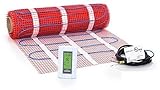
- Electric Floor Heating Mats are 20" wide. The electric floor heating cable is spaced at 3" apart.
- Combine 120V Electric Floor Heating Mats to heat up to 150 sq.ft of floor space (300 sq.ft for 240V systems)
- Heating cable is only ~1/8" thick and produces an impressive 41 BTU's per sq.ft heat output
- ADHESIVE mat backing makes installation faster and easier - no need for constant re-stapling.
- UL listed and/or ETL listed for the USA and Canada. 25-year Manufacturer's Warranty on Heating Mats. 3-year Manufacturer's Warranty on AUBE Floor Sensing Thermostats.
Frequently Asked Questions
How does Pavegen flooring generate electricity?
Current commercial Pavegen tiles use electromagnetic induction. A step compresses the tile, a mechanical linkage converts that movement into rotary motion, and magnets moving relative to copper coils generate electricity.
How much electricity does one footstep generate?
Pavegen’s current technical explanation gives approximately 3–5 watt-seconds, or 3–5 joules, per step. The exact output depends on the tile, the person’s movement and installation conditions.
Can footsteps power a house or building?
It can support low-power applications such as interactive LEDs, sensors, displays, battery charging and educational demonstrations. It is not intended to power a building or replace grid electricity.
Recommended Free Tools
Can I make a footstep energy harvester at home?
Yes. Piezoelectric discs, a rectifier, a capacitor and a low-power circuit can demonstrate the principle. A DIY setup will have very different output, durability and safety characteristics from a commercial kinetic floor.
Where is electricity-generating flooring most useful?
High-footfall sites such as airports, stations, campuses, shopping centres, museums, stadiums and event venues are the strongest candidates. The project should also have a clear use for the lighting, data or engagement features.
The Bottom Line
Bottom line: Kinetic flooring can turn heavy pedestrian traffic into small amounts of usable electricity, but its best business case usually combines low-power energy harvesting with lighting, sensing, education and engagement. Treat it as specialist smart flooring—not as a replacement for grid power or large-scale renewable generation.
Quick Recap
Product prices and availability are accurate as of the date/time indicated and are subject to change. Any price and availability information displayed on Amazon at the time of purchase will apply.
Do these 3 things before closing this tab:
1Scan for outdated or missing drivers - takes under a minute2Repair Windows errors before they cause bigger problems3Fix the driver behind crashes, sound loss and screen glitches