Solar panels still produce electricity in cold weather, but snow covering their surface blocks sunlight and can temporarily reduce or stop production. Light snow often slides, melts, or blows away naturally. Heavy, wet, drifting snow and ice are more serious because they can cause prolonged production losses and add stress to panels, racking, roofs, or foundations.
The important distinction is that solar panels need light, not heat. Cold temperatures can improve photovoltaic efficiency; winter’s lower total output usually comes from shorter days, a lower sun angle, cloud cover, shading, and snow that remains on the array.
As an Amazon Associate I earn from qualifying purchases.
How photovoltaic panels make electricity
A solar panel generates electricity through the photovoltaic effect:
- Sunlight reaches semiconductor cells in the panel.
- Photons in that light transfer energy to the material.
- That energy creates mobile electrical charges.
- An internal electric field directs the charges, producing direct current (DC).
- An inverter converts the DC electricity into alternating current (AC) for a home or the grid.
Snow matters because it interferes with the first step. If a thick, opaque layer prevents sunlight from reaching the cells, the covered portion of the panel cannot produce its normal output. The basic process is explained by the U.S. Department of Energy.
#1 Best Overall
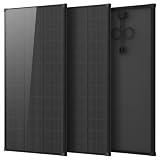
- 【25.6% High-Efficiency & Ultra-Stable Output】AeternaSol 200W solar panel, a premium n type solar panel with 18 BB Full-Welding Silver-Containing Busbars, boasting N-Type A+ Grade Cell, achieves a 25.6% high conversion efficiency. This 200 watt solar panel’s A+ grade monocrystalline silicon effectively reduces microcrack risks, while the 18BB busbars further cut down power loss—ensuring ultra-low degradation and prolonged service life. Note: The 200W rated power is measured under Standard Test Conditions (STC): 1000W/m² irradiance, 25°C, and 1.5 air mass. Real‑world output will vary due to panel angle, operating temperature, shading, wiring loss and connected‑device efficiency.
- 【IP68 Waterproof】Equipped with an exclusive IP68 Waterproof, our solar panels feature advanced potting technology that creates an impermeable seal to prevent water or steam from reaching internal wires. This design minimizes short-circuit risks to the greatest extent, effectively inhibits rust and corrosion, and ensures the solar panel maintains optimal performance even in harsh weather. The junction box’s excellent thermal conductivity enhances heat dissipation, further extending the lifespan of the entire 200 watt solar panel, which is essential for long-term use of solar panels for rv and outdoor applications.
- 【11 AWG 100% Oxygen-Free Copper Wire】Our 200w solar panel comes with 11 AWG 100% Oxygen-Free Copper Wire, which outperforms common copper-clad aluminum cables in conductivity and durability. This extra-thick oxygen-free copper wire can withstand up to 25A current, ensuring efficient power transmission—perfect for rv solar panel and solar panels for camping setups. Beyond the standard insulation layer, the wire is sheathed in a UV-resistant jacket, which significantly extends its lifespan compared to conventional alternatives, providing long-lasting reliability for solar panels for rv and other outdoor uses.
- 【Durable MC4 Connector for Stable Connection】The 200 watt solar panel is fitted with a durable MC4 connector, featuring galvanized copper pins encased in a larger PPO shell that outperforms aluminum-pin connectors with a higher current rating. This robust connector ensures stable power connection for the solar panel charger and compatible devices, while its sturdy PPO shell offers superior compatibility with other connectors on the market. Whether you’re expanding your solar system or replacing parts, this connector makes the 200w solar panel a flexible choice for any setup, including solar panel charger configurations.
- 【Sturdy Aluminum Alloy Frame】Crafted with a more durable aluminum alloy frame, our solar panel is sturdier than steel frames—retaining a sleek shine for years while resisting rust and corrosion. Additional frame sealant prevents air from corroding the monocrystalline cells, protecting the 200w solar panel (200 watt solar panel) from environmental damage, which is crucial for panel solar portatil and solar panels for camping that face frequent outdoor exposure. Pre-drilled holes on the frame ensure effortless installation, making this panel solar portatil easy to set up on RVs, campsites, or rooftops.
Do solar panels work while it is snowing?
Yes, although output may be reduced. Snow falling through the air is less important than snow that stays on the panel.
- During active snowfall: Clouds and precipitation reduce the available sunlight.
- A light dusting: Some light may still reach exposed cells, and the layer may clear quickly.
- Patchy coverage: Uncovered sections can continue producing, though the result depends on the system’s wiring and shading.
- Thick, opaque coverage: Production can fall dramatically until the snow clears.
- Ice or wet snow: These can remain longer and create greater loading concerns than loose, dry snow.
There is no universal rule that “snow means zero production.” Snow density, depth, coverage, temperature, irradiance, panel tilt, wiring, and panel technology all affect the result. NREL’s snow-performance models account for factors including snow depth, array tilt, irradiance, and ambient temperature.
Why cold weather can help—but winter can still produce less power
Photovoltaic cells generally operate more efficiently at lower temperatures. As temperature rises, voltage typically falls more significantly than current rises, reducing the cell’s efficiency. A cold, sunny panel can therefore perform very efficiently. See the DOE’s explanation of solar photovoltaic performance and efficiency.
Crashes, No Sound, or Screen Glitches?
Random freezes, missing sound and display glitches usually trace back to one bad driver. Find and replace yours safely.Free scan · under a minutePC Slower Than It Used to Be?
A free scan shows the junk files, broken settings and background clutter dragging Windows down - then fixes them in one click.Free scan · Windows 10 & 11However, efficiency is not the same as total energy production:
- Efficiency is the share of incoming sunlight converted into electricity.
- Energy yield is the amount of electricity generated over a day, month, or season.
Winter can produce less total energy because days are shorter, the sun is lower in the sky, clouds may be more frequent, snow can cover the array, and nearby trees, chimneys, dormers, or buildings cast longer shadows. Severe cold can also affect inverters and batteries, depending on their operating specifications.
Does snow automatically slide off solar panels?
No. Snow shedding depends on the array’s design and the weather. Important factors include:
- Panel tilt and roof slope
- Snow type, moisture, and depth
- Wind and sunlight
- Temperature
- Panel orientation and layout
- Whether the lower frame edge catches snow
- Nearby roof structures, parapets, valleys, or other panels that create drifts
- Clearance beneath the array
Steeper arrays generally shed snow more effectively. DOE guidance identifies significant snow-shedding gains around 30–35 degrees, with additional benefits possible at angles up to about 60 degrees. NREL operational guidance reports that snow generally slides from arrays around 30 degrees, while low-sloped arrays below 20 degrees are more likely to retain it.
Recommended Free Tools
Those angles are useful guidance, not guarantees. A steep array can still retain wet snow or ice, and a lower array may clear quickly in strong sun and wind. Increasing tilt can also increase wind loading, installation complexity, and cost, and may not be optimal for annual energy production.
Rank #2

- 【High Conversion Rate】This 20W solar panel with monocrystalline A+ solar cell has an excellent cell efficiency of 21%-30%. Designed to charge and maintain 12V rechargeable batteries like LiFePO₄, Lithium Ion, AGM, SLA, GEL, EFB, MF, etc. Keep batteries in charged for trailer, tractor, truck, boat, motorcycle, RV, car, lawn mower, water pump, gate opener, electric fence, etc
- 【Built to Last】 Low-iron tempered glass surface and corrosion-resistant aluminum frame, make this solar panel 100% waterproof and rustproof, and provide the prolonged lifespan up to 25 years. This 12V solar panel can withstand all weather conditions such as sandstorm, strong wind, thunderstorm, blizzard, hail, etc. It can withstand up to 2400Pa wind pressure and 5400Pa snow load
- 【Smart MPPT Controller】The charging efficiency of this upgraded 10A controller is 30% higher than other controllers on the market. Its intelligent three-stage charging design effectively prevents the battery from overcharging, over-voltage and short circuit. It takes no power from the battery. You will clearly know the charging status of the battery through the two indicator lights on the controller
- 【360° Adjustable Bracket & Plug-and-Play Installation】Comes with a fully 360° angle adjustable mounting bracket, which allows you to adjust the solar panel to the optimal sun-facing angle for maximum solar energy absorption and higher charging efficiency. Pre-drilled mounting holes and matched screws greatly simplify the installation process, no complicated tools or professional skills are required. All cable connections support plug-and-play, enabling quick and effortless installation and disassembly for both indoor and outdoor scenarios.
- 【Complete Accessories & Reliable After-Sales Service】Our SOLPERK Solar Panel kit includes 1*20W solar panel, 1*smart MPPT charge controller, 1*adjustable mounting bracket, 1*alligator clip, 1*O-ring and a full set of mounting accessories to meet your diverse installation and use needs. We offer 1-year professional after-sales service and lifetime technical support, with 7×24-hour online customer service to respond to your questions and solve problems within 24 hours, bringing you a worry-free shopping and using experience.
Do solar panels melt snow?
Panels may help snow melt or slide because they are dark, exposed to sunlight, and often tilted. Sunlight can warm the surface, while warmer air and wind can loosen or remove snow.
Standard photovoltaic panels should not be treated as built-in snow-melting heaters. Ordinary systems are not normally designed to electrically heat their surfaces to clear snow. Clearing depends on natural warming, sunlight, wind, panel design, and weather conditions. Snow may remain during a storm, overnight, in freezing wind, or beneath a thick wet layer.
Can snow reflection increase solar production?
Snow has a bright surface and can reflect light toward an exposed array. This may be useful for bifacial panels, which collect light from both sides, and can also contribute some reflected light to other exposed panels.
But reflection does not make a snow-covered conventional panel productive. A thick layer blocking the front of the module usually causes a much larger loss than any benefit from reflected light. The effect varies by panel type, ground surface, sun position, and coverage, so it should not be treated as a guaranteed winter production bonus.
How much energy can snow cost?
There is no single snow-loss percentage that applies to every home. Snow persistence, not just annual snowfall, is often the more useful question. Several small storms that clear quickly may have less effect than one storm that leaves a thick layer for weeks.
NREL’s operations and maintenance guidance cites these estimated annual-average snow-related losses:
| Region or condition | Estimated annual-average loss |
|---|---|
| Southern U.S. states | Approximately 0%–2% |
| Arid states such as Colorado | Approximately 2%–4% |
| Heavy-snow locations such as Michigan, Wisconsin, and Maine | Approximately 10%–16% |
These are regional estimates, not a prediction for a particular roof. A steep, sunny array may perform better than a regional average, while a shallow, shaded array may perform worse. The figures come from NREL’s PV operations and maintenance guidance.
The Tool Desk
Outbyte Driver Updater FREEFix the driver behind crashes, sound loss and screen glitchesFind Drivers →Outbyte PC Repair FREEClear out junk files and repair common Windows errorsFree Scan →If you are considering solar, use the NREL PVWatts Calculator for an initial site-specific production estimate. Then ask an installer how the proposal accounts for snow losses, roof geometry, winter shading, tilt, and local weather. PVWatts is an energy estimate, not a structural snow-load assessment.
Rank #3

- [Industry-Leading 25% Efficiency] 16BB N-Type cells deliver more power from the same sunlight, supporting RV trips, camping, blackout backup, and off-grid use in limited or cloudy conditions.
- [Lightweight & Magnetic Design] Weighing 13.89 lb and folding to 23.72 x 22.99 x 1.97 in, this 200W panel stores at backpack size with a magnetic closure for SUVs, RVs, and campsites.
- [Direct Device Charging] Charge 3 devices with USB-C PD 45W and dual USB-A ports for phones, tablets, laptops, GPS, and cameras.
- [Compatible with Most Power Stations] Compatible with Jackery Explorer 1000 v2, EcoFlow DELTA 3/DELTA 3 Max/RIVER 3 Max, Anker SOLIX S2000, and other models that meet the requirements. MC4 output only; the 4-in-1 adapter is sold separately.
- [UL 61730 Certified] Tested to UL 61730 and listed with CE, RoHS, FCC, CA65, PSE, and ISO 9001 claims. Four kickstands, an accessory pouch, reinforced grommets, and 40°/50°/60° angles help position the panel on RVs, tents, or windy campsites.
Can heavy snow damage a solar system?
Normal snow exposure does not automatically damage a properly designed system. Severe conditions can create problems, especially when snow accumulates unevenly or combines with ice and wind.
Potential damage includes:
- Broken glass or invisible cell cracks
- Warped modules or detached frames
- Damaged rails, clamps, racking, or roof attachments
- Overstressed roof structures
- Uneven loading at the lower edge of framed modules
- Wind-driven drifts
- Freeze-thaw movement affecting ground-mounted foundations
- Buried, displaced, or damaged cables and equipment
Snow does not always sit as a uniform blanket. It may collect at the lower edge of tilted framed modules or in drifts beside roof features. The relevant risk is the complete system—modules, clamps, rails, attachments, roof, foundation, and site conditions—not just the average snow depth.
NREL has reported greater annual performance losses in its fleet analysis after severe weather events, including events involving snow depths greater than one meter. That is a fleet-level observation, not a precise damage threshold for a residential installation.
Do these 3 things before closing this tab:
1Repair Windows errors before they cause bigger problems2Fix the driver behind crashes, sound loss and screen glitches3Clear out junk files and repair common Windows errorsWhat snow-load rating should buyers look for?
DOE says modules are commonly tested under IEC 61215 and that a typical module rating may be around 2,400 pascals (Pa). For heavy-snow locations, DOE recommends selecting modules certified for at least 5,000 Pa and checking the manufacturer’s installation manual for the rating under the exact mounting configuration.
A 5,000-Pa module is not automatically safe everywhere. Your installer or engineer must also account for:
- Local roof and ground snow loads
- Roof shape, slope, and attachment points
- Racking design and clamp zones
- Nonuniform accumulation and drifting
- Wind exposure
- Module orientation and mounting configuration
- Local building codes and permits
Ask to see both the module documentation and the design assumptions for the complete array.
How panel design and layout affect snow
Tilt
A higher tilt can help snow slide sooner and reduce the time cells remain covered. The trade-offs are greater wind loading, potentially more expensive racking, and a tilt that may not suit the roof or maximize annual production.
Free tools Windows power users keep installed
One-click scans. No signup required.
Landscape versus portrait orientation
Landscape orientation can allow upper portions of modules to become exposed sooner as snow slides or melts. It may also change bypass-diode behavior and electrical layout. Landscape is not automatically better; the designer must balance snow, shading, roof dimensions, wiring, and structural requirements.
Rank #4

- ⚡ Ultra-Lightweight & Ultra-Portable: 100W Foldable Solar Panel Weighing only 4.1lbs (1.85kg) with a sleek 0.59-inch profile, this solar charger is engineered for ultimate portability. It folds down to a compact 12.99 x 10.43 x 2.17" (330x265x55mm) and includes a premium carry bag, making it effortless to transport during camping, hiking, or road trips. The generous unfolded size of 45.47 x 26.18" ensures maximum power capture while remaining easy to handle.
- 🔌 Universal 3-in-1 Output & Versatile Adapters: Equipped with PD 3.0 45W USB-C, 18W USB-A, and 100W DC outputs, this solar panel powers all your devices simultaneously. The included 4-in-1 charging cable (DC5521, DC7909, Anderson, XT60) provides universal compatibility for most portable power stations, power banks, and smartphones. It is the ultimate solution for off-grid living and emergency power outages.
- ☀️ High-Efficiency Monocrystalline Technology: Built with premium monocrystalline silicon cells and durable E-Film lamination, this panel delivers an impressive 23%+ energy conversion efficiency. This advanced technology ensures faster charging even in low-light conditions, providing reliable performance on overcast days or in harsh outdoor environments.
- 🛡️ IP67 Waterproo f & Dustproof for All-Weather Use: Engineered to meet the IP67 waterproof and dustproof standard, this solar panel is built to withstand the elements. It is fully protected against rain, dust, sand, and extreme temperatures, ensuring uninterrupted power generation during your adventures by the lake, in the desert, or during sudden downpours.
- 🏕️ Rugged & Reliable for Outdoor Emergencies: Designed to thrive in the great outdoors, this foldable solar panel is perfect for camping, fishing, RV travels, and unexpected power outages. Its durable E-FLIM lamination construction guarantees long-term durability, making it an essential and cost-effective power backup solution for your outdoor lifestyle and emergency preparedness kit.
Framed versus frameless modules
Frameless modules may shed snow more readily because there is no lower frame edge to catch it. Their structural ratings and installation requirements can differ, however. A stronger, correctly engineered system matters more than a promise of faster shedding.
Clearance and snow guards
Adequate clearance can reduce snow piling beneath the array and help preserve drainage. Snow guards can control where snow sheds, protecting people, vehicles, landscaping, or lower roofs. They may also increase retained snow load, so they must be designed with the roof and array rather than added casually.
Roof-mounted versus ground-mounted systems
Ground-mounted panels may be easier to inspect without climbing onto a roof, but they have their own winter risks:
What’s actually slowing this PC down?
Pick the symptom - the matching free tool is one click away.
- Wind-driven drifting
- Snowplow or vehicle damage
- Buried or obscured equipment
- Blocked access after a storm
- Foundation movement from frost heave and freeze-thaw cycles
Ground-mounted systems need foundations designed for local frost depth and soil conditions. Mark the array and any buried equipment clearly so snow-removal crews cannot walk or drive into it.
Tracking systems may use a “snow stow” mode that tilts the array steeply during severe weather. This is a specialized feature and does not apply to ordinary fixed rooftop systems.
Independent reader supportYour contribution helps us test, update, and keep practical guides available for everyone.Should you remove snow from solar panels?
Usually, you should not remove snow yourself. The short-term production recovered is often not worth the risk of falling, damaging the modules, or creating hidden cracks.
Do not:
- Climb onto the roof to clear panels.
- Walk on the modules.
- Use a shovel, ice scraper, metal rake, or pressure washer.
- Use salt or hot water.
- Pull frozen snow or ice across the glass.
DOE warns that manual removal can scratch or damage modules and that walking on panels can damage them. NREL likewise describes snow removal as generally not recommended. If removal is necessary because of a credible structural, roof, drainage, or access hazard, contact the installer or a qualified solar professional. Professional procedures may use soft tools or specialized equipment appropriate to the installation.
Quick wins for a faster PC:
Scan for outdated or missing drivers - takes under a minuteDriver Scan →Repair Windows errors before they cause bigger problemsFix Now →When can snow removal be justified?
Production loss alone is usually not a sufficient reason for risky DIY clearing. Professional intervention may be appropriate when:
Best Value

- 【Grade A+ Cells, Up to 25.6% Efficiency】200 watt solar panel utilizes advanced N-Type A+ Grade solar cells and utilizes advanced 18 BB Silver-Containing Full Welding Busbars technology(which improves the photoelectric conversion efficiency and ensures a longer service life compared to traditional 10BB/12BB solar cells) with an increased cell efficiency of 25.6% EL tested,outperforming traditional panels.
- 【No energy drains at night】By incorporating reverse current blocking diode technology, photovoltaic systems achieve “lossless” operation during night-time hours, thereby enhancing energy utilisation efficiency while simultaneously improving safety and durability.
- 【IP68 waterproof certification】Exclusive Filled with Polyurethane polymer Junction Box.it prevents water or steam from reaching the wires inside,Rated IP68 for dust and water resistance, 200W solar panel is designed to endure dirt, splashes, and rain effortlessly. Its anti-corrosion aluminum alloy frame ensures decades of reliable outdoor performance. Engineered for extreme conditions, it withstands 2400 Pa wind pressure and 5400 Pa snow loads.
- 【Enhanced MC4 Connector】Crafted from premium galvanised copper for superior conductivity, effectively reducing resistance and heat generation while boosting transmission efficiency. PPO engineering plastic, it offers exceptional heat resistance and anti-ageing properties. Oversized design enhances structural integrity and delivers superior protection ratings, ensuring reliability in demanding outdoor conditions.Standard MC4 interface for plug-and-play functionality and effortless installation.
- 【11 AWG 100% Oxygen-Free Copper Wire】 Crafted from high-purity oxygen-free copper (OFC) with conductivity reaching 99.99%, offers lower resistance and more efficient transmission, and capable of handling currents up to 25 amps. Beyond standard insulation, it features an additional UV-resistant sheath that effectively withstands prolonged sunlight exposure, high-temperature ageing, and moisture corrosion.
- Accumulation creates a credible structural-overload concern.
- Ice dams or drainage problems are developing.
- Emergency access is required.
- A professional identifies a specific roof or equipment hazard.
- A commercial or utility-scale operator has a documented maintenance procedure and suitable equipment.
Before a severe storm, prioritize system survival and personal safety over a few hours of production. During a storm, sunlight is usually limited anyway, while damage could cause much longer downtime.
Before-and-after storm checklist
Before a major snowstorm
- Have a qualified professional assess existing accumulation if loading is a concern.
- Check gutters and drainage.
- Ensure surrounding roof or ground areas can shed snow safely, where appropriate.
- Confirm tracker communications and snow-stow operation if applicable.
- Follow the installer’s instructions for powering down equipment when appropriate.
- Charge an associated battery where practical, without assuming it can cover a prolonged outage.
After the storm
Arrange a professional inspection after an extreme event, particularly in a heavy-snow region. Look for broken glass, warped or detached modules, loose attachments, moved racking, damaged cables, water intrusion, or an unexpected production decline.
If damage is visible, stay clear of the equipment and follow the manufacturer’s and installer’s procedures for shutting down or leaving the system offline until it can be inspected and repaired. Do not assume a monitoring alert proves that snow is the cause: inverter faults, grid outages, shading, wiring problems, ice, and storm damage can produce similar symptoms.
Designing solar for a snowy climate
When evaluating a proposed installation, focus on these questions:
- How long does snow remain on comparable local arrays? Persistence matters more than storm count alone.
- What are the roof slope, tilt, and winter shading conditions? Low winter sun can make trees and roof features especially important.
- What are the module and complete racking load ratings? Check the manufacturer’s manual and mounting configuration.
- Where will snow drift? Consider roof valleys, edges, parapets, nearby structures, and ground-mounted clearance.
- Does the installer understand local requirements? Look for demonstrated experience with snow loads, frost depth, roof structure, permitting, and winter design.
- How is production modeled? Ask for assumptions covering tilt, shading, snow persistence, and local weather.
- Do you need backup power? A battery can bridge short outages but does not increase solar production or eliminate a seasonal energy deficit.
Solar can be worthwhile in a snowy climate, but the answer depends on local sunlight, electricity rates, incentives, shading, roof design, and how quickly snow clears. A site assessment is more useful than judging a system by annual snowfall alone.
Useful monitoring and backup tools
Monitoring platforms such as Enphase Enlighten and SolarEdge Monitoring can help identify unusually low output after a storm. They cannot remove snow or diagnose every physical problem without visual inspection and weather context.
Home batteries such as Tesla Powerwall or Enphase storage can provide backup power during outages or short periods of low production. They do not make a snow-covered array generate electricity, and a battery may not cover a prolonged winter outage unless it is appropriately sized and charged.
For snow guards and roof-snow management, use a roof-specific product designed as part of the PV system. DOE’s PV lifecycle guidance identifies snow guards as a design consideration, but retaining snow can increase the load, so professional design is essential.
Quick Recap
Product prices and availability are accurate as of the date/time indicated and are subject to change. Any price and availability information displayed on Amazon at the time of purchase will apply.




