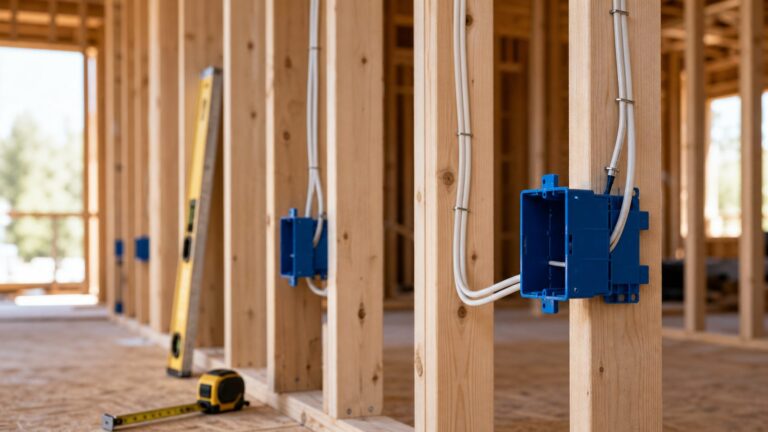
Building codes set minimum safety requirements, permits give the local building department a chance to review proposed work, and inspections check construction at selected stages. Together, they create a process for finding and correcting some problems before work is concealed or a building is occupied. The exact rules and inspection sequence depend on the jurisdiction, and an approval is not a guarantee that a building is free of every defect.
How the safeguards work together
In the United States, building safety oversight typically connects three activities: setting technical requirements, reviewing proposed work, and checking construction in the field. Each serves a different purpose. A code supplies the baseline; a permit ties a project to an official review and enforcement process; inspections check work against applicable requirements and approved documents.
As an Amazon Associate I earn from qualifying purchases.
The International Code Council (ICC) describes the International Building Code (IBC) as a model code providing minimum requirements intended to safeguard occupants’ health, safety, and general welfare. A model code is not automatically binding everywhere. State or local governments adopt codes, often with amendments, and the locally adopted rules determine what applies to a particular project. ICC’s 2021 IBC preface explains the model-code purpose.
The Tool Desk
Outbyte PC Repair FREEClear out junk files and repair common Windows errorsFree Scan →Outbyte Driver Updater FREEFix the driver behind crashes, sound loss and screen glitchesFind Drivers →These safeguards are connected, but none is a substitute for the others. A code supplies criteria, not project-specific approval. A permit begins a formal process, but obtaining one does not by itself verify that construction matches the approved documents. An inspection checks selected work at a particular stage; it does not establish that every part of the building has been examined. The process is intended to identify and address some compliance problems, not to promise a defect-free result.
#1 Best Overall

- Valued Carpenter Pencil Set: You will get 2 pcs solid carpenter pencils with 26 piece 2.8 mm refills, 1 replaceable sharpener, 1 plastic storage box.The complete carpenter pencils combination allows you to finish your work faster and more easily
- Deep Hole Marker Pencil: The deep-hole construction pencils adopts 45mm elongated tip design, which is more convenient to mark in the small hole or in other tight areas that other carpenter markers cannot reach
- Carpenter Pencils with Sharpener: The sharpener is screwed into the top of the work pencil, which won't get lost either. Built-in pencil sharpener that keep the lead with pointed and smooth to Improves line of sight in fine work
- Stronger Solid Lead: This work pencil is matched with a 2.8 mm thick lead , which is much thicker and stronger during the drawing process of construction work, it will not break or damage easily
- Marks on Various Surfaces: 3 colors solid construction pencil can marks on various surfaces,such as metal, plastic, wood, paper etc. Ideals for woodworkers, contractors, craftsmen, builders, merchants and masons
What building codes do
Building codes establish minimum technical requirements for areas such as structural safety, fire and life safety, sanitation, and building systems. They provide a common framework for design and construction, so plans and work can be evaluated against defined requirements rather than informal expectations.
“Minimum” matters: code compliance is a baseline, not a promise of ideal design, flawless workmanship, or suitability for every owner’s preferences. The relevant code edition and amendments are those adopted by the authority having jurisdiction (AHJ)—usually a local building department, though the responsible authority varies. Ask the AHJ which edition and local amendments govern your project before relying on a general code reference.
For example, citing an ICC model-code chapter can help explain the general framework, but it does not establish that the same edition or wording applies at a particular address. Adoption can differ by state or locality, and amendments may change requirements. Even official model-code material should therefore be treated as background until the local authority confirms what governs the project.
Do these 3 things before closing this tab:
1Repair Windows errors before they cause bigger problems2Scan for outdated or missing drivers - takes under a minute3Clear out junk files and repair common Windows errorsWhy permits are part of the process
A permit application creates a project record and gives the building department an opportunity to review construction documents before work proceeds. The cited IBC administration provisions assign the building official responsibility for receiving applications, reviewing documents, issuing permits, inspecting permitted work, and enforcing the code. The 2006 IBC administration chapter illustrates these administrative duties; it is an older model-code text, not a statement of current local requirements.
Permit requirements are not identical for every job. They depend on local rules, the scope of work, and the project’s circumstances; some jurisdictions exempt certain limited work. Do not assume that every repair needs a permit—or that a repair is exempt just because it seems small. Before starting, give the building department a clear description of the work and ask whether a permit is required, what documents it needs, and whether any trade permits or separate reviews apply.
Rank #2

- Ergonomically Designed: Work in tight areas with a compact design that gets into tough spots
- Compact and Lightweight: Both tools are designed to fit into difficult to reach spaces. The 1/4" impact driver has a length of 5.55 in. and weighs just 2.8 lbs, while the 1/2" drill/driver measures only 7.5 in. and weighs 3.6 lbs
- Both the DEWALT impact driver and electric drill driver feature integrated LED work lights with a convenient 20-second delay, ensuring enhanced visibility in dimly lit or challenging work areas
- One-Handed Loading - Keep one hand free with a 1/4 in. hex chuck that accepts 1 in. bit tips
- Power drill cordless with 1/2" single sleeve ratcheting chuck provides tight bit gripping strength, making bit changes faster and more secure
For an owner, the practical value of asking early is that permit triggers, required documents, and inspection conditions can be confirmed before work is underway. The department can tell you whether the proposed scope needs review and what information it expects. No single national list of documents or universal application process applies, so avoid relying on another town’s checklist or assuming that a neighbor’s similar project follows the same rules.
What inspections check—and when they happen
Inspections check permitted work at points selected by the applicable code and project. An inspector may compare visible construction with the approved documents and code requirements. Staging matters because some components become difficult or impossible to assess once they are covered. The 2023 Florida Building Code, Building, for example, requires permitted work to remain exposed and accessible until inspection approval and includes staged inspections such as foundation work. That is a Florida-specific example, not a nationwide schedule. Florida Building Code inspection provisions set out that jurisdiction’s process.
Quick wins for a faster PC:
Repair Windows errors before they cause bigger problemsFix Now →Fix the driver behind crashes, sound loss and screen glitchesFind Drivers →The 2024 International Residential Code (IRC) also provides a model-code example for permits, inspections, and notification of deficiencies. Its provisions can help explain the general process, but local adoption and amendments determine the requirements for an actual project. The 2024 IRC administration chapter describes these procedures.
There is no single inspection calendar that applies to every building or renovation. The required stages depend on the adopted code and the work covered by the permit. A foundation inspection is one example in the Florida provisions; readers should not infer that every project has that stage, or that a list found online is complete for their job. Ask the AHJ for the inspection sequence attached to the permit and clarify whether any tests or additional checks are required.
Plan the inspection sequence before work is covered
- Confirm the required inspections. Ask the AHJ which inspections apply to your permit and whether scheduling is handled online, by phone, or through another local process.
- Check the approved documents and permit conditions. Identify any project-specific notes, required tests, or sequencing conditions rather than relying on a generic checklist.
- Request an inspection at the right stage. Contact the department when the work is ready for the applicable inspection, allowing for its scheduling requirements.
- Keep work accessible until it is approved. Do not cover or conceal items that must be inspected first. If work is covered prematurely, ask the inspector or building department what must be exposed or otherwise provided to resolve the issue.
- Address any deficiencies and arrange follow-up. If the inspector identifies an issue, clarify what correction or documentation is needed and whether another inspection is required before the project proceeds.
This sequence is a planning aid, not a replacement for the permit conditions. The key point is to coordinate the inspection before a component becomes inaccessible. If the inspector identifies a deficiency, get the requested correction or documentation clear before moving forward; the applicable department determines what follow-up is needed.
Rank #3

- 【Great Compatibility】This Katerk 1/4 inch hex shank bit holder is specifically designed for 1/4 inch hex shank drill bits. It's compatible with most 1/4 fast hex handles, hex sockets, various electric screwdrivers, and handheld screwdrivers. The bit holder makes it a valuable addition for any handyman.
- 【Secure and Safe】Built with a secure backup nut design, each drill bit holder securely locks onto your bits, ensuring they stay firmly in place. Additionally, our bit holder incorporates a high-quality steel ball rolling design that holds up to several kilograms of weight, ensuring your various drill bits don't fall off.
- 【Easy One-Handed Operation】The bit holder for impact driver allows you to change bits single-handedly, simplifying your workflow. Its multi-color design further allows for quick identification of the drill bit you need.
- 【Compact and Convenient】Thanks to its compact size, this 1/4 inch bit holder is easy to carry around. The bit holder allows for easy attachment to various tools, making this a convenient addition to your construction accessories. The Katerk bit holder is cast from high-quality alloy material, promising a long product lifespan. Despite its rugged strength, the bit holder remains lightweight, making it portable.
- 【Cool Christmas Gift For Men Stocking Stuffers】 This screwdriver bit holder, driver bit holder, impact bit holder, can be given as a gift to your loved one, especially for anyone involved in construction or electrical work. It's a must-have for stocking stuffers for men and women, tools gifts for dad, tech gadgets for men, gifts for dad, gifts for him, gifts for husband, gifts for boyfriend, cool gadgets for men, and cool gifts for dad.
When special inspections and testing add scrutiny
Routine permit inspections are not the only form of verification. Chapter 17 of the 2024 IBC addresses special inspections and tests for specified materials, assemblies, and structural work. Where those provisions apply, qualified individuals may be required to perform inspections or testing and document results. These checks supplement ordinary building-department inspections; they are not a universal substitute for them. Whether special inspections are required, who qualifies, and how findings are accepted depend on the adopted code and project. The 2024 IBC special-inspection chapter describes the model-code framework.
Recommended Free Tools
The practical distinction is who performs the check and how its results enter the approval process. A routine inspection is part of the local permit process; a special inspection or test may add qualified technical review for specified work. Where an alternative or third-party route is authorized locally, confirm which work and code provisions it covers, the qualifications required, how findings must be documented, and how the AHJ accepts them. Do not assume that hiring a third party automatically replaces an inspection required by the building department.
What a passed inspection does—and does not—mean
An approval is a finding within the inspection process about the work evaluated at that stage. It does not establish that every component was examined, that concealed conditions are defect-free, or that the building will never develop a problem. Inspection scope and visibility are limited by the stage and requirements of the particular inspection.
The 2023 Florida Building Code, Building, makes one important limit explicit: “Approval as a result of an inspection shall not be construed to be an approval of a violation of the provisions of this code or of other ordinances of the jurisdiction.” This is wording from Florida’s Eighth Edition (2023), not a universal quotation from every jurisdiction. The practical lesson is that inspection approval is not a warranty or blanket authorization for noncompliant work. Florida’s code provisions on inspection approval state the jurisdiction-specific rule.
For the same reason, a passing inspection should not be described as proof that a home is completely safe or free of defects. It confirms an outcome within a particular code process and inspection scope. It does not necessarily speak to work that was concealed, components outside the inspection, or future performance. The cited sources do not quantify how many unsafe outcomes the process prevents, so claims of a specific percentage or nationwide reduction would go beyond the evidence.
Rank #4

- Long Nib and Deep Hole Marker: Our mechanical carpenter pencil with 45mm nib is designed for easy marking of deep holes or narrow areas. These construction pencils are the great choice for woodworking tools, construction tools, carpenter tools, contractor tools, wood carpentry tools and architect tools
- Extra Refills in 2 Colors for Versatile Marking: The construction mechanical pencil comes with 12 extra 2.8mm refills, including 6 red and 6 black refills. The black refill is suitable for light surfaces, while the red wax is perfect for dark surfaces. Our carpenter mechanical pencil makes sure that you'll have an ample supply for extended use
- Built-in Sharpener: Our construction pencil comes with a built-in sharpener to ensure the mechanical pencil tip is always sharp and ready for use. Never buy an extra pencil sharpener again. A great tool for any woodworker pencil, contractor pencils. The refill can easily be extended or retracted with a simple click of the pencils mechanical, allowing you to work more efficiently and accurately
- Portable Clip Design: Our deep hole construction pencil features a portable clip design, easy to carry and attach to your pocket or tool box, so that you can keep the carpenter pencils mechanical close at hand, making it a convenient tool to have on the go. Great gifts choice for carpenters
- Stronger Pencil Lead: The black refills are made of lead, sturdy and smooth. The red refills are made of wax, clear and light. These marking pencils are much thicker and stronger than normal pencils during the marking process of construction work, suitable for various surfaces, such as glasses, metal, boards, floors, walls, furniture, etc. The written marks can be easily wiped with a wet paper towel when needed
Questions to ask your local building department
- Which code edition and local amendments apply to this address and scope of work?
- Does this work require a building permit, trade permits, or another approval?
- What plans, calculations, or other documents must be submitted?
- Which inspections and tests are required, and in what order?
- What work must remain exposed, and when may it be covered?
- If a deficiency is found, what correction and reinspection process applies?
- Are special inspections or an approved third-party inspection arrangement authorized for this work, and how must findings be documented and accepted?
Where a local code allows more than one inspection route, ask who performs the inspection, which code provisions and work it covers, what qualifications are required, and how the AHJ accepts the findings. Do not assume a third-party report replaces a permit inspection unless the building department confirms that arrangement for the project.
Finding code-administration guidance
A code-administration reference can help explain how plan review, permitting, and inspections fit together, but a model-code publication may not reflect local adoption or amendments. The ICC lists code-administration and permit-process education resources in its code-development and education materials and catalog. For a live project, the local building department and the approved project documents are the sources to check for applicable requirements.
If you consult a codebook or administration guide, use it to understand terminology and the general process, not as proof that a particular provision applies in your locality. Check the edition and amendments with the AHJ, especially before making a design or construction decision. No specific book listing, price, or availability is confirmed here.
Frequently Asked Questions
Do I need a building permit for a repair or renovation?
It depends on the jurisdiction, the scope of work, and local exemptions. Some limited work may be exempt, but there is no universal rule that every repair needs—or does not need—a permit. Describe the work to your local building department and ask whether a building permit, trade permit, or other approval is required before starting.
What does a building inspection check?
An inspection checks work covered by the permit at a selected stage, often comparing visible construction with the approved documents and applicable code requirements. The exact scope and stages vary by project and jurisdiction. Some work must remain exposed and accessible until the required inspection is approved.
Best Value

- Milwaukee Ink all Fine Point Marker, Black, 4 Per Pack
- 4 per pack Features Clog Resistant Marker Tip Writes through Dusty, Wet and Oily Surfaces Durable Marker Tip for Writing on Concrete, OSB and Rough Surfaces
- Clog resistant tip writes on dusty, wet and oily surfaces and is optimized for rough surfaces such as OSB, cinderblock and concrete
- Hard hat clip- attaches for easy access
- Quick dry time with reduced smearing and marking
When should I call for an inspection, and can work be covered first?
Confirm the inspection sequence and scheduling process with the AHJ, then request each inspection when the work reaches the required stage. Do not cover work that must be inspected first; the 2023 Florida code, for example, requires permitted work to remain exposed and accessible until approval. That example is jurisdiction-specific, so follow the conditions for your own permit.
Does passing an inspection mean a house is safe or defect-free?
No. Approval is a finding about work evaluated within a particular inspection process. It does not guarantee that every component was examined, that hidden conditions are defect-free, or that future problems will not occur. It also does not authorize a code violation; the Florida code states that limit explicitly.
Are special inspections the same as ordinary permit inspections?
No. Special inspections and tests under the 2024 IBC address specified materials, assemblies, or structural work and may require qualified individuals and documented results. They supplement ordinary permit inspections rather than universally replacing them. The adopted local code and project determine whether they apply and how findings are accepted.
What’s actually slowing this PC down?
Pick the symptom - the matching free tool is one click away.
Can a third-party inspector replace the building department’s inspection?
Only if an arrangement is authorized for the work under local rules. Ask the AHJ who may perform the inspection, what work and code provisions are covered, what qualifications and documentation are required, and how results are accepted. Do not assume a third-party report substitutes for a required permit inspection.
The Bottom Line
Codes establish a minimum safety baseline, permits connect proposed work to local review, and inspections check permitted work at selected stages—sometimes with special testing for specified work. The process can help identify deficiencies before construction continues or work is concealed, but requirements differ by jurisdiction and an approval is not a warranty. For any live project, confirm the adopted code, permit triggers, inspection sequence, and conditions for covering work with the local building department.
Quick Recap
Product prices and availability are accurate as of the date/time indicated and are subject to change. Any price and availability information displayed on Amazon at the time of purchase will apply.