A thermos is not a heater or a refrigerator. It is a heat-transfer bottleneck: a container engineered to slow the movement of thermal energy between its contents and the surrounding environment.
A thermos is not a heater or a refrigerator. It is a heat-transfer bottleneck: a container engineered to slow the movement of thermal energy between its contents and the surrounding environment.
As an Amazon Associate I earn from qualifying purchases.
When the contents are hotter than the room, energy naturally moves outward, and the thermos slows that loss. When the contents are colder than the room, energy moves inward, and the thermos slows that gain. It does not stop the process permanently; it simply makes the contents approach room temperature much more slowly.
Quick wins for a faster PC:
Clear out junk files and repair common Windows errorsFree Scan →Scan for outdated or missing drivers - takes under a minuteDriver Scan →The basic construction: two containers with a vacuum between them
A conventional thermos, also called a vacuum flask or Dewar flask, generally has an inner container surrounded by an outer wall. The space between those walls is evacuated, leaving a near-vacuum rather than ordinary air.
#1 Best Overall

- MINIMALISTIC DESIGN: The steel water bottle comes without any paint to ensure scratch resistance and durability. The neutral design makes the stainless steel water bottles ideal for work, hiking, yoga, travelling and all everyday activities.
- ECO-FRIENDLY: Made of 18/8 stainless steel, this 24 oz insulated water bottle is designed to last a lifetime. Say no to plastic water bottles and plastic pollution! The eco friendly water bottles are a safe option for you and the environment.
- STAY HYDRATED: Drinking plenty of water is crucial for your overall wellbeing. Make this insulated water bottle your new companion and stay hydrated. The vacuum insulated water bottle keeps your drinks hot for up to 12 hours and cold for 24 hours.
- BIG OPENING: The opening of the metal water bottle is big enough to add ice cubes or a tea infuser which makes it perfect for all your drinks – hot and cold. The wide neck makes it possible to infuse fruits in your double wall water bottle.
- EASY TO CLEAN: The wide opening and simple closing system makes the canteen water bottle hygienic. Thanks to its big neck you can also easily see inside the hiking water bottle metal, making sure it is clean avoiding.
That distinction matters. “Double-wall insulated” does not necessarily mean “vacuum insulated.” A double-wall bottle may contain air, foam, or another insulating material between its walls. A vacuum-insulated bottle removes most of the gas from that space, eliminating the material needed for ordinary convection and greatly reducing gas-phase conduction.
Practical example
A vacuum-insulated thermos bottle is the consumer product that most closely demonstrates this design: a separated inner and outer wall, a reduced-pressure gap, reflective surfaces, and a closure that limits heat exchange through the opening. Individual bottles still differ in wall thickness, steel construction, stopper design, and tested retention time.
The same general idea appears in building science. A well-designed wall assembly reduces unwanted heat flow by interrupting conductive paths, limiting air movement, and controlling radiant exchange. A thermos applies those principles in a compact container, although a bottle’s near-vacuum gap is not the same as the insulation system in a building wall.
Recommended Free Tools
Heat moves in three ordinary ways
To understand the thermos, start with the three principal modes of heat transfer: conduction, convection, and radiation.
| Heat-transfer mode | What it is | How a thermos reduces it |
|---|---|---|
| Conduction | Energy passing through matter by direct interaction between neighboring particles. | The vacuum removes the continuous gas path between the main walls. Solid bridges remain at the neck, rim, supports, base, and closure. |
| Convection | Heat carried by the bulk movement of a fluid such as air or liquid. | There are too few gas molecules in the evacuated gap to support normal air currents. |
| Radiation | Electromagnetic energy, mainly infrared at everyday temperatures. | Reflective or low-emissivity surfaces reduce infrared emission and absorption between the walls. |
1. How the vacuum reduces conduction
In a single-wall container, heat can conduct directly through the wall. If the liquid is hot, energy travels through the wall toward the cooler outside surface. If the liquid is cold, energy travels in the opposite direction.
In a vacuum flask, the inner and outer walls are physically separated across most of the body. With very little gas in the space between them, there is no continuous material path for normal conduction across the main gap.
However, conduction is not eliminated. The walls must connect somewhere, and the bottle must remain structurally sound. Heat can still travel through:
Outdated Drivers Are Slowing You Down
One free scan finds every outdated or missing driver and matches the right update for your exact hardware.Free scan · exact hardware matchWindows Errors? Fix Them Before They Spread
Repair common Windows errors and clear accumulated junk for a smoother, more stable PC - no reinstall needed.Free scan · no reinstall- the neck and rim;
- small structural supports between the walls;
- the base and joined sections;
- the stopper, cap, or lid;
- the container material around the opening.
These paths are intentionally made as limited as practical, but they are why a thermos is not a perfect thermal barrier.
2. How the vacuum suppresses convection
Convection requires a moving fluid. In an ordinary air-filled cavity, air next to the warmer wall becomes less dense and rises, while cooler air falls. That circulation transfers heat from one wall to the other.
A near-vacuum contains too few molecules to form useful convection currents. Removing the air therefore removes one of the most effective ways heat could cross the space between the walls.
The liquid inside the thermos can still circulate internally, especially while it is being poured or if temperature differences exist within the liquid. The vacuum mainly suppresses convection in the sealed gap around the inner vessel; it does not prevent every movement of fluid inside the bottle.
Free tools Windows power users keep installed
One-click scans. No signup required.
3. Why heat can still cross a vacuum
A vacuum blocks most ordinary conduction and convection across the wall gap, but it cannot block thermal radiation. All objects above absolute zero emit electromagnetic radiation. At the temperatures of coffee, soup, ice water, and the surrounding air, much of that radiation is infrared.
Rank #2
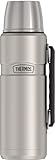
- STAYS HOT OR COLD: THERMOS vacuum insulation technology for maximum temperature retention of hot or cold beverages. Perfect take-along for outdoor adventures, keeping beverages hot or cold for 24 hours
- EXTREMELY DURABLE: High quality 18/8 stainless steel construction is dependable any time of year for long treks or road trips. Includes a built-in serving cup and carry handle
- SWEAT-PROOF: Exterior stays cool to the touch with hot beverages and sweat-proof with cold. THERMOS brand beverage bottles are dishwasher safe, top rack recommended
- TWIST AND POUR STOPPER: Allows for pouring without removing the stopper completely. Perfect for serving the entire family hot or cold beverages
- LARGE CAPACITY: Carry enough coffee for the whole group. This 40 ounce beverage bottle will hold enough coffee for the whole group to get a cup. This beverage bottle also comes in a 68 ounce capacity
The warm inner wall emits infrared energy toward the cooler outer wall. For cold contents, the net radiative exchange runs in the opposite direction. No air is required; electromagnetic radiation can cross empty space.
Radiative heat transfer is often described using a Stefan–Boltzmann relationship. In simplified form, the rate depends on the surface area, the emissivity of the surfaces, and the fourth power of their absolute temperatures:
radiative heat transfer ∝ emissivity × area × (T14 − T24)
This equation explains two important design choices:
- Radiation becomes more significant as absolute temperature differences and surface temperatures change.
- Reducing emissivity reduces the amount of radiation exchanged between the walls.
A consumer thermos is more complicated than this simplified equation. Its total heat leak combines radiation across the gap with conduction through supports and the neck, plus heat transfer through the lid and opening. Still, the equation captures why a vacuum by itself is not the complete explanation.
Why thermoses have shiny or reflective surfaces
Shiny metal or other low-emissivity surfaces emit and absorb less thermal radiation than dull, high-emissivity surfaces at the same temperature. Reflective inner surfaces therefore reduce the infrared exchange that can still occur across the vacuum gap.
The reflective coating does not “reflect heat” in the same way a mirror reflects visible light in every circumstance, and it does not eliminate radiation. Its practical role is to lower emissivity and reduce the net radiant heat flow between the two walls.
The lid and neck are major weak points
The vacuum normally surrounds the main body, but the bottle still needs an opening. The neck, rim, stopper, screw threads, gasket, and lid cannot be isolated in exactly the same way as the cylindrical wall.
These parts provide solid paths for conduction. The opening also creates an opportunity for air exchange. If the lid is removed, warm air can escape from a hot drink and cooler air can enter. With hot liquids, escaping vapor carries energy away as well.
A well-fitting stopper helps by limiting:
- direct air circulation through the opening;
- evaporation and vapor escape;
- contact between the contents and the relatively cool outside air;
- heat conduction through unnecessarily large or poorly fitted closure components.
This is why replacing a damaged closure can matter, but replacement parts must match the bottle model. A generic lid may fit the threads while sealing poorly, or it may create a different conductive path. If the closure is the problem, look for a thermos replacement lid or stopper specifically identified as compatible with the exact bottle.
Why a thermos keeps both hot and cold contents stable
The physics is symmetrical:
- Hot contents: the room is cooler, so energy tends to leave the drink. The thermos slows that outward flow.
- Cold contents: the room is warmer, so energy tends to enter the drink. The thermos slows that inward flow.
A thermos does not produce cold, add heat, or maintain a fixed temperature. Over enough time, its contents will move toward the ambient temperature. A cold drink eventually warms; a hot drink eventually cools.
The time required depends on factors including:
- the starting temperature of the contents;
- the surrounding air temperature;
- the amount of liquid or food inside;
- the bottle’s surface area and geometry;
- the quality of the vacuum and reflective surfaces;
- the design and condition of the lid;
- how often the bottle is opened;
- whether the bottle is full or nearly empty.
For that reason, a stated retention time is a test-condition result, not a universal promise for every thermos. Model, fill volume, starting temperature, ambient conditions, and measurement method all affect the outcome.
Rank #3

- 【Double Wall Vacuum Insulation】 Enjoy 24+ hours of ice-cold drinks and 12+ hours of hot beverages with our premium vacuum insulated bottle, crafted from 18/8 food-grade 304 stainless steel
- 【Safe & Portable】 Our BPA free, rustproof bottle keeps drinks tasting fresh with odor-resistant stainless steel. The 17 oz size fits perfectly in car cup holders and backpacks for worry-free hydration on the go
- 【Leakproof & Condensation-Free】 Precision-engineered threading and a reinforced silicone seal ensure no leaks, while the sweat-free exterior keeps your belongings dry
- 【Flexible Packaging Options】 Available in convenient single or multi-pack configurations (1/4/8/12 count), perfect for personal use, family outings, team events, or thoughtful gifting occasions
- 【Satisfaction Guaranteed】 Volhoply stands behind every product. If you’re not completely satisfied, contact us for a hassle-free resolution
Why preheating and pre-cooling improve performance
Suppose boiling liquid is poured into a room-temperature thermos. Before the bottle reaches a steady condition, some of the liquid’s energy warms the inner wall, lid, and other internal components. That energy is no longer available to keep the drink hot.
Preheating reduces this initial penalty:
- Fill the thermos with hot water.
- Close it and let the interior warm for a short period.
- Empty it carefully.
- Immediately add the hot drink or food and replace the lid.
For cold contents, use the reverse process: add cold water or ice briefly to lower the temperature of the inner surfaces, empty the bottle, and then add the chilled contents.
Preheating or pre-cooling does not strengthen the vacuum or change the underlying insulation. It simply reduces the initial energy exchange between the contents and the container.
Do these 3 things before closing this tab:
1Scan for outdated or missing drivers - takes under a minute2Clear out junk files and repair common Windows errors3Fix the driver behind crashes, sound loss and screen glitchesHow to get the best thermal performance
- Condition the bottle first: preheat it for hot contents or pre-cool it for cold contents.
- Fill it appropriately: a larger volume generally has more thermal energy relative to the area through which it can escape, although the exact result depends on the design.
- Keep the lid closed: every opening allows air exchange and exposes the contents to a direct heat-transfer route.
- Inspect the gasket and stopper: dirt, wear, cracking, or an incorrect replacement can compromise the seal.
- Use the intended closure: a drinking spout or wide opening may be more convenient but can retain heat differently from a fully sealed stopper.
- Do not infer performance from one temperature check: retention should be evaluated under repeatable conditions if comparison matters.
The same principles apply to packed meals. A vacuum-insulated food jar uses the same general strategy for slowing heat exchange, but its actual performance depends on its lid, opening, fill level, and tested design. Insulation alone should not be treated as a universal food-safety guarantee; safe storage also depends on the food, starting temperature, handling, and applicable guidance.
What happens when the vacuum seal fails?
If the evacuated gap develops a leak, gas gradually occupies the space. That restores a path for gas-phase conduction and can permit convection currents, increasing the rate of heat transfer through the main body.
A practical symptom may be reduced temperature retention. The outside of a compromised bottle may also feel unusually warm when it contains a hot liquid or unusually cold when it contains a cold liquid. However, that is not a universal diagnostic: exterior temperature depends on the bottle’s construction, the failure mode, the contents, and the time since filling.
To check a suspected failure without special equipment, compare the bottle’s performance with a known-good bottle under the same conditions. Use the same liquid volume and starting temperature, leave both unopened for the same period, and measure the contents with the same thermometer. A single casual touch test cannot prove that the vacuum has failed.
If the bottle is damaged, unusually hot on the outside, leaking, or no longer retaining temperature, follow the manufacturer’s inspection and replacement guidance. Do not attempt to drill, cut, or repair a sealed vacuum wall; the pressure difference and construction can make such modifications unsafe.
Independent reader supportYour contribution helps us test, update, and keep practical guides available for everyone.Materials: glass versus stainless steel
Early Dewar flasks commonly used glass walls and reflective coatings. Modern consumer bottles often use double-wall stainless steel because it offers a useful combination of durability, corrosion resistance, manufacturability, and reasonable weight.
The material still matters. It affects how much heat travels through the neck and supports, how easily the bottle survives impact, how the surfaces are formed, and how the container resists corrosion. But changing from glass to stainless steel does not change the central principle: the evacuated space suppresses conduction and convection across the main body, while reflective surfaces reduce radiation and the closure limits the remaining heat paths.
Common misconceptions
“A vacuum eliminates heat transfer.”
No. It largely suppresses conduction and convection across the gap, but radiation still crosses the vacuum. Solid bridges and the lid also conduct heat.
What’s actually slowing this PC down?
Pick the symptom - the matching free tool is one click away.
“Every double-wall bottle is a thermos.”
No. Double-wall construction describes two walls, not what fills the space between them. Check whether the product specifically states that it is vacuum insulated.
Rank #4

- STAYS HOT OR COLD: THERMOS vacuum insulation technology for temperature retention of hot or cold beverages. Perfect take-along for outdoor adventures, keeping beverages hot for 18 hours or cold for 24 hours
- EXTREMELY DURABLE: High quality 18/8 stainless steel construction is dependable any time of year for long treks or road trips. Includes a built-in serving cup
- SWEAT-PROOF: Exterior stays cool to the touch with hot beverages and sweat-proof with cold. THERMOS brand beverage bottles are dishwasher safe, top rack recommended
- TWIST AND POUR STOPPER: Allows for pouring without removing the stopper completely. Perfect for serving the entire family hot or cold beverages
- OTHER CAPACITIES: Love the bottle but looking for a different size? The STAINLESS KING beverage bottle also comes in a 40 ounce and 68 ounce capacity
“A thermos keeps a drink at its original temperature forever.”
No. It slows the approach to ambient temperature. It does not create or remove thermal energy.
“The shiny surface is the whole insulation system.”
No. Reflective surfaces reduce radiation, but the vacuum, structural design, neck, lid, gasket, and opening all influence total performance.
“A warm exterior always proves the vacuum is broken.”
Not necessarily. Some heat can travel through the closure, base, neck, and supports even when the vacuum is functioning. An unusually large change in performance is more meaningful than a single surface-temperature observation.
The Tool Desk
Outbyte Driver Updater FREEScan for outdated or missing drivers - takes under a minuteDriver Scan →Outbyte PC Repair FREERepair Windows errors before they cause bigger problemsFix Now →The complete picture
A thermos works by attacking all three major heat-transfer routes rather than relying on one magical material. Its evacuated double wall removes most of the gas available for conduction and convection. Its reflective or low-emissivity surfaces reduce infrared radiation. Its narrow neck, stopper, gasket, and lid limit the unavoidable heat paths around the opening.
Those measures do not make the container perfectly insulated. They make heat exchange slow enough that hot and cold contents remain useful for much longer than they would in an ordinary single-wall container.
Frequently Asked Questions
Does a thermos keep things hot and cold?
A thermos slows heat transfer in both directions. It reduces heat leaving a hot drink and heat entering a cold drink, so either one approaches room temperature more slowly.
Does a vacuum thermos stop all heat transfer?
No. The vacuum largely suppresses conduction and convection across the main wall gap, but radiation, solid supports, the neck, base, and lid still transfer some heat.
Recommended Free Tools
How can I make a thermos retain temperature longer?
Preheat it with hot water before adding hot contents, or pre-cool it with cold water or ice before adding chilled contents. Keep the lid closed and ensure the stopper and gasket fit correctly.
Is every double-wall bottle vacuum insulated?
A double-wall bottle may contain air, foam, or another material between its walls. A vacuum-insulated bottle specifically has most of the gas removed from that space.
The Bottom Line
Bottom line: A vacuum thermos works by slowing conduction, convection, and radiation at the same time. The vacuum removes most of the gas path between the walls, reflective surfaces reduce infrared exchange, and the lid limits the remaining heat flow through the opening. It preserves a drink’s temperature; it does not create heat or cold.
Quick Recap
Product prices and availability are accurate as of the date/time indicated and are subject to change. Any price and availability information displayed on Amazon at the time of purchase will apply.
Do these 3 things before closing this tab:
1Scan for outdated or missing drivers - takes under a minute2Clear out junk files and repair common Windows errors3Fix the driver behind crashes, sound loss and screen glitches
