Do these 3 things before closing this tab:
1Clear out junk files and repair common Windows errors2Scan for outdated or missing drivers - takes under a minute3Repair Windows errors before they cause bigger problemsThe best kitchen floor tile balances appearance with wet-floor performance, cleaning demands, room scale, and installation conditions. This visual menu covers 24 options—from warm wood-look planks to graphic checkerboard, stone-look porcelain, mosaics, and continuous open-plan floors—without pretending one style suits every kitchen.
The best kitchen floor tile balances appearance with wet-floor performance, cleaning demands, room scale, and installation conditions. The 24 ideas below are a visual menu rather than a ranking: a warm wood-look plank may suit one kitchen, while a graphic checkerboard or durable stone-look porcelain may be better in another. Before choosing a color or pattern, confirm that the specific product is rated for floors, appropriate for the room’s moisture and traffic, and compatible with the substrate and installation system.
As an Amazon Associate I earn from qualifying purchases.
Wood-look kitchen floor tile ideas
1. Warm oak-look porcelain planks
Long porcelain planks with an oak visual bring the warmth and directional grain of hardwood to a tile floor. They suit transitional, Scandinavian, modern farmhouse, and classic kitchens, especially alongside white, cream, or natural-wood cabinetry. Run the planks along the room’s longest sightline to make the kitchen feel more elongated. Choose a floor-rated product with a matte or low-sheen finish, and check the installation instructions for allowable plank offset and joint width.
2. Herringbone wood-look tile
A herringbone arrangement gives plank tile a tailored, traditional feel and adds movement without introducing another color. It works especially well in a kitchen with simple cabinetry, where the floor can act as the main decorative feature. Plan the centerline carefully before setting tile; the pattern produces more cuts and waste than a straightforward running bond. Keep grout close to the tile color if you want the grain to remain the focus, or use contrast when the geometry is meant to stand out.
3. Chevron plank layout
Chevron tile creates a continuous V-shaped rhythm, unlike herringbone’s broken zigzag. It can be striking in a long galley kitchen because the repeated V directs attention down the room. The look requires precise alignment and more cutting, so verify that the chosen planks are suitable for the pattern and have enough material for the layout. A simple cabinet profile and restrained backsplash help prevent the floor from becoming visually busy.
#1 Best Overall
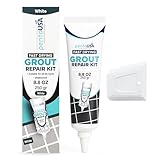
- Acrylic Sanded Grout Filler That Cures Into Solid Grout - This premixed tile grout repair contains acrylic sanded grout material in a clean white tone that fills cracks, missing sections, and damaged joints, curing into solid grout-like material that bonds to existing grout and tile for durable structural repair on floors, walls, and countertops. Designed for DIY tile grout repair, suitable for first-time users, homeowners, and handyperson-level work.
- Reliable Coverage with Standard Cure Time - Touch dry in approximately 2 hours and fully cured in 24 hours. One 8.8 oz tube covers approximately 29 square feet using 12x12 inch tiles at 1mm (1/32 inch) depth including waste, suitable for shower grout repair, bathroom grout repair, and kitchen tile touch-ups. Allow full 24-hour cure before water contact for best moisture resistance. Suitable for renters, rental hosts, and homeowners.
- Water-Resistant Grout Line Filler - Designed to fill missing grout gaps, repair cracked lines, and refresh discolored joints with a clean white finish. Stain-resistant barrier helps guard against moisture penetration in interior wet zones. Suitable for shower walls, bathtub surrounds, bathroom floors, kitchen backsplashes, and laundry room tile. Recommended for splash zones and occasional water contact rather than constant submersion.
- Water-Based Formula for Indoor Use - Premixed grout repair paste with low-odor, water-based formula suitable for indoor use. Thick consistency stays in grout lines without dripping. Built-in anti-clog nozzle pin inside the cap helps keep the tube sealed and grout fresh between uses, so you can store and reuse the tube for future touch-ups. Included scraper makes smoothing and cleanup simple. Designed for easy DIY use with controlled application from the squeeze tube. Cleanup with water before the product sets.
- Premixed Acrylic Sanded Grout Formula - PentaUSA grout repair white features an acrylic sanded grout formula. Kit includes premixed grout tube and precision scraper for tile floor, wall, or shower repair applications. Larger sizes available: 13.4 oz covering approximately 44 sq ft and 17.6 oz 2-Pack covering approximately 58 sq ft for larger projects. Designed for targeted repair as an alternative to full regrouting.
4. Whitewashed wood-look porcelain
Pale gray, cream, and white wood-look planks help reflect light in a small or north-facing kitchen. They pair naturally with light cabinets, pale stone counters, and coastal or contemporary finishes. Use a close grout color for a calm, broad surface; choose contrast only if emphasizing each plank is intentional. Bring a sample into the room at different times of day, because cool daylight and warm artificial light can change whether the floor reads gray, beige, or stark white.
5. Dark wood-look porcelain
Charcoal, espresso, and smoked-oak visuals ground white cabinetry and complement brass, bronze, and other warm-metal hardware. They are a good fit for dramatic transitional, industrial, and contemporary kitchens. Dark floors show light dust and crumbs more readily, so a matte or lightly textured finish is often more forgiving visually than a polished one. Balance the floor with lighter walls, counters, or an island if the kitchen has limited natural light.
6. Wood-look hexagon tile
Wood-grain hexagons offer a more distinctive alternative to conventional planks. Their honeycomb field suits vintage, eclectic, modern farmhouse, and playful contemporary kitchens. Because the geometry already supplies strong pattern, use quiet cabinetry and a restrained grout color. Confirm that the product is specifically listed for floor use; a wood appearance alone does not establish its technical suitability.
Stone, marble, and mineral-inspired floors
7. Marble-look porcelain
Marble-look porcelain provides bright veining and an upscale appearance while generally avoiding the maintenance approach required by natural marble. It works with simple white, gray, or warm-wood cabinetry. Let the floor supply most of the visual movement: pairing dramatic floor veining with a heavily veined counter and backsplash can make a kitchen feel unsettled. The individual porcelain product still controls its absorption, finish, and floor rating, so read the technical data rather than relying on the word “porcelain.”
8. Large-format marble-look tile
Twelve-by-24-inch and larger marble-look tiles reduce visible grout lines and can make a kitchen appear more expansive. They are particularly effective in open-plan rooms and minimalist kitchens. The trade-off is installation precision: large formats need a flatter substrate, careful mortar coverage, and an installer who can control lippage. Measure transitions, cabinet clearances, and appliance openings before committing to an unusually large format.
9. Soft gray stone-look porcelain
Gray limestone- or slate-inspired porcelain creates a neutral foundation for colorful cabinets, wood islands, and black fixtures. It is a flexible choice if you expect the kitchen to be redecorated later. A softly varied visual hides everyday debris better than a completely uniform dark floor, while a low-sheen finish usually feels more natural than high polish. Check how the sample looks beside both the countertop and the cabinet hardware.
Free tools Windows power users keep installed
One-click scans. No signup required.
10. Travertine-look porcelain
A warm beige travertine visual supports Mediterranean, Tuscan, Spanish, and transitional kitchens without requiring the same care as actual porous stone. It pairs well with cream cabinetry, walnut, aged metals, and textured plaster finishes. Look for a product whose variation feels intentional rather than repetitive. A matte surface generally reinforces the natural-stone impression and is less likely to emphasize reflections and smudges.
11. Slate-look tile
Charcoal and blue-gray slate visuals add depth to farmhouse, rustic, contemporary, and industrial kitchens. They can anchor pale cabinets and bring texture to an otherwise smooth room. Surface texture is the practical consideration: a highly cleft-like tile may be harder to sweep and mop than a relatively smooth slate visual. Select a floor-rated product and examine a full-size sample, not only a small online photograph.
Rank #2

- EASY TO USE SQUEEZABLE TUBE & PRECISION APPLICATION: Hemway grout repair has waterproof and fast-drying features, and it also restores and protects. The ready mixed grout reviver is designed to color and cover stained, dirty, or old grout.
- GROUT REPAIR WITH 4 X PROFILING TOOLS: Complete 4 piece tool kit designed for precise application and high quality results. Each tool features multiple edge shapes and sizes, making it the ideal profiling tool for achieving smooth, consistent lines.
- LONG-LASTING LIGHT GREY GROUT: The tile adhesive is designed using an advanced formula that helps prevent staining and spots & protects against grubby grout while delivering richly pigmented color.
- FAST DRYING & TRIPLE PROTECTION: Permanent on most surfaces and has triple protection that repairs, renews, fills & adhesively fixes. Ideal for non-ventilated workspaces. Make your bathroom, kitchen, tile floor, countertop, and walls look new again.
- TILE GROUT LIGHT GREY: It is eco-friendly and odorless. The light grey grout reviver is ready mixed for ease of use, and provides high quality results to renew and repair. The light grey tile grout can be used on a wall and floor for tiles.
12. Terracotta-look porcelain
Terracotta-colored porcelain brings the warmth of fired clay to Mediterranean, Southwestern, cottage, and eclectic kitchens without the sealing and variation-management demands of actual terracotta. It looks especially natural with cream cabinets, pale grout, exposed wood, and woven accents. Use a sample to judge whether the orange, red, or brown undertone works with the room’s lighting. A matte finish usually keeps the look grounded and less decorative than a glossy surface.
13. Concrete-look porcelain
A smooth gray concrete visual suits minimalist, industrial, and modern kitchens. It gives the room a quiet architectural base and allows colorful cabinetry or sculptural lighting to take priority. Gray concrete can feel cold when combined with only white, black, and stainless steel, so add warmth through wood, leather, woven materials, or warm-toned metals. Confirm that the finish is intended for floor use and that its texture is practical to clean.
Quick wins for a faster PC:
Repair Windows errors before they cause bigger problemsFix Now →Scan for outdated or missing drivers - takes under a minuteDriver Scan →14. Terrazzo-look porcelain
Terrazzo-look porcelain introduces small flecks of color that can connect cabinets, counters, hardware, and artwork. It is useful when you want more personality than a solid neutral but less directional movement than marble veining. Matte terrazzo visuals are available in both conventional formats and geometric options such as hexagons. Pull one or two fleck colors into the rest of the kitchen rather than trying to match every color exactly.
Graphic and geometric kitchen floor ideas
15. Black-and-white checkerboard
Alternating black-and-white squares create a classic graphic floor that can suit traditional, vintage, cottage, and modern kitchens. Larger squares produce a calmer, more architectural effect; smaller squares feel more retro. Pure white and black are high contrast, so consider charcoal with ivory if the cabinets are cream or the room needs a softer relationship between surfaces. Establish the pattern around the room’s main sightline and account for cabinet legs, islands, and door openings.
16. Oversized checkerboard
Large-format charcoal-and-ivory or black-and-white squares make a checkerboard feel intentional rather than diner-like. This scale works well in open kitchens, where small squares could become visually noisy. A soft off-white is often easier to coordinate with cream cabinetry than a bright, cool white. Keep the backsplash and counters relatively quiet so the oversized pattern remains a deliberate architectural element.
17. Small hexagon mosaic
Small hexagons add classic geometric texture and suit vintage, cottage, traditional, and retro-inspired kitchens. Their many grout joints can help a layout negotiate irregular room edges, but they also create more grout to clean. Use a floor-rated porcelain or ceramic mosaic rather than assuming every hexagon product is suitable for foot traffic. Dark grout can emphasize the pattern and conceal some everyday discoloration, but it may also make the floor look busier.
The Tool Desk
Outbyte Driver Updater FREEScan for outdated or missing drivers - takes under a minuteDriver Scan →Outbyte PC Repair FREEClear out junk files and repair common Windows errorsFree Scan →18. Large hexagon tile
Large hexagons provide the geometry of a mosaic at a more contemporary scale, with fewer joints than small-format pieces. Terrazzo-look and wood-look versions can make the shape feel either graphic or organic. They work particularly well in kitchens with flat-front cabinetry and simple lighting. Dry-lay the pattern or use a detailed layout plan first: large hexagons create conspicuous partial pieces at walls and around islands if the field is not centered.
19. Two-tone neutral tile field
Combine two close shades of gray, beige, or greige in a running-bond or staggered layout for subtle interest. This is a practical option when you want something more considered than a single-color floor but need flexibility for future cabinet or countertop changes. Keep the value difference modest if the kitchen is small; stronger contrast turns the floor into a more obvious pattern. Use the grout color to unify the two shades rather than introducing a third competing color.
Rank #3

- Powerful Grout Paint kits - You can easily fix tile gaps without preparing any additional tools.Our grout repair kit is designed to repair holes and cracks or renew grout lines, providing greater coverage capability, and helping to prevent the formation of dark stains and spots while preventing dirty grout.
- 3 in 1 Caulk Scraper - Caulk Repair Kit comes with a multi-purpose caulk scraper, caulk tool to help you repair gaps and remove excess adhesive. With 5 replaceable silicone pads (including 3R, 6R, 10R, 13R, 17R radius), it won't damage the surface, easy to clean and won't waste caulk. Great for corners and seamless joints.
- Procedure for use - All surfaces should be clean, dry and remove old sealant. Smooth the sealant with the silicone caulking tool within 5 minutes of application. Replace cap on fube and clean out nozzle with water. Sealant will skin over within 30 minutes and cure in 24-48 hours. Avoid water contact untilsealant is fully cured.
- Use Widely - You can use our tile grout repair kit to renew and refresh your bathroom, kitchen, shower, toilet, bathtub, sink, window, and any other room that has floor or ceiling tiles. For use on Porcelain, Metal, Vinyl, Laminate, Stone, Ceramic, Stainless Steel, Granite, Wood, Glass.
- After-sales Service - The optimal temperature of the product is 5 ° C to 30 ° C. If sealant cannot be squeezed out, remove the solid material from the outlet of the tube body and then it can be used normally. If you have any questions during the process of purchase or use, please feel free to contact us!
Patterned and decorative layouts
20. Decorative encaustic-look porcelain
Patterned porcelain can deliver the visual impact of cement tile with a manufactured surface that is generally easier to care for than actual encaustic or cement tile. Use it across the full floor when the palette is restrained, or create a defined zone beneath an island or breakfast table. Before ordering, confirm the pattern repeat and how the design is oriented on each piece. A sample board is especially valuable because small showroom samples can hide how strongly the pattern reads across a full room.
21. Bordered patterned tile
Frame a central patterned field with a simple coordinating tile or narrow border to create a rug-like composition. This can define the cooking zone in an open-plan kitchen without adding a physical transition. The border must be planned around cabinets, appliances, door openings, and the island; otherwise it may disappear under millwork or end in awkward slivers. A scaled drawing or taped floor mock-up is worth the time before installation.
Outdated Drivers Are Slowing You Down
One free scan finds every outdated or missing driver and matches the right update for your exact hardware.Free scan · exact hardware matchPC Slower Than It Used to Be?
A free scan shows the junk files, broken settings and background clutter dragging Windows down - then fixes them in one click.Free scan · Windows 10 & 1122. Basketweave mosaic
Basketweave mosaics add traditional character and can be made from marble-look, stone-look, or contrasting porcelain pieces. The small units make it easier to negotiate irregular edges than large tile, but the increased grout area requires more cleaning attention. Basketweave works well with shaker cabinets, classic hardware, and restrained marble-look surfaces. Verify the mosaic’s floor application and choose grout based on the tile and manufacturer’s instructions.
23. Penny-round mosaic
Penny rounds create a playful retro floor, particularly with light tile and dark grout. They can soften a compact kitchen and work with vintage, diner-inspired, cottage, or eclectic schemes. Select a matte, floor-rated product; the fact that a round mosaic is sold as tile does not automatically mean it is intended for floor traffic. Because penny rounds have many joints, grout color will strongly affect the final appearance and maintenance profile.
24. Continuous tile into adjacent areas
Extending the same tile from the kitchen into an entry, dining area, or nearby circulation space creates visual continuity and reduces transition strips. Large-format tile and coordinated surfaces can make an open-plan layout feel more uninterrupted. The larger connected area also makes substrate preparation, transitions, perimeter details, and movement accommodation more important. Confirm that the same product is appropriate for every connected space and plan movement joints rather than treating one continuous visual field as one joint-free assembly.
Independent reader supportYour contribution helps us test, update, and keep practical guides available for everyone.How to choose the right kitchen floor tile
Start with the product’s technical data
“Porcelain” is not, by itself, a complete specification. Compare the manufacturer’s stated application, water absorption, performance data, finish, and intended use. Porcelain is frequently selected for kitchens because it is marketed for moisture-prone rooms and easy maintenance, but the individual product determines whether it is suitable for your floor. Ceramic can also be appropriate when the specific product is floor-rated and matches the room’s conditions.
Check wet-floor slip performance
For a level interior floor that may be walked on when wet, ANSI-linked guidance commonly uses a wet dynamic coefficient of friction, or wet DCOF, benchmark of 0.42 or greater. Treat that number as a product-use benchmark, not a guarantee that the installed floor cannot be slippery. Cooking oil, grease, standing water, cleaning residue, footwear, and maintenance all affect traction. Ask for the manufacturer’s wet DCOF and application classification, and do not substitute a wall-only or backsplash product.
Choose a finish you can live with
Matte, textured, and low-sheen surfaces generally support a practical kitchen-floor brief better than polished surfaces. They tend to reduce glare and make minor smudges less prominent. However, texture has limits: an extremely rough surface can hold soil and complicate mopping. Review the exact technical and care information for the product, not only its marketing photograph.
Rank #4

- Keep a clean, NATURAL APPEARANCE and improve the DURABILITY of your grout in your shower, kitchen, bathroom, and tile flooring
- EASILY RINSE OFF Unsightly Stains and other dirt after sealing with AQUA-X Grout Sealant due to its MOISTURE BARRIER
- BREATHE EASY when applying this sealer due to NO HARSH ODOR and LOW VOCs
- Your money goes farther with this product with our AMAZING COVERAGE RATE up to 75 linear feet per 16 ounces, per coat, and up to 5 years before resealing
- EASY SPRAY ON APPLICATION; wipe off overspray off of any glazed tile
Match format to the room and installer
Large tile reduces grout lines and can make a room look more spacious, but it demands a flatter substrate and more precise installation. Small mosaics provide pattern flexibility and can follow irregular edges, but they add grout to maintain. Planks, herringbone, chevron, borders, and hexagons also require more layout planning and cutting than a basic square grid.
Plan grout deliberately
A close grout color creates a quieter, more continuous surface and is useful for wood-look planks or subtle two-tone fields. Contrasting grout emphasizes joints, checkerboards, mosaics, and geometric patterns. Grout selection, joint width, and sealing requirements must follow the tile and grout manufacturer’s instructions. Do not assume every grout or sealer is interchangeable, or that every tile requires sealing.
Recommended Free Tools
Respect movement and substrate requirements
Tile assemblies need perimeter and field movement joints because temperature, moisture, and loading can create stress. An uncoupling membrane may be useful in an appropriate assembly, but it does not eliminate movement-joint requirements. The layout should account for the room’s connected areas, perimeter gaps, transitions, cabinet conditions, and the installation system specified by the manufacturers. A visually continuous floor still needs a technically appropriate movement plan.
Kitchen floor tile buying and installation checklist
- Floor rating: Confirm the exact product is intended for interior floor use and is suitable for the kitchen’s traffic and moisture conditions.
- Safety data: Check wet DCOF or the manufacturer’s applicable slip-performance and use classification. Remember that no rating guarantees traction under grease, water, or residue.
- Sample approval: Order tile samples or view full-size samples in the actual kitchen lighting, beside cabinet, counter, paint, and hardware samples.
- Pattern mock-up: Dry-lay herringbone, chevron, checkerboard, borders, or hexagons to see how the pattern lands at walls, doors, islands, and appliances.
- Quantity: Ask the installer for a cut and waste estimate before ordering. A 10% overage is a common starting point for straightforward layouts, but room shape, pattern, tile size, and future repairs can change the appropriate allowance.
- Substrate: Confirm flatness, cleanliness, moisture conditions, and preparation requirements before choosing large-format or plank tile.
- Cutting: Plan for a suitable manual cutter or tile wet saw. The right tool depends on tile hardness, thickness, format, edge cuts, and project scale.
- Setting materials: Choose thin-set mortar, grout, spacers, and any grout sealer only after checking the tile, substrate, and manufacturer instructions.
- Large-format control: A tile leveling system may help manage lippage during installation, but it does not correct an excessively uneven substrate or replace proper mortar coverage and layout.
- Movement joints: Include perimeter and field movement accommodation where required. An uncoupling membrane does not make movement joints unnecessary.
- Transitions: If continuing tile into adjacent rooms, plan elevations, door transitions, substrate continuity, and movement joints across the full connected area.
- DIY boundaries: Do not treat peel-and-stick wall or backsplash products as equivalent to thin-set floor tile. Product listings distinguish wall products from floor-rated tile, and heat near a stove can loosen some adhesive-backed mosaics.
For most kitchens, the strongest choice is the one that satisfies the technical requirements first and the style brief second: a properly rated, appropriately textured tile installed over a suitable substrate with planned grout, transitions, and movement accommodation. Once those conditions are confirmed, the visual decision can be as warm, graphic, quiet, or decorative as your kitchen allows.
Frequently Asked Questions
Is porcelain or ceramic tile better for a kitchen floor?
Porcelain is often selected for kitchen floors because manufacturers commonly market it for moisture-prone rooms and easy maintenance, but the individual product matters more than the category name. Check the product’s stated floor application, absorption, finish, and performance data. A floor-rated ceramic tile can also be suitable when its specifications match the room.
What DCOF rating should kitchen floor tile have?
For a level interior floor expected to be walked on when wet, ANSI-linked guidance commonly uses a wet DCOF benchmark of 0.42 or greater. This is not a guarantee against slipping: grease, water, cleaning residue, footwear, and maintenance also affect traction. Check the exact manufacturer data for the tile.
What’s actually slowing this PC down?
Pick the symptom - the matching free tool is one click away.
Are large-format tiles a good choice for kitchen floors?
Large formats reduce grout lines and can make a kitchen feel more expansive, but they require a flatter substrate and more precise installation. Smaller mosaics provide pattern flexibility and help with irregular edges, but create more grout to clean. Choose based on room scale, layout, maintenance preference, and installer capability.
How much extra kitchen floor tile should I buy?
A 10% overage is a common starting point for a straightforward layout, but it is not universal. Herringbone, chevron, borders, diagonal layouts, irregular rooms, fragile materials, and future repair needs may require a different allowance. Have the installer calculate cuts and waste before ordering.
The Bottom Line
Choose kitchen floor tile by confirming floor use, wet-floor performance, finish, format, substrate compatibility, and installation details before committing to the look. Then test samples in the actual room and plan waste, cuts, transitions, grout, and movement joints before ordering.
Quick Recap
Product prices and availability are accurate as of the date/time indicated and are subject to change. Any price and availability information displayed on Amazon at the time of purchase will apply.

