Some links on this page are affiliate links: if you buy through them we may earn a commission, at no extra cost to you.
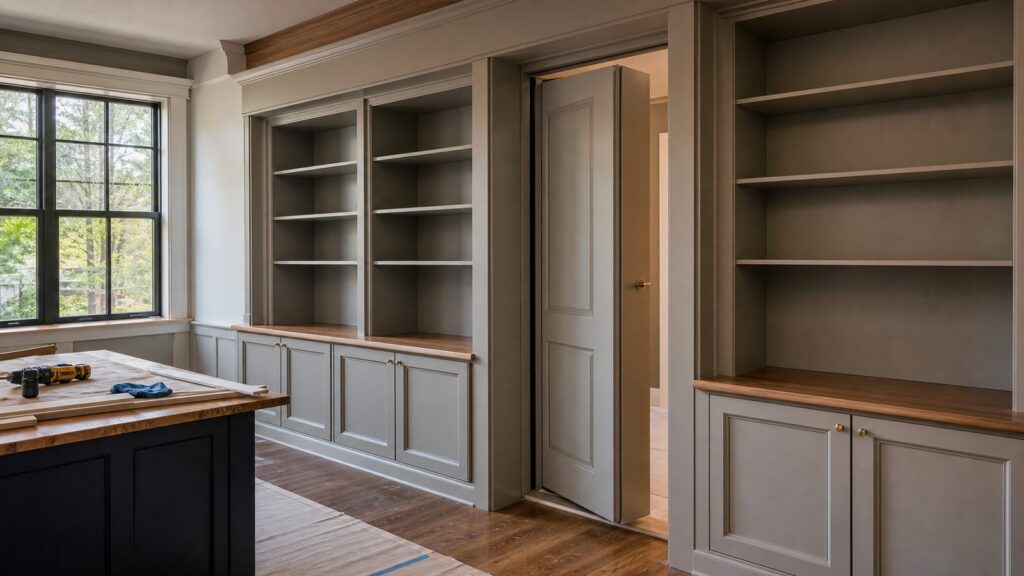
A hidden bookcase door can be a sharp piece of woodworking, but it is not just a bookcase with hinges screwed to one side. The moving case may weigh 125 to 150 pounds before you add books, decor, trim, or hardware. Once loaded, it behaves more like a small cabinet wall than a normal interior door. That changes the planning, framing, hinge selection, clearances, and safety checks.
For most homeowners in 2026, a realistic installed hidden bookcase door costs about $2,500 to $8,000 for a single interior opening. A simple DIY build can land around $500 to $1,500 if the opening is already square and you own the tools. A prebuilt hidden-door unit with local installation often runs about $1,800 to $4,500. A custom wall of built-ins with a disguised passage can run $4,000 to $12,000 or more, especially with hardwood, stain-grade finishing, lighting, locks, or double doors.
As an Amazon Associate I earn from qualifying purchases.
The Tool Desk
Outbyte Driver Updater FREEScan for outdated or missing drivers - takes under a minuteDriver Scan →Outbyte PC Repair FREEClear out junk files and repair common Windows errorsFree Scan →On our job sites, the successful projects are the ones planned backward from the opening, the hinge system, and the room behind the door. The cabinet box is only one piece of the job. The real make-or-break details are the load path into framing, the reveal lines, floor clearance, latch operation, and whether the door is allowed to be disguised in that location.
Start With the Room Behind the Bookcase
Before choosing wood or sketching shelves, answer one question: what is behind the hidden door?
Popular on Amazon

- 【Package Included】- The hidden door hinge set included 1 set heavy-duty pivot hinge with 30 screws, which with top and bottom hinge; 1 ball catch hardware with 4 screws; 1 screwdriver.
- 【360° Quiet Rotation】- The pivot hinge is installed on the central axis of the door, and it can rotate 360 degrees flexibly and quietly in linkage with the upper and lower parts. The hidden door hinge shaft can rotate at multiple angles to achieve a high-end and outstanding hidden effect.
- 【570lbs High Load-Bearing】- The hidden barn door hardware kit with high load-bearing design, the base support up to 570 LBS/259 kg. The heavy-duty door hinges with improved pivot mechanism provide quiet, smooth and flexible door movement even under heavy pressure.
- 【High-Quality Material】- The hidden door pivot hinge is made of 304 solid stainless steel material, which is more sturdy. The surface is specially treated to prevent rust and breakage, fine workmanship, and improve its service life.
- 【Easy to Install】- The hidden door hinge is equipped with a telescopic pin for adjusting the up and down telescopic distance, easy to install. The pivot hinge is installed on the central axis of the door or installed on the side of the door. If you feel that the gap is too large, you can dig a groove of the door.
A hidden bookcase serving a storage closet, office, pantry, wine room, mechanical alcove, or playroom is usually straightforward if the opening is not part of required egress or a rated assembly. A hidden door serving a bedroom, basement sleeping area, garage separation, furnace room, or required exit path deserves more caution.
Do not disguise a door in a way that creates a life-safety problem. If the room behind the bookcase must provide emergency escape or rescue access, the door needs to operate reliably from the occupied side. A secret latch that only works from the hallway may look clever, but it can be a serious egress issue. The same logic applies to doors in fire-rated separations, utility areas, and spaces where smoke alarms, return air, combustion air, or access panels may be affected.
For residential work, local code enforcement matters more than internet plans. Before building, verify whether your project affects required egress, fire separation, stair access, mechanical equipment access, electrical panels, or bedroom doors. If the project touches any of those, call the building department or bring in a qualified remodeler before ordering parts.
Pick the Right Hidden-Door Approach
There are three common ways to build a hidden bookcase door: a full DIY cabinet-and-hardware build, a prebuilt hidden bookcase door kit, or a fully custom built-in wall with an integrated moving section.
A DIY build gives the most flexibility, but it also puts the risk on the builder. You are responsible for sizing the case, choosing hinges, reinforcing the opening, controlling sag, and making the door close without rubbing. This route fits capable woodworkers with table saw accuracy, router skills, layout discipline, and patience for repeated dry-fitting.
A prebuilt hidden bookcase door kit is faster and more predictable. Common retail units are made to replace standard interior openings, often around 30 to 36 inches wide by 80 inches tall. Many paint-ready units start around $895 to $1,300 before shipping, finishing, trim changes, installation, locks, or upgrades. This is often the best middle path when the home has a reasonably standard opening.
Recommended Free Tools
A custom built-in hidden door is the right choice when the bookcase needs to blend into a full wall of cabinetry, match existing millwork, carry a stain-grade finish, include lighting, or solve an awkward opening. This costs more because the work includes design, framing correction, cabinetry fabrication, installation, scribing, trim, finishing, and tuning.
| Option | Typical 2026 Cost | Best Fit | Main Risk |
|---|---|---|---|
| DIY materials and hardware | $500-$1,500 | Skilled woodworker, square opening, paint-grade finish | Sag, poor reveal control, latch issues |
| Prebuilt hidden bookcase door plus install | $1,800-$4,500 | Standard interior opening, faster timeline | Opening may need correction before unit fits |
| Custom hidden bookcase built-in | $4,000-$12,000+ | High-end remodel, wall-to-wall cabinetry, stain-grade work | Higher design and labor cost |
| Baseline prehung interior door install | $529-$804 | Normal interior door comparison only | Does not include cabinetry or hidden-door complexity |
Measure the Opening Like a Finish Carpenter
A hidden bookcase door punishes sloppy measuring. A hollow-core door can tolerate a little framing imperfection because it is light and thin. A loaded bookcase cannot.
Measure the rough opening width at the top, middle, and bottom. Measure height at both sides and the center. Check the jamb depth, wall thickness, casing projection, baseboard height, flooring transition, and ceiling height. Use a 6-foot level to check both sides of the opening for plumb. Measure diagonals to see how square the opening is. Check the floor for slope across the swing path.
For a typical single hidden bookcase door, many kits target rough openings around standard door sizes, such as 30, 32, or 36 inches wide by 80 inches tall. Custom builds can vary, but wider and deeper doors become heavy quickly. A 36-inch-wide bookcase with 10-inch-deep shelves creates more torque than a 30-inch unit with 8-inch shelves. That torque shows up later as rubbing, latch misalignment, or hinge wear.
Do these 3 things before closing this tab:
1Clear out junk files and repair common Windows errors2Fix the driver behind crashes, sound loss and screen glitches3Repair Windows errors before they cause bigger problemsOn our projects, we do not trust drywall edges or old casing as structural references. The hinge side needs solid framing, blocking, or a corrected jamb capable of carrying the moving load. Fasteners should bite into framing, not just casing, MDF trim, or drywall.
Also popular on Amazon

- Heavy Duty and Durable Material: Crafted from solid 304 stainless steel, this hidden door pivot hinge is engineered to support up to 570 lbs. The high-quality construction ensures exceptional strength and longevity, effectively preventing rust and breakage. Whether you are building a heavy hidden door or a bookshelf door, this hidden door hinge provides the robust support needed for long-term reliability
- Smooth and Silent Operation: Our unique ball bearing design in the lower hinge set ensures fluid motion even under heavy loads. The upper and lower hinge sets work in perfect harmony to provide a silent rotation, allowing your hidden door to swing effortlessly. Enjoy a quiet environment without any annoying squeaks, jams, or sagging, making it the ideal choice for a secret door experience
- Flexible 180° and 360° Rotation: This hidden door hinges kit offers two installation methods to suit your space. Choose side mount for a 180° inward or outward swing, or center mount for a full 360° rotation. This flexibility is perfect for creating a hidden door bookcase or for murphy door bookcase projects, achieving a seamless hidden effect with a clean, high-end aesthetic that elevates the overall style of your home
- Easy to Install: The upper hinge set is equipped with a retractable pin for convenient adjustment of the telescopic distance during setup. We provide a detailed installation manual and all necessary hardware to save you time and effort. It is a user friendly solution for murphy door hinges and serves as a complete for murphy door bookcase hinge kit for your custom hidden doors projects
- Package Contents: 1 x Upper Hinge Set, 1 x Lower Hinge Set, 1 x Door Catch Set, 1 x Screwdriver, 1 x Pair of Gloves, 4 x Catch Screws, 30 x Mounting Screws, 1 x Quick Start Guide, and 1 x Installation Manual
Plan the Swing Before You Build the Box
The most common hidden-door mistake is designing a good-looking bookcase that cannot swing cleanly in the real room. A bookcase door is thicker than a slab door. Shelf depth projects into the room as the unit swings, so it needs more clearance at nearby walls, furniture, stairs, trim, and flooring transitions.
Use a full-size swing template on the floor before cutting material. Painter’s tape works well. Mark the face of the bookcase, the shelf depth, the pivot point, and the arc of the outer corner. Open and close the template path and look for conflicts. Check baseboards, crown returns, window stools, radiator covers, stair skirt boards, area rugs, door stops, and furniture.
For many single-door builds, an 8-inch shelf depth is more forgiving than 10 or 12 inches. It reduces weight, torque, and swing clearance problems. If you want a deeper bookcase, consider making the moving section shallow and placing deeper fixed bookcases beside it. Visually, the entire wall can still read as one built-in if the face frames, trim, and shelf lines are aligned.
Free tools Windows power users keep installed
One-click scans. No signup required.
Recommended Dimensions for a Practical Build
A good hidden bookcase door is stiff, square, and not overloaded. The following dimensions are a practical starting point for a paint-grade residential interior project:
- Door opening: 30 to 36 inches wide by about 80 inches tall
- Moving bookcase depth: 7 to 8 inches for easier swing clearance
- Case sides: 3/4-inch cabinet-grade plywood
- Fixed shelves: 3/4-inch plywood, dadoed or securely joined into the sides
- Back panel: 1/4-inch plywood minimum, or 1/2-inch plywood for more stiffness
- Face frame: 3/4-inch hardwood or paint-grade poplar
- Toe or bottom rail clearance: planned around flooring and hinge requirements
- Reveal: commonly 1/8 to 3/16 inch where movement is expected
Fixed shelves are not just storage surfaces; they help the cabinet resist racking. Adjustable shelves are useful, but do not rely on a stack of loose shelves to stiffen a moving door. At minimum, use fixed top, middle, and bottom members, and add a solid back or diagonal resistance through the cabinet construction.
For books, plan loads conservatively. Heavy hardcovers should stay low and closer to the hinge side. Avoid loading the latch side with dense books from top to bottom. Even when a hinge system advertises support up to 300 pounds, real performance depends on the width, shelf depth, fastener quality, jamb condition, installation accuracy, and where the weight sits.
Hardware: Hinges, Latches, and Releases
Most hidden bookcase doors use pivot hinges or specialty hidden-door hinge systems rather than standard butt hinges. The hardware needs to carry vertical load, resist sag, and allow the bookcase to clear the jamb as it opens. Choose the hardware before finalizing cabinet dimensions.
Read the hinge manufacturer’s published dimensions and weight limit. Build from those dimensions rather than adapting hinge placement casually. The pivot offset, bottom clearance, top clearance, casing detail, and door thickness all affect whether the unit opens without binding.
For latching, choose a system that is reliable and code-appropriate for the room. Magnetic touch latches, mechanical catches, concealed pulls, book-trigger releases, and keyed locks all have different tradeoffs. A concealed latch for a storage room may be fine. A concealed latch for an occupied room must be easy to operate from the inside. If a child, guest, or future buyer can be behind the door, the release should be obvious enough to use without special knowledge.
For premium installations, keep electrical features out of the moving door when possible. We prefer putting outlets, switches, low-voltage controls, and lighting feeds into fixed side cabinetry. If lighting is built into the moving section, wiring must be protected, flexible, serviceable, and installed according to electrical code.
Also popular on Amazon

- 【Package Included】- The hidden door hinge set included 1 set heavy-duty pivot hinge with 30 screws, which with top and bottom hinge; 1 ball catch hardware with 4 screws; 1 screwdriver.
- 【360° Quiet Rotation】- The pivot hinge is installed on the central axis of the door, and it can rotate 360 degrees flexibly and quietly in linkage with the upper and lower parts. The hidden door hinge shaft can rotate at multiple angles to achieve a high-end and outstanding hidden effect.
- 【570lbs High Load-Bearing】- The hidden barn door hardware kit with high load-bearing design, the base support up to 570 LBS/259 kg. The heavy-duty door hinges with improved pivot mechanism provide quiet, smooth and flexible door movement even under heavy pressure.
- 【High-Quality Material】- The hidden door pivot hinge is made of 304 solid stainless steel material, which is more sturdy. The surface is specially treated to prevent rust and breakage, fine workmanship, and improve its service life.
- 【Easy to Install】- The hidden door hinge is equipped with a telescopic pin for adjusting the up and down telescopic distance, easy to install. The pivot hinge is installed on the central axis of the door or installed on the side of the door. If you feel that the gap is too large, you can dig a groove of the door.
Material Choices: Paint-Grade vs Stain-Grade
Paint-grade hidden bookcases are usually the most practical choice. Cabinet-grade plywood with poplar face frames gives a stable, strong, and clean result at a reasonable cost. MDF can be useful for panels and paint-grade trim, but it is heavy and less forgiving around fasteners. For the moving structural case, plywood is usually the better material.
Quick wins for a faster PC:
Clear out junk files and repair common Windows errorsFree Scan →Scan for outdated or missing drivers - takes under a minuteDriver Scan →Repair Windows errors before they cause bigger problemsFix Now →Stain-grade work raises the bar. Hardwood face frames, veneer-matched plywood, finished end panels, and clear-coated trim all expose small alignment differences. The reveal must be intentional, the grain and color must be coordinated, and the finish process needs more control. Stain-grade hidden doors also become expensive quickly because matching existing flooring, paneling, or cabinetry is skilled labor.
For a balanced paint-grade plan, use 3/4-inch birch or maple plywood for the case, poplar or maple for the face frame, 1/2-inch plywood for the back if extra stiffness is needed, and high-quality primer before enamel paint. Seal hidden edges and back surfaces to reduce uneven moisture movement. Pre-finish parts where access will be difficult later, but dry-fit and tune the hardware before final finish coats.
A Practical Cut List for a Single Paint-Grade Bookcase Door
This sample plan assumes a roughly 32-inch by 80-inch interior opening and an 8-inch-deep moving bookcase. Final dimensions must be adjusted to your hinge system and actual opening.
- Two side panels: 3/4-inch plywood, full cabinet height by 7 1/4 inches deep
- Top and bottom panels: 3/4-inch plywood, cabinet width between side panels by 7 1/4 inches deep
- Three to five fixed shelves: 3/4-inch plywood, same width as top and bottom panels
- Back panel: 1/4-inch or 1/2-inch plywood, sized to the assembled cabinet back
- Face-frame stiles: 3/4-inch hardwood, typically 1 1/2 to 2 inches wide
- Face-frame rails: 3/4-inch hardwood, sized to align with fixed shelves and top/bottom rails
- Trim or applied molding: sized to match adjacent casing or built-ins
- Pivot hinge system: rated for the finished door weight plus expected contents
- Latch or catch: selected for room use and required release direction
Build the cabinet square on a flat surface. Use dados, rabbets, pocket screws, confirmat screws, biscuits, dominos, or another cabinet-grade joinery method you trust. Glue and mechanical fastening should work together. The back panel should be installed square because it locks the case against racking.
What’s actually slowing this PC down?
Pick the symptom - the matching free tool is one click away.
Before installing trim, hang the raw or primed case and test the swing. Add temporary weight to simulate loaded shelves. Check the reveal at the top, hinge side, latch side, and floor. Open and close the bookcase repeatedly. It is better to discover a rub mark before the final enamel or stain is on the project.
Installation Sequence We Use on Site
A hidden bookcase installation works best when treated like cabinetry, not like a quick door swap.
First, we inspect the opening and correct framing problems. If the hinge side is weak, twisted, or out of plumb, we add blocking or rebuild the jamb area. The hinge system needs a straight, solid reference.
Second, we dry-fit the hardware and case. We check floor clearance, pivot movement, and the reveal before adding finish trim. If the floor is out of level, the fix may involve scribing trim, adjusting the bottom clearance, or correcting the opening. Shimming must support the load path, not just make the casing look straight.
Also popular on Amazon

- 【Package Included】- The hidden door hinge set included 1 set heavy-duty pivot hinge with 30 screws, which with top and bottom hinge; 1 ball catch hardware with 4 screws; 1 screwdriver.
- 【360° Quiet Rotation】- The pivot hinge is installed on the central axis of the door, and it can rotate 360 degrees flexibly and quietly in linkage with the upper and lower parts. The hidden door hinge shaft can rotate at multiple angles to achieve a high-end and outstanding hidden effect.
- 【570lbs High Load-Bearing】- The hidden barn door hardware kit with high load-bearing design, the base support up to 570 LBS/259 kg. The heavy-duty door hinges with improved pivot mechanism provide quiet, smooth and flexible door movement even under heavy pressure.
- 【High-Quality Material】- The hidden door pivot hinge is made of 304 solid stainless steel material, which is more sturdy. The surface is specially treated to prevent rust and breakage, fine workmanship, and improve its service life.
- 【Easy to Install】- The hidden door hinge is equipped with a telescopic pin for adjusting the up and down telescopic distance, easy to install. The pivot hinge is installed on the central axis of the door or installed on the side of the door. If you feel that the gap is too large, you can dig a groove of the door.
Third, we tune the latch. A hidden door that needs a shoulder shove to close is not finished. It should swing smoothly, stop predictably, latch cleanly, and release without drama. Minor hinge adjustments are normal. Major rubbing usually means the opening, cabinet, or load distribution needs correction.
Finally, we integrate the trim. The reveal should look intentional. Trying to hide every gap often backfires because tight lines rub as humidity changes. A consistent shadow line aligned with casing, panel molding, adjacent stiles, or a full built-in layout usually looks cleaner and performs better.
Independent reader supportYour contribution helps us test, update, and keep practical guides available for everyone.Cost Factors in 2026
Hidden bookcase doors cost more than normal interior doors because the job combines door installation, cabinet fabrication, finish carpentry, and sometimes electrical or framing work.
As a baseline, a standard prehung interior door installation commonly runs about $529 to $804 per door. That does not include building a bookcase, specialty hinges, concealed latches, finish matching, or correcting an old opening for a heavy moving cabinet.
Built-in bookcase pricing gives a better comparison. In 2026, many professional built-in bookshelf projects fall around $1,400 to $4,900 for simpler installations, with custom work often priced around $400 to $1,200 per linear foot depending on materials and detailing. Basic plywood built-ins may be closer to $150 to $400 per linear foot, while premium glass, hardwood, lighting, and specialty designs can reach $750 to $1,200 per linear foot.
The biggest cost drivers are region, labor rates, door size, rough opening condition, shelf depth, paint-grade versus hardwood material, locking hardware, finish matching, trim complexity, freight, electrical relocation, and permit requirements. Contractor bill rates also reflect more than wages. Insurance, trucks, equipment, layout time, shop time, callbacks, overhead, and small-job minimums all affect the final price.
When to DIY vs When to Hire a Pro
DIY makes sense when the door serves a low-risk interior space, the opening is square, the wall is not part of a rated assembly, and you have the tools to build a square cabinet. You should be comfortable reading hinge diagrams, cutting plywood accurately, installing face frames, scribing trim, and adjusting hardware under load.
Hire a finish carpenter, cabinetmaker, or remodeling contractor if the opening is badly out of plumb, the door is wider than 36 inches, the shelves need to be deep, the finish is stain-grade, the project includes electrical work, or the room behind the door may involve egress or code concerns. Also hire a pro if the bookcase needs to disappear into a larger built-in wall. That is not just a door job; it is a millwork layout problem.
Windows Errors? Fix Them Before They Spread
Repair common Windows errors and clear accumulated junk for a smoother, more stable PC - no reinstall needed.Free scan · no reinstallOutdated Drivers Are Slowing You Down
One free scan finds every outdated or missing driver and matches the right update for your exact hardware.Free scan · exact hardware matchFor many homeowners, the best value is a hybrid approach: buy a reputable hidden-door kit, then hire a skilled carpenter to correct the opening, install the unit, adjust the swing, and integrate the trim. That avoids the hardest fabrication risk while still allowing a custom-looking result.
Also popular on Amazon

- 900 LBS SUPERIOR LOAD‑BEARING CAPACITY This heavy‑duty hidden door hinge is engineered with thickened solid steel and a reinforced alloy steel shaft, supporting up to 900 lbs (400 kg) without sagging. Perfect for massive secret doors, oversized bookcase doors, Hidden door systems, and solid wood shelving – the robust construction ensures long‑term stability even under extreme weight, giving you peace of mind for your heaviest hidden room projects.
- 360° SMOOTH ROTATION Featuring a unique bearing device, this pivot hinge delivers whisper‑quiet, friction‑free 360° rotation. Whether you’re designing a swiveling bookshelf door for a home library, a concealed cabinet entry in a home office, or a pivot door system for a theater room, the fluid motion and precise positioning enhance both functionality and a premium feel – no squeaking, no sticking.
- FLEXIBLE CENTER OR SIDE MOUNTING Install on the central axis for full 360° swing or on the side for nearly 180° inward/outward opening. This adaptability suits secret passageways, room dividers, custom pivot doors, and covert storage – you can tailor the installation to any spatial layout, making it a go‑to choice for DIY enthusiasts and contractors alike.
- DISCREET BAFFLE COVER FOR SEAMLESS HIDDEN LOOK The integrated baffle completely conceals the mounting gap after installation, creating a truly invisible appearance. Ideal for secret bookshelf doors, hidden wine cellars, concealed office entries, and private gun rooms – the flush surface blends perfectly with surrounding cabinetry or walls, preserving the aesthetic integrity of your design.
- WIDE COMPATIBILITY & INSTALLATION NOTES Compatible with door thickness from 2.4″ to 16″ (60–400 mm) and hinge plate width 2.36″ (60 mm). For proper mortising, remember to reserve 2.6″ at the top of the door frame. If your door thickness falls outside this range, professional installation is recommended. This hinge works excellently with Hidden door kits, swinging shelf doors, panel doors, and custom concealed entries.
Maintenance and Long-Term Performance
A hidden bookcase door should be treated like moving cabinetry. Keep the swing path clear. Do not overload the latch side. Put heavier books low and toward the hinge side. Avoid using the outer stile as a handle unless it was designed for that pull.
Inspect hinge screws after the first few weeks of use and again seasonally. Wood movement, house movement, and load changes can affect the reveal. If the door starts rubbing, do not keep forcing it. Check for loose fasteners, shifted contents, latch misalignment, or floor contact. A small adjustment early can prevent damaged trim or a sprung hinge later.
For painted doors, expect occasional touch-ups at high-contact areas. For stain-grade doors, keep humidity reasonably stable. Large seasonal humidity swings can move the cabinet and surrounding trim enough to change the shadow lines.
Free tools Windows power users keep installed
One-click scans. No signup required.
The Bottom Line
A hidden-door bookcase is worth doing when it is planned as real finish carpentry. Start with the room use and code question. Measure the opening carefully. Choose the hinge system before designing the cabinet. Keep the moving case as shallow and stiff as practical. Build a consistent reveal instead of chasing invisible gaps. Dry-fit, load-test, and tune the door before final finish.
Done right, the result is not just a novelty door. It is a durable built-in that opens smoothly, carries its load, blends into the room, and still works years after the first week of showing it off.
Frequently Asked Questions
How much does a hidden bookcase door cost in 2026?
A DIY hidden bookcase door often costs about $500 to $1,500 for materials and hardware if the opening is already square. A prebuilt hidden-door unit with local installation commonly runs $1,800 to $4,500. Custom built-in hidden bookcase walls often cost $4,000 to $12,000 or more.
Can a hidden bookcase door be used for a bedroom?
Sometimes, but egress and safety must come first. A bedroom door must be easy to open from the room side, and the installation cannot interfere with required escape, rescue openings, smoke alarms, or local code requirements. Check with your local building department before disguising a bedroom door.
What hinges should I use for a hidden bookcase door?
Use a pivot hinge or specialty hidden-door hinge system rated for the finished weight of the bookcase plus contents. Build around the manufacturer’s published dimensions, clearances, and weight limits rather than adapting hinge placement casually.
How much weight can a hidden bookcase door hold?
Many hidden-door systems advertise support up to about 300 pounds, but real performance depends on door width, shelf depth, jamb strength, fasteners, installation accuracy, and load placement. Keep heavy books low and close to the hinge side.
Is it cheaper to build a hidden bookcase door or buy a kit?
DIY materials can be cheaper if you already own the tools and have cabinetmaking experience. A kit usually costs more upfront, but it reduces design risk and can save labor time. For many homeowners, a kit plus professional installation is the most predictable value.
How do you keep a hidden bookcase door from sagging?
Use a rated hinge system, fasten into solid framing, keep the case shallow when possible, build the cabinet square with fixed shelves and a stiff back, avoid overloading the latch side, and test the swing with weight before final finishing.
Quick Recap
Product prices and availability are accurate as of the date/time indicated and are subject to change. Any price and availability information displayed on Amazon at the time of purchase will apply.

