The correct connection depends on the heater element rating—not on a universal preference for star or delta. If each element is rated for the full three-phase line-to-line voltage, the heater is typically connected in delta (Δ). If each element is rated for line voltage divided by √3, approximately 0.577 times line voltage, it is typically connected in star (Y or wye). Always follow the heater manufacturer’s model-specific wiring diagram.
For the same three equal resistive elements on the same supply, delta produces three times the power of star. An incorrect connection can therefore cause severe overvoltage, overheating, fire, element failure, or nuisance tripping.
As an Amazon Associate I earn from qualifying purchases.
Star and delta connections explained
In a three-phase resistive heater, three heating elements are connected to L1, L2, and L3. Line voltage is the voltage measured between two supply lines. Element voltage is the voltage applied across one heating element.
Windows Errors? Fix Them Before They Spread
Repair common Windows errors and clear accumulated junk for a smoother, more stable PC - no reinstall needed.Free scan · no reinstallCrashes, No Sound, or Screen Glitches?
Random freezes, missing sound and display glitches usually trace back to one bad driver. Find and replace yours safely.Free scan · under a minuteDelta (Δ)
L1 ── E1 ── L2
      ╲     ╱
       E3 E2
        ╲ ╱
         L3
In a delta arrangement:
- E1 connects between L1 and L2.
- E2 connects between L2 and L3.
- E3 connects between L3 and L1.
- Each element receives the full line-to-line voltage.
- A neutral is normally not used.
- Line current is √3 times the current in an individual element.
Star or wye (Y)
L1 ── E1 ──┐
L2 ── E2 ──┼── star point
L3 ── E3 ──┘
In a star arrangement, one end of each element joins at a common star point and the other ends connect to L1, L2, and L3. Each element receives line voltage divided by √3. In a balanced load, line current equals element current.
#1 Best Overall
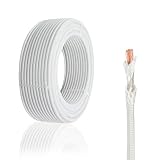
- PRODUCTOR SPECIFICATION: This high temperature wire is made of mica tape, fiberglass, and stranded oxygen-free pure copper wire, the working temperature is from -76℉ to 932℉(-60℃ to 500℃), The rated temperature is 752℉. Wire Guage: 14 AWG, rated voltage: 300V/500V, wire length: 16.4 FT
- EXCELLENT PRODUCTION TECHNOLOGY: This heat resistant cable uses mica and glass fiber as an insulator, and winds glass fiber braid and high temperature resistance fluoroglovite tape around the conductor, such multi-layer wrapped insulation, pure copper core high temperature resistance, so that the cable has ultra-low eccentricity, excellent heat resistance, insulation and high conductivity; The glass fiber braid spacing is short and tight, providing good fire and wear resistance to the cable
- WIDELY APPLICATION: Because high temperature mica wire has excellent high temperature resistance, corrosion resistance and fire resistance, it can be widely used in a variety of high temperature environment electrical devices, such as electric heating, lighting heat sources, air conditioning machines, motors, ovens, water heaters, kilns, civil electric furnaces and so on. It is also suitable for metallurgy, chemical industry, power plant, mechanical and electrical industries
- EASY TO USE: The mica braided cable has excellent high temperature resistance, flame retardant, insulation and flexibility, suitable for many ordinary wires can not be qualified for the harsh environment, you only need to cut into the length you want, strip the connecting end of the mica tape and glass fiber braided layer, and then wiring can be
- QUALITY ASSURANCE: We are committed to providing high quality products, it is our priority to let our customers have a good experience, if you have any questions about the use of our mica high temperature wire, please contact us, our team will provide maximum support within 24 hours
A balanced star heater may operate without a physical neutral conductor. However, the manufacturer must specify whether the star point is to be connected, isolated, or monitored. Do not assume that a neutral is either always required or never required.
The nameplate-based selection rule
| Heater information | Typical connection |
|---|---|
| Each element is rated for the full line-to-line supply voltage | Delta |
| Each element is rated for line voltage ÷ √3 | Star/wye |
| The nameplate supplies a specific Δ or Y diagram | Follow that diagram exactly |
| Only a two-voltage rating is provided | Confirm the manufacturer’s terminal diagram; do not guess |
| Six leads or terminals are present but no diagram is available | Do not energize until the element rating and internal arrangement are verified |
Six terminals do not automatically mean that the heater can be changed between star and delta. The terminals may belong to separate element groups, staged circuits, internal links, or a custom voltage arrangement. The supply voltage, element voltage, total kW, and manufacturer’s documentation control the decision.
Voltage, current, and power calculations
Assume three equal elements, each with resistance R, supplied by a balanced three-phase system with line voltage VL.
What’s actually slowing this PC down?
Pick the symptom - the matching free tool is one click away.
Delta
- Element voltage:
VP = VL - Element current:
IP = VL / R - Line current:
IL = √3 × IP - Total power:
PΔ = 3VL2 / R
Star
- Element voltage:
VP = VL / √3 - Element and line current:
IL = VL / (√3R) - Total power:
PY = VL2 / R
For the same three equal resistances at the same line voltage:
PY = PΔ / 3
Star therefore draws one-third of the delta line current and produces one-third of the delta power in balanced operation. These relationships are described in the Chromalox technical overview, the Marathon handbook, and Fast Heat reference material.
Rank #2

- MATERIAL: The heat shrinkable braided sleeving is made of PET fiber and PE filaments. This braided sleeving can shrink its inner diameter to 1/2 of the original diameter. Operating Temperature: -55° C to +135° C (-67° To 275° F) - Maximum Continuous Use Temperature: 135° C (275° F)
- FEATURES: It features an outstanding noise reduction, flexibility, and heat resistance. It also provided good insulation and protection from moisture and abrasion
- EASY TO USE, PERFECT FIT: The Heat Shrink Braided Sleeving is very easy to use and will do the job perfectly. It shrinks quickly and evenly with a heat gun, and it fit snugly over the wires and connectors
- WIDELY APPLICATIONS: Braided sleeving is mainly used to bundle and protect cables for electrical projects, electrical Insulation, Strain Relief, Corrosion Protection, Solder Insulation, Wire Bundling & more.This ratio 2:1 Shrinkable sleeving can be easily installed within irregular tubes
- PACKAGE INCLUDES: Diameter 12mm(1/2") Length 20 FT Ratio 2:1 Heat Shrinkable Braided Sleeving * 1 roll
Worked example: three 20-ohm elements on 480 V
This is a calculation example, not a wiring recommendation. Assume three identical 20 Ω elements and a 480 V line-to-line supply.
Delta connection
Each element receives 480 V:
IP = 480 / 20 = 24 A
PΔ = 3 × 4802 / 20 = 34,560 W
Line current is:
IL = √3 × 24 ≈ 41.6 A
Star connection
Each element receives:
480 / √3 ≈ 277 V
Element and line current are:
IL = 277 / 20 ≈ 13.9 A
Total power is:
PY = 4802 / 20 = 11,520 W
The star-connected heater produces one-third of the delta output because each element receives only 57.7% of the voltage, and resistive power follows P = V2/R.
Voltage changes can damage a heater
For a fixed resistance:
P2 = P1 × (V2 / V1)2
This applies when comparing different supplies or an incorrect star/delta connection. If a star-rated element is connected in delta, its voltage rises by √3 and its theoretical power rises by a factor of three. That is not a minor adjustment; it can rapidly overheat the element and associated wiring.
The same rule matters when comparing nominally different systems such as 440 V and 480 V, or 230 V and 240 V. Confirm the actual equipment rating rather than treating those values as interchangeable.
How to verify the connection before wiring
- Read the nameplate. Record supply voltage, total kW, phase count, frequency, element voltage, and any Δ, Y, star, or delta designation.
- Find the exact terminal diagram. Use the model number and document revision. Do not substitute a generic internet diagram.
- Identify the terminal arrangement. Three terminals may indicate an internally connected load; six may permit external configuration. Neither proves the correct connection.
- Isolate and de-energize the heater. Measure element resistance only when the equipment is safely isolated. Compare equivalent elements for large differences.
- Calculate expected output and current. Check that the proposed connection agrees with the nameplate kW and the element resistance.
- Check the complete circuit. Verify the disconnect, fuses, branch protection, contactor or controller, conductors, enclosure, grounding, and control circuit.
- Perform continuity and insulation-resistance checks according to the manufacturer’s procedure.
- Verify process protections. Confirm airflow, fluid-flow, temperature, and high-limit interlocks before energizing.
Electrical heater wiring should comply with the applicable electrical code and be completed and checked by a qualified person. Chromalox’s technical overview also emphasizes qualified installation and manufacturer-specific wiring instructions.
Rank #3

- 600PCS - 12 Sizes for Any Wire: No more mismatched shrink tubing! Eventronic 12-size assortment (1/24''-1/2'') heat shrink tubing covers everything from tiny electronics to thick cables. Stop wasting time hunting for the right fit—we’ve got you covered.
- Super-Shrink for a Rock-Solid Seal:Tired of loose shrink tubing that slips or cracks? These heat shrink tubing kit shrink to half their size, gripping wires tightly for insulation that actually lasts. Say goodbye to electrical tape mess!
- Color-coded - Neat & Quick:Frustrated with tangled wires? The included storage box keeps 5 vibrant colors heat shrink wrap(Black/Red/Blue/Yellow/Green) neatly sorted, so you can quickly ID circuits and work efficiently.
- Connector-Safe Fix: Our heat shrink tube won't crack or corrode, and keeps connections protected for the long haul. Wire hrink wrap tubing has high recovery ratio makes it possible to repair most damaged cable jackets without removing connectors.
- For DIY/pros: 600 pcs shrink wrap tubing perfect for electricians, car repairs, or home projects. Heat shrink tubing is used for marine and automotive wiring, wire connections and DIY electrical wiring projects. No more last-minute store runs!
Does a star-connected heater need a neutral?
- Delta: Normally a three-wire load with no neutral point.
- Balanced star: May operate without a neutral because the three currents sum to zero.
- Unbalanced star: May require a neutral connection or another engineered neutral-point arrangement.
- Floating star point: If an element fails or the load becomes unbalanced, the star point can shift and produce unequal element voltages.
Armstrong Chemtec warns that a failed element in a floating star arrangement can increase the risk of overvoltage on another element. A neutral should therefore be treated as part of the engineered heater design, not as an assumption based on the supply wiring.
The Tool Desk
Outbyte PC Repair FREEClear out junk files and repair common Windows errorsFree Scan →Outbyte Driver Updater FREEScan for outdated or missing drivers - takes under a minuteDriver Scan →Failure modes to consider
| Failure or condition | Possible result |
|---|---|
| One element open in a three-element delta circuit | Reduced output; Chromalox documents approximately 33% reduction for the cited configuration. |
| One element open in a three-element wye circuit | Reduced output; Chromalox documents approximately 50% reduction for the cited open-wye arrangement. |
| One phase lost | Reduced heating, current imbalance, nuisance tripping, and possible overheating of remaining components. |
| Loose terminal | Localized heating, arcing, discoloration, terminal damage, and eventual failure. |
| Floating star point becomes unbalanced | Unequal element voltage and possible overvoltage on an element. |
| Loss of airflow or process flow | Element overheating and premature burnout. |
| Moisture in the terminal box | Short circuits, loss of output, or heater assembly damage. |
The 33% and 50% figures are configuration-specific, not universal results for every heater. Consult the manufacturer’s failure-mode information for the actual assembly.
Controls and switching equipment
A heater may use a mechanical contactor for on/off or staged heating, or an SSR/SCR power controller for frequent cycling or proportional control. The control system may also include:
- A temperature controller with a correctly matched thermocouple or RTD.
- An independent high-limit or overtemperature device.
- An airflow switch for duct heaters.
- A fluid-flow or process interlock for immersion and process heaters.
- A fused disconnect and branch-circuit overcurrent protection.
- Separate protection for the control circuit.
Switching devices must be rated for the heater’s continuous resistive current, voltage, switching frequency, fault protection, and enclosure temperature. Chromalox wiring diagrams show combinations of disconnects, contactors, electronic controllers, SCR controllers, sensors, and control-circuit protection.
Why a motor star-delta starter is not a heater wiring diagram
A motor star-delta starter reduces motor starting current by initially connecting motor windings in star and then changing them to delta during acceleration. A resistive heater does not require motor-style acceleration.
Quick wins for a faster PC:
Fix the driver behind crashes, sound loss and screen glitchesFind Drivers →Repair Windows errors before they cause bigger problemsFix Now →Rank #4

- Top-notch Heat Tolerance and Heat Dispersion: The braided construction facilitates heat dissipation, mitigating the risks associated with elevated wire temperatures. Our automotive wire loom is crafted from a Heat-retardant woven PET polyethylene Material, ensuring exceptional heat resistance up to 302 degrees F. This high-temp automotive wire sheathing serves as a protective sleeve, significantly extending the lifespan of your cables in high-temperature environments
- Abrasion-Resistant Woven Material: Our precision-woven encryption wear-resistant split-sleeve offers discreet and durable protection for your wiring needs. The tightly woven design not only effectively shields against mud and dirt but also ensures proper drainage. Ideal for intricate wiring setups, this auto wire protector tubing excels in safeguarding wire harnesses with its advanced wire harness wrap technology
- Enhanced Wire Security with 25% Overlap: This black braided wire split loom with a self-closing wrap-around design ensures hassle-free cable management. Say goodbye to the need for extra tape or zippers - this automotive wire loom tubing automatically secures harness wraps. The 25% overlap mesh design provides extended coverage while maintaining flexibility, preventing the braid from separating or twisting
- Facilitating Easy Installation: The side entry design of this heat-resistant wire loom ensures effortless installation and maintenance of bundles. Easy to apply on assembled cable harnesses, this automotive wire loom allows for cable breakouts at any point, offering swift adjustments without hassle. Maintaining, removing, or adding cables is now a quick and seamless process with this versatile wire cover and sleeve
- One-Year Warranty: No need to return it to us. We will issue a refund and send a new one to you if there are any problems within 1 year
A heater can use contactors or a power controller to select heating stages, but the arrangement must be engineered for the heater’s element ratings, current, switching duty, fault behavior, interlocking, and required output. Do not copy a motor starter diagram onto a heater. The Schneider Electric LE3D/LC3D documentation is motor-control documentation, not a generic heater wiring guide.
Independent reader supportYour contribution helps us test, update, and keep practical guides available for everyone.Installation and thermal safety
The electrical topology is only part of a safe installation. Heater terminals and nearby conductors can be considerably hotter than the surrounding room. Check:
- Conductor insulation and ampacity at the actual ambient temperature.
- Whether standard 60 °C building wire is suitable near the heater terminals.
- Whether high-temperature insulation or nickel-based conductors are required.
- Terminal torque and inspection intervals, particularly where thermal cycling occurs.
- Gasketed boxes and suitable wiring methods in wet locations.
- Approved enclosures, conduit, seals, and cable systems in hazardous locations.
- Effective grounding of the heater frame and enclosure.
- Airflow or process-flow protection before the heater can energize.
Conductor suitability depends on actual temperature, insulation rating, ampacity, installation method, and applicable code. Follow the heater manufacturer’s installation instructions rather than relying on a generic wire-size chart.
Troubleshooting symptoms
The heater produces roughly one-third of the expected output
Check whether elements intended for delta have been connected in star, whether one phase or element is open, and whether the supply voltage is correct. Verify measured element voltage and line current against the calculated values.
The breaker trips immediately
Possible causes include a delta connection applied to star-rated elements, a shorted element, incorrect terminal links, insulation failure, phase-to-ground fault, or protection incorrectly sized for the circuit. De-energize and test rather than repeatedly resetting the breaker.
Best Value

- 3:1 SHRINK RATIO & FAST CONTRACTON SPEED: Shrinks to 1/3 of its original diameter and seals extremely tightly, solving the problem of many 2:1 shrink tubes that don't shrink enough and therefore don't seal tightly enough, Shrink temperature: 80 to 125°C, Provides a professional connection within seconds.
- INCLUDES ADHESIVE COATING: When the heat shrink tubing is heated, it automatically releases adhesive and seals the connection extremely reliably. This creates a waterproof and durable insulation with a satisfaction guarantee.
- DUAL WALL TUBING: The outer wall of the shrink tube provides extremely high abrasion resistance. The inner wall creates a consistently waterproof seal and excellent strain relief. Our solder connectors will also impress you!
- 7 SIZES: We offer 7 of the most commonly used shrink tube diameters in the world, ranging from 3/32" to 3/4". All of our shrink tubes are pre-cut to 1.77 inches. It alse as valentines gifts for men.
- VERSATILE APPLICATIONS: The waterproof Eventronic shrink tubing can be used in marine and automotive wiring, model building, and DIY electrical wiring projects or valentines gifts for men. The application areas are very diverse, such as electrical insulation/environmental sealing to protect against moisture, fuel and chemicals/protection of surfaces against abrasion, peeling and denting.
One element is much hotter than the others
Look for an unbalanced element resistance, an open or loose neutral/star-point connection, incorrect links, phase loss, or unequal airflow. Do not continue operating until the cause is identified.
Contactor terminals discolor or melt
Inspect terminal torque, conductor size, lug compatibility, contactor rating, switching duty, enclosure temperature, and signs of arcing. Discoloration usually indicates a connection or thermal problem, not a normal heater condition.
The heater works briefly and then trips
Check airflow or process flow, high-limit operation, blocked ducts, inadequate heat removal, elevated terminal temperature, and overload settings. A correct electrical connection cannot compensate for insufficient heat removal.
Recommended Free Tools
The controller reads correctly but process temperature remains low
Measure actual heater output, line voltage, element voltage, and current. Check for star/delta mismatch, a failed element, phase loss, excessive process flow, heat loss, or an incorrectly scaled sensor.
The star point shows unexpected voltage
A floating star point can move under an unbalanced load. Stop and investigate the element resistances, neutral-point design, failed element, and manufacturer’s diagram. Do not treat the measured voltage as harmless simply because the star point is not intended to carry load current.
Quick Recap
Final decision checklist
- What is the supply line-to-line voltage?
- What voltage is each heating element rated for?
- What connection does the manufacturer specify for this model?
- What kW and line current should result from that connection?
- Are the protection, controls, conductors, grounding, enclosure, airflow or process-flow safeguards, and thermal environment suitable?
Product prices and availability are accurate as of the date/time indicated and are subject to change. Any price and availability information displayed on Amazon at the time of purchase will apply.

