Recommended Free Tools
Some links on this page are affiliate links: if you buy through them we may earn a commission, at no extra cost to you.
The face side of hardwood plywood is the show side: the veneer surface intended to be seen, stained, clear-coated, painted to a high standard, or oriented toward the finished room. On a cabinet end, bookcase side, island back, wall panel, open shelf, drawer front, or built-in partition, the face side is the side the homeowner will live with every day.
That sounds simple, but on real job sites it becomes a specification decision. The right face side depends on veneer grade, back grade, wood species, grain direction, veneer cut, core type, finish schedule, code requirements, and which side of the panel will actually be visible after installation. A sheet marked A-1 is not the same buying decision as C-3. A prefinished one-side panel is not the same choice as two-good-sides material. A stain-grade maple face is not interchangeable with paint-grade birch just because both sheets are called hardwood plywood.
As an Amazon Associate I earn from qualifying purchases.
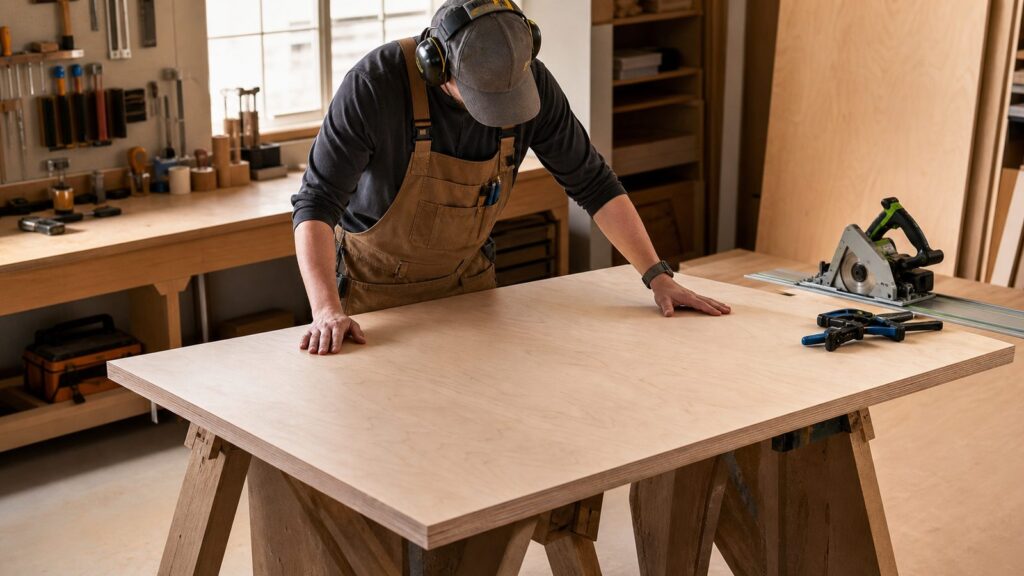
On our projects, we treat the face side as a planning item before the first cut. We inspect the sheet, mark the face, decide which parts need the best veneer, and cut the visible parts first. That small habit prevents a surprising number of expensive mistakes.
What the Face Side Means on Hardwood Plywood
Hardwood plywood is generally an appearance panel, not a structural sheathing panel. It is selected for visible work: cabinets, furniture, casework, shelving, wall panels, reception desks, mudroom built-ins, and finish-grade trim assemblies. Unlike roof or wall sheathing, hardwood plywood is usually bought by face species, veneer grade, core, thickness, and finish expectations rather than by span rating.
#1 Best Overall

- Valued Carpenter Pencil Set: You will get 2 pcs solid carpenter pencils with 26 piece 2.8 mm refills, 1 replaceable sharpener, 1 plastic storage box.The complete carpenter pencils combination allows you to finish your work faster and more easily
- Deep Hole Marker Pencil: The deep-hole construction pencils adopts 45mm elongated tip design, which is more convenient to mark in the small hole or in other tight areas that other carpenter markers cannot reach
- Carpenter Pencils with Sharpener: The sharpener is screwed into the top of the work pencil, which won't get lost either. Built-in pencil sharpener that keep the lead with pointed and smooth to Improves line of sight in fine work
- Stronger Solid Lead: This work pencil is matched with a 2.8 mm thick lead , which is much thicker and stronger during the drawing process of construction work, it will not break or damage easily
- Marks on Various Surfaces: 3 colors solid construction pencil can marks on various surfaces,such as metal, plastic, wood, paper etc. Ideals for woodworkers, contractors, craftsmen, builders, merchants and masons
The face side is typically the better-looking veneer. It should have the grade, color, grain, and surface quality required for the finished work. The back side may be lower grade, more heavily patched, less consistent in color, or intended to be hidden against a wall, inside a cabinet box, or behind another finished panel.
In common hardwood plywood grade notation, the first grade describes the face and the second describes the back. That means A-1, A-2, B-2, C-3, and similar callouts are not decorative trivia. They tell you which side is expected to perform visually.
Free tools Windows power users keep installed
One-click scans. No signup required.
For example, an A-1 sheet has a high-grade face and a high-grade back. It is appropriate when both sides may be seen, such as open shelving, glass-door cabinets, room dividers, exposed panels, and clear-finished furniture-style work. A C-3 sheet can still be useful, but it belongs in lower-visibility work, paint-grade assemblies, utility cabinet parts, backs, or areas where only one side matters.
How to Tell Which Side Should Face Out
Start by laying the sheet flat under good lighting. Look at both faces from several angles, not just straight down. The face side usually has better color consistency, fewer patches, fewer mineral streaks, tighter veneer repairs, less open grain, and a more attractive grain pattern.
Then look at the grade stamp, supplier label, or invoice description. Hardwood plywood labels can be less obvious than structural sheathing stamps, so the paperwork often matters. If the sheet is sold as A-2 maple, the A side is the face and the 2 side is the back. If it is prefinished one side, the factory-coated side is usually the face for the intended finished surface, but that does not automatically mean it belongs outward in every cabinet.
On our job sites we mark every face immediately after inspection. A light pencil mark on the edge, a piece of low-tack tape, or a cabinet part label can save a crew from flipping a panel by mistake after ripping it into smaller pieces. Once a 4-foot by 8-foot sheet becomes six cabinet parts, the original face orientation is easy to lose.
Common Face-Side Clues
The better side will usually have fewer football patches, less filler, more consistent sanding, and a more pleasing veneer sequence. On rotary-cut panels, the grain may look wide and sweeping. On plain-sliced veneer, you may see cathedral grain. On quarter-sliced or rift-cut veneer, the grain is straighter and more controlled. None of these is automatically better for every project; the correct choice depends on the design and finish.
If both sides look similar, do not guess from appearance alone. Check the grade callout. If the work is stain-grade or clear-finished, confirm the face species, cut, match, and grade before ordering. “Birch plywood” is not a complete specification for a visible built-in.
Hardwood Plywood Grades: A-1, A-2, B-2, C-3, and What They Mean
The U.S. decorative hardwood plywood standard is ANSI/HPVA HP-1. The current standard is ANSI/HPVA HP-1-2024, which superseded HP-1-2020. It covers face grades, back grades, inner ply grades, formaldehyde emissions, moisture content, tolerances, sanding, and grade marking. For a homeowner, the practical takeaway is this: hardwood plywood grades are meant to communicate appearance and manufacturing expectations, not just thickness.
Hardwood plywood grades often combine a letter for the face with a number for the back. The face grade usually runs A, B, C, and so on, with A being the cleaner, more uniform face. Back grades are commonly numbered, with 1 being a high-quality back and higher numbers allowing more defects or repairs.
Do these 3 things before closing this tab:
1Clear out junk files and repair common Windows errors2Fix the driver behind crashes, sound loss and screen glitches3Repair Windows errors before they cause bigger problems| Grade Callout | What It Usually Means | Best Use | When to Avoid It |
|---|---|---|---|
| A-1 | High-quality face and high-quality back | Open shelving, glass-door cabinets, dividers, clear-finished panels visible on both sides | Hidden cabinet parts where the upgrade is wasted |
| A-2 | High-quality face with a good but lesser back | Cabinet doors, exposed ends, stain-grade built-ins, wall panels | Panels where the back is also highly visible |
| B-2 | Good face with a serviceable back | Paint-grade cabinets, secondary stain-grade areas, shop-built storage | Premium clear finishes with strong lighting |
| C-3 | Lower appearance expectations on both sides | Utility work, hidden backs, painted shop fixtures, non-show parts | Prominent stain-grade faces or feature walls |
APA panel descriptions often refer to face and back veneer grades with combinations such as A-B or B-C. Hardwood plywood suppliers frequently use appearance-grade combinations such as A-1 or B-2. The exact grading language can vary by supplier and product line, so we verify the product data, not just the shelf tag.
If you are hiring a contractor for built-ins or cabinetry, ask what grade is being priced. A bid that says “3/4-inch birch plywood” leaves too much open. A better specification reads more like “3/4-inch maple hardwood plywood, A-2 face/back grade, veneer core, TSCA Title VI compliant, stain-grade face outward at exposed ends.” That level of detail prevents mismatched expectations.
Face Veneer, Grain Direction, and Matching
The face side is a thin decorative veneer. It may be rotary cut, plain sliced, quarter sliced, or rift cut. It may be book matched, slip matched, or plank matched. These choices affect how the finished plywood looks across doors, panels, and long built-in runs.
Rotary-cut veneer is peeled from the log and often shows broad, repeating grain. It is common and efficient, but it may not give the furniture-grade look some clients expect. Plain-sliced veneer often creates cathedral patterns. Quarter-sliced veneer tends to look straighter and more formal. Rift-cut veneer is often specified when a clean, linear look is needed, especially with oak.
Matching matters on highly visible work. Book matching flips adjacent veneer leaves like pages in a book, creating a mirrored pattern. Slip matching keeps leaves oriented the same direction, which can reduce barber-pole color effects in some species. Plank matching intentionally looks more like separate boards, with natural color variation from strip to strip.
Rank #2

- Ergonomically Designed: Work in tight areas with a compact design that gets into tough spots
- Both tools are designed to fit into difficult to reach spaces
- Complete a wide range of applications with a high-performance motor that delivers up to 300 UWO, and an impact driver delivering up to 1,400 in-lbs of torque
- Both the DEWALT impact driver and drill driver feature integrated LED work lights with a convenient 20-second delay, ensuring enhanced visibility in dimly lit or challenging work areas
- One-Handed Loading - Keep one hand free with a 1/4 in. hex chuck that accepts 1 in. bit tips
Most 4-foot by 8-foot hardwood plywood panels have grain running in the long 8-foot direction unless otherwise specified. That matters for cabinet ends, doors, tall panels, wall paneling, and island backs. If you accidentally cut a vertical cabinet side with the grain running sideways, the panel may look wrong even if the face grade is technically good.
Which Side Faces Out on Cabinets, Built-Ins, and Panels?
The best face should point toward the visible side of the finished work. That includes exposed cabinet ends, finished interiors, open shelving, island backs, appliance panels, room-facing partitions, bookcase sides, bench fronts, drawer faces, and wall panels. Hidden backs, nailers, cleats, toe-kick parts, and covered sides can use lesser areas of the sheet.
For cabinet boxes, the answer depends on the cabinet design. If the outside end of a cabinet will be covered by a finished end panel, the plywood box side may not need the premium face outward. If the cabinet side itself is the finished exposed end, the face belongs outward. For open cabinets or glass doors, the interior face may matter more than the exterior side against a wall.
Prefinished plywood adds another layer. Many cabinet shops use prefinished one-side plywood with the factory-finished face toward the cabinet interior. That gives a durable, washable interior and saves finishing labor. If the outside of the cabinet will later receive paint, veneer, or an applied panel, that orientation works well. If the outside end is clear-finished and exposed to the room, you may need a two-good-sides sheet or a separate finished end panel.
Our Job-Site Layout Rule
We lay out exposed parts first. The most visible doors, ends, shelves, and panels get the best sections of the best sheets. After that, we use remaining areas for less visible parts. This reduces waste and keeps natural color variation from becoming obvious in the most prominent locations.
For stain-grade built-ins, we also sort sheets under lighting similar to the finished room. A maple sheet that looks close in the shop can jump noticeably under warm LED lighting in a living room. When adjacent faces will meet, we group compatible sheets before cutting.
Cutting Hardwood Plywood Without Damaging the Face
The face veneer is thin. Once it splinters, chips, burns, or sands through, the defect usually cannot be fixed invisibly. Cutting technique matters more with hardwood plywood than with rough construction panels.
The Tool Desk
Outbyte Driver Updater FREEFix the driver behind crashes, sound loss and screen glitchesFind Drivers →Outbyte PC Repair FREEClear out junk files and repair common Windows errorsFree Scan →Use a sharp fine-tooth blade designed for plywood or finish cuts. A zero-clearance insert on a table saw helps support the veneer fibers at the cut. A track saw with a clean splinter guard can produce excellent job-site cuts. For crosscuts on visible veneer, painter’s tape or a shallow scoring pass can help reduce tear-out.
Tool orientation matters. As a general rule, hardwood plywood is often cut face-up on a table saw because the blade enters from the top and exits below. With many circular saw setups, the better face is placed down because the blade cuts upward and splintering is more likely on the top surface. That said, we verify with the actual blade, saw, and panel because tooth geometry and setup can change the result.
Do not assume the edge is part of the face. Hardwood plywood edges usually expose plies or a composite core. Visible edges need edge banding, solid wood nosing, veneer tape, applied molding, or a deliberate laminated-edge detail. A $150 sheet can still look unfinished if the edges are left raw on a built-in shelf.
Finishing the Face Side
The face side can be painted, stained, clear-coated, or factory prefinished, but each approach changes what grade and core make sense.
For clear finishes, the face veneer carries the whole appearance. Color, grain, mineral streaks, sapwood, heartwood, patches, and veneer matching all remain visible. We prefer approving the exact species, cut, match, and grade before ordering. A stain sample on one scrap does not guarantee every sheet in the stack will behave the same way.
For stain-grade work, sanding must be controlled. Many hardwood plywood face veneers are thin enough that aggressive belt sanding, heavy random-orbit sanding, or repeated refinishing can sand through the decorative layer. Once that happens, the core or glue line may telegraph through the finish. We sand only enough to prepare the surface, usually working through fine grits appropriate to the finish manufacturer’s schedule.
For paint-grade work, the face still matters, but the goals change. A smooth, stable surface with minimal grain telegraphing may be more important than dramatic wood character. MDF-core hardwood plywood can be a strong choice for very flat paint-grade doors, panels, and slab fronts. Veneer core may be better where weight, screw holding, and edge durability matter more.
Seal both faces when practical, especially on doors, drawer fronts, panels, shelves, and built-ins exposed to seasonal humidity swings. Finishing only one side can contribute to uneven moisture movement. That does not mean both faces need the same show-quality finish, but they should be protected in a way that keeps the panel stable.
Quick wins for a faster PC:
Scan for outdated or missing drivers - takes under a minuteDriver Scan →Repair Windows errors before they cause bigger problemsFix Now →Thickness, Core, and Real-World Measurements
Hardwood plywood thickness is often nominal. A sheet sold as 3/4 inch may not measure 0.750 inch. One common 3/4-inch maple hardwood plywood listing states an actual thickness of 0.703 inch. That difference matters when cutting dadoes, rabbets, shelf grooves, cabinet backs, drawer bottoms, and hardware layouts.
On site, we measure the actual material before machining joinery. A dado cut for true 3/4-inch stock will be sloppy if the panel is really 23/32 inch or 18 mm. Adjustable router bits, undersized plywood bits, test cuts, and calipers are normal parts of cabinet-grade work.
Rank #3

- 【Great Compatibility】This Katerk 1/4 inch hex shank bit holder is specifically designed for 1/4 inch hex shank drill bits. It's compatible with most 1/4 fast hex handles, hex sockets, various electric screwdrivers, and handheld screwdrivers. The bit holder makes it a valuable addition for any handyman.
- 【Secure and Safe】Built with a secure backup nut design, each drill bit holder securely locks onto your bits, ensuring they stay firmly in place. Additionally, our bit holder incorporates a high-quality steel ball rolling design that holds up to several kilograms of weight, ensuring your various drill bits don't fall off.
- 【Easy One-Handed Operation】The bit holder for impact driver allows you to change bits single-handedly, simplifying your workflow. Its multi-color design further allows for quick identification of the drill bit you need.
- 【Compact and Convenient】Thanks to its compact size, this 1/4 inch bit holder is easy to carry around. The bit holder allows for easy attachment to various tools, making this a convenient addition to your construction accessories. The Katerk bit holder is cast from high-quality alloy material, promising a long product lifespan. Despite its rugged strength, the bit holder remains lightweight, making it portable.
- 【Cool Christmas Gift For Men Stocking Stuffers】 This screwdriver bit holder, driver bit holder, impact bit holder, can be given as a gift to your loved one, especially for anyone involved in construction or electrical work. It's a must-have for stocking stuffers for men and women, tools gifts for dad, tech gadgets for men, gifts for dad, gifts for him, gifts for husband, gifts for boyfriend, cool gadgets for men, and cool gifts for dad.
Core type also affects how the face performs. Veneer-core plywood is lighter, holds screws well, and has layered edges that can be banded or intentionally exposed in some designs. MDF-core plywood is flatter and more uniform, which helps with paint-grade slab doors and panels. Particle-core plywood can be stable and economical for some cabinet work, but it is heavier and less forgiving at fasteners and exposed edges.
2026 Hardwood Plywood Costs
In 2026, national retail pricing for 4-foot by 8-foot hardwood plywood commonly runs from about $35 to $170 per sheet. The final number depends on thickness, species, grade, core, domestic versus import source, prefinished status, region, and whether the panel is one-good-side or two-good-sides.
What’s actually slowing this PC down?
Pick the symptom - the matching free tool is one click away.
| Panel Type | Typical 2026 U.S. Price Per 4×8 Sheet | Good Use |
|---|---|---|
| 1/4 in. to 5.2 mm utility birch, sande, or similar | $35-$45 | Drawer bottoms, backs, paint-grade utility panels, non-show surfaces |
| Common 1/2 in. hardwood plywood | $50-$120 | Cabinet backs, light built-ins, panels, shelving with proper support |
| Common 3/4 in. hardwood plywood | $75-$165 | Cabinet boxes, shelves, built-ins, furniture-style casework |
| A-1 or two-good-sides hardwood plywood | Often near the upper end of the range | Open shelving, visible dividers, clear-finished panels seen from both sides |
| Prefinished UV-coated plywood | Varies by supplier, usually a premium over unfinished stock | Cabinet interiors, closets, shop-built casework where labor savings matter |
Some real 2026 retail examples show the spread clearly. Budget 1/2-inch sande plywood may be around $50 per sheet at a big-box store, while 1/2-inch birch A-1 at a regional lumber supplier can be around $118. Common 3/4-inch birch may be around $75-$80 in some retail channels, while 3/4-inch birch A-1 can run around $164. Red oak examples can range from about $67.50 for 1/4-inch A-2 domestic panels to more than $100 for good-two-sides panels, depending on thickness and source.
Regional pricing moves. West Coast and Northeast projects can see higher pricing because of freight, inventory depth, and specialty species demand. Midwest and Southern markets may price domestic oak and maple more competitively where distribution is strong, but imported birch and sande can still swing with tariffs, freight, and supply chain changes.
For visible face-side work, we usually budget 10% to 20% extra material. That waste factor is not carelessness. It covers grain matching, color sorting, damaged corners, veneer defects, and layouts that keep the best face visible.
Safety, Code, and Permit Notes
Hardwood plywood used in homes and commercial interiors may need more than a good-looking face. Formaldehyde compliance, flame spread classification, and documentation can matter, especially in permitted work, commercial spaces, multifamily buildings, schools, offices, and owner-architect projects.
Crashes, No Sound, or Screen Glitches?
Random freezes, missing sound and display glitches usually trace back to one bad driver. Find and replace yours safely.Free scan · under a minuteWindows Errors? Fix Them Before They Spread
Repair common Windows errors and clear accumulated junk for a smoother, more stable PC - no reinstall needed.Free scan · no reinstallIn the United States, composite wood products are regulated under TSCA Title VI formaldehyde emission standards. Hardwood plywood is one of the covered product categories. For professional work, we keep labels, invoices, and product data sheets when the job requires documentation. If a client asks for no-added-formaldehyde, ultra-low-emitting-formaldehyde, FSC, or similar attributes, those requirements should be written into the specification before ordering.
For wall and ceiling applications, interior finish rules may apply. The 2024 International Building Code addresses interior finishes in Chapter 8, and flame spread classification is commonly evaluated through ASTM E84 testing. The exact requirement depends on occupancy, location, use, local amendments, and whether the plywood is decorative paneling, casework, or part of another assembly.
For a single-family built-in cabinet, permits are often not involved unless electrical, plumbing, structural changes, or egress conditions are affected. For commercial wall panels, ceiling panels, corridors, lobbies, tenant improvements, or public spaces, we treat code review as part of the material selection. A beautiful veneer face does not excuse missing flame-spread documentation where the building code requires it.
Independent reader supportYour contribution helps us test, update, and keep practical guides available for everyone.Common Mistakes With the Face Side
The first mistake is assuming the face side is simply “the prettier side” after the sheet is already cut. By then, the best grain may be on hidden parts and the patched side may be facing the room. Face planning should happen at layout, not during assembly.
The second mistake is buying too low a back grade. If both sides of a shelf, divider, door, or open cabinet panel will be visible, one-good-side plywood can disappoint. The fix is to specify two-good-sides material, upgrade the back grade, or change the design so an applied panel covers the lesser side.
The third mistake is sanding like the face veneer is solid lumber. It is not. Hardwood plywood has a real wood veneer face, but that veneer is thin. Heavy sanding can expose the substrate, especially on budget panels.
The fourth mistake is ignoring grain direction. On tall cabinet ends and wall panels, sideways grain can make a project look amateur even when the joinery is sound.
The fifth mistake is leaving edges unresolved. The face is the broad veneer surface. The edge needs its own plan: banding, solid nosing, veneer tape, trim, or a deliberate exposed-ply detail.
When to DIY vs. When to Hire a Pro
A careful homeowner can use hardwood plywood successfully for utility shelves, painted storage, closet systems, garage cabinets, simple bookcases, and small furniture projects. If you can transport 4-foot by 8-foot sheets safely, support panels during cutting, use a sharp blade, and make accurate measurements from actual thickness, DIY can make sense.
Rank #4

- Long Nib and Deep Hole Marker: Our mechanical carpenter pencil with 45mm nib is designed for easy marking of deep holes or narrow areas. These construction pencils are the great choice for woodworking tools, construction tools, carpenter tools, contractor tools, wood carpentry tools and architect tools
- Extra Refills in 2 Colors for Versatile Marking: The construction mechanical pencil comes with 12 extra 2.8mm refills, including 6 red and 6 black refills. The black refill is suitable for light surfaces, while the red wax is perfect for dark surfaces. Our carpenter mechanical pencil makes sure that you'll have an ample supply for extended use
- Built-in Sharpener: Our construction pencil comes with a built-in sharpener to ensure the mechanical pencil tip is always sharp and ready for use. Never buy an extra pencil sharpener again. A great tool for any woodworker pencil, contractor pencils. The refill can easily be extended or retracted with a simple click of the pencils mechanical, allowing you to work more efficiently and accurately
- Portable Clip Design: Our deep hole construction pencil features a portable clip design, easy to carry and attach to your pocket or tool box, so that you can keep the carpenter pencils mechanical close at hand, making it a convenient tool to have on the go. Great gifts choice for carpenters
- Stronger Pencil Lead: The black refills are made of lead, sturdy and smooth. The red refills are made of wax, clear and light. These marking pencils are much thicker and stronger than normal pencils during the marking process of construction work, suitable for various surfaces, such as glasses, metal, boards, floors, walls, furniture, etc. The written marks can be easily wiped with a wet paper towel when needed
For basic paint-grade work, budget panels in the $35-$80 range can be reasonable. Expect to spend additional money on edge banding, primer, finish, blades, fasteners, sandpaper, and possibly a track saw guide. A single built-in bookcase can easily use 2 to 5 sheets, plus trim and finish materials.
Hire a pro when the work is stain-grade, highly visible, built into an uneven room, part of a kitchen or bath, integrated with electrical, or expected to match existing millwork. Also hire a pro for commercial interiors where flame spread, formaldehyde documentation, submittals, or inspection requirements apply.
The labor difference is not just cutting wood. A professional cabinet or finish crew is managing layout, grain, scribe fits, reveals, hardware clearances, finishing sequence, dust control, seasonal movement, and installation tolerances. On face-side work, those details decide whether the project looks built-in or merely installed.
How We Specify Hardwood Plywood for Finished Work
For a professional project, a good hardwood plywood specification should answer at least nine questions: species, thickness, actual measured tolerance, face grade, back grade, core type, veneer cut, veneer match, finish plan, and compliance requirements. For example, “3/4-inch maple hardwood plywood” is incomplete. “3/4-inch nominal maple A-2 veneer-core hardwood plywood, plain-sliced face, long-grain orientation, TSCA Title VI compliant, exposed faces stain-grade, backs sealed” is much clearer.
For paint-grade built-ins, we may choose birch, maple, or MDF-core panels depending on the design. For clear-finished walnut, white oak, cherry, or maple, we spend more time approving veneer appearance because the face is the finish. For cabinet interiors, prefinished plywood can reduce labor and provide a consistent washable surface. For exposed cabinet ends, we often prefer applied finished end panels because they allow better control of grain, finish, and replacement if damage occurs.
The right answer is not always the most expensive sheet. It is the sheet that puts the best face where it matters, uses the right back where it will be seen, accepts the planned finish, and meets the project’s code and documentation requirements.
Bottom Line
The face side of hardwood plywood is the surface you are asking the project to show to the room. Treat it that way from the start. Read the grade callout, inspect both sides, mark the face, plan grain direction, cut visible parts first, protect the veneer, and finish both faces when stability matters.
What’s actually slowing this PC down?
Pick the symptom - the matching free tool is one click away.
For hidden utility work, a lower-cost sheet may be perfectly fine. For cabinets, built-ins, wall panels, and furniture-quality work, the face side is where the value of the material shows. Spending more on the right grade, core, and veneer layout is usually cheaper than rebuilding a panel that was cut, flipped, sanded through, or finished with the wrong face exposed.
Frequently Asked Questions
What is the face side of hardwood plywood?
The face side is the better decorative veneer surface intended to be visible, stained, clear-coated, painted to a high standard, or oriented outward on cabinets, built-ins, furniture, and wall panels.
How can you tell which side of plywood should face out?
Inspect both sides under good lighting and check the grade callout or supplier label. In hardwood plywood grades, the first grade usually describes the face, so in A-2 plywood the A side is the primary show face.
What does A-1 or A-2 mean on hardwood plywood?
The first letter usually refers to the face veneer grade, and the second number refers to the back grade. A-1 has a high-quality face and high-quality back, while A-2 has a high-quality face with a lesser but still useful back.
The Tool Desk
Outbyte Driver Updater FREEFix the driver behind crashes, sound loss and screen glitchesFind Drivers →Outbyte PC Repair FREERepair Windows errors before they cause bigger problemsFix Now →Should the good side of plywood face inside or outside on cabinets?
It depends on what will be visible. For exposed cabinet ends, the good face should point outward. For prefinished cabinet interiors, the factory-finished face often points inside, while the exterior may be painted, veneered, or covered with a finished end panel.
Can you sand through the face veneer on hardwood plywood?
Yes. The decorative hardwood face is thin, especially on budget or imported panels. Heavy sanding, belt-sander leveling, or repeated refinishing can expose the core or glue line.
How much does hardwood plywood cost in 2026?
Most 4×8 hardwood plywood sheets run about $35 to $170 in the U.S. Budget thin panels may be $35-$45, common 1/2-inch panels about $50-$120, and common 3/4-inch panels about $75-$165 depending on grade, species, core, and region.
Quick Recap
Product prices and availability are accurate as of the date/time indicated and are subject to change. Any price and availability information displayed on Amazon at the time of purchase will apply.

