Do these 3 things before closing this tab:
1Clear out junk files and repair common Windows errors2Scan for outdated or missing drivers - takes under a minute3Repair Windows errors before they cause bigger problemsGoogle announced the Nest Learning Thermostat (4th gen) on August 6, 2024. It went on sale in the United States on August 20, 2024, for $279.99, including one Nest Temperature Sensor. As of 2026, it remains Google’s current premium Nest thermostat, with a larger display, expanded HVAC support, Matter compatibility and updated energy-management features.
For homeowners, the important question is not only whether the new thermostat looks better. It is whether it fits the home’s wiring and HVAC equipment, whether its connected features work with the household’s preferred smart-home platform, and whether the upgrade justifies its premium price.
As an Amazon Associate I earn from qualifying purchases.
What Google announced
The fourth-generation Nest Learning Thermostat is a substantial hardware redesign rather than a minor cosmetic update. Google describes it as its smartest Nest thermostat, highlighting adaptive energy features, a new borderless display, environmental sensing and Matter support. The original Google announcement dates the product to August 6, 2024.
What’s actually slowing this PC down?
Pick the symptom - the matching free tool is one click away.
| Specification | Nest Learning Thermostat (4th gen) |
|---|---|
| U.S. price | $279.99 |
| Canadian launch price | CA$379.99 |
| Display | 2.7-inch circular LCD, 600 × 600 pixels |
| Dimensions | 3.9-inch diameter; 1.1-inch depth |
| Weight | 5.7 ounces |
| Finishes | Polished Silver, Polished Obsidian and Polished Gold |
| Sensors | Soli Motion Sense, temperature, humidity and ambient light |
| Connectivity | Dual-band 2.4GHz/5GHz 802.11n Wi-Fi |
| Power | HVAC wiring with a built-in rechargeable lithium battery |
| Included accessory | One Nest Temperature Sensor |
| Smart-home standard | Matter-certified control through compatible platforms |
See Google’s official specifications for the complete hardware details. The listed price is for the thermostat itself; installation, optional accessories and additional sensors may cost extra.
#1 Best Overall

- Nest’s smartest, most advanced thermostat yet, the Google Nest Learning Thermostat (4th gen) is a beautiful, brilliant way to save energy, keep your home comfortable, and help make sure your heating and cooling systems are running smoothly[4]
- Savings you can count on: The Nest Learning Thermostat can help save up to 31% on heating and cooling bills[2]
- Improved compatibility: It works with most 24V systems, including gas, electric, oil, forced air, heat pump, and radiant, and no C wire is required for installation in most homes; visit the Nest Compatibility Checker for more info[5]
- Easy control in the Google Home app: Adjust on your phone from anywhere[1] or by using your voice with Alexa, Siri, or Google Assistant smart speaker[3], it’s easy to install yourself and it’s Matter compatible for simple integration into your smart home[5]
- Beautiful design: With a 60% larger display[11] and Dynamic Farsight, you can see info from across the room[1]; choose the design, like a clock or the weather; it automatically adjusts brightness for the best readability or you can adjust manually
What is new compared with earlier premium Nest models?
A larger, borderless display
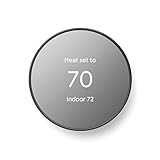
The 2.7-inch circular display has a resolution of 600 by 600 pixels and provides approximately 60% more visible display area than the previous model, according to Google. Its stainless-steel ring still provides the familiar rotating-and-pressing control method.
The display can show temperature, time, weather, humidity and outdoor air-quality information through Google’s dynamic Farsight feature. The larger screen is primarily a usability improvement: information should be easier to read from across a room, while the physical ring remains useful for quick adjustments without reaching for a phone.
More sensing, plus one remote temperature sensor
The thermostat combines temperature, humidity and ambient-light sensing with Soli-based Motion Sense. The box also includes one Nest Temperature Sensor, which can be placed in another room and selected as the priority temperature reference.
Google says up to six additional Nest Temperature Sensors can be added per thermostat. These sensors measure temperature and help the system prioritize a room; they should not be confused with ecobee’s SmartSensor, which also provides occupancy detection. That difference matters if the goal is to adjust comfort based on whether somebody is actually in a room.
Rank #2

- Nest’s smartest, most advanced thermostat yet, the Google Nest Learning Thermostat (4th gen) is a beautiful, brilliant way to save energy, keep your home comfortable, and help make sure your heating and cooling systems are running smoothly[4]
- Savings you can count on: The Nest Learning Thermostat can help save up to 31% on heating and cooling bills [2]
- Improved compatibility: It works with most 24V systems, including gas, electric, oil, forced air, heat pump, and radiant, and no C wire is required for installation in most homes; visit the Nest Compatibility Checker for more info[5]
- Easy control in the Google Home app: Adjust on your phone from anywhere[1] or by using your voice with Alexa, Siri, or Google Assistant smart speaker[3], it’s easy to install yourself and it’s Matter compatible for simple integration into your smart home[5]
- Beautiful design: With a 60% larger display[11] and Dynamic Farsight, you can see info from across the room[1]; choose the design, like a clock or the weather; it automatically adjusts brightness for the best readability or you can adjust manually
More detailed energy-management features
The thermostat supports several features intended to reduce unnecessary heating and cooling:
- Smart Schedule: Learns household routines and temperature preferences.
- Adaptive Eco: Adjusts energy-saving behavior using household and environmental conditions.
- Natural heating and cooling: Can use favorable outdoor conditions where supported.
- Smart ventilation: Helps manage ventilation behavior on compatible systems.
- Energy suggestions: The Google Home app can provide recommendations.
- System-health information: Provides HVAC-related insights and alerts.
These are potential energy-management tools, not guaranteed savings. Results depend on climate, insulation, HVAC efficiency, utility rates, schedules and how the system is configured.
HVAC compatibility and installation
Google says the fourth-generation thermostat works with most 24-volt HVAC systems, including gas, electric and oil equipment; furnaces; air conditioners; heat pumps; forced-air systems; and radiant systems. The official Google compatibility and specification guidance should be checked before purchase.
The phrase “works without a C wire” needs qualification. The thermostat is designed to operate without a C wire in most homes, but wiring and equipment configuration still determine whether an installation is suitable. A C-wire issue can also become more complicated when the system includes accessories or unusual control equipment.
Rank #3

- Nest’s smartest, most advanced thermostat yet, the Google Nest Learning Thermostat (4th gen) is a beautiful, brilliant way to save energy, keep your home comfortable, and help make sure your heating and cooling systems are running smoothly[4]
- Savings you can count on: The Nest Learning Thermostat can help save up to 31% on heating and cooling bills[2]
- Improved compatibility: It works with most 24V systems, including gas, electric, oil, forced air, heat pump, and radiant, and no C wire is required for installation in most homes; visit the Nest Compatibility Checker for more info[5]
- Easy control in the Google Home app: Adjust on your phone from anywhere[1] or by using your voice with Alexa, Siri, or Google Assistant smart speaker[3], it’s easy to install yourself and it’s Matter compatible for simple integration into your smart home[5]
- Beautiful design: With a 60% larger display[11] and Dynamic Farsight, you can see info from across the room[1]; choose the design, like a clock or the weather; it automatically adjusts brightness for the best readability or you can adjust manually
Check these systems particularly carefully
- Multi-stage heating or cooling
- Heat pumps with auxiliary or emergency heat
- Dual-fuel systems
- Radiant heating
- Zone-controlled HVAC
- Humidifiers, dehumidifiers or other accessory terminals
- Older, proprietary or unusually labeled wiring
Google’s software version 2.4, released April 30, 2026, expanded support for multi-stage heat pumps and other HVAC configurations, added on-device setup and introduced Matter-bridge support. That update improves the product’s capabilities, but it does not remove the need to verify the specific system.
Installation can also create construction and finish issues. The existing thermostat may leave a visible paint gap, requiring a trim plate. A mounting location on an electrical box may require a steel plate. Incorrectly labeled wires, insufficient power or a complex control board can require troubleshooting or professional HVAC work. Homeowners should use Google’s compatibility checker and consider a qualified HVAC professional for heat pumps, dual-fuel systems, multi-stage equipment, zone controllers or accessory wiring.
How the thermostat is controlled
Users can adjust the thermostat with the physical rotating ring and press control, through the Google Home app, with compatible voice assistants, and through compatible Matter-enabled smart-home apps. Google also positions it within its wider device ecosystem, including Pixel Watch and Google TV Streamer integrations.
Free tools Windows power users keep installed
One-click scans. No signup required.
Setup requires a phone or tablet, Wi-Fi and the Google Home app. Matter makes basic control more portable across compatible ecosystems, including Google Home, Alexa and Apple Home-compatible environments, but it does not guarantee feature parity. Advanced scheduling, energy reports, sensor behavior and some HVAC controls may remain dependent on Google Home or vary by platform.
Rank #4

- Programmable smart thermostat that learns your schedule and the temperatures you like and programs itself to help you save energy and stay comfortable
- Home/Away Assist automatically adjusts itself to an Eco Temperature after you leave, so you don’t heat or cool an empty home; remote control lets you change the temperature from anywhere on your phone, laptop, or tablet[1]
- With Energy History, just check your phone to see how much energy you used and why, or use Quick View on the display to reach Energy History, settings, or your schedule; the Nest Leaf appears when you choose a temperature that saves energy
- Smart thermostat with HVAC monitoring, which looks out for your heating and cooling systems; sends an alert if something doesn’t seem right, along with helpful reminders to make maintenance easier[2]
- The Nest Learning Thermostat works with the Nest Temperature Sensor (sold separately) to help make sure a certain room is the exact temperature you want it to be
How much does it cost in practice?
The current U.S. Google Store listing is $279.99. That price includes one Nest Temperature Sensor, which strengthens the value compared with a thermostat that sells its remote sensor separately.
The real project cost may include:
- The $279.99 thermostat
- Additional Nest Temperature Sensors
- A trim plate or steel mounting plate
- Professional installation
- Electrical or wiring work
- Potential repairs or HVAC-system modifications
Utility rebates can reduce the effective cost, but eligibility varies by utility territory, equipment, season and program rules. Check with the electricity or gas provider before buying; a rebate should not be assumed.
Nest Temperature Sensor versus ecobee SmartSensor
| Feature | Nest Temperature Sensor | ecobee SmartSensor |
|---|---|---|
| Included with flagship thermostat | One included with the fourth-generation Nest | Availability depends on the ecobee model and package |
| Primary role | Remote temperature measurement and room prioritization | Temperature measurement and occupancy-aware sensing |
| Occupancy detection | Not the same as an occupancy sensor | Occupancy detection is a major differentiator |
| Ecosystem | Google Home and compatible Matter control | ecobee’s ecosystem with broad platform support |
Choose Nest’s sensor if the main problem is a room that runs warmer or cooler than the thermostat’s location. Consider ecobee if the system needs to know whether a room is occupied before prioritizing it.
Should existing Nest owners upgrade?
First- and second-generation Learning Thermostat owners
This is the clearest upgrade case. Google ended Nest and Google Home app connectivity, third-party assistant support and other cloud-based features for first- and second-generation Learning Thermostats on October 25, 2025. Their local thermostat controls continue to work, so the devices are not completely unusable, but remote access and connected functions are gone. Google explains the change in its support notice.
Best Value
- ENERGY STAR certified smart thermostat for home that helps you save energy and stay comfortable.Connectivity : Wi-Fi - 802.11b/g/n 2.4 GHz, 802.11a/n 5 GHz Wi-Fi., Wireless interconnect : Bluetooth Low Energy Please refer to the product description section below for all applicable legal disclaimers.Product note: You can also check your system’s compatibility before purchasing a Nest thermostat with our online Nest Compatibility Checker on the Google Nest support page
- The Nest Thermostat is designed to work without a C wire in most homes, but for some systems, including heating only, cooling only, zone controlled, and heat pump systems, you’ll need a C wire or other compatible power accessory
- Nest Thermostat turns itself down when you leave, so you don’t waste energy heating or cooling an empty home. Lock feature: No
- Programmable thermostat that lets you create an energy efficient schedule in the Google Home app on your Android or iPhone
- Remote control lets family members change the thermostat temperature from anywhere on a phone, laptop, or tablet[1]
Third-generation Learning Thermostat owners
The upgrade is less automatic. A working third-generation model may still provide the core experience its owner wants. The fourth generation becomes more compelling when the homeowner wants the larger display, an included remote sensor, Matter control, newer HVAC support or updated energy features.
Basic Nest Thermostat owners
The fourth-generation model offers a more premium physical design, learning behavior, broader sensing and a more advanced display. Owners who mainly need remote scheduling may find a less expensive thermostat sufficient, while Google Home users seeking the flagship Nest experience have a clearer reason to upgrade.
New smart-thermostat buyers
Buy the Nest if the home already uses Google Home, the HVAC system passes compatibility checks, and the physical dial, adaptive scheduling and included temperature sensor are valuable. Look elsewhere if occupancy-aware sensing, a built-in speaker, Apple Home integration or the lowest purchase price matters more.
Recommended Free Tools
Alternatives worth considering
| Model | Listed or MSRP price | Best suited to |
|---|---|---|
| ecobee Smart Thermostat Premium | $259.99 | Occupancy-aware sensing, built-in smart speaker, air-quality monitoring and broad platform support |
| ecobee Smart Thermostat Enhanced | $199.99 | Buyers wanting ecobee features at a lower price |
| ecobee Smart Thermostat Essential | $139.99 | Budget-conscious buyers wanting smart controls |
| Sensi Touch 2 | $209.99 MSRP | Touchscreen control, privacy positioning and app-guided installation |
| Sensi Smart | $129.99 MSRP | Lower-cost scheduling and remote control |
| Sensi Lite | $89.99 MSRP | Basic smart-thermostat functions at the lowest listed price |
| Honeywell Home X8S | Approximately $220 in 2026 comparison coverage | A large touchscreen with Matter and broad platform compatibility |
The ecobee lineup is especially relevant for Apple Home users and households that want occupancy-aware remote sensors or a built-in smart speaker. Sensi’s homeowner lineup is better suited to buyers prioritizing price, privacy and simpler controls, although C-wire requirements and compatibility vary by model. The Honeywell Home X8S information is secondary-market context rather than a Google-confirmed price comparison.
Verdict
The Nest Learning Thermostat (4th gen) is a meaningful upgrade for Google Home households that want a premium physical thermostat, a larger display, one remote temperature sensor and Matter support. It is also a sensible replacement for first- and second-generation owners who lost cloud-connected functionality.
It is not automatically the best choice for every home. A third-generation Nest owner with a compatible, fully satisfactory system may gain more from keeping the existing thermostat. ecobee is stronger for occupancy-aware room sensing, built-in audio and broad platform use; Sensi is stronger for lower-cost installations. In every case, verify the HVAC wiring and equipment before treating the advertised price as the complete project cost.
Quick Recap
Product prices and availability are accurate as of the date/time indicated and are subject to change. Any price and availability information displayed on Amazon at the time of purchase will apply.

