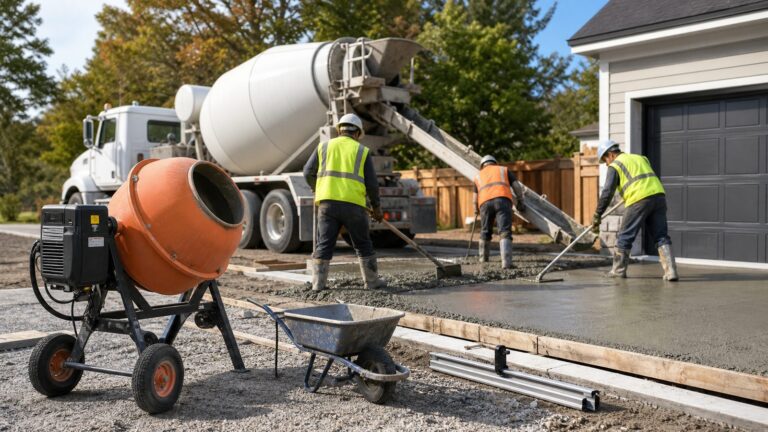
There is no universally most fuel-efficient construction-equipment powertrain. Diesel, hybrid, and battery-electric machines need to be compared within the same machine class and against the same work: measure fuel or electricity use alongside useful output, then account for duty cycle, site energy access, emissions goals, and operating costs. Battery-electric machines eliminate exhaust emissions at the machine, but whether one fits a job depends on its capability, working time, charging access, and downtime.
What does “fuel-efficient” mean for construction equipment?
Fuel used per hour is useful, but it does not show whether a machine completes more or less work during that hour. A fair comparison records both energy consumption and useful output—for example, fuel per hour and material moved per hour, or energy per unit of work—under comparable operating conditions.


As an Amazon Associate I earn from qualifying purchases.
- Match the work: Compare machines in the same class doing the same application, with similar payload, material, travel distance, and operating cycle.
- Include idle time: A machine that spends more time idling can use energy without producing useful work. Operator practice, job planning, and features such as economy modes affect consumption.
- Use actual productivity: Rated capacity is not the same as output on a particular site. Record the work completed as well as energy consumed.
- Keep the comparison boundaries consistent: Diesel fuel, electricity drawn for charging, exhaust pollutants, upstream energy emissions, and life-cycle impacts are different measures.
Caterpillar says operator behavior affects fuel efficiency and jobsite performance, and identifies reducing idle time and using machine technologies such as economy modes as ways to reduce consumption. Its information does not establish one savings figure that applies across equipment types.
How do diesel, hybrid, and battery-electric machines differ?
The table summarizes the main decision factors. Actual energy use, productivity, cost, and emissions depend on the model and application; no matched, cross-powertrain test or universal cost comparison is established by the cited sources.
#1 Best Overall

- Diecast Keychain ring
- Highest details
- Dimensions: 1.6"L x 0.9"w x 0.8"H inches
- Komatsu Official Licensed Product
- Recommended Age: 14 years and up
| Powertrain | Energy and work | Site requirements | Emissions considerations |
|---|---|---|---|
| Diesel | Compare model-specific fuel use with useful output on the same duty cycle. Idling and operator practice affect consumption. | Requires suitable diesel supply and refueling logistics. Service availability and local operating conditions matter. | Produces exhaust emissions. Applicable engine requirements depend on jurisdiction and engine class. |
| Hybrid | Potential benefit depends on the machine’s work cycle and its ability to recover and reuse energy. Do not assume a single fuel saving applies to every hybrid. | Assess the particular model’s capability, service support, and fit for the job; the cited sources do not establish a universal hybrid infrastructure requirement. | A change in one pollutant does not guarantee a reduction in every pollutant. Compare pollutants separately for the model and duty cycle. |
| Battery-electric | Compare electricity use with useful output. Fuel use is not the right energy measure for a battery machine. | Requires a workable charging plan, adequate site power and access, and a schedule that accommodates charging and any resulting downtime. | Has zero exhaust emissions at the machine. Upstream and life-cycle emissions depend on electricity supply and assessment boundaries. |
What do published efficiency figures actually show?
Manufacturer figures and field-study results can help assess a named machine, but they are not interchangeable: the comparators, applications, and measurement methods differ.
| Finding | What it applies to | How to interpret it |
|---|---|---|
| “Up to 13% less fuel” | Caterpillar D6 XE versus the previous D6T T4F, according to Caterpillar’s product information. | A manufacturer claim with a named comparator; it is not an independent comparison of diesel, hybrid, and electric machines as categories. |
| “Up to 25% less fuel per unit of material moved” | Caterpillar D11 XE versus the D11, according to Caterpillar’s product information. | The stated measure is fuel per unit of material moved. Retain the “up to” qualification and the named comparator. |
| 13–26% lower tailpipe CO2 and 26–27% higher diesel particulate matter | A 2018 study summarized in the U.S. EPA HERO record: Komatsu HB215 hybrid excavator compared with a similar conventional excavator over the study duty cycle. | The study involved three hybrid and four conventional excavators and a developed test cycle with seven work modes. The reported CO2 and particulate results move in different directions; neither result should be generalized to all hybrids. |
These figures do not constitute a direct ranking: the two Caterpillar figures are manufacturer claims for different dozers and comparators, while the hybrid figures report pollutant measurements from a particular study cycle.
When can a hybrid reduce fuel use?
A hybrid’s potential benefit depends on its design and work cycle. The relevant question is whether the machine can capture and reuse energy during the tasks it actually performs, and whether the result reduces energy use per unit of useful work.
The Tool Desk
Outbyte PC Repair FREERepair Windows errors before they cause bigger problemsFix Now →Outbyte Driver Updater FREEScan for outdated or missing drivers - takes under a minuteDriver Scan →The 2018 Cao et al. study, as summarized by the U.S. EPA HERO record, is a concrete caution against treating “lower emissions” as one undifferentiated outcome. For the HB215 and the study’s similar conventional excavator, the reported tailpipe CO2 result was lower while diesel particulate matter was higher under the tested cycle. Those figures describe that comparison and cycle, not a guaranteed result for other hybrid models, sites, or pollutants.
When is battery-electric equipment practical?
Battery-electric construction equipment can be a fit when the machine can perform the required work and charging can be integrated into the site plan. Evaluate the full operating schedule rather than assuming that a zero-exhaust machine can run any shift without interruption.
- Confirm the machine can do the job: Check the model’s capability against the application, workload, and required operating time.
- Plan charging at the site: Establish the available connection, power, access, charging window, and how charging fits around work.
- Allow for downtime: Charging arrangements and the time they take can constrain adoption, particularly where sites lack infrastructure.
- Check local availability and support: Product availability varies by market; verify current specifications, dealer support, and charging options for the location.
Caterpillar identifies the 301.9 Mini Excavator, 906 Compact Wheel Loader, 320 Excavator, and 950 GC Wheel Loader as battery-electric products on its sustainability page. The manufacturer describes them as producing zero exhaust emissions and performing the same tasks with capabilities of diesel-powered versions; check current regional availability and model specifications before treating that description as a fit for a particular job.
Rank #4

- HYBRID SHOULDER, BACK AND LEG COMFORT PADDING: Lightweight, moisture wicking and breathable padding with soft edging wraps around the wearer for the ultimate in comfort, security and no-tangle donning
- BODY BELT/HIP PAD WITH SIDE D-RINGS: Provides hip D-rings ideal for positioning, additional back lumbar support and tool carrying options
- AUTO-LOCKING QUICK CONNECT CHEST AND LEG STRAPS: Secure contact with webbing, reducing the need to readjust
- INTEGRATED TRAUMA STRAPS: Provide an adjustable, continuous loop for post fall, minimizing suspension trauma
- BUILT IN REFLECTIVE MATERIALS: Integrated on legs, chest, shoulders and back for enchanced visibility in low light conditions
EPA’s West Coast Collaborative describes a demonstration involving a 2.5-ton battery-electric compact excavator with a 20 kWh battery and a 5-ton battery-electric compact wheel loader with a 40 kWh battery. These are specifications for the machines in that demonstration, not a general specification for electric excavators or loaders. EPA also notes that construction sites may lack charging infrastructure and that downtime requirements constrain adoption. John Deere describes flexible charging solutions and its development of charging infrastructure, underscoring that charging is part of the equipment decision.
How should emissions be compared?
Tailpipe emissions
Battery-electric equipment has zero exhaust emissions at the machine. Diesel engines produce exhaust, and hybrid machines may still use an engine; evaluate the relevant pollutants rather than relying on a broad “cleaner” label. In the United States, EPA’s nonroad compression-ignition overview covers engines used in excavators and other construction equipment and describes multiple tiers of emissions standards, including Tier 4 as an integrated program of engine and fuel controls. Requirements are jurisdiction- and engine-class-specific, so confirm which rules apply where the machine will operate.
Best Value

- HYBRID DESIGN FOR ULTIMATE PERFORMANCE – Engineered for durability and flexibility, our everyday carry work belt combines the strength of a reinforced tactical belt with the comfort of an elastic EDC belt. When you're carrying IWB, this EDC belt provides the perfect balance between rigidity and comfort for everyday wear.
- CORRECT SIZING FOR THE BEST FIT – Choose your belt BASED on pant size, NOT a waist measurement. Our sizing ranges already account for IWB carry and common gear setups. Small: fits pant sizes 28–34, Medium: fits pant sizes 35–42, Large: fits pant sizes 43–48. If you fall between sizes, choose the larger size for the best comfort and adjustability.
- ALL-DAY COMFORT WITHOUT COMPROMISE – Designed for everyday carriers who demand both support and wearability, this tactical belt for jeans, tactical pants, or shorts, delivers a snug, pressure-free fit. The breathable and elastic material ensures all-day comfort, so you can stay prepared without sacrificing mobility.
- VERSATILE AND DISCREET FOR EDC – Designed specifically for IWB carry, this minimalist CCW tactical belt offers the perfect blend of support and flexibility without unnecessary bulk. Whether you carry appendix or strong-side, its low-profile design stays secure and discreet under any outfit, adapting seamlessly to your EDC needs for all-day comfort.
- EASE OF USE AND QUICK ADJUSTMENTS – Featuring a hook-and-loop buckle system, our quick-release EDC tactical belt makes securing and adjusting your fit effortless. The set-and-forget belt length adjustment ensures a consistent fit every time—no constant readjustments, just a rugged, reliable EDC belt that’s ready when you are.
Upstream and life-cycle emissions
Zero exhaust at the machine does not mean zero emissions across energy production or a machine’s life cycle. A 2023 life-cycle assessment, “Toward Zero Emission Construction: A Comparative Life Cycle Impact Assessment of Diesel, Hybrid, and Electric Excavators,” modeled a standard excavator over 9,200 effective operating hours and reported lower global warming, ozone depletion, and acidification impacts for its hybrid and electric scenarios than for its diesel scenario. Its electricity assumption was a Norwegian electricity mix, and its machine assumptions and system boundaries limit how directly the result applies to another machine or grid.
For a local comparison, keep tailpipe results separate from upstream energy and life-cycle estimates. The latter depend on the electricity mix, fuel supply, machine assumptions, and what the assessment includes.
How can you compare operating cost without assuming a payback?
The available sources do not establish a universal total-cost-of-ownership result or payback period across matched diesel, hybrid, and battery-electric construction machines. Use local, model-specific data rather than extrapolating from a fuel-efficiency percentage or a life-cycle study.
- Define the work: Specify the machine class, application, expected workload, shift pattern, and useful output to compare.
- Collect matched operating data: Obtain model-specific fuel or electricity consumption and productivity for a comparable duty cycle. Include idle time and realistic utilization.
- Price energy locally: Use the expected diesel and electricity costs, and include the costs and logistics of refueling or charging.
- Compare ownership or rental costs: Include purchase or rental price, maintenance, service access, expected machine life, charging infrastructure where needed, and downtime.
- Check operational and regulatory fit: Confirm machine capability, local emissions requirements, site power, and current regional availability before comparing totals.
A short-term rental or a site-specific trial can help establish whether a machine fits a particular work cycle, but any financial conclusion still depends on the actual local quote, utilization, and operating data.
Which powertrain should you choose?
Choose the machine that delivers the required work reliably at an acceptable energy cost and operational impact for the site. Diesel, hybrid, and battery-electric are not universal efficiency rankings: compare equivalent machines and report energy per useful work, then account for charging or refueling, emissions objectives, local rules, support, and utilization. Treat manufacturer claims and study results as evidence about their named models and conditions—not as guarantees for a whole category.
Quick Recap
Product prices and availability are accurate as of the date/time indicated and are subject to change. Any price and availability information displayed on Amazon at the time of purchase will apply.