Some links on this page are affiliate links: if you buy through them we may earn a commission, at no extra cost to you.
A good flower arrangement is not just a bundle of pretty stems dropped into water. Florists treat it like a small build: choose the location, size the vessel, prep the materials, set the structure, place the feature pieces, and then maintain the finished work. That same job-site thinking makes home arrangements look cleaner, last longer, and cost less.
For most homeowners, the right approach is simple: start with a clean vase, use sharp snips, remove every leaf that would sit below the waterline, recut stems, hydrate them before arranging, and build from greenery to focal flowers to smaller filler. Plan on spending about $25 to $75 for a strong DIY seasonal arrangement, or $75 to $200-plus if you are using premium flowers, a large vessel, or imported stems. A florist-designed vase arrangement commonly runs about $50 to $150-plus in 2026, depending on size, stem choice, container, delivery, and local labor.
As an Amazon Associate I earn from qualifying purchases.
Here are 14 flower arranging tips we would use in a real home, not just on a styled tabletop for a photo.
1. Start With the Location, Not the Flowers
Before buying a single stem, decide where the arrangement will live. This is the same way we approach built-ins, lighting, trim, and exterior details on a construction project: the site conditions drive the design.
Popular on Amazon

- Flexible silicone grid that stretches over the rim of your favourite vase, making arranging flowers super easy.
- Being washable and reusable, Vase Buddy replaces the need for toxic floral foam, tape or fussy chicken-wire when arranging and allows for water in the vase to be changed regularly. Simply slip it off and on again once the water has been replaced without losing the design of the arrangement.
- Vase Buddy was born with a purpose to making gorgeous floral vase arrangements super easy for anyone! It is the easiest way to construct a perfect arrangement with fewer flowers: It maintains structure and prevents flowers flopping to the side of the vase that can happen with long-stemmed flowers in wide-mouthed containers.
- When stretched, Vase Buddy self-grips to any smooth surfaced container and removes cleanly after use.
- Vase Buddy has been designed for use on vase openings from 5" - 8". Measure your vase opening for the best fit.
A kitchen island arrangement needs to look good from all sides and stay low enough that people can talk across it. A good target is 10 to 16 inches tall for everyday use. An entry console can handle more height, often 18 to 30 inches, because people view it from the front and side. A mantel arrangement should be shallow front-to-back, usually 6 to 10 inches deep, so it does not overhang the edge or crowd artwork, sconces, or a TV.
For a dining table, keep the finished height under about 12 inches if people will be seated across from each other. For a sideboard, foyer, or empty corner, you can go taller, but widen the base or use heavier mechanics so it does not become top-heavy.
Free tools Windows power users keep installed
One-click scans. No signup required.
2. Match the Vase to the Scale of the Arrangement
A practical rule is to choose a vase that is about one-third to one-half the height of the total finished arrangement. If your flowers will finish at 24 inches tall, a vase in the 8- to 12-inch range usually looks balanced. If the vase is too short, the design looks unstable. If it is too tall, the flowers disappear into the container.
Width matters just as much. A wide-mouth vase without support will force you to use more stems than necessary just to keep everything upright. That raises the cost and often makes the arrangement look crowded. For a 5- to 7-inch opening, use a tape grid, chicken wire, or a pin frog. For a narrow 2- to 3-inch opening, fewer stems can look intentional.
Protect the surface below the vase. Stone, stained wood, painted shelves, and concrete countertops can all be damaged by standing water, flower food residue, pollen, or condensation. Use a saucer, cork pad, felt pad, or low-profile tray, especially on mantels, built-ins, antique tables, and outdoor furniture.
3. Budget the Arrangement Before You Shop
Flower costs can run away quickly because premium stems are sold by variety, season, and availability. In 2026, a simple grocery or market bouquet commonly costs about $10 to $35. A stronger DIY arrangement using seasonal flowers, greenery, and a reusable vase usually lands around $25 to $75. Larger or more premium home arrangements can run $75 to $200-plus.
Do these 3 things before closing this tab:
1Scan for outdated or missing drivers - takes under a minute2Clear out junk files and repair common Windows errors3Fix the driver behind crashes, sound loss and screen glitchesIf you arrange flowers more than twice a year, buy a basic toolkit instead of fighting with kitchen scissors and the wrong vase every time.
| Item | Typical 2026 Cost | Why It Matters |
|---|---|---|
| Floral snips or bypass pruners | $10-$35 | Clean cuts help stems drink water instead of crushing the tissue. |
| Floral tape | $3-$10 | Useful for making a grid across wide vase openings. |
| Chicken wire or reusable flower frog | $8-$30 | Holds stems in position without overstuffing the vase. |
| Vase or container | $10-$75+ | Controls scale, stability, and total stem count. |
| Floral preservative | $5-$20 | Feeds flowers, improves water chemistry, and slows bacteria. |
| Gloves | $5-$15 | Helpful for roses, woody stems, and skin-sensitive plants. |
| Lazy Susan or turntable | $10-$30 | Makes it easier to check all sides as you build. |
For events, the price jumps because labor, transport, refrigeration, setup, teardown, mechanics, and venue access all matter. Wedding and event florals in 2026 often range from $2,000 to $8,000 for many couples, with full-service 100-guest floral design commonly around $3,500 to $5,500. A bridal bouquet may run $100 to $350, centerpieces $50 to $600 each, altar arrangements $150 to $600, and floral arches or arbors $200 to $4,500-plus depending on size and installation complexity.
4. Clean the Vase Like It Is Part of the Job
Dirty containers shorten vase life. Old organic matter, cloudy residue, and bacteria clog stems and make fresh flowers decline faster. Wash the vase with hot soapy water before arranging. Rinse it well. If the container has been sitting in a garage, shed, or cabinet, do not assume it is clean enough.
On our job sites, surface prep is never optional. Paint, tile, sealant, and finish work all fail early when the base conditions are poor. Flowers are the same. A clean vase and clean water are the foundation of the arrangement.
Also clean buckets if you condition flowers before arranging. A dirty utility bucket can undo the benefit of good stems and fresh water in a few hours.
5. Strip Every Leaf Below the Waterline
Any foliage sitting below the waterline will decay. That creates bacteria, cloudy water, bad odor, and clogged stems. Before arranging, hold each stem against the vase and strip leaves from the lower portion that will be underwater.
This step takes 5 to 10 minutes for most home arrangements and makes a visible difference. It also gives the lower part of the design a cleaner look through clear glass. Keep upper leaves if they add shape, but be ruthless below the waterline.
Also popular on Amazon

- Multi-Purpose Flower Arranging Tool: Set of 3 metal floral frogs or kenzans for arranging flowers, branches, and greenery in vases or bowls, suitable for decorating home, kitchen, and bedroom spaces
- Versatile Design: Round metal pin holders with multiple prongs to securely hold stems in place for Ikebana and DIY floral arrangements, equipped with rubber non-slip mat
- Sturdy Construction: Built with a heavy metal floral frog base with spiky flower pins to hold flower stems in place, will not scratch the bottom of the container and allows for easy cleaning
- Flower Arrangement Tool: This flower arrangement tool makes a thoughtful gift for friends or family who enjoy floral arrangement and brings warmth to comfortable living spaces
- Size and Package: The package includes 3 pieces of floral frogs with dimensions of 2 inches, 1.3 inches, and 0.9 inches to accommodate various arrangement sizes
For roses, remove damaged guard petals only if they look bruised or torn. For hydrangeas, avoid stripping all leaves at once unless needed for the design; large leaves help the stem hydrate, but none should sit in water.
The Tool Desk
Outbyte PC Repair FREERepair Windows errors before they cause bigger problemsFix Now →Outbyte Driver Updater FREEScan for outdated or missing drivers - takes under a minuteDriver Scan →6. Recut Stems With Sharp Tools
Cut stems with clean floral snips, a floral knife, or bypass pruners. Avoid dull household scissors, which can crush the stem and reduce water uptake. Cut about 1/2 inch to 1 inch off the bottom before placing stems in water. For stems that have been out of water for a while, a fresh cut is not optional.
Angle cuts can help keep the stem end from sitting flat against the bottom of the vase. The bigger point is clean tissue. If the end is dry, blocked, or crushed, the flower cannot drink well.
Trim gradually. Beginners often cut stems too short right away. Start long, test the height, then cut again. You can always remove another inch. You cannot put it back.
7. Condition Flowers Before Styling
Florists do not usually design straight from the shopping bag. They condition flowers first. At home, that means recutting stems, placing them in clean water with preservative, and giving them time to hydrate before final arranging.
A strong conditioning window is 3 to 12 hours in a cool place. Professional guidance commonly recommends storing conditioned cut flowers around 35 to 40 degrees Fahrenheit when possible. Most homeowners do not have a dedicated floral cooler, so use the coolest practical room in the house, away from direct sun, appliances, and heat vents.
Do not refrigerate flowers with fruits or vegetables. Fruit gives off ethylene gas, which speeds aging, petal drop, and decline. The same rule applies after arranging: do not place flowers next to a fruit bowl on the counter.
8. Use Floral Preservative Instead of Guesswork Recipes
Commercial floral preservative is usually the most defensible choice. Cut flowers need three things from their water: carbohydrate for energy, an acidifier to improve water uptake, and a biocide to slow bacteria. Good flower food is designed around those functions.
DIY sugar, vinegar, aspirin, soda, bleach, or coin tricks are inconsistent. Some can help one part of the problem while making another part worse. If the flowers came with a packet, use it according to the label. More is not better; concentrated preservative can damage stems.
Crashes, No Sound, or Screen Glitches?
Random freezes, missing sound and display glitches usually trace back to one bad driver. Find and replace yours safely.Free scan · under a minutePC Slower Than It Used to Be?
A free scan shows the junk files, broken settings and background clutter dragging Windows down - then fixes them in one click.Free scan · Windows 10 & 11Water quality also matters. Chemically softened water can hurt some cut flowers because of sodium content. Roses and carnations can be sensitive to sodium, and flowers such as gerbera, gladiolus, and freesia may be harmed by fluoride. If your home has softened water and arrangements fail quickly, try unsoftened tap water, filtered water, or bottled water for a side-by-side comparison.
9. Build the Framework First
Start with greenery, branches, or sturdy stems to create the outline. This is the framing stage. It gives the arrangement width, height, and direction before the expensive flowers go in.
For a round table arrangement, place greenery at several angles and rotate the vase every few stems. For a one-sided entry arrangement, build a taller back, a lower front, and side pieces that create width. For a mantel, keep the depth tight and let the greenery run horizontally instead of reaching too far forward.
Once the greenery is placed, add focal flowers. These are the largest or most expensive stems: roses, peonies, lilies, dahlias, hydrangeas, orchids, ranunculus, or large seasonal blooms. Then add secondary flowers and filler. This sequence reduces crowding and keeps the arrangement from turning into a dense ball.
What’s actually slowing this PC down?
Pick the symptom - the matching free tool is one click away.
Also popular on Amazon

- 4-PIECE, 3-SIZE SET: Includes one 1-inch, two 2-inch and one 3-inch flower frog. Use a single holder for a small tabletop display or combine sizes to support fuller floral arrangements.
- WEIGHTED METAL BASES: Solid iron construction adds the weight needed to help keep stems balanced in shallow bowls and vases, giving beginners and experienced arrangers greater control over placement.
- SHARP COPPER PINS HOLD STEMS: Closely spaced needles pierce and grip delicate, thick or woody stems, helping flowers stay at the chosen angle while you build ikebana, garden bouquets and centerpieces.
- NON-SLIP BOTTOM RINGS: Rubber padding underneath helps reduce sliding and tipping on smooth vase surfaces. The three size options work with compact displays, tall stems and multi-stem compositions.
- REUSABLE FLORAL DESIGN TOOL: A practical alternative to disposable floral foam for home decor, weddings, events and fresh-cut garden flowers. Pins are sharp; handle carefully, remove stem debris, rinse and dry promptly after use.
10. Use Mechanics for Wide-Mouth Vases
Mechanics are the hidden supports that keep stems where you put them. For home arranging, the most useful options are a tape grid, chicken wire, and a pin frog.
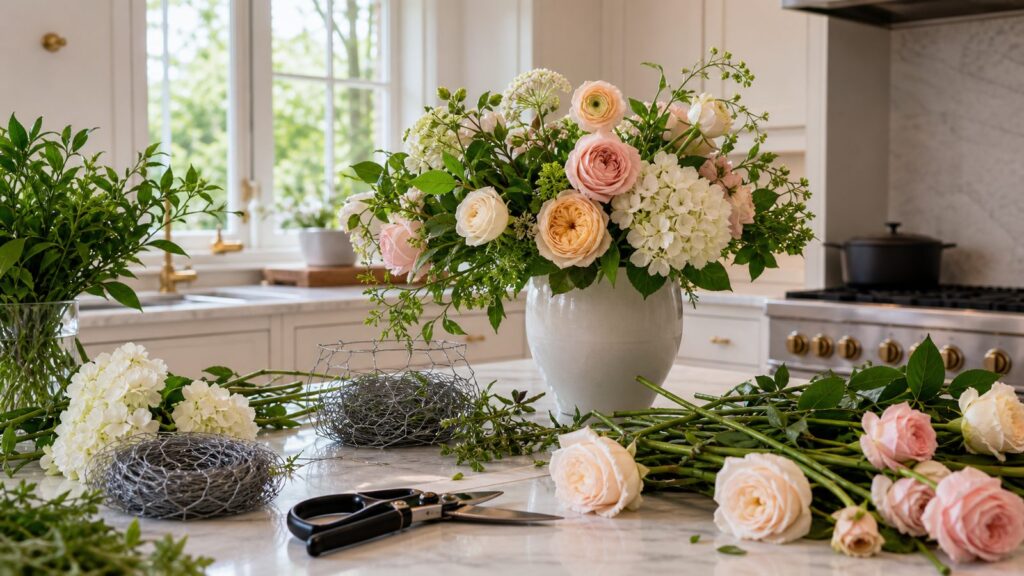
A tape grid is inexpensive and fast. Use waterproof floral tape across the vase opening in a simple checker pattern, leaving openings around 1 to 1.5 inches wide. Chicken wire is reusable, flexible, and good for loose garden-style arrangements. Shape it into a ball, place it inside the vase, and let stems pass through the openings. A pin frog is heavier and cleaner for low bowls, ikebana-style designs, and sparse arrangements.
Floral foam can be useful for some event work, but we would not treat it as the default for home arrangements. It is single-use, creates waste, and can shed small plastic particles. It also holds stems in a fixed position, which can encourage beginners to overfill. Chicken wire, frogs, branches, and tape grids are better reusable starting points for most homeowners.
11. Vary Height, Depth, and Negative Space
Odd numbers of focal blooms are a good beginner shortcut: 3, 5, or 7 large flowers are easier to place than an even number. But count is not what makes an arrangement look professional. Movement does.
Quick wins for a faster PC:
Scan for outdated or missing drivers - takes under a minuteDriver Scan →Repair Windows errors before they cause bigger problemsFix Now →Place focal blooms at different heights and depths. Set one lower near the rim, one slightly higher toward the center, and one farther back or off to the side. Turn the vase as you work. Leave some air between flowers. Negative space makes an arrangement look intentional and often more expensive than packing every gap.
A common mistake is cutting every flower to the same height and creating a tight dome. That can work for a formal centerpiece, but it often looks stiff in a modern kitchen, open-plan room, or casual outdoor setting. Let a few stems extend, let others tuck in, and keep the outline from becoming a perfect ball.
12. Choose Flowers for the Conditions
Flower selection should match the room, season, and expected use. Heat, sun, HVAC drafts, wind, and handling all affect performance.
Longer-lasting vase flowers often include carnations, chrysanthemums, alstroemeria, lilies, orchids, roses, lisianthus, stock, and some mums. More delicate or temperature-sensitive flowers, such as sweet peas, poppies, certain tulips, and some garden roses, can be beautiful but may have a shorter display window.
Recommended Free Tools
For outdoor dining, patios, decks, and porches, choose sturdier stems and lower profiles. Use heavier vessels, wide bases, and water-resistant pads under containers. Avoid tall, narrow glass vases on breezy tables. On a deck rail, stair landing, or exterior side table, a top-heavy arrangement is not just inconvenient; it can fall, break glass, stain decking, or injure someone.
For homes with pets or young children, check plant safety before bringing flowers inside. Lilies are especially dangerous to cats. Also be careful with thorny stems, pollen-heavy lilies, and plants that shed berries or small parts onto the floor.
Independent reader supportYour contribution helps us test, update, and keep practical guides available for everyone.13. Maintain the Arrangement Every 2 to 3 Days
Flower arranging does not end when the vase hits the table. Maintenance is what gets you extra days.
Change the water every third day, or sooner if it turns cloudy. Wash the vase if residue is forming. Recut stems when you change the water; even a small fresh cut can improve uptake if the stem end is blocked. Remove spent blooms and yellowing leaves before they decay. Keep the arrangement out of direct sun, away from heating and cooling vents, and away from fruit.
Expect most mixed arrangements to look best for 3 to 7 days, with some hardy stems lasting longer. If one flower type fails early, pull it and let the rest of the arrangement continue. Florists edit arrangements as they age; homeowners should too.
Also popular on Amazon

- 【Secure Stem Placement for Perfect Arrangements】 Each kenzan flower frog features sharp brass needles that firmly grip flower stems in position, letting you create professional floral designs with ease. The anti slip rubber base keeps flowers upright and stable in any vase or container, making it an essential tool for ikebana and modern flower arrangements. The compact floral pins are designed for small to medium vases where precision matters most.
- 【Brass Needles Built to Last】Crafted from solid brass with high hardness and strong wear resistance, these floral frog pins stay sharp and functional through repeated use. Unlike thin metal alternatives that bend or rust, the dense brass construction resists corrosion and maintains its grip strength season after season. The needles are firmly fixed to the weighted base, ensuring they will not loosen or fall out during arrangement work.
- 【Versatile for Every Floral Project】Whether you are practicing traditional ikebana, arranging fresh garden flowers, or creating centerpiece displays for events, these kenzan tools adapt to your creative vision. Suitable for beginners learning flower arrangement and experienced florists alike, they work seamlessly with ikebana vases, small bowls, and various container types. Also ideal as florist supplies for wedding decorations and DIY craft projects.
- 【Versatile for Every Floral Project】Whether you are practicing traditional ikebana, arranging fresh garden flowers, or creating centerpiece displays for events, these kenzan tools adapt to your creative vision. Suitable for beginners learning flower arrangement and experienced florists alike, they work seamlessly with ikebana vases, small bowls, and various container types. Also ideal as florist supplies for wedding decorations and DIY craft projects.
- 【Complete 3-Size Brass Flower Frogs Set】Package includes 3 brass floral frogs (23mm, 34mm, 40mm diameter) with rubber base pads. The variety of sizes covers most ikebana and flower arrangement needs from single stems to multi-flower designs. Compact storage-friendly design fits easily in any craft kit or floral supply box.
14. Treat Large Event Florals Like an Installation
A vase on a table is decoration. A floral wall, hanging ceiling piece, arbor, exterior entry display, or tent installation is closer to temporary construction. The flowers may be light individually, but the total assembly can become heavy once you include water tubes, foam, cages, wire, lumber, greenery, wet stems, lighting, and wind load.
Separate the floral design from the structure. Florists can handle the flowers and mechanics, but heavy arbors, suspended pieces, ceiling installs, and exterior displays may need proper anchoring, rated hardware, venue approval, or help from a qualified installer. Do not hang a floral chandelier from a light fixture, sprinkler pipe, ceiling tile grid, curtain rod, or decorative trim unless that element is rated for the load.
For tents and public events, consider fire access, exit paths, extension cords, candles, open flame, trip hazards, and aisle width. Decorations should not block exits, cover exit signs, obstruct fire equipment, or create overhead hazards. Some special events, tents, membrane structures, or public venues may require permits, inspections, flame-resistant materials, or approval from the authority having jurisdiction. A normal home vase arrangement does not need a permit; a large event structure might.
The Tool Desk
Outbyte Driver Updater FREEScan for outdated or missing drivers - takes under a minuteDriver Scan →Outbyte PC Repair FREEClear out junk files and repair common Windows errorsFree Scan →When to DIY and When to Hire a Florist
DIY makes sense when the arrangement is small, the schedule is flexible, and the consequences of imperfection are low. Everyday kitchen flowers, entry table arrangements, holiday sideboard pieces, porch pots, and casual dinner centerpieces are good DIY projects. Budget about 30 to 90 minutes for shopping, conditioning, arranging, and cleanup if you are new to it.
Hire a florist when the flowers matter to the event outcome, when the design requires transport and setup, or when the installation has scale, height, weather exposure, or structural risk. Weddings, corporate events, large dinner parties, memorial services, floral arches, stair installations, hanging pieces, and time-sensitive deliveries are usually worth professional help.
There is also a middle ground. You can hire a florist for the bridal bouquet, ceremony pieces, or arbor, then DIY smaller bud vases or simple table greenery. That keeps the high-visibility, high-risk work professional while controlling the budget.
A Simple Home Arrangement Plan
For a reliable first arrangement, use one 8- to 10-inch vase with a 4- to 5-inch opening, one bunch of greenery, 5 focal flowers, 6 to 10 secondary stems, and one small filler bunch. Expect to spend about $35 to $85 depending on your market and flower choice.
Recommended Free Tools
Wash the vase. Add water and preservative. Make a tape grid or use chicken wire. Strip leaves below the waterline. Recut stems. Build greenery first, then place 5 focal flowers at varied heights, then fill with secondary blooms. Rotate the vase as you go. Stop before it looks packed.
The best arrangements usually come from restraint. Fewer varieties, better prep, clean water, proper scale, and good placement will beat an expensive pile of stems almost every time.
Frequently Asked Questions
How do florists make flower arrangements last longer?
They start with sanitation and conditioning: clean vase, clean water, leaves removed below the waterline, fresh stem cuts, floral preservative, and cool storage before arranging. Afterward, change the water about every third day, recut stems, remove fading flowers, and keep the vase away from sun, HVAC drafts, heat, and fruit.
What tools do I need to arrange flowers at home?
Start with floral snips or bypass pruners, floral tape, chicken wire or a reusable flower frog, a clean vase, floral preservative, and gloves. A basic setup usually costs about $40 to $150 depending on the vase and tools you choose.
Free tools Windows power users keep installed
One-click scans. No signup required.
How much does a DIY flower arrangement cost in 2026?
A simple grocery bouquet may cost $10 to $35. A stronger DIY arrangement with seasonal stems and greenery usually costs about $25 to $75. Premium stems, large arrangements, imported flowers, and upgraded containers can push the cost to $75 to $200-plus.
What is the best vase size for a flower arrangement?
Use a vase about one-third to one-half the height of the finished arrangement. For a 24-inch arrangement, an 8- to 12-inch vase usually works well. Wide openings need support such as tape, chicken wire, or a frog so stems do not flop outward.
Should I use floral foam, chicken wire, or a flower frog?
For most home arrangements, chicken wire, tape grids, and flower frogs are better first choices because they are reusable and flexible. Floral foam can be useful for some event designs, but it is single-use, creates waste, and is not necessary for most vases.
Do flower arrangements need permits for weddings or outdoor events?
Normal home vase arrangements do not need permits. Larger event installations can raise safety or approval issues if they involve tents, arbors, hanging florals, exterior structures, lighting, candles, blocked exits, or public venues. In those cases, check venue rules and local fire or event requirements.
What’s actually slowing this PC down?
Pick the symptom - the matching free tool is one click away.
Quick Recap
Product prices and availability are accurate as of the date/time indicated and are subject to change. Any price and availability information displayed on Amazon at the time of purchase will apply.

