Do these 3 things before closing this tab:
1Clear out junk files and repair common Windows errors2Fix the driver behind crashes, sound loss and screen glitches3Repair Windows errors before they cause bigger problemsChoose construction-site fire extinguishers by the materials and work hazards they must cover, then verify the label, rating, placement and applicable rules. Under U.S. federal OSHA construction requirements, the minimum includes a 2A extinguisher for each 3,000 square feet of protected building area or major fraction, with no more than 100 feet of travel to the nearest unit. Additional requirements apply to each floor and to certain quantities of flammable liquids or gases. These are minimums—not a universal extinguisher plan—and site hazards change as construction progresses.
Start with the fire hazards, not the extinguisher size
An extinguisher is suitable only when its label covers the kind of fire it may face. Inventory the fuels and processes on site before choosing equipment, and repeat that assessment as work areas, stored materials and building systems change. A construction site is not a fixed environment: materials accumulate or move, temporary work areas shift, and fire-protection features may be incomplete. A selection made for one phase of a project may not be adequate for the next.
As an Amazon Associate I earn from qualifying purchases.
Begin with what can burn, how it could ignite, and where a worker would need an extinguisher. Include permanent and temporary work areas, as well as changing storage and access conditions. Do not begin with a preferred extinguisher weight or assume one unit type can cover every risk. A unit’s class letters, numeric rating, listing, location and suitability for site conditions all matter.
- Ordinary combustibles: Wood, cloth, paper, rubber and many plastics are Class A hazards. Water-type units are intended for suitable Class A fires.
- Flammable or combustible liquids and gases: Gasoline, oils, some paints and solvents, and similar materials are Class B hazards. Use a unit labeled for Class B.
- Energized electrical equipment: This is a Class C hazard. OSHA’s extinguisher guidance describes carbon dioxide (CO2) and dry chemical as options for B and C risks; confirm the extinguisher label and consider site conditions.
- Combustible metals: Magnesium, titanium, sodium and potassium can require a Class D agent specifically suitable for the metal involved. Do not assume a multipurpose ABC extinguisher will work.
- Commercial cooking: Cooking oils and fats are Class K hazards. This class is relevant when the site has that type of cooking operation.
Never use water on a flammable-liquid fire or energized electrical equipment. CO2 is not recommended for Class A fires because material can continue smoldering and reignite after the gas disperses. OSHA also cautions against using CO2 in a confined space with people present unless they have proper respiratory protection.
#1 Best Overall
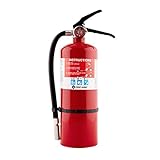
- The First Alert HOME2PRO Fire Extinguisher is UL rated 2-A: 10-B:C and meets minimum 2-A: 10-B:C code requirements; It features durable all-metal construction with a commercial-grade metal valve and trigger
- Heavy-duty fire extinguisher fights wood, paper, trash, plastics, gasoline, oil, and electrical-equipment fires; ideal for offices, homes, and workshops
- Uses mono ammonium phosphate extinguishing agent; Rechargeable by certified professionals after use
- Includes wall hook and easy-to-read, color-coded, corrosion-resistant pressure gauge
- 12-year limited
What extinguisher types cover common site hazards?
A listed multipurpose dry-chemical extinguisher may be labeled for Classes A, B and C, making it a practical category for sites with those hazards. Check the actual label: a dry-chemical unit is not automatically an ABC unit. An ABC extinguisher also does not replace specialized equipment for combustible-metal hazards or any other hazard its label does not cover. “Multipurpose” describes the coverage printed on the specific unit; it is not a promise that the extinguisher is suitable for every fire that might occur on a construction site.
Where several agent categories could be considered, compare the approved fire classes and the real work conditions rather than choosing by name alone. Water-based equipment, for example, may be appropriate for suitable Class A risks, but freezing exposure is a selection consideration. CO2 is an option described for B and C risks, but it is not recommended for Class A and has a specific confined-space caution. For combustible metals, the agent must be approved for the metal involved. If cooking hazards are present, check for Class K coverage.
| Extinguisher or agent category | Typical labeled use | Important limitation |
|---|---|---|
| Water-type | Suitable Class A fires | Do not use on flammable liquids or energized electrical equipment; account for freezing exposure when selecting water-based equipment. |
| Multipurpose dry chemical | May cover A, B and C when the specific unit is labeled accordingly | Not all dry-chemical units cover all three classes; not a substitute for suitable Class D equipment. |
| CO2 | OSHA describes it as an option for B and C risks | Not recommended for Class A because of possible smoldering and reignition; confined-space use with people present requires proper respiratory protection. |
| Class D agent | Combustible-metal fires, when approved for the metal involved | Select for the specific metal; a general-purpose ABC rating is not enough. |
| Class K agent | Cooking-oil and fat fires in commercial cooking operations | Relevant where that cooking hazard exists. |
Use this comparison as a starting point, not a replacement for the extinguisher label or the site hazard assessment. The same class can occur in different places and work phases. For example, ordinary building materials create Class A concerns, while liquid fuels, paints or solvents may introduce Class B concerns. Energized electrical work adds a Class C condition. A project may have several of these at once, so a single-unit plan should not be assumed to address all hazards without checking coverage and placement.
How to read the class and rating on the label
Class letters identify the fire types for which the extinguisher is approved. The numeric rating indicates extinguishing capacity under the rating system; it is not the unit’s weight. OSHA explains that each Class A rating unit is equivalent to 1.25 gallons of water. For a Class B rating, the number before the letter represents the area, in square feet, of a Class B fire that a nonexpert user should be able to extinguish.
Match both parts of the label to the need: class coverage must fit the fuel or condition, and the rating must meet the applicable minimum and the site’s hazard assessment. OSHA requires extinguishers used to meet its construction standard to be listed or approved by a nationally recognized testing laboratory. Verify that information on the particular unit rather than inferring approval from its appearance, agent type or marketing description.
Do not treat a high number or a heavy cylinder as proof that an extinguisher is appropriate. A rating answers a capacity question within its class; it does not change the class coverage. A Class A rating does not mean the unit is approved for an energized electrical hazard, and an ABC label does not make the extinguisher appropriate for a combustible-metal fire. Check the complete label for both the letters and numbers, then compare those markings with the hazard and the relevant requirement.
Rank #2
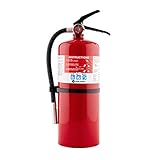
- The First Alert PRO10 Fire Extinguisher is UL rated 4-A:60-B:C; it features durable all-metal construction with a commercial-grade metal valve and head
- Heavy-duty fire extinguisher is ideal for offices and commercial purposes and fights wood, fabric, paper, flammable-liquid, and electrical fires
- Uses monoammonium phosphate extinguishing agent; rechargeable by certified professionals after use
- Includes mounting bracket and easy-to-read, color-coded, corrosion-resistant pressure gauge
- 12-year limited warranty
When comparing products, consider portability, reach, mounting, exposure to weather or temperature, and the possibility of damage or displacement. A unit that is difficult to reach or that cannot remain suitable under site conditions is not a good practical choice simply because its rating looks adequate. Also consider inspection, service, recharge and replacement needs. No one generic extinguisher size is sufficient for every construction site; the correct rating and number depend on the hazards, protected area, placement requirements and applicable rules.
Outdated Drivers Are Slowing You Down
One free scan finds every outdated or missing driver and matches the right update for your exact hardware.Free scan · exact hardware matchWindows Errors? Fix Them Before They Spread
Repair common Windows errors and clear accumulated junk for a smoother, more stable PC - no reinstall needed.Free scan · no reinstallU.S. federal OSHA construction minimums
The figures below come from OSHA’s construction standard, 29 CFR 1926.150(c)(1), available on the current regulation page. They apply to work covered by that U.S. federal construction standard. State-plan requirements, local fire codes, project specifications and the authority having jurisdiction may add to or differ from these minimums.
| Requirement | Federal construction-standard minimum |
|---|---|
| Class A coverage | At least one extinguisher rated 2A for each 3,000 square feet of protected building area, or major fraction thereof. |
| Travel distance | No more than 100 feet from any point in the protected area to the nearest extinguisher. |
| Floors and stairs | At least one extinguisher rated 2A on each floor; in a multistory building, at least one must be adjacent to a stairway. |
| Flammable liquids and gas | Where more than 5 gallons of flammable or combustible liquids, or 5 pounds of flammable gas, are being used on the jobsite, place an extinguisher rated at least 10B within 50 feet. The rule excludes integral fuel tanks of motor vehicles from this particular requirement. |
| Listing or approval | Units used to meet the subpart must be listed or approved by a nationally recognized testing laboratory. |
As OSHA states in 29 CFR 1926.150(c)(1)(i): “A fire extinguisher, rated not less than 2A, shall be provided for each 3,000 square feet of the protected building area, or major fraction thereof.” The 2A-per-area requirement is only one part of the placement calculation. The same provision limits travel distance, and separate provisions address floors, stairs and specified quantities of flammable liquids or gas.
For the coverage calculation, identify the protected building area and provide a 2A unit for each 3,000 square feet or major fraction; also check travel distance and the floor and stair requirements. The 10B rule is triggered by the stated quantity of liquids or gas being used on the jobsite, not simply by choosing a larger general-purpose unit. The rule specifies more than 5 gallons of flammable or combustible liquids or 5 pounds of flammable gas, and a 10B extinguisher must be within 50 feet. Integral fuel tanks of motor vehicles are excluded from that particular requirement.
These requirements answer some, but not all, of the question “How many extinguishers are required?” The protected area determines one minimum, the 100-foot travel limit and floor provisions affect placement, and the 10B rule adds a separate location requirement when its threshold is met. Other hazards may call for equipment whose labels cover those hazards. A count based only on square footage could therefore overlook the other provisions or the needs of a particular work process.
Recommended Free Tools
OSHA’s separate general-industry placement eTool discusses NFPA 10 spacing guidance. Do not treat that general-industry material as a replacement for the specific construction requirements in 29 CFR 1926.150. The eTool refers to NFPA 10 (2010) for one Class A recommendation; verify the currently applicable NFPA edition and local adoption independently rather than presenting that reference as a universal current construction rule.
Rank #3

- All-in-One ABC Fire Protection: Forget one-trick fire safety gear—this 5lb ABC dry chemical extinguisher crushes Class A (wood, paper), Class B (grease, gasoline), and Class C (electrical) fires like a pro. Picture this: a grease splatter gone wrong on your kitchen stove, a rogue spark near your grill, or an electrical glitch in your RV—this extinguisher handles it all. It’s not just a home fire extinguisher; it’s your sidekick for cars, boats, offices, and even your weekend camping trailer. The eco-friendly, non-toxic formula means you’re protecting your family without harsh chemicals—total peace of mind
- All-Weather Reliability That Lasts for Years: American weather is unpredictable—but your fire safety shouldn’t be. This extinguisher laughs at extreme temps, working flawlessly from -22°F (perfect for winter car trunks in the North) to 140°F (no sweat in a summer boat cabin). The corrosion-resistant steel cylinder isn’t just tough—it’s built to last 5 full years of regular use. Whether it’s sitting under your kitchen sink, mounted in your truck, or stowed on your boat, it’s ready to perform when you need it most. No more worrying about duds when emergencies strike
- Quick-Release Handle: Activate in Seconds—Emergencies don’t wait for you to fumble with complicated latches. Our quick-release handle pops open in an instant, so you can respond before a small spark becomes a disaster. The ergonomic grip fits every hand—from your teen’s first time using it to your grandma’s steady hold—no training required. And with a 15ft discharge range, you stay safely back while dousing flames. It’s commercial-grade reliability wrapped in everyday ease—perfect for busy parents, road trippers, and small business owners alike
- Compact & Easy to Mount: This compact extinguisher slips under your kitchen sink, tucks into your car trunk, or fits in your RV’s storage nook. We include a heavy-duty metal mounting bracket (way sturdier than plastic knockoffs) so you can mount it on your garage wall, boat bulkhead, or office closet—installation takes 5 minutes, no fancy tools needed. Finally: fire safety that fits your space, not the other way around. Keep it where fires are most likely to start, and stay prepared without clutter
- Stop Fires Before They Spread: The #1 rule of fire safety? Act fast. This portable extinguisher smothers flames in seconds, turning a potential tragedy into a minor hiccup. Imagine stopping a kitchen grease fire before it reaches your cabinets, or putting out a car engine spark before it melts your dashboard. It’s not just “fire safety”—it’s protecting your kids’ toys, your grandma’s recipe box, and all the things that make your home yours. This isn’t a “nice-to-have”—it’s the essential gear that stands between you and disaster
Choose and position extinguishers as the project changes
1. Inventory the site’s hazards
List ordinary building materials, flammable or combustible liquids and gases, energized electrical work, hot work such as welding, temporary heating, any combustible-metal processes, and cooking operations if present. OSHA notes that construction and renovation can involve concentrated combustible materials, varied ignition sources and incomplete fire-protection features. The list should reflect the actual site, not just its original plans: work processes and materials can change over the course of construction and demolition.
Identify where the hazards are concentrated and which areas are likely to change. For instance, hot work, temporary heating, stored materials and electrical work are all reasons to look again at the current hazard picture. This does not mean every activity automatically requires a particular extinguisher type; it means that the site plan should account for the fuels, conditions and locations that exist and confirm appropriate coverage.
2. Map minimum coverage and practical access
Use the protected area, 3,000-square-foot coverage rule, 100-foot travel limit, floor and stair requirements, and any applicable 10B location requirement to map units. Measure the route a worker can actually take; a unit that is blocked, hard to see or inaccessible does not provide useful coverage. Account for multiple floors and stair access. Keep the distinction between the 100-foot travel limit for the protected area and the separate 50-foot location requirement for the specified flammable-liquid or gas use.
Quick wins for a faster PC:
Clear out junk files and repair common Windows errorsFree Scan →Scan for outdated or missing drivers - takes under a minuteDriver Scan →Consider the routes available during the current work phase, not only the eventual finished layout. Temporary partitions, stored materials and changing work zones can alter access. Place equipment conspicuously and keep the approach clear. A map that shows an extinguisher nearby is not enough if a worker cannot reach it along the route available on site.
3. Confirm the unit matches the hazard
Read each extinguisher’s class and rating label and verify its listing or approval. A multipurpose ABC unit can address common A, B and C risks only if its label says so. Add the appropriate specialized equipment where the hazard assessment identifies a risk outside that coverage. In particular, use a Class D agent approved for the metal involved when combustible-metal hazards are present; do not assume an ABC unit is sufficient.
Where a flammable-liquid or gas threshold applies, check that the location and rating meet the 10B provision instead of assuming another nearby extinguisher satisfies it. For any product under consideration, compare the stated classes, rating, physical practicality, environmental suitability and maintenance requirements with the jobsite conditions. A brand or model recommendation is not a substitute for these checks, and no particular brand, model or price is established by the requirements described here.
Rank #4

- The First Alert PRO5 Fire Extinguisher is UL rated 3 A: 40 B:C and exceeds minimum 2 A:10 B:C code requirements; It features durable all metal construction with a commercial grade metal valve and head
- Heavy duty fire extinguisher is ideal for home offices and small businesses, and fights wood, fabric, paper, flammable liquid, and electrical fires
- Uses mono ammonium phosphate extinguishing agent; Rechargeable by certified professionals after use
- Includes mounting bracket and easy to read, color coded, corrosion resistant pressure gauge
- 12 year limited warranty
4. Protect access and account for site conditions
Place units conspicuously and keep them accessible. Consider freezing exposure for water-based equipment and the chance that units may be struck, displaced or obstructed as work proceeds. Recheck locations when access routes, temporary partitions, work zones or stored materials change. Include mounting and protection from damage in the comparison, without making the extinguisher so difficult to access that it cannot be used promptly.
Free tools Windows power users keep installed
One-click scans. No signup required.
Access is both a placement issue and a continuing site-management issue. Materials can be moved in front of a unit, or work can change the practical route to it. Revisit the layout when the site changes, including when a new floor or work area comes into use. Verify that workers can identify the equipment and that the relevant minimum travel distances still work from the protected area.
5. Reassess, inspect and maintain
OSHA requires a fire-protection program throughout construction and demolition, with required firefighting equipment made available without delay as hazards arise. Extinguishers must be periodically inspected and maintained in operating condition; defective equipment must be replaced immediately. Include these checks as the project changes and arrange qualified service where needed.
Inspection and maintenance are part of the selection decision, not an afterthought. Consider how the units will be inspected, serviced, recharged or replaced, and establish a process that keeps them in operating condition. If a unit is found defective, OSHA’s construction requirement is immediate replacement. A selection plan that cannot keep equipment available and serviceable does not fulfill the practical purpose of the equipment.
Independent reader supportYour contribution helps us test, update, and keep practical guides available for everyone.Extinguishers are one part of the fire-protection program
Portable extinguishers are for early-stage fires and only when using one is safe. They do not replace evacuation, raising the alarm, calling the fire department or the broader fire-protection measures needed on a construction project. OSHA’s construction standard also addresses adequate water supplies as combustible materials accumulate, the progress of sprinklers and standpipes, and alarm arrangements. Workers should know the site’s alarm and reporting procedure and receive training appropriate to their roles and the employer’s fire-safety plan.
The Tool Desk
Outbyte Driver Updater FREEFix the driver behind crashes, sound loss and screen glitchesFind Drivers →Outbyte PC Repair FREEClear out junk files and repair common Windows errorsFree Scan →Do not treat placing extinguishers as the whole fire plan. The standard calls for a fire-protection program throughout construction and demolition and requires firefighting equipment to be provided without delay as hazards arise. Extinguishers work within that wider arrangement, alongside site alarm and reporting procedures, evacuation, fire-department response and the project’s broader fire-protection measures. Employers should apply training appropriate to worker roles and their fire-safety plan.
Best Value

- PORTABLE EXTINGUISHER STAND: Bright red extinguisher stand designed for indoor or outdoor use made of a durable polypropylene plastic that will not fade outdoors. Holds standard 5 pound fire extinguishers and up to 30 pound extinguishers!
- COLLAPSABLE FIRE EXTINGUISHER STAND: Stackable fire extinguisher stand with easy disassembly and assembly without tools for efficient shipping and storage. No drilling required, move your extinguisher stand anywhere you may need it.
- FIRST AID KIT MOUNT: Mount first aid kits and other safety supplies directly to the firebox to create a highly visible centralized location for dealing with emergencies on the jobsite, warehouse, or parking garage.
- FIREBOX SPECS: 20” X 20” base designed to not knock over, 34” height, weighs only 13 pounds, fire extinguisher holding area: 8-1/2” x 8-1/2” x 5-1/2”.
- OSHA COMPLIANT: 1926.150 (A) (1,2,3,4) & (C) (1) (I), 1926.24, 1910.144 & 1910.157 (C), FIRE EXTINGUISHER NOT INCLUDED.
Selection checklist
- Identify the fire classes present and select units whose labels cover them.
- Meet the OSHA construction coverage, travel-distance, floor and stair minimums that apply, plus the 10B requirement when its quantity threshold is met.
- Check the numeric rating as well as the class letters; do not use weight as a substitute for rating.
- Confirm listing or approval by a nationally recognized testing laboratory for units used to meet the OSHA subpart.
- Consider portability, reach, mounting, weather and temperature exposure, and protection from damage.
- Set a plan for access checks, periodic inspection, maintenance, and immediate replacement of defective units.
- Verify state, local, project and authority-having-jurisdiction requirements before treating a federal minimum as a complete site plan.
- Revisit the hazard inventory and placement when work areas, materials, equipment, building systems or access routes change.
- Confirm workers know the site alarm and reporting procedure, and follow the training approach appropriate to their role and the employer’s fire-safety plan.
Frequently Asked Questions
What type of fire extinguisher do I need for a construction site?
There is no single type that covers every construction site. Identify the fire classes present, then choose units whose labels cover those hazards. A listed multipurpose dry-chemical extinguisher may cover common Class A, B and C hazards when its specific label says so. It is not a substitute for an agent approved for a combustible-metal fire, and cooking hazards may call for Class K coverage. Confirm the rating, listing, location and site conditions as well as the class letters.
How many fire extinguishers are required on a construction site?
For work covered by U.S. federal OSHA construction requirements, 29 CFR 1926.150(c)(1) calls for an extinguisher rated at least 2A for each 3,000 square feet of protected building area, or major fraction thereof, and limits travel distance to 100 feet. At least one 2A extinguisher is required on each floor, and at least one must be adjacent to a stairway in a multistory building. Additional rules, including the 10B requirement for certain quantities of flammable liquids or gas, can affect placement. Local, state-plan, project or authority-having-jurisdiction requirements may also differ or add requirements.
What size fire extinguisher do I need for flammable liquids?
Do not choose by cylinder weight alone. Read the class and numeric rating on the label and match them to the hazard and applicable rules. Under the OSHA construction standard, where more than 5 gallons of flammable or combustible liquids or 5 pounds of flammable gas are being used on the jobsite, an extinguisher rated at least 10B must be within 50 feet; integral motor-vehicle fuel tanks are excluded from this particular rule. No universal extinguisher size is established for every flammable-liquid hazard.
Can an ABC extinguisher handle every fire on a construction site?
No. An ABC unit may cover ordinary combustibles, flammable liquids and energized electrical hazards only if its label confirms those classes. It is not a substitute for a Class D agent suitable for the specific combustible metal involved. Check for Class K coverage if commercial cooking oils or fats are a hazard, and do not infer coverage from the phrase “dry chemical” or from extinguisher weight.
Can I use a water extinguisher on an electrical or flammable-liquid fire?
No. Water should not be used on flammable-liquid fires or energized electrical equipment. Water-type extinguishers are for suitable Class A fires, and freezing exposure should be considered when selecting water-based equipment for a site.
Do OSHA construction minimums apply everywhere?
The figures described here are U.S. federal construction-standard requirements in 29 CFR 1926.150. State-plan rules, local fire codes, project specifications and the authority having jurisdiction may impose additional or different requirements. Verify what applies to the particular site before treating the federal minimum as a complete fire-protection plan.
The Bottom Line
Choose extinguishers by the hazards and the label, then check rating, listing, location, access and site conditions. For covered U.S. federal construction work, apply OSHA’s minimum area, travel-distance, floor, stair and applicable 10B requirements—but reassess as the project changes and verify local rules. Extinguishers support, but do not replace, the site’s wider fire-protection and emergency plan.
What’s actually slowing this PC down?
Pick the symptom - the matching free tool is one click away.
Quick Recap
Product prices and availability are accurate as of the date/time indicated and are subject to change. Any price and availability information displayed on Amazon at the time of purchase will apply.




