Some links on this page are affiliate links: if you buy through them we may earn a commission, at no extra cost to you.
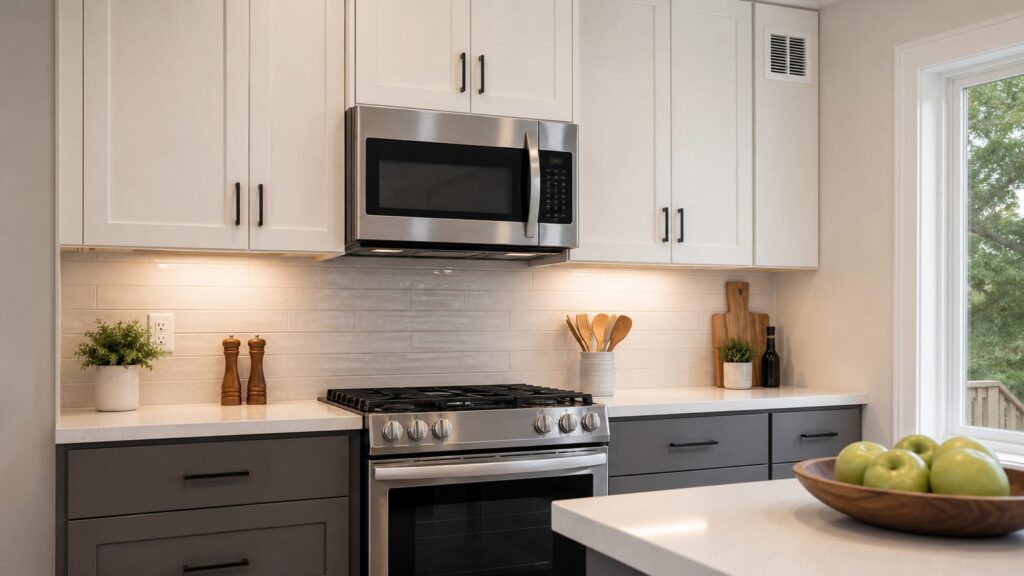
An externally vented over-the-range microwave can be a smart kitchen upgrade when space is tight and the existing layout supports a short duct run to the outside. The best models for most homes are 30 inches wide, deliver about 300 to 400 CFM of rated airflow, have a practical 1.7 to 2.1 cubic foot cavity, and can be ducted straight through the rear wall or up through a properly sized roof duct.
But it is not the same thing as a real range hood. On our kitchen remodels, we treat an over-the-range microwave as a space-saving ventilation compromise. It can work well for everyday cooking, boiling, reheating, light sauteing, and smaller kitchens. For frequent high-heat searing, wok cooking, long simmering, or a powerful gas range, a dedicated hood usually captures smoke and grease better because it projects farther over the front burners.
As an Amazon Associate I earn from qualifying purchases.
Free tools Windows power users keep installed
One-click scans. No signup required.
The biggest mistake homeowners make is buying by CFM alone. A microwave rated at 400 CFM can still perform poorly if the blower is left in recirculating mode, the duct is undersized, the route has too many elbows, or the unit barely covers the front burners. A good choice starts with the house, not the appliance box.
What an External Vent Microwave Actually Does
An externally vented microwave pulls air from above the cooktop and sends it outdoors through metal ductwork. That air can include steam, odors, grease-laden vapor, smoke, heat, and, with gas cooking, combustion byproducts. A recirculating microwave, by contrast, pulls air through grease and charcoal filters and sends it back into the kitchen.
#1 Best Overall

- Space-Saving Over-the-Range Design: Maximize kitchen space with this 30-inch microwave that mounts above your stove. This microwave hood vent combo combines cooking and ventilation in one appliance. Measures: 16.12" H x 29.87" W x 15.56" D
- Trusted GE Performance: From quick breakfasts to late-night snacks, this GE over-the-range microwave delivers the reliable performance, user-friendly controls, and everyday convenience that have made GE a trusted name in kitchens for generations
- Powerful 2-Speed Ventilation: Keep small spaces clear of cooking odors, steam and smoke with a 300-CFM ventilation system and 2-speed fan
- Charcoal Filter: Enjoy cooking and cleaner air, too. The replaceable charcoal filter removes fumes and odors that are released from foods during cooking
- Simple One-Touch Controls: One-touch express cooking settings and 4 convenience cook settings provide easy operation for busy lifestyles, while the digital display and electronic keypad provide precise control of cook time and power settings
That difference matters. Charcoal filters help with odor, but they do not remove heat, humidity, or combustion gases from the home. If you boil pasta under a recirculating unit, the moisture stays inside. If you sear meat under a recirculating unit, the kitchen may still smell like dinner the next morning. Exterior venting gives the air somewhere to go.
Most over-the-range microwaves are convertible. That means the same appliance can often be configured for recirculation, rear-wall venting, or top venting. The installer has to rotate or reposition the blower correctly. We have opened cabinets on service calls and found a microwave connected to ductwork while the blower was still aimed for recirculation. The duct was there, but the air was not going into it.
Best Microwave Types for External Venting
The best externally vented microwave is the one that fits the cooking load, cabinet layout, duct route, and electrical conditions. The following categories are the ones we most often consider during remodel planning.
Best overall choice: 30-inch, 300 to 400 CFM standard over-the-range microwave
For a typical American kitchen with a 30-inch range, this is the practical sweet spot. Most standard models are about 30 inches wide, roughly 15 to 18 inches tall, and 15 to 17 inches deep. Capacities commonly run from about 1.7 to 2.2 cubic feet, with cooking power around 1,000 watts.
A 300 to 400 CFM unit is enough for moderate cooking when the duct route is short and clean. Rear-wall venting is usually the best path when the range sits on an exterior wall because the duct can run almost straight out. That keeps static pressure low, reduces noise, and makes installation less expensive.
Best for tight cabinet layouts: low-profile over-the-range microwave
Low-profile models are usually around 10 to 11 inches tall instead of the 16 to 17 inches common on full-height units. They are useful when upper cabinets sit lower than ideal, when the cooktop clearance is tight, or when the homeowner wants more open sightlines over the range.
The tradeoff is interior height. A low-profile microwave may still fit plates, bowls, mugs, and many covered dishes, but it will not feel as roomy as a 2.0 cubic foot unit. We use these when the kitchen needs ventilation and microwave function but the cabinet geometry will not support a full-height appliance without crowding the cooking surface.
Best for higher-end remodels: convection or air-fry over-the-range microwave
Premium models may add convection baking, air-fry modes, sensor cooking, smart controls, better lighting, stainless interiors, or higher listed airflow. These units can be useful in compact kitchens where a second oven function has real value.
The cost jump can be significant. Mainstream over-the-range microwaves commonly list around $229 to $449, while premium convection, air-fry, smart, or higher-CFM models often run around $799 and up. Before spending the premium, confirm the venting layout. A costly microwave connected to a poor duct route is still a poor ventilation system.
Best for serious cooking: separate range hood plus microwave elsewhere
If ventilation is the priority, a dedicated range hood usually wins. The reason is capture area. Many over-the-range microwaves extend only about 16 inches from the wall, which leaves the front burners less covered than a purpose-built hood. A deeper hood with a proper capture zone does a better job collecting smoke and grease before it rolls into the room.
In kitchens with frequent cast-iron searing, wok cooking, griddle use, or a larger gas range, we often recommend putting the microwave in a drawer base, pantry cabinet, island, wall cabinet, or countertop station and using the space over the range for a hood.
What to Look For Before You Buy
Start with the measurements. Match the microwave width to the cooking appliance below it. A 30-inch microwave over a 30-inch range is standard. Avoid placing a narrow microwave over a wider cooktop because the steam and smoke from the outer burners will escape around the sides.
Capacity matters, but not as much as fit and venting. Most households do fine with 1.7 to 2.1 cubic feet. Compact low-profile units around 1.1 cubic feet can work if the microwave is mostly used for plates, mugs, and reheating. Cooking power around 1,000 watts is common and practical.
Look at lighting and filters. We prefer bright LED cooktop lighting, accessible grease filters, and controls that are easy to use while standing at the range. A hidden control panel can look clean, but it should still be practical with steam and cooking mess nearby.
The Tool Desk
Outbyte Driver Updater FREEFix the driver behind crashes, sound loss and screen glitchesFind Drivers →Outbyte PC Repair FREERepair Windows errors before they cause bigger problemsFix Now →For ventilation, ask four questions before comparing finishes and presets: Can this model vent out the rear or top in the direction we need? Is the listed airflow certified or clearly documented? What duct size does the manufacturer require? Will the unit cover enough of the cooktop to capture smoke from the front burners?
CFM, Static Pressure, and Real Installed Airflow
CFM stands for cubic feet per minute. It is the amount of air the fan can move under test conditions. Over-the-range microwaves commonly land around 300 to 400 CFM. Some slim or premium models advertise 400 to 550 CFM.
Higher CFM is not automatically better. Installed airflow is often lower than the rated number because real ductwork creates resistance. Every elbow, reducer, roof cap, wall cap, long run, crushed transition, or undersized duct reduces performance. A microwave rated at 400 CFM may move noticeably less air once installed.
When code or program compliance matters, rated airflow should be evaluated under realistic static pressure, commonly at least 0.10 inches water gauge. That is a technical way of saying the fan should be assessed against resistance, not in perfect open air. Where available, compare certified airflow and sound data instead of relying only on retailer copy.
Do these 3 things before closing this tab:
1Scan for outdated or missing drivers - takes under a minute2Repair Windows errors before they cause bigger problems3Fix the driver behind crashes, sound loss and screen glitchesRank #2

- Large Capacity: 13.9"D x 29.9"W x 16.4"H. Featuring a spacious interior, this 1.7 cubic feet microwave oven includes a 12.4-inch turntable and will serve as your top sous chef for any meal or cooking adventure.
- 10 Cooking Levels: With a 1000-watt output, this over-the-range microwave oven has 6 quick menus for your daily meals, including settings for Popcorn,Potato, Beverage, Melt/Soften, Reheat, and Defrost.
- Speedy Cooking: For quick action, press numbers 1, 2, or 3 for using the 100% power level at 1-3 minutes.
- Multi-stage Cooking: Save time by cooking with 90% microwave power for 10 minutes and then cooking with 50% power for 20 minutes in one time setting.
- 300 CFM Vent Fan with Light: With a 2-speed strong suction, the powerful vent on this stainless steel microwave helps to remove fumes and odors while an integrated light offers focused lighting while cooking.
Sound matters too. A high-CFM microwave on a restricted duct can be loud enough that homeowners avoid using it. A slightly lower airflow unit with a straight rear-wall exit may perform better in daily use than a louder unit fighting a long roof run.
Duct Routing Makes or Breaks the Project
The best duct route is short, straight, smooth, and direct to the outdoors. In many kitchens, that means a rear wall exit through an exterior wall. A roof exit can work, but it usually adds vertical duct length, attic coordination, flashing, weatherproofing, and more labor. It also creates more places for installation errors.
Do not vent a microwave into an attic, soffit, crawlspace, garage, wall cavity, or shared duct. Kitchen exhaust should terminate outdoors through an approved wall or roof cap with a working damper. Dumping moist, greasy air into hidden spaces can create stains, odors, mold risk, and building damage.
Use rigid metal duct where possible and follow the microwave manufacturer’s duct size and maximum equivalent length. Equivalent length adds penalties for elbows and fittings. For example, a short straight run may be fine, while the same physical distance with two elbows, a reducer, and a restrictive cap may perform poorly.
Quick wins for a faster PC:
Clear out junk files and repair common Windows errorsFree Scan →Fix the driver behind crashes, sound loss and screen glitchesFind Drivers →Repair Windows errors before they cause bigger problemsFix Now →During remodels, decide the vent path before cabinets are ordered. Duct placement can affect upper cabinet height, shelf layout, crown molding, backsplash tile, blocking, and the location of the outlet. When we frame or modify a kitchen wall, we want the duct route, cap location, damper direction, and blower orientation documented before the wall or cabinet is closed.
Cost to Install an Externally Vented Microwave in 2026
Appliance price is only part of the budget. In 2026, big-box pricing for over-the-range microwaves commonly ranges from about $229 to $449 for mainstream models, with premium convection, air-fry, smart, low-profile, or high-CFM models around $799 and higher. Category pricing can stretch from about $100 to $2,000 depending on brand, finish, features, and capacity.
Labor varies more than the appliance. A simple replacement where the old microwave already has exterior ducting, a solid upper cabinet, correct outlet, and aligned mounting plate may only take two to four hours. A new exterior vent route can turn it into a multi-trade project involving carpentry, electrical, roofing or siding, drywall, tile repair, and inspection.
| Project condition | Typical 2026 cost range | What is usually included |
|---|---|---|
| Straight replacement | $350-$800 | New microwave plus basic removal and installation using existing outlet, mounting support, and aligned duct |
| Replacement with moderate changes | $700-$1,500 | Appliance, labor, small cabinet adjustments, minor duct correction, outlet work, or trim repair |
| New exterior venting or complex remodel | $1,500-$2,800+ | New duct route, wall or roof penetration, cabinet rebuild, backsplash repair, electrical upgrades, permits, or makeup-air review |
| New ductwork add-on only | $150-$600 | Typical added ductwork cost for vented over-the-range microwave work, depending on route and access |
| Range hood ductwork benchmark | About $500 average | Useful comparison point for kitchen exhaust ducting, with higher costs for long runs or roof penetrations |
Several cost drivers are easy to miss: cabinet depth, cabinet bottom height, stud and blocking conditions, tile backsplash layout, whether the duct exits through brick, stucco, siding, or roof, the number of elbows, duct size changes, permit requirements, and whether the home has gas appliances that need combustion-safety review.
What’s actually slowing this PC down?
Pick the symptom - the matching free tool is one click away.
Code, Makeup Air, and Safety Notes
Kitchen exhaust work is not just an appliance swap when air is being moved out of the building. Local code rules can vary, but exterior kitchen exhaust generally needs to terminate outdoors and should not discharge into concealed building spaces. The duct, cap, damper, and clearances need to follow the appliance instructions and local requirements.
The 400 CFM range deserves a real conversation. Many jurisdictions use 400 CFM as a threshold where makeup air may need to be reviewed. Makeup air is replacement air brought into the home so the exhaust fan does not depressurize the house. In a tight home, or a home with atmospherically vented gas appliances, strong exhaust can affect draft and combustion safety.
That does not mean every 400 CFM microwave automatically becomes a major project. It means the installer or remodeler should check local code, the home’s mechanical systems, and the actual ventilation plan. In some houses, a 300 CFM unit with a good rear-wall exit is a better fit than chasing the largest number on the appliance label.
Electrical also matters. Most over-the-range microwaves need a properly placed grounded outlet in the upper cabinet, often on a dedicated or appropriately rated kitchen circuit depending on local code and manufacturer instructions. Extension cords are not an acceptable permanent solution.
Clearance is another safety point. Follow both the microwave manufacturer’s installation guide and the range manufacturer’s clearance requirements. Many layouts target the microwave bottom roughly 13 to 18 inches above the cooking surface, but the correct answer depends on the appliance pair. Too low can create heat issues and poor working clearance. Too high can reduce usability and capture performance.
When to DIY and When to Hire a Pro
A capable homeowner can sometimes replace an over-the-range microwave if the existing unit is already vented correctly, the new model is the same width, the outlet is already in the right upper cabinet, the mounting wall is sound, and the duct lines up. Even then, it is a two-person job. A 30-inch over-the-range microwave often weighs 50 to 75 pounds, and it has to be lifted, tilted, locked onto the rear bracket, and bolted through the upper cabinet.
DIY makes the most sense for a like-for-like replacement: same width, same vent direction, no cabinet cutting, no new wiring, no tile repair, no new wall or roof cap. Plan on two to four hours if everything goes smoothly and you have the right drill bits, stud finder, level, template, fasteners, and a helper.
Hire a pro when you need new exterior ducting, a roof penetration, siding or masonry work, electrical changes, cabinet modification, backsplash cutting, gas-appliance coordination, permit handling, or makeup-air review. Also hire out the job if the existing cabinet feels weak. The upper cabinet and rear wall carry the appliance, and poor support can become a real hazard.
Recommended Free Tools
On our job sites, we also bring in the right trade when the duct path crosses structural framing, fire blocking, plumbing, or electrical runs. What looks like a simple hole from inside the kitchen can become a problem if it lands behind a stud pack, vent pipe, exterior light, gutter, or roof valley.
Independent reader supportYour contribution helps us test, update, and keep practical guides available for everyone.Common Installation Mistakes We Look For
The first mistake is leaving the blower in the wrong orientation. Convertible microwaves must be configured for the selected vent path. If the blower is set for recirculation, connecting ductwork will not fix it.
Rank #3

- Large Capacity: 13.9"D x 29.9"W x 16.4"H. Featuring a spacious interior, this 1.7 cubic feet microwave oven includes a 12.4-inch turntable and will serve as your top sous chef for any meal or cooking adventure.
- 10 Cooking Levels: With a 1000-watt output, this over-the-range microwave oven has 6 quick menus for your daily meals, including settings for Popcorn, Beverage, Melt/Soften, Reheat, and Defrost.
- Speedy Cooking: For quick action, press numbers 1, 2, or 3 for using the 100% power level at 1-3 minutes.
- Multi-stage Cooking: Save time by cooking with 90% microwave power for 10 minutes and then cooking with 50% power for 5 minutes in one time setting.
- 300 CFM Vent Fan with Light: With a 2-speed strong suction, the powerful vent on this stainless steel microwave helps to remove fumes and odors while an integrated light offers focused lighting while cooking.
The second mistake is using a poor duct route. Too many elbows, undersized duct, flexible duct, crushed transitions, or restrictive caps can turn a good fan into a noisy, weak system. The shortest route is usually the best route.
The third mistake is ignoring the front burners. If the microwave barely projects over the range, smoke from front-burner cooking can roll past the intake. That is one reason serious cooks often prefer a deeper range hood.
Crashes, No Sound, or Screen Glitches?
Random freezes, missing sound and display glitches usually trace back to one bad driver. Find and replace yours safely.Free scan · under a minuteWindows Errors? Fix Them Before They Spread
Repair common Windows errors and clear accumulated junk for a smoother, more stable PC - no reinstall needed.Free scan · no reinstallThe fourth mistake is treating 400 CFM as a magic number. Higher airflow can help, but only when the duct can handle it and the home can replace the exhausted air safely.
The fifth mistake is ordering cabinets before the vent plan is settled. A duct conflict can force awkward shelves, short cabinets, off-center crown, patched tile, or a visible compromise that could have been avoided with one planning session.
Our Practical Buying Checklist
Before you buy, confirm the range width, cabinet opening, cabinet depth, distance above the cooktop, outlet location, and available duct route. Then choose the microwave.
For most standard kitchens, look for a 30-inch externally ventable model with about 1.7 to 2.1 cubic feet of capacity, roughly 1,000 watts of cooking power, LED cooktop lighting, washable grease filters, and 300 to 400 CFM of rated exhaust. Prefer models with clear documentation for rear and top venting, specified duct dimensions, and certified airflow and sound data where available.
If your range is on an exterior wall, prioritize rear-wall venting. If the duct must go through the roof, budget for more labor and inspection of the roof cap, flashing, attic path, and insulation details. If you cook heavily or have a larger gas range, price a dedicated hood before committing to an over-the-range microwave.
A good externally vented microwave should solve three problems at once: free up counter space, put the microwave at a usable height, and remove everyday cooking air outdoors. If it only solves the first two, the kitchen may still need a better ventilation plan.
Bottom Line
The best microwave with an external vent is not the fanciest model on the shelf. It is the model that matches your range width, fits your cabinets, vents through a short properly sized duct, provides enough capture for how you cook, and stays within the mechanical limits of the house.
Expect about $350 to $800 for a straightforward appliance-and-replacement project, $700 to $1,500 when moderate duct, cabinet, or electrical work is involved, and $1,500 to $2,800 or more when adding new exterior ducting, roof work, cabinet rebuilding, tile repair, upgraded electrical, or makeup-air provisions.
The Tool Desk
Outbyte Driver Updater FREEFix the driver behind crashes, sound loss and screen glitchesFind Drivers →Outbyte PC Repair FREERepair Windows errors before they cause bigger problemsFix Now →For everyday cooking in a compact kitchen, an externally vented over-the-range microwave can be a very efficient choice. For heavy cooking, wide ranges, or gas appliances used hard, evaluate a dedicated range hood before the cabinet order is final. That decision is much cheaper on paper than it is after the kitchen is already built.
Frequently Asked Questions
Do over-the-range microwaves actually vent outside?
Many do, but not all are installed that way. Most over-the-range microwaves are convertible and can be set up for recirculating, rear-wall venting, or top venting. For true exterior venting, the blower must be oriented correctly and connected to ductwork that terminates outdoors.
Is an externally vented microwave better than a recirculating microwave?
Yes for ventilation performance. External venting removes smoke, steam, odors, heat, grease-laden air, and gas-cooking byproducts outdoors. Recirculating models filter air and return it to the kitchen, which is easier to install but less effective.
How much does it cost to install an over-the-range microwave with exterior venting in 2026?
A straightforward replacement typically runs about $350 to $800 including the appliance. If moderate duct, electrical, or cabinet work is needed, expect about $700 to $1,500. More complex projects with new exterior ducting, roof work, cabinet rebuilding, tile repair, or makeup air can reach $1,500 to $2,800 or more.
Do these 3 things before closing this tab:
1Scan for outdated or missing drivers - takes under a minute2Repair Windows errors before they cause bigger problems3Fix the driver behind crashes, sound loss and screen glitchesWhat CFM should an over-the-range microwave have?
Most homes should look in the 300 to 400 CFM range for a standard over-the-range microwave, assuming the duct route is short and properly sized. Higher CFM can help, but real performance depends on capture area, duct length, elbows, cap design, and static pressure.
Does a 400 CFM microwave require makeup air?
It may. Many code frameworks and local jurisdictions use 400 CFM as a threshold for makeup-air review. The answer depends on local code, home tightness, duct design, and whether the house has atmospherically vented gas appliances.
Is a range hood better than an over-the-range microwave for gas cooking?
Often, yes. A dedicated range hood usually has better capture area, especially over the front burners, and is a stronger choice for frequent high-heat cooking or larger gas ranges. An externally vented microwave is usually best for moderate cooking and space-constrained kitchens.
Quick Recap
Product prices and availability are accurate as of the date/time indicated and are subject to change. Any price and availability information displayed on Amazon at the time of purchase will apply.
Quick wins for a faster PC:
Repair Windows errors before they cause bigger problemsFix Now →Scan for outdated or missing drivers - takes under a minuteDriver Scan →Clear out junk files and repair common Windows errorsFree Scan →
