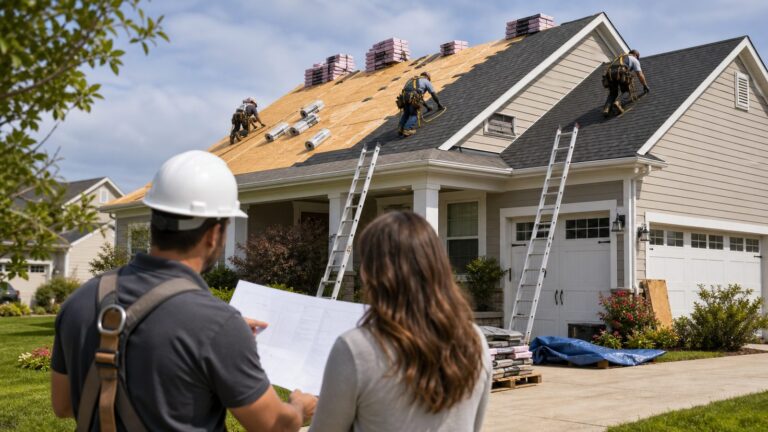
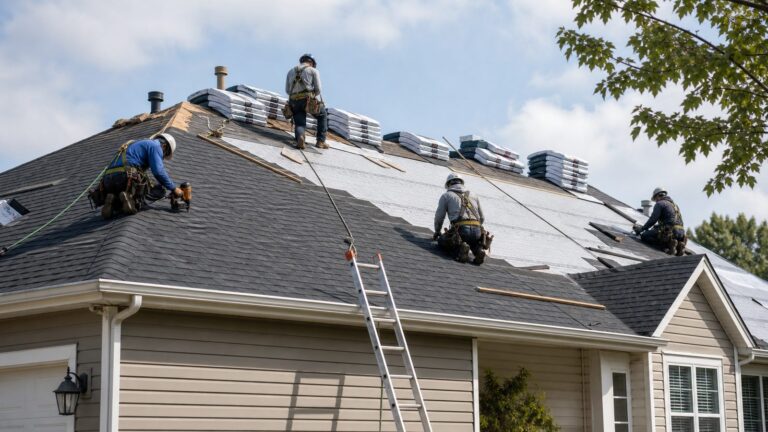
For an asphalt-shingle replacement, a current HomeAdvisor estimator reports a broad range of $6,135 to $13,985, with an average near $10,060. Use that only as a preliminary planning benchmark: it is not a national bid standard, and a local inspection may produce a very different number.
The reliable way to understand roofing prices is to compare the complete project scope—measured roof area, materials, labor, tear-off, disposal, decking, flashing, ventilation, permits, cleanup, and warranties. Here is how to budget without mistaking a low headline price for a complete roof replacement.
As an Amazon Associate I earn from qualifying purchases.
What roofing prices usually look like
For a typical asphalt-shingle replacement, a current HomeAdvisor estimator reports a broad range of $6,135 to $13,985, with an average near $10,060. That is useful as an initial planning benchmark, not as a national price list or a substitute for a local roof inspection and written proposal.
Quick wins for a faster PC:
Scan for outdated or missing drivers - takes under a minuteDriver Scan →Repair Windows errors before they cause bigger problemsFix Now →Many homeowners should think in terms of a broad five-figure planning range, but the final price can be much lower or higher depending on the measured roof area, roof pitch and geometry, material grade, number of existing layers, local labor rates, access, season, permits, and the amount of concealed damage discovered after tear-off. Two houses with similar interior floor areas can have very different roofing prices because roofers price the roof itself—not simply the living space beneath it.
#1 Best Overall

- High-quality material for durability
- 𝗪𝗢𝗩𝗘𝗡 𝗣𝗥𝗢𝗧𝗘𝗖𝗧𝗜𝗢𝗡: LWE is Lighter, stronger, and more energy efficient than felt, our professional-grade polypropylene roofing underlayment is designed to resist tearing, cracking, and moisture for dependable roof deck coverage and protection.
- 𝗛𝗜𝗚𝗛 𝗨𝗩 𝗦𝗧𝗔𝗕𝗜𝗟𝗧𝗬: Built for temporary outdoor exposure during roofing projects, UV treated to 180 days, allowing flexibility in installation scheduling. Suitable for both commercial and residential rooftops.
- 𝗡𝗢𝗡-𝗦𝗞𝗜𝗗 𝗦𝗨𝗥𝗙𝗔𝗖𝗘: Our woven top surface provides sure-footed traction, while the slip-resistant base layer helps support easier installation.
- 𝗘𝗔𝗦𝗬 𝗜𝗡𝗦𝗧𝗔𝗟𝗟𝗔𝗧𝗜𝗢𝗡: Placement guides help simplify alignment and fastening. Evenly rewound, rolls out flat, and holds a chalk line.
What a roofing price includes
A complete replacement price covers far more than the visible shingles or other roof covering. A properly defined scope may include:
- Roof covering: shingles, metal panels, tile, slate, wood products, membrane, or a solar-roofing system.
- Installation labor: removal, preparation, cutting, fastening, flashing, detailing, and cleanup. The HomeAdvisor benchmark indicates that labor and installation may account for roughly 60% of a shingle-replacement project, although the proportion varies by job.
- Tear-off and disposal: removing existing roofing layers, loading debris, hauling it away, and paying disposal fees.
- Roof-system accessories: underlayment, ice-and-water barrier where required or specified, starter strips, ridge caps, flashing, vents, fasteners, and sealants.
- Decking or sheathing: replacement of rotten, delaminated, or otherwise unsuitable boards or panels exposed during removal.
- Ventilation: repair, replacement, or addition of intake and exhaust ventilation when the design calls for it.
- Penetrations and transitions: work around chimneys, skylights, plumbing vents, walls, dormers, valleys, and other areas where leaks commonly develop.
- Project administration: permits, inspections, taxes, property protection, landscaping protection, final cleanup, and warranty documentation.
Owens Corning installation materials treat shingles, synthetic underlayment, ice-and-water barriers, starter strips, ridge products, and other items as separate parts of a roofing system. That distinction matters when comparing bids. A shingle-only number is not comparable with a complete installed-system price.
One useful line item to ask about is roofing underlayment. It sits beneath the roof covering and should be selected according to the proposed roofing system, local code, roof design, climate, and manufacturer instructions. Treat it as an item to understand and have your contractor specify—not as an invitation to purchase or install a product yourself.
Recommended Free Tools
The most important roofing cost drivers
1. Measured roof area
Roofers normally measure a roof in squares, with one roofing square equal to 100 square feet of roof surface. The measurement includes slopes, overhangs, attached structures, valleys, and other areas that may not be apparent from the home’s interior square footage.
A larger roof requires more covering, underlayment, fasteners, labor, tear-off, disposal, staging, and cleanup. Ask for the measured roof area and any stated waste factor in every proposal. Without those figures, it is difficult to tell whether one contractor is offering a lower price or simply estimating less material.
2. Roof shape and complexity
A simple gable roof is generally easier to measure and install than a roof with multiple planes, hips, valleys, dormers, skylights, chimneys, wall transitions, or numerous plumbing penetrations. Complex geometry creates more cutting, flashing, waste, layout work, and opportunities for detailing errors.
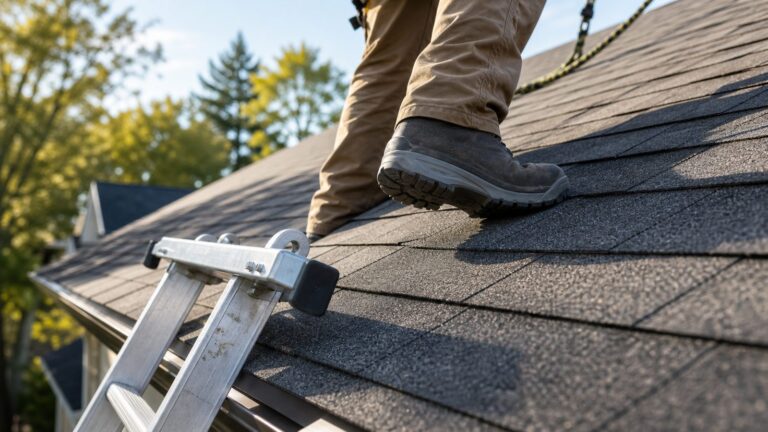
Roof height and steepness also affect labor. A steep or difficult-to-access roof may require additional fall protection, staging, setup time, and specialized installation procedures. A low bid that ignores access and safety requirements is not necessarily a bargain; it may be an incomplete scope.
Free tools Windows power users keep installed
One-click scans. No signup required.
3. Roofing material and product grade
Asphalt shingles are often the baseline residential comparison, but asphalt is a category rather than one uniform product. Three-tab, architectural, impact-rated, algae-resistant, designer, and other classes can differ in appearance, performance claims, installation requirements, available warranties, and price.
Metal, tile, slate, wood, membrane, and solar roofing systems have different material, handling, structural, flashing, and labor requirements. Do not rely on a generic claim that one material always costs more or less than another. A meaningful comparison must identify the system type, product specification, roof design, region, and whether the figure is material-only or fully installed.
4. Tear-off, layers, and disposal
Removing an existing roof adds labor, hauling, disposal, and often additional protection or staging. The cited consumer estimator places tear-off at approximately $1 to $5 per square foot, but that is only a broad reference. The actual charge can depend on the number of layers, local disposal fees, roof access, the type of existing material, and whether unusual or hazardous material is present.
Ask how many existing layers the contractor has assumed and whether the price includes complete removal down to the deck. If a contractor prices an overlay instead, ask how the proposed work complies with local code and the roofing manufacturer’s installation instructions. Do not compare a full tear-off bid with an overlay bid as if they were the same project.
Rank #2
- WHAT'S IN THE BOX: One 4 ft x 250 ft roll covering 10 squares, 1,000 sq ft, plus 50 galvanized plastic cap nails to start your run; additional fasteners sold separately
- 4-Layer Synthetic Protection: Durable professional-grade construction is designed to resist tearing, cracking, and moisture for dependable roof deck coverage.
- High UV Stability: Built for temporary outdoor exposure during roofing projects, with UV resistance for up to 6 months when needed.
- SAFER WALKABILITY: Non-woven top surface provides sure-footed traction, while the slip-resistant base layer helps support easier installation
- EASY INSTALLATION SUPPORT: Printed nail placement guides help simplify alignment and fastening, and included galvanized plastic cap nails support secure installation
5. Decking and concealed damage
Tear-off can reveal rotten, delaminated, or otherwise damaged roof decking that could not be priced accurately from the ground. This is a legitimate reason for a documented change order, but the contract should explain how the work will be priced.
Look for a defined per-sheet or per-square-foot rate, or a clearly described allowance for concealed damage. A vague clause allowing the contractor to charge whatever is necessary leaves you with little ability to evaluate an increase. Ask whether you will receive photographs, written authorization, or both before additional decking work proceeds.
6. Flashing, penetrations, and ventilation
The roof covering is only one part of the weather-resistant assembly. Flashing around chimneys, skylights, walls, valleys, and plumbing penetrations may need repair or replacement. Pipe boots and other penetration details can also be included, excluded, or priced as allowances.
Ventilation deserves the same attention. A quote should state whether existing intake and exhaust vents will remain, be repaired, be replaced, or be supplemented. Adding a ridge vent without adequate intake ventilation—or changing the system without explaining the design—does not automatically improve a roof. Ask the contractor to identify the proposed ventilation approach and the products included.
7. Location, labor market, and season
Roofing prices vary by location because labor rates, building requirements, disposal charges, transportation, climate, and contractor availability vary. NRCA identifies material, contractor, home size, location, local labor rates, and time of year as important price variables.
Seasonal demand can affect scheduling and price. A 2026 industry report also identifies labor costs, material costs, inflation, and shortages of qualified workers as significant industry concerns. That report provides industry context, not a homeowner quote database. A local proposal remains the relevant evidence for your property.
Comparing common roofing materials
The right question is not simply which material has the lowest purchase price. Compare the complete installed system, the expected maintenance, structural requirements, detailing, warranty conditions, and how well the material suits the property and climate.
| Material or system | What changes the price | What to verify in the quote |
|---|---|---|
| Asphalt shingles | Shingle class, profile, impact or algae-resistance features, roof complexity, tear-off, accessories, and warranty tier. | Exact product line, color, underlayment, starter strips, ridge caps, flashing, ventilation, disposal, and installation requirements. |
| Metal roofing | Panel or shingle system, coating, substrate or gauge, geometry, custom detailing, flashing, and installation labor. | System type, finish, fastening method, details at valleys and penetrations, substrate preparation, and warranty terms. |
| Tile, slate, or wood | Weight, handling, cutting, specialty labor, structural capacity, battens or support systems, underlayment, and detailing. | Whether the structure can support the system and whether underlayment, flashings, battens, disposal, and specialty labor are included. |
| Cool roofing | Reflective product options, roof type, insulation, climate, and installation requirements. | Solar reflectance and thermal emittance information, the complete installed cost, and whether projected energy savings are realistic for the property. |
| Solar shingles or tiles | Roofing work plus electricity-generating equipment, electrical work, design, permitting, storage or interconnection requirements, and specialized installation. | Separate the roofing and electrical scopes, identify incentives based on the installation date, and obtain current tax guidance before relying on a credit. |
Cool roofs and energy savings
The U.S. Department of Energy explains that cool roofs can remain substantially cooler than traditional dark roofs in summer. Solar reflectance—the amount of sunlight reflected—and thermal emittance—the ability to release absorbed heat—are relevant properties.
Do these 3 things before closing this tab:
1Scan for outdated or missing drivers - takes under a minute2Repair Windows errors before they cause bigger problems3Fix the driver behind crashes, sound loss and screen glitchesThat does not mean a cool roof automatically pays for itself. Climate, insulation, roof construction, HVAC efficiency, roof color, and building use all affect the result. Cool roofs may offer more benefit in hot climates, while the advantage can be less clear in colder climates. Ask for a property-specific explanation rather than accepting a general energy-savings promise.
Solar roofing and tax-credit caution
Solar shingles or solar tiles combine a roof covering with electricity generation. Compare them with two separate alternatives: a conventional roof by itself, and a conventional roof plus a separate solar installation. This makes it easier to see what portion of the proposal pays for weather protection and what portion pays for power generation.
Rank #3

- 95 GSM PREMIUM DENSITY – Engineered with 95 gsm woven polypropylene, this underlayment is heavier and more durable than standard grades. Provides superior tear resistance and secondary water protection (rain, snow, wind-driven). Outperforms #15/#30 asphalt felt, while staying lightweight for reduced labor fatigue.
- 1000 SQ. FT. COVERAGE (10 SQUARES) – Each roll measures 48 inches wide by 250 feet long, covering a full 10 squares (1000 sq. ft.). The large roll size reduces costly labor, minimizes waste, and requires fewer roll changes – saving you time and money on every job.
- UV TREATED FOR 180 DAYS – UV-stabilized polypropylene construction resists degradation from sun exposure for up to 180 days. Provides reliable temporary cover and long-lasting secondary water-shedding protection during construction delays or before final roofing materials are applied.
- SLIP-RESISTANT SURFACE FOR SAFE WALKABILITY – Coated with a non-skid TPO (thermoplastic olefin) textured surface that provides excellent traction for roofers. Minimizes slip hazards and enhances safety during installation – even on steep slopes.
- Code Approved for Peace of Mind: This underlayment is rigorously tested and certified to meet ICC-ES ESR-5197 and AC188 criteria, complying with ASTM D8257 and CAN/CSA A123.3. It holds specific approvals for high-wind regions, including Florida FL-17194 and Texas T.D.I. approvals. Rest assured, this product meets or exceeds all major U.S. and Canadian building code requirements for mechanically attached synthetic underlayment.
Do not assume that ordinary roofing qualifies for a federal energy credit. Current IRS guidance cited for this article states that traditional shingles and roof structures generally do not qualify for the Residential Clean Energy Credit, while some solar roofing tiles and solar shingles may qualify because they generate electricity. That guidance also states that the credit is unavailable for property placed in service after December 31, 2025. Tax rules can change, so confirm the current IRS guidance and applicable instructions for the actual installation date before including any credit in your budget.
How to compare three or four roofing bids
NRCA recommends obtaining three or four proposals and warns that price should not be the only selection criterion. The goal is not to find the lowest number; it is to determine which proposals describe the same work and which contractor appears prepared to perform it properly.
What’s actually slowing this PC down?
Pick the symptom - the matching free tool is one click away.
Put the bids into a simple comparison sheet with these columns:
- Measured roof area and stated waste factor.
- Roofing material, brand or product line where relevant, profile, color, and warranty tier.
- Number of existing layers to be removed and the tear-off method.
- Disposal and cleanup arrangements.
- Underlayment, ice-and-water barrier, starter strips, ridge caps, flashing, vents, fasteners, and other accessories.
- Decking replacement price, allowance, or exclusion.
- Chimney, skylight, wall-flashing, valley, and plumbing-penetration work.
- Ventilation work, including whether intake and exhaust components change.
- Permit fees, inspections, taxes, property protection, and landscaping protection.
- Start date, expected completion, payment schedule, and change-order process.
- Product warranty, workmanship warranty, exclusions, and transfer terms.
When a bid is substantially lower than the others, first look for missing scope. It may exclude tear-off, disposal, flashing, ventilation, permits, decking, or cleanup. It may also specify a lower-grade product or assume fewer roof squares. A higher bid is not automatically better, but a lower bid is not meaningful until the scopes are normalized.
Questions to ask before signing
- What is the measured roof area, and how many existing layers are included in the tear-off?
- What exact roof covering and accessories are being installed?
- How will concealed decking damage be documented and priced?
- Which flashings and pipe boots will be replaced, repaired, or reused?
- What ventilation work is included?
- Who obtains the permit, who pays the fee, and which inspections are required?
- Who will supervise the crew, and who is responsible for quality control?
- What happens if weather delays the work?
- How are changes approved before extra work is performed?
- What are the payment milestones, and what amount is due before work begins?
- Which product and workmanship warranties apply, and can I read the actual documents?
Contractor checks that protect the budget
Before accepting a bid, verify that the contractor has a permanent business presence and provides the business information required in your area. Check required licensing, liability insurance, and workers’ compensation coverage. Ask for references and contact them. Confirm who will supervise the project and how the company handles quality control.
FTC consumer guidance recommends multiple written estimates, verification of licensing and insurance, resisting pressure to sign immediately, avoiding full payment upfront, and looking beyond the lowest bidder. These precautions matter after hail, wind, wildfire, hurricanes, or other disasters, when unsolicited storm-repair offers can arrive quickly.
Outdated Drivers Are Slowing You Down
One free scan finds every outdated or missing driver and matches the right update for your exact hardware.Free scan · exact hardware matchPC Slower Than It Used to Be?
A free scan shows the junk files, broken settings and background clutter dragging Windows down - then fixes them in one click.Free scan · Windows 10 & 11Be especially cautious about a contractor who:
- Arrives uninvited and insists that you sign that day.
- Uses an expiring discount or emergency to prevent comparison shopping.
- Refuses to provide a detailed written scope.
- Will not show insurance or required licensing information.
- Requests the entire price before meaningful work or inspection milestones.
- Cannot explain allowances, change orders, or the workmanship warranty.
- Promises that insurance or a tax credit will pay for the project without confirming the claim.
After storm damage, contact your insurer directly about coverage rather than relying on a contractor’s promise. Insurance decisions depend on the policy, cause of loss, age and condition of the roof, local rules, and the insurer’s evaluation. Never treat an insurance assumption as part of your roofing budget until it is confirmed.
Independent reader supportYour contribution helps us test, update, and keep practical guides available for everyone.Permits, inspections, and local code
The 2024 International Residential Code contains dedicated roof-assembly provisions and a section addressing reroofing. It is a model code, however, not a single nationwide permit rule. A city or county may use a different edition, add local amendments, set its own permit thresholds, or require particular inspections.
Before signing a proposal, contact the local building department or ask the contractor for the applicable requirements in writing. Confirm:
- Who obtains the permit.
- Whether the permit fee is included in the quoted price.
- Which inspections are required and who schedules them.
- Whether the proposed assembly complies with local code and manufacturer instructions.
- How permit and inspection records will be delivered to you at completion.
Do not assume that a contractor’s statement that no permit is needed settles the question. The responsible authority is the local building department, and the answer can depend on the scope of work and jurisdiction.
Rank #4

- Synthetic Roofing Underlayment: 48" x 250' (covers 1,000 sq ft) roll qualified with ASTM, waterproof vapor barrier materials alternative for roofing felt, tear/ UV/ wind resistance insulation paper for metal, shingle, tile roof, roof slopes of 2:12 (17%) or steeper.
- Vapor Barrier Underlayment: APX waterproof insulation is vapor permeable (0.12 perms per ASTM E96), accelerates moisture escape, keeps the roof structure dry, professional synthetic PP barrier for metal, shingle, tile roof in humid or coastal climates.
- Jobstie Convenience: APX non-woven membrane (ASTM D8257) is UV, wind, fire and 90 days exposure resistance , designed with cover area guide line and standard 1-inch nails fixing sign for easy and proper construction. Non slip, lightweight and easy to cut roof paper provides convenience and safety.
- Roofing Membrane: -RL85 underlayments meet ICC-ES AC188 standards, 4 layers consisting of non-woven polypropylene, scrim coated, better tensile strength and more energy efficient make it a perfect replacement for traditional #30 roofing felt, reinforced moisture resistance performance.
- NO Season Limit: HVHZ standard (FL47795), APX roofing underlayment can form an ice barrier in extreme weather conditions and withstand 90 days of UV exposure, meets ASTM E108 Class A fire resistance for construction anywhere any season. Contact us for 24/7 technical support.
How roofing warranties affect the real value of a bid
A warranty labeled lifetime does not mean the roof will last forever, and it does not necessarily cover every leak or installation problem. Owens Corning distinguishes product-defect coverage from workmanship coverage and describes enhanced warranty tiers that may require specified components and installation by authorized or certified contractors.
Ask for the actual warranty documents and check:
- Which product defects are covered.
- Whether labor is included and for how long.
- Whether coverage becomes prorated after an initial period.
- Whether tear-off, disposal, leak investigation, and consequential damage are covered or excluded.
- Whether particular underlayments, ridge products, ventilation components, or other accessories are required.
- Whether certified or authorized installation is necessary.
- Whether the warranty transfers to a future owner and the deadline or paperwork required.
Have the contractor identify both the manufacturer’s product warranty and the contractor’s separate workmanship warranty in the proposal. A product warranty may address a manufacturing defect while excluding an installation error; those are different risks.
A practical roofing-price checklist
Before requesting bids
- Determine whether you are pricing a repair, partial replacement, or complete replacement.
- Collect any prior roof records, warranty documents, permits, and insurance information.
- Ask the building department about current permit and inspection requirements.
- Decide which material categories you want contractors to price, without assuming they are interchangeable.
When contractors inspect the roof
- Ask how the roof area was measured.
- Ask how many layers and what condition the contractor expects to find.
- Ask about pitch, access, ventilation, flashing, penetrations, and structural concerns.
- Request photographs or other documentation of conditions that cannot be seen from the ground.
When reviewing proposals
- Make sure every proposal describes the complete system, not only the visible roof covering.
- Compare tear-off, disposal, decking rates, flashing, ventilation, permits, cleanup, and warranties line by line.
- Reject vague allowances where a defined unit price or decision process is possible.
- Verify insurance, licensing where required, references, business information, and the project supervisor.
- Never let a storm-related deadline replace normal due diligence.
Before the first payment
- Sign a written contract with the scope, schedule, payment milestones, change-order process, and warranty terms.
- Confirm who obtains permits and how inspections will be documented.
- Agree on how landscaping, siding, windows, gutters, and other exterior surfaces will be protected.
- Keep copies of the contract, product information, permits, inspection records, invoices, photographs, and warranty documents.
Once you have a clear scope, the practical next step is to get written roofing estimates from several properly qualified local contractors. A quote service or lead marketplace can help start that process, but every lead should still be screened using the same insurance, licensing, scope, payment, and warranty checks.
Frequently Asked Questions
What is the average price to replace a roof?
A current HomeAdvisor estimator places a typical asphalt-shingle replacement between $6,135 and $13,985, with an average near $10,060. This is only a broad planning benchmark. The actual price depends on measured roof area, pitch, geometry, material, tear-off, disposal, local labor rates, access, permits, and concealed damage.
Can I compare roofing contractors by price per square foot?
No. A per-square-foot figure is useful only when the roof area, material, installation scope, tear-off assumptions, accessories, disposal, and local conditions are the same. A shingle-only price should not be compared with a complete installed roofing-system price.
Do I need a permit to replace my roof?
Ask the local building department. Permit rules vary by city and county because the 2024 International Residential Code is a model code that jurisdictions may adopt, amend, or replace. Confirm who obtains the permit, whether fees are included, and what inspections are required.
Does a lifetime roofing warranty cover the whole roof?
Not necessarily. A lifetime label usually describes a manufacturer’s product warranty under stated conditions, not an unlimited service-life promise. Ask separately about product defects, workmanship, labor, prorating, tear-off, required components, certified installation, and transfer to a future owner.
What should I do if the roofing price rises after tear-off?
Do not accept the increase without documentation. The contract should explain how concealed decking damage is priced, preferably with a per-sheet or per-square-foot rate or a defined allowance. Ask for photographs and written approval before authorizing additional work.
The Tool Desk
Outbyte PC Repair FREEClear out junk files and repair common Windows errorsFree Scan →Outbyte Driver Updater FREEScan for outdated or missing drivers - takes under a minuteDriver Scan →The Bottom Line
Roofing prices are project prices, not reliable single-number commodities. Use the broad asphalt-shingle benchmark only to set an initial expectation, then compare three or four written proposals based on the measured roof area and the complete roofing system. The bid that clearly accounts for tear-off, disposal, decking, flashing, ventilation, permits, cleanup, labor, and warranty obligations is more useful than the bid with the lowest headline number.
Quick Recap
Product prices and availability are accurate as of the date/time indicated and are subject to change. Any price and availability information displayed on Amazon at the time of purchase will apply.