Do these 3 things before closing this tab:
1Fix the driver behind crashes, sound loss and screen glitches2Clear out junk files and repair common Windows errors3Scan for outdated or missing drivers - takes under a minuteThere is no universal winner. Use EPS, XPS or polyiso only after matching the exact board and the complete wall or roof assembly to your required R-value, service temperature, moisture exposure, drainage strategy, vapor-control plan, compressive load, facer, fire requirements and fastening details. A generic “R per inch” ranking is a useful starting point, not a design decision.
For a final choice, obtain the manufacturer’s data sheet for the specific thickness, density, facer and intended application. The same foam category can perform differently when those variables change.
As an Amazon Associate I earn from qualifying purchases.
Quick comparison
| Material | Typical thermal reference | Typical vapor classification | Moisture and strength tendencies | Often considered when |
|---|---|---|---|---|
| EPS (expanded polystyrene) | R-3.8 to R-4.4 per inch in the Pacific Northwest National Laboratory (PNNL) 2021 typical-material table; PIMA reports roughly R-4.2 to R-4.4 for EPS commonly used in 20–25 psi boards. | Class III in PNNL’s typical classifications. | Closed-cell beads with gaps that can permit moisture passage. Higher density generally raises thermal resistance and compressive strength. | The assembly benefits from comparatively greater drying potential, and the product’s density, water-management details and strength meet the design. |
| XPS (extruded polystyrene) | About R-5 per inch in PNNL’s 2021 table and PIMA’s 1-inch, 75°F comparison. | Class II in PNNL’s typical classifications. | More regular cell structure generally gives better strength and water resistance than EPS. Vapor resistance increases as thickness increases. | Water resistance, compressive capacity or a taped drainage-plane application is important, provided the assembly can still dry in the intended direction. |
| Polyiso (polyisocyanurate) | Approximately R-6 per inch in PNNL’s typical table. PIMA lists roof polyiso at R-5.7 LTTR per inch and wall products at R-6.0–R-6.5 per inch, using its stated 75°F comparison basis. | Usually Class I when faced; the facer controls the result. | High published R-value per inch, but effective value varies with mean temperature, aging basis, thickness and facer. Unfaced products require separate water-management protection. | Limited thickness, a specified roof or wall system, or a high nominal R-value is useful and the design accounts for cold-weather performance and facer compatibility. |
These are category references, not guarantees for every product. PNNL’s table is dated December 23, 2021; PIMA Technical Bulletin #203 is marked April 2022 and advises using the exact product data sheet. Test methods, mean temperature and jurisdictional rules can change the reported number.
Why the labeled R-value is not the whole answer
R-value is resistance to heat flow, but the reported value depends on thickness, density, test method, mean test temperature, aging treatment and, for polyiso, the facer and board thickness. The Federal Trade Commission’s R-value Rule, quoted in Building Science Corporation’s Info-502, says: “manufacturers and others who sell home insulation determine and disclose each product’s R-value and related information (e.g., thickness, coverage area per package) on package labels and manufacturers’ fact sheets.” Read that label as a documented test result for a defined product, not as a promise for every installed assembly.
#1 Best Overall

- Dual-Layer Insulation Design: Double-layer foam panels help reduce gaps around window vent openings and support airflow through the vent kit.
- Helps Limit Heat, Light and Noise: The 2-layer foam can help reduce heat transfer, reduce light entry, and lower outside noise.
- Adjustable Length up to 50 in: Includes 3 foam panels that can be combined up to 50 in, suitable for many sliding window vent panels
- Easy to Cut and Install: Trim the foam panels to match your window sealing plates; install using the included double-sided tape.
- Wide Compatibility: Works with many portable AC window vent kits, dryer vent kits, and other window ventilation systems for sealing around vent openings.
The standard labeling condition is a 75°F mean temperature. Real walls and roofs experience temperature gradients, fasteners, joints, compression, air leakage and moisture. Continuous insulation works only when boards are fitted tightly, seams are treated as specified and thermal bridges are addressed. DOE wall-insulation guidance treats rigid foam as part of a continuous-insulation strategy rather than a substitute for sound air and water control.
EPS: where it fits and what to verify
Thermal and structural behavior
EPS is made from expanded beads. It is closed-cell, but the spaces between beads can provide paths for moisture movement. Increasing density generally reduces those spaces and increases both thermal resistance and compressive strength. Therefore, two EPS boards of the same thickness can have materially different design properties.
Check the data sheet for density, compressive strength at the required deformation, water absorption, dimensional stability and the R-value at the thickness you will install. Do not substitute a low-density packaging or fill product for a board specified to carry cladding, soil or roof loads.
Free tools Windows power users keep installed
One-click scans. No signup required.
Moisture and drying
EPS can be useful where an assembly needs more drying potential, but that is an assembly judgment, not a blanket claim that every EPS board is vapor-open. PNNL’s typical classification is Class III. The board still needs a deliberate water-control layer: PNNL guidance says unfaced EPS should be covered by a weather-resistant barrier (WRB) rather than treated as a stand-alone drainage plane.
When EPS is a sensible candidate
- The specified density supplies the required compressive strength.
- The assembly has a separate WRB and a clear drainage path.
- Vapor control and drying calculations favor its permeance at the installed thickness.
- The available thickness meets the design R-value without creating cladding, flashing or fastening conflicts.
XPS: water resistance, strength and vapor trade-offs
Cell structure and load capacity
XPS has a more regular cell structure than EPS. Building Science Corporation describes it as generally providing greater water resistance and better strength properties. Select the required compressive-strength rating for the actual load: below-grade soil pressure, slab loads, roof traffic and cladding systems do not impose the same demand.
Increasing XPS density to obtain higher compressive strength has little to no effect on vapor transmission in the BSC guide. Thickness does matter. As an illustration from that guide, unfaced XPS at 1 inch is about 1.1 perms, while 2 inches is about 0.55 perms. Those figures illustrate the direction of change; they are not universal specifications for every XPS product.
Rank #2

- Perfect design: The window air conditioner insulated foam panels board is designed with aluminum foil, which can reflect the sun and heat well, maintain the indoor temperature, and play a waterproof role at the same time.
- Quality materials: Window foam for air conditioner for window units made High quality EVA foam, It features great insulation and is dust-proof, environmentally friendly, and durable.
- Save energy noise reduction: Window air conditioner insulation keep cool air summer and keep warm air winter, help reduce noise, and eliminates cold drafts and light. improve comfort and energy efficiency.
- EASY install: Suitable for window air conditioner units from 5000 to 22000 btu.Measure the area you want to seal, cut the foam block according the size you need for better sealing.
- Satisfaction Guarantee: If you have any questions after receiving our products, please feel free to contact our customer service support, and we will give you a satisfactory solution.
Drainage-plane use
PNNL says taped XPS can hold out water when joints and penetrations are handled correctly, and suggests shiplapped joints to improve drainage. The tape, primer, sealant and flashing must be approved for the exact facer and exposure. A board that is water-resistant by itself can still leak at an untaped butt joint, a cut edge, a fastener or a window opening.
What’s actually slowing this PC down?
Pick the symptom - the matching free tool is one click away.
When XPS is a sensible candidate
- Water resistance and compressive strength are more important than maximum nominal R-value per inch.
- A taped, detailed board layer can serve the specified drainage function.
- The increase in vapor resistance at the chosen thickness does not block needed drying.
- The product’s surface is compatible with the membrane, adhesive, tape and cladding attachment system.
Polyiso: high published R-value with temperature qualifications
What LTTR means
Polyiso’s blowing-agent gases are gradually replaced by air. Long-term thermal resistance (LTTR) methods age specimens to produce a published value intended to represent long-term performance. LTTR is an aging measure, not a guarantee that a board will deliver its label value at every service temperature or moisture condition.
PIMA’s comparison lists roof polyiso at R-5.7 LTTR per inch and wall polyiso at R-6.0–R-6.5 per inch, with the stated 75°F basis. PNNL rounds typical polyiso to approximately R-6 per inch. Use the value and thickness listed for the exact board and application; a roof facer and a wall facer may not be interchangeable.
Cold-weather performance
BSC reports test results in which polyiso R-value decreased as mean temperature moved away from 75°F, and every sample discussed declined as outdoor temperatures went below freezing. The guide does not establish one fixed percentage reduction for every product. Your designer should use the manufacturer’s temperature-adjusted design data, especially for exterior walls, roof edges and assemblies exposed to prolonged cold.
Facers control vapor and water behavior
PNNL classifies polyiso as typically Class I when faced, while noting that the facer determines the result. Faced polyiso can serve as a drainage-plane layer when joints are taped according to the product instructions. Unfaced polyiso should be covered by a WRB. Foil, coated glass mat and other facers also change adhesive compatibility, fire performance, permeance and the way finishes can be attached.
When polyiso is a sensible candidate
- High published R-value per inch helps fit insulation within a limited cavity or exterior build-up.
- The selected facer supplies the required vapor and water-control function.
- Temperature-adjusted design values remain adequate for the project climate.
- The board is approved for the roof or wall membrane, adhesive and fastening system being specified.
Moisture, vapor and drainage: design the assembly, not just the board
Water control and vapor control are different jobs. A drainage plane sheds bulk rainwater; a vapor-control layer limits vapor diffusion; an air-control layer limits air-transported moisture. One foam board may perform one or more of these jobs only when its seams, edges, penetrations and transitions are detailed as a continuous layer.
Rank #3
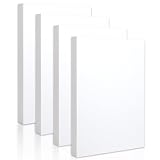
- High-Quality Material and Construction: The high-density white XPS foam is made of white pure polystyrene particles, free of impurities and pigments, non-toxic, peace lf mind to use,can be safely used for various applications.33kg/m3 density provides lightweight construction with excellent structural integrity, making it resistant to damage and easy to operate. Widely used in handicraft production, building insulation, plant cultivation, package applications and other fields
- Superior Rigidity and Durability: Our foam sheets feature excellent rigidity and thickness with pressure resistance up to 300kpa. Suitable for school DIY art projects, party decoration, cosplay props, building models, poster board, sculptures, pin board, and more to achieve your creative vision. This foam board is durable and does not deform, and unlike EPS foam, it will not produce particles that are easily broken and flying everywhere
- Waterproof and Thermal Insulation Properties: The foam board is waterproof closed cell foam with superior 034 level thermal insulation performance and can reduce certain noise effect. Very suitable for wall insulation and sound insulation, floor heating and attic. It can also be used as a moisture-proof backboard, leveling and height increasing, and for plant cultivation. You may also use it to make outdoor cabins and provide warm shelter for animals
- Easy to Customize and Paint: White polystyrene foam board with smooth surface can easily be painted in various colors. Free adhesion of various materials allows you to create your own designs, beautify your family spaces, and enhance party decorations to showcase your vision
- Simple Cutting and Shaping: You can easily cut the foam board with an art knife or a hot melt machine for your projects. Please pay attention to safety when working with cutting tools
| Condition | What the guidance indicates | Design check |
|---|---|---|
| Unfaced EPS | Cover with a WRB rather than relying on the foam as the drainage plane. | Show the WRB, laps, flashings and drainage outlet on the wall details. |
| Taped XPS | Can hold out water; shiplapped joints are suggested for drainage. | Use compatible tape and detail every joint, corner, opening and fastener. |
| Faced polyiso | Can serve as a drainage-plane layer when joints are taped. | Confirm facer, tape, sealant and exposure limits in the product instructions. |
| Unfaced polyiso | Should be covered by a WRB. | Do not count the board alone as the rain-control layer. |
Vapor classifications are typical categories only. Thickness, facer and temperature alter permeance. Evaluate where the assembly can dry—toward the exterior, interior or both—before selecting a low-perm board. In mixed or cold climates, an apparently efficient vapor barrier can trap construction moisture if the rest of the wall is not designed to dry.
How to choose: a project-by-project sequence
- Define the location and exposure. Record climate zone, design temperatures, interior humidity, rain and wind exposure, below-grade contact, roof or wall orientation and whether the board will be temporarily exposed during construction.
- Set the thermal target. Determine the required whole-assembly R-value, not only the board value. Account for framing, fasteners, joints, thermal bridges and the temperature basis of the listed R-value.
- Check moisture control. Identify the water-control layer, drainage path, vapor-control layer and air-control layer. Decide which direction must remain open for drying.
- Set structural requirements. Specify compressive strength and allowable deformation for soil, slabs, roofs, cladding, pavers or equipment. Use the design value, not a marketing description such as “high density.”
- Select the facer and thickness. Confirm permeance, fire behavior, surface adhesion, UV limits and compatibility with membranes, tapes, sealants and finishes.
- Verify temperature-adjusted data. For polyiso, obtain service-temperature information rather than assuming the 75°F label value applies in a cold assembly.
- Review code and listing requirements. Confirm the complete tested or approved assembly for fire exposure, interior finish, cladding, roof covering, below-grade use and thermal or vapor provisions in the governing jurisdiction.
- Coordinate fastening and transitions. Obtain the manufacturer’s fastening schedule, washer or plate requirements, joint layout, edge distances and details at windows, doors, parapets, roof edges and penetrations.
- Approve the submittal. Compare the data sheet, safety information and installation instructions with the drawings. Reject substitutions that change density, facer, thickness, permeance or strength without a design review.
Installation details that determine performance
Prepare and fit the boards
- Install over a clean, sound substrate; repair projections that would create gaps or point loads.
- Stagger joints between layers and keep boards tight, cutting accurately around openings and penetrations.
- Do not compress boards beyond the manufacturer’s permitted limit or leave unsupported edges under cladding or roofing.
Seal seams with compatible materials
Use only tapes, primers, sealants and adhesives listed for the exact board facer and exposure. A generic construction tape can lose adhesion, attack the foam or fail under ultraviolet light. Follow the specified surface preparation and rolling pressure. Treat corners, transitions and penetrations as part of the same control layer rather than stopping at the field of the board.
Follow the fastening schedule
Fastener type, length, plate size, spacing and edge distance depend on substrate, wind load, cladding and board thickness. Use the product’s schedule; do not copy spacing from another foam category. Overdriving fasteners can crush insulation and create a leak path, while under-fastening can allow movement and open seams.
Protect from ultraviolet exposure and incompatible products
Rigid foam should not remain exposed to prolonged sunlight beyond the product’s stated limit. Cover it with the specified WRB, roof membrane, cladding or protective layer. Keep solvents, hot-applied materials and incompatible adhesives away from the foam unless the manufacturer specifically approves them.
Independent reader supportYour contribution helps us test, update, and keep practical guides available for everyone.Choosing by common application
| Application question | What to prioritize | Likely candidates to investigate |
|---|---|---|
| Exterior wall with a separate WRB | Whole-wall R-value, drying direction, thickness, cladding attachment and thermal bridging. | Any of the three, provided the exact permeance and facer support the wall design. |
| Exterior wall where the foam layer is also intended to shed rain | Seam detailing, compatible tape, transitions, window flashing and WRB requirements. | Taped XPS or taped faced polyiso where the product instructions permit that use; unfaced EPS and unfaced polyiso need a WRB. |
| Below-grade wall or slab | Water absorption, compressive strength, soil or slab load, drainage and protection during backfill. | Products specifically rated for below-grade exposure; verify the exact board rather than choosing by category alone. |
| Low-slope roof | Roof-system listing, facer compatibility, compressive strength, attachment, moisture and temperature design values. | Roof-rated polyiso is common in systems where its tested properties fit; EPS or XPS require an approved roof assembly. |
| Very cold exterior assembly | Temperature-adjusted R-value, vapor strategy and inward or outward drying. | Whichever product’s service-temperature data and permeance produce a safe assembly; do not select solely by nominal label R-value. |
Common mistakes and fixes
Choosing by the highest number
Problem: A nominal per-inch value is treated as the installed value in every season. Fix: Compare the same thickness, test basis and aging basis, then use temperature-adjusted design data and whole-assembly calculations.
Assuming every foam board is a drainage plane
Problem: Unfaced EPS or polyiso is left behind cladding without a WRB. Fix: Provide the WRB required by the product and wall design, or specify a board and taped-joint system explicitly approved for drainage.
Rank #4

- Reflective Window Insulation: Our rv window insulation is well-made, which is weight of 200 g / 10.76 sqft. It is of good material and long-lasting
- Aluminum foil roll: Foil insulation roll is the ideal solution for you to beat the heat, reflective insulation roll can stay cool in summer heat and keep your house warm in winter, making you feel comfortable, available in multiple sizes to meet your all need
- Good Material: Reflective insulation roll is made of reflective double aluminum foil and bubble type material, its reflective surface helps to block out the sunshine effectively keep the heat out from the windows, insulation summer,not easily scratched, which can be used for a long time
- Good Performance: Window insulation kit for summer heat not only blocks the sun but it avoid heat loss window insulation summer,and keeps the room cool. This reflective insulation also acts as a barrier insulation summer heat and protects your privacy with its opaque foil surface
- Wide Application: Our insulation roll can be used for a variety of spaces, you can use aluminum insulation roll in windows insulation, garage insulation, rv window insulation,house insulation,roof insulation, window heat blocker, garage door and etc
Ignoring thickness-dependent permeance
Problem: A wall is checked using a thin-board vapor value after the design changes to a thicker board. Fix: Recalculate permeance and drying for the installed thickness and facer.
Mixing incompatible materials
Problem: Solvent-based adhesive, sealant or tape damages foam or loses adhesion. Fix: Verify compatibility in the exact manufacturer’s instructions and make a field adhesion check when required.
Using an unverified fastening pattern
Problem: Spacing from another product is copied onto a new board or substrate. Fix: Use the board manufacturer’s schedule coordinated with wind, cladding and substrate design.
Bottom-line selection
Choose EPS when its specified density, strength, R-value and separate water-control layer fit the assembly and its drying needs. Choose XPS when its water resistance, strength and taped-joint capability solve a defined exposure, while accounting for increased vapor resistance at greater thickness. Choose polyiso when its facer, tested system and high published R-value per inch are advantageous, after checking LTTR, cold-temperature performance and moisture details.
If climate, moisture exposure, design temperature, loads, code jurisdiction or the exact product data are unknown, the correct decision is to complete that design information—not to declare one foam universally best.
The Tool Desk
Outbyte Driver Updater FREEScan for outdated or missing drivers - takes under a minuteDriver Scan →Outbyte PC Repair FREEClear out junk files and repair common Windows errorsFree Scan →Quick Recap
Product prices and availability are accurate as of the date/time indicated and are subject to change. Any price and availability information displayed on Amazon at the time of purchase will apply.

