Recommended Free Tools
Choose an electric demolition hammer when you have dependable site power and need a self-contained handheld tool. Choose a handheld hydraulic breaker when a correctly sized power pack, hoses and sustained-duty capability are already available or clearly justified. For either option, compare the complete tool-and-support system—not an impact-energy number alone—on the same material and task.
Start with the right equipment comparison
“Demolition hammer” and “breaker” can describe different equipment classes. A corded electric demolition hammer is normally a handheld tool that plugs into an electrical supply. A handheld hydraulic breaker is also portable, but it receives pressurized oil through hoses from a separate power pack. A machine-mounted hydraulic breaker is an attachment fitted to an excavator, skid steer, demolition robot or other carrier. It is not a fair comparison with a person carrying a handheld electric hammer.
As an Amazon Associate I earn from qualifying purchases.
The work direction matters as well. A demolition hammer can be used on vertical and horizontal surfaces; a manufacturer FAQ describes that versatility directly at Bosch Power Tools’ demolition-hammer page. Heavier breakers are often selected for horizontal slab work, while a wall, overhead repair or confined utility cut may favor a lighter handheld design. Brokk’s hydraulic breaker attachments are matched to particular demolition-robot models, illustrating why carrier compatibility must be checked for mounted equipment.
Do these 3 things before closing this tab:
1Clear out junk files and repair common Windows errors2Scan for outdated or missing drivers - takes under a minute3Repair Windows errors before they cause bigger problemsElectric and hydraulic at a glance
| Decision factor | Corded electric demolition hammer | Handheld hydraulic breaker |
|---|---|---|
| Power source | Electrical circuit, distribution equipment and suitable extension leads | Hydraulic power pack with specified flow and pressure, hoses and couplers |
| Deployment | Generally quick when a compliant circuit is close to the work | Requires transport, positioning and fueling or powering the pack before breaking |
| Mobility | Limited by cable length, routing and available outlets | Limited by hose length and pack location, but no electrical cable at the tool |
| Typical strength | Simple setup, predictable handheld operation and broad wall/floor usability | Useful where hydraulic infrastructure is already present and sustained duty is expected |
| Main burden | Circuit capacity, water exposure and cable management | Pack, hoses, oil cleanliness, flow/pressure matching and extra handling |
| Fair performance comparison | Compare impact energy, impact rate, mass, vibration and task output under the same conditions | Use the same measures, while including pack losses, hose routing and operator fatigue |
Neither technology has a universal winner for power, speed or cost. A tool’s published impact energy and blows per minute are catalog specifications, not a guaranteed production rate. Concrete strength, reinforcement, chisel geometry, operator technique, access and pauses can change the result more than a single headline number.
#1 Best Overall

- AVAILABLE MODE: Please note!!! This ENDH45 demolition jack hammer only has hammer-only function and chisel position adjustment function. NO DRILLING function is available. Adapts only to SDS-Max type chisels
- SAY GOODBYE TO BULKY MACHINES: At just 12.8 lbs, this lightweight demolition jack hammer is easy to control and handle. It's equipped with an 11Amp industrial motor and a heat-resistant copper wire motor, delivering 4100BPM, 11.6ft/lbs(15.7 Joule) of concrete-breaking power for medium-duty work projects, this powerful tool is designed to enhance convenience and efficiency
- THOUGHTFUL HUMANIZED DESIGN: With an anti-scald front housing, ENDH45 jack hammer is designed to protect the user from potential burns. And the 360 adjustable handle is designed for both horizontal and vertical demolitions. The upgraded anti-vibration system and PU soft grip significantly reduce fatigue, while the aluminum alloy shell ensures durability and resilience, even if accidentally dropped
- HIGH-EFFICIENCY DESIGN: The SDS-MAX chuck enhances your work efficiency. It's designed for easy chisel changes without the need for extra tools, meanwhile a thick clamping section locks the chisel securely for a more precise and powerful transfer of energy. ENDH45 demo hammer also equipped with a self-lock button for continuous operation, you can effortlessly carry out long tasks without having to hold down the power switch all the time, making this an efficient concrete breaker
- PRACTICAL & WIDE APPLICATIONS: This ENDH45 demo hammer is suitable for a variety of medium-duty tasks including demolition, chipping, trenching, breaking concrete, blocks, bricks, tiles, stucco, and more. Suitable for housing foundation removal, tile removal, mechanical installation, demolishing brickwork, interior decoration, concrete slabs, oil chimneys, and plumbing tasks
How each system delivers breaking force
Electric mechanism
An electric motor drives a percussion mechanism that repeatedly accelerates a piston or striker into the shank of an SDS-Max or similar chisel. The tool contains the motor and impact mechanism in one housing, so the crew supplies electricity, positions the chisel and controls the trigger. A corded design avoids charging pauses and does not require a hydraulic pack, but the circuit must be sized for the tool and the cable must be protected from water, traffic and sharp edges.
As one current example, the Hilti TE 600-AVR SDS-Max demolition hammer is listed at 13 lb, with 8.8 ft-lb single-impact energy, 2,700 impacts per minute, 3.8 m/s² triaxial vibration for chiseling concrete and an 88 dB(A) emission sound-pressure level. Those are the manufacturer’s figures for that model, not a category-wide electric specification. The US product page displays a price from $1,429; it notes that prices vary for Hawaii, Alaska and US territories, so treat that amount as a volatile, location-specific listing rather than an average purchase price: Hilti TE 600-AVR product and service page.
Hydraulic mechanism
A hydraulic breaker converts oil flow and pressure from a power pack into reciprocating impact energy. The tool, pack and hoses form one working system. Flow that is too low can reduce impact rate; excessive flow or pressure can overheat or damage the breaker. Hose inside diameter, length, coupler type and cleanliness also affect operation. The manufacturer’s flow and pressure limits take priority over a generic rule of thumb.
Chicago Pneumatic’s handheld-equipment leaflet gives model-specific examples: some breakers are designed for 20 or 30 L/min power-pack compatibility, and the BRK 95 is specified at 1,150 blows per minute with a leaflet footnote stating that the figure is measured at 30 L/min. These values apply to the named models and conditions, not to every hydraulic hammer. Confirm the exact requirement in the tool and power-pack manuals: Chicago Pneumatic handheld hydraulic equipment leaflet.
Rank #2

- Wide Range of Application - XtremepowerUS demolition hammer gains itself good fame in demolition, chipping, trenching, breaking holes in concrete, block, brick, tile stucco, etc. You may find it applicable for various situations by its versatility, such as plumbing, mechanical installation, construction of water supply and drainage facilities, interior decoration, port facilities' construction, and other construction projects
- Industrial Performance & Quality: It's marvelous performance in demolition is one particular feature that makes the XtremepowerUS demolition jack hammer so remarkable & popular! It features 1800/min impact rate and 2200 watts of motor power. With a supporting the powerful function is the heavy-duty metal construction that symbolizes extreme durability and corrosion resistance
- 360° Rotary Front Handle - To cater to different positions under varied circumstances, the 360-degree adjustable fore handle was designed to achieve full control of the electric hammer and a delightful work experience
- Include Replacement Chisels Included: Package include (2) chisel bits: flat chisel and point chisel, meeting a variety of demands for construction purposes. They are all made from heat-treated alloy steel. Once being clamped, it will never drop by accident
- Including Electric Demolition Jack Hammer with 16" bull point chisel, 16" flat chisel, pair of protective gloves, protective goggles, hex wrenches
Hydraulic tools can be attractive when a contractor already owns a compatible pack or when the job demands long, repeated breaking cycles. The pack adds a second engine or motor, fuel or electrical demand, noise, transport weight and maintenance points. Those costs can be worthwhile only when utilization and access justify them.
What the published specifications really tell you
| Model and source | Published figures | How to interpret them |
|---|---|---|
| Hilti TE 600-AVR (Hilti USA product page) | 13 lb; 8.8 ft-lb single-impact energy; 2,700 impacts/min; 3.8 m/s² triaxial vibration for concrete chiseling; 88 dB(A) emission sound pressure | One electric handheld model’s catalog data. The page’s $1,429 starting price is location-specific and can change. |
| Chicago Pneumatic BRK 95 (leaflet) | 1,150 blows/min; measurement footnote specifies 30 L/min | Impact rate is tied to the stated hydraulic flow and cannot be compared without equivalent test conditions. |
| KW Hydraulik HYCON HH20RV | 23.9 kg; 60 J; 1,560 rpm; 4.8 m/s² vibration; 20 L/min at 100–160 bar hydraulic requirement | Model specifications from KW Hydraulik’s product page. They are not a controlled comparison with the electric example. |
Impact energy is reported in different units and may be measured by different methods. “Impacts per minute,” “blows per minute” and “rpm” are not automatically interchangeable labels, and they do not predict how quickly a reinforced slab will be removed. One supplier’s statement that a hydraulic model offers “up to twice the impact power” has no test basis established here; do not present it as a general electric-versus-hydraulic result.
Cost: calculate the whole working system
The purchase price of the hammer is only the first line. Build a job-specific cost using the following categories:
- Tool acquisition: purchase, rental or fleet charge for the hammer and required chisels.
- Support equipment: electrical distribution, generator or transformer for an electric tool; power pack, fuel or motor electricity, hoses and couplers for a hydraulic tool.
- Transport and setup: delivery, lifting, hose or cable routing, barriers and pack positioning.
- Consumables: pointed, flat, tile, asphalt or other task-appropriate chisels; retaining components; hydraulic filters and oil where specified.
- Service: inspections, lubrication, brush or seal replacement, hose repair, pack maintenance and calibration of protective devices.
- Downtime: waiting for a circuit, refueling, cooling, tool change, blocked access, breakdowns or a replacement unit.
- Energy: electricity demand for the hammer or pack, plus fuel where a combustion engine drives the hydraulic system.
For intermittent work, renting a hydraulic breaker and pack can avoid ownership costs, but delivery, minimum rental periods and local availability may dominate the calculation. For regular work, a fleet program can bundle service or loan tools. Hilti describes fleet fees, tool service, loan tools and temporary tools on its service page, but no independent, matched lifecycle-cost study or common rental-price dataset establishes that one technology is cheaper in every market. Obtain written rates for your region and utilization before deciding.
Rank #3

- ATTENTION: The BSK-45HMC has only a "hammer only" function and "variable-lock positioning" function. NO DRILLING function is available. Adapts only to SDS-Max type chisels
- Lightweight but powerful: Weight only 12 pounds, Facilitates both horizontal and vertical concrete demolition applications. Powerful 1,300 watts 11 AMP motor delivers 4,100 BPM, 11.1 ft.lbs.(15 Joules) of impact energy for fast chipping and demolition applications
- Easy to operate: SDS-Max bit system provides tool free bit changes with automatic bit locking, dust protection and maximum impact energy transfer. When used for long-term applications, The lock-on button allows us not to control the start up button all the time,added user comfort during extended periods of work
- Ergonomic design: 360°adjustable accessory handle and ergonomic grip area applies to different work accasion. The vario-lock positioning allows rotates and locks chisel into 12 different positions to optimize the working angle, maximum comfort when chiseling in tight spaces or in a wide variety of positions
- Triple vibration control: The upgraded Anti-Vibration Technology designed to decrease the vibration effectively, reduce fatigue and offer a better using experience; Longer air cushion in the hammer mechanism reduces vibration and improves hammer performance; Additional vibration-absorbing rear handle is spring-loaded to further reduce vibration
Match the hammer to the material and task
| Work condition | Questions to answer before selecting | Likely selection logic |
|---|---|---|
| Concrete slab or foundation | Thickness, reinforcement, access for a pack or carrier, removal volume and allowable vibration | Compare a heavy handheld or mounted breaker with enough duty capacity; verify that the operator can control the tool safely. |
| Reinforced concrete | Bar size and spacing, whether cutting follows breaking, and risk of tool binding | Plan a sequence using the correct chisel and separate steel-cutting equipment; do not assume higher impact energy alone solves reinforcement. |
| Masonry or block wall | Wall orientation, nearby occupied spaces, dust containment and need for selective removal | A maneuverable electric hammer may simplify vertical work when a suitable circuit is available. |
| Tile, render or surface removal | Need for control, risk of substrate damage and chisel profile | Use a lighter tool and broad or tile chisel; excessive energy can damage the base material. |
| Asphalt, frozen soil or utility work | Ground temperature, water, traffic, trench access and hose/cable protection | Choose the model approved for the material and environment, then plan containment and service access. |
Use the manufacturer’s chisel-shank and material guidance. A tool that is excellent on a horizontal slab may be awkward overhead, while a compact tool may be productive for repair patches but slow for bulk demolition. If two candidates remain close, run a supervised trial on the same material, thickness and removal target; record square metres or cubic metres per productive hour, tool-change time, operator breaks and downtime.
Job-site setup: electric workflow
- Confirm the nameplate and circuit. Check voltage, amperage, plug configuration and any manufacturer requirement for a generator, transformer or residual-current protection. Do not assume a household outlet is suitable.
- Plan distribution. Use appropriately rated, heavy-duty leads and distribution equipment. Keep connectors out of standing water and protect the route from vehicles, falling debris and sharp reinforcement.
- Install the chisel correctly. Fit the specified shank, retaining system and any lubrication required by the manual. Inspect the point or edge before starting.
- Control the work zone. Establish exclusion zones for fragments, noise and dust. Verify that the substrate will not expose hidden services or destabilize a wall or slab.
- Apply dust and water controls. If water is used, use electrical equipment and connectors rated for the environment and prevent water from entering the tool or extension connection.
- Break in a controlled pattern. Start with the manufacturer’s recommended angle and avoid levering the chisel sideways. Stop for tool inspection, chisel changes and operator recovery.
OSHA advises ground-fault circuit interrupters (GFCIs) and watertight, sealable electrical connectors for electric construction tools. These controls are in addition to ordinary cable inspection and site electrical procedures.
Job-site setup: hydraulic workflow
- Match the pack to the breaker. Verify the exact flow range, pressure range, return-line requirement and any case-drain specification. For example, the HYCON HH20RV listing calls for 20 L/min at 100–160 bar; that is not a universal hydraulic setting.
- Inspect and route hoses. Check covers, fittings, couplers and cleanliness. Route hoses away from traffic, hot surfaces, sharp edges and pinch points; provide slack for tool movement without loops that can snag.
- Position the power pack. Set it on stable ground with ventilation, refueling access and a clear emergency shutoff. Keep exhaust away from occupied or enclosed areas when the pack uses an engine.
- Connect with the system depressurized. Use the specified couplers, cap unused ports and confirm that supply and return lines are not reversed.
- Warm up and test. Start at the manufacturer’s procedure, check for leaks and verify operating pressure and flow. Never search for a leak with your hand; pressurized oil can penetrate skin.
- Operate without side-loading. Keep the chisel aligned, allow the percussion mechanism to work and stop immediately for abnormal noise, heat, vibration or loss of impact.
- Shut down safely. Isolate the pack, release pressure before disconnecting, cap fittings and inspect the breaker and hoses for damage.
Productivity: why catalog numbers are not a job-rate promise
A breaker’s output depends on the energy transferred into the material, impact frequency, chisel shape, contact angle and the time the operator can maintain a productive stance. Reinforcing steel, embedded pipe, voids, delamination and hidden anchors interrupt the cycle. Pack flow can fall when other hydraulic functions operate, while an electric tool can trip a marginal circuit or require cable moves.
Quick wins for a faster PC:
Fix the driver behind crashes, sound loss and screen glitchesFind Drivers →Clear out junk files and repair common Windows errorsFree Scan →Measure the complete cycle during a trial:
- Record the material type, thickness, reinforcement and weather or temperature.
- Use the same chisel condition and operator skill level for each candidate.
- Time setup, productive trigger time, chisel changes, clearing debris and breaks separately.
- Record removed area or volume, not only minutes of trigger time.
- Log circuit trips, hydraulic-temperature alarms, hose moves, refueling and unplanned maintenance.
No independent, matched electric-versus-handheld-hydraulic field test or named cross-category productivity statistic establishes a universal winner. A controlled trial on your material is stronger evidence than comparing one vendor’s impact figure with another vendor’s.
Rank #4

- Wide Range of Applications Use - Our power demolition drills & hammers include 2 chisel bits (flat chisel & point chisel). It is perfect for demolition, trenching, chipping, and breaking holes in concrete, block, brick, and tile. It is also ideal for various applications such as pipeline, mechanical installation, drainage facilities construction, housing foundation removal, concrete slab, oil chimney, interior decoration, and much more!
- Heavy Duty - The high-strength alloy chuck can withstand the strong impact of the demolition operation. The chipping hammer chuck features quick assembly and disassembly. It is easy to replace the chisel that will never drop accidentally after being clamped. The handle is made of plastic to avoid electric shock hazards.
- Stays Cool During Intense Work - Efficient cooling system, effectively cools the motor to improve the concrete breaker's life. The engine will be at low temperatures even after a long working time
- Designed To Go Above And Beyond - 360°rotary handle reduces fatigue during prolonged work. It provides accuracy and precision in some relatively narrow places. The demolition hammer is also equipped with a suitcase for carrying conveniently. The locking button can automatically maintain operation, saving effort.
- Superior Performance & Top Quality Material - Industrial motor with powerful impact energy is designed to complete concrete and metalworking projects quickly and precisely. It is intended for professionals. This electric jack hammer adopts heavy-duty aluminum construction, is highly durable, and is corrosion resistance for long-term use
Handling, vibration, noise and operator exposure
Mass changes portability and fatigue. The 13-lb electric example is substantially lighter than the 23.9-kg HYCON HH20RV specification, but weight alone does not determine comfort: balance, handle design, reaction force, hose drag and working posture matter. A heavier tool may reduce the number of repositioning cycles on a floor while increasing fatigue during overhead or wall work.
Vibration values must be read with their test description. Hilti lists 3.8 m/s² triaxial vibration for chiseling concrete; KW Hydraulik lists 4.8 m/s² for the HYCON HH20RV. Different tools, measurement methods and operating conditions mean these figures should not be turned directly into a safe daily trigger-time limit. Use the manufacturer’s declared vibration information, your jurisdiction’s exposure rules, job rotation, maintenance and actual measured exposure when required.
The electric example’s 88 dB(A) emission sound-pressure level signals a hearing-conservation issue. Hydraulic packs add their own engine or motor noise, and hoses can transmit vibration. Assess the whole work area, including bystanders and adjacent trades, and select hearing protection, barriers and communication methods accordingly.
Dust and silica controls apply to both technologies
Breaking concrete, masonry or other silica-containing material can generate respirable crystalline silica. OSHA states this explicitly in its fact sheet on jackhammers and handheld powered chipping tools: OSHA FS 3629 (2017). The control method is driven by the material and process, not by whether the breaker is electric or hydraulic.
Best Value
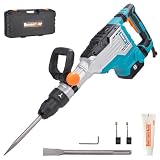
- Exceptional Performance: Powerful 1,700 Watts motor delivers maxmium 2,100 BPM and 45 Joules(33.2 ft.lbs.) of impact energy for rapidly chipping and chiseling, suitable for concrete road surface, trenching, heavy demolition of wall, etc
- Well-Balanced & Ergonomic: Weighing 25 lbs, its well-balanced design provides greater comfort and control for both horizontal and vertical applications. The D-shaped handle rotates 360° on the main axis and 180° on the secondary axis, while the ergonomic grip enhances stability and control
- Easy to Operate: The 6-level available device can switch 200-2,100BPM, which is suitable for more work scenarios. SDS-Max bit system provides tool free bit change with automatic bit locking, and maximum impact energy transfer. Self-lock design avoids trouble of keeping pressing, make work more conveniently
- Reduce Vibration & Leakage: Adopted double anti-vibration design that double spring at handle and built-in longer air cushion, reduces vibration to the maximum extent and provides better use experience. High-strength aluminum-magnesium alloy housing integrated design, which can greatly prevent oil leakage
- Wide Practical Applications: The demolition jack hammer 65H is perfect for breaking holes, trenching, chipping and demolition in concrete, block, brick, tile, cement, housing foundation removal, pavement and much more! We provide 24 months warranty service
- Wet suppression: Deliver water at the impact point when the method is permitted and the site can manage slurry, runoff, electrical safety and freeze conditions.
- Shrouds and collection: Use an appropriate shroud with a dust-collection system where specified, and maintain the collector and filter.
- Work-zone control: Keep other workers out of the dust plume, use ventilation or containment as appropriate and clean with methods that do not re-aerosolize dust.
- Program requirements: Follow the applicable exposure assessment, written control plan, training, housekeeping and respiratory-protection requirements under OSHA 29 CFR 1926.1153 or the governing local rule.
Water and electricity require additional planning. Protect GFCI devices, connectors and distribution equipment, and use only equipment approved for the conditions. Hydraulic operation avoids an electrical cable at the handheld tool but does not eliminate silica, noise or struck-by hazards.
Maintenance and failure points
Electric hammer checks
- Inspect cord, plug, housing, handles and trigger before each shift.
- Keep air inlets clear and follow the specified grease or lubrication interval.
- Replace worn chisels and retaining parts before they create excessive side load.
- Tag out a tool with damaged insulation, unusual arcing, overheating or loss of impact.
Hydraulic breaker and pack checks
- Inspect hoses, couplers, seals and guards for cuts, abrasion and leaks.
- Maintain oil cleanliness, filter intervals and the fluid grade specified for the pack and breaker.
- Verify flow and pressure with calibrated service equipment rather than adjusting relief settings by guesswork.
- Check pack cooling, fuel or electrical supply and emergency shutdown functions.
- Depressurize before disconnecting and contain spills for proper disposal.
In both systems, planned service is cheaper than a seized tool, a damaged chisel or a lost shift. Keep a log of trigger hours, material, abnormal events and parts replaced so the next rental or purchase decision uses your actual duty cycle.
A practical selection decision
- Define the task. Write down material, thickness, orientation, removal quantity, access, reinforcement and allowable working hours.
- Decide whether the comparison is handheld or mounted. Do not compare a robot attachment with a person-carried electric hammer.
- Check infrastructure first. Confirm a compliant electrical supply or an available hydraulic pack with matching flow, pressure and hoses.
- Screen handling and exposure. Compare mass, balance, vibration information, noise, dust controls and operator positions.
- Price the complete system. Include acquisition or rental, support equipment, transport, consumables, service, energy and downtime.
- Test finalists. On the same material, measure removed volume per productive hour and record interruptions and operator feedback.
- Document the choice. Save the model, shank, settings, controls, inspection frequency and emergency procedure in the job plan.
Common selection mistakes and corrections
- Comparing unlike classes: Correct it by matching handheld with handheld or carrier attachment with carrier attachment.
- Choosing by impact energy alone: Add impact rate, chisel, access, operator time and measured output.
- Ignoring hydraulic support: Verify pack flow, pressure, return circuit, hoses and couplers before the breaker arrives.
- Using a price as total cost: Add transport, energy, service, consumables and downtime over the expected utilization.
- Assuming hydraulic means dust-free or risk-free: Apply silica, noise, struck-by and vibration controls to the actual process.
- Overlooking vertical work: Confirm that the tool’s mass, handles and reaction force suit walls or overhead positions.
- Failing to validate claims: Ask for the measurement method and test conditions; do not convert an unsubstantiated “twice the power” statement into a productivity promise.
Bottom line for contractors
Electric is usually the simpler handheld choice when reliable power is already at the work face, the circuit can support the tool and the job includes walls, patches or other positions where a compact self-contained hammer helps. Hydraulic becomes compelling when a correctly matched power pack is available, the work is sustained and the hose-and-pack system offers a practical access or duty-cycle advantage. For a major demolition package, a mounted hydraulic attachment may be the right class entirely.
The Tool Desk
Outbyte Driver Updater FREEFix the driver behind crashes, sound loss and screen glitchesFind Drivers →Outbyte PC Repair FREEClear out junk files and repair common Windows errorsFree Scan →Make the final decision with a complete cost and risk worksheet, then verify it with a same-material field trial. The evidence available for the models above supports careful specification matching, not a blanket claim that electric or hydraulic is always faster, stronger or cheaper.
Quick Recap
Product prices and availability are accurate as of the date/time indicated and are subject to change. Any price and availability information displayed on Amazon at the time of purchase will apply.

