What’s actually slowing this PC down?
Pick the symptom - the matching free tool is one click away.
COOLERCHIPS is not a single cooling product. It is a U.S. Department of Energy program run through ARPA-E that funds 15 research projects developing more efficient, reliable cooling for high-density computing. Its central objective is ambitious: reduce cooling energy to less than 5% of a data center’s IT load, support computing densities above 80 kW/m³, and keep the temperature difference between a chip and its coolant below 10°C. Those figures are program targets—not proof that every project or commercial data center has achieved them.
The program matters because AI accelerators and high-performance-computing processors are pushing heat loads beyond what conventional air cooling can efficiently handle. COOLERCHIPS addresses the problem at several levels, from microfluidic chip cooling to liquid-cooled racks, modular facilities, digital modeling, and independent testing.
As an Amazon Associate I earn from qualifying purchases.
What COOLERCHIPS is—and is not
COOLERCHIPS stands for Cooling Operations Optimized for Leaps in Energy, Reliability, and Carbon Hyperefficiency for Information Processing Systems. ARPA-E lists the program’s release date as September 22, 2022. The Department of Energy announced up to $40 million for 15 selected projects on May 9, 2023, while later ARPA-E material describes approximately $42 million committed across 15 projects. The difference appears to reflect the initial award announcement versus the later committed program total.
In November 2025, ARPA-E held its COOLERCHIPS annual review. The program page currently displays 19 project records, although the funding announcements and annual-review material refer to 15 funded projects. Those counts should not be silently merged: the available program information does not establish exactly why the page contains additional records. The safest description is that COOLERCHIPS is a 15-project funded portfolio with additional records shown in ARPA-E’s program database.
#1 Best Overall

- Condition: 100% Brand New and in Perfect package to ensure you receive a perfect product
- Model: DV4600-492
- Bearing Type: Ball; Fan Diameter: 120mm; Maximum Fan Speed: 2650/3100 RPM; Material: Plastic; Type: Axial cooling fan
- Packaging: Carton; Power Connection: 2-Pin; Voltage: 115VAC
- Fan size: 120*120*38MM
Its four broad areas are:
- Efficient cooling for next-generation, high-power-density servers.
- High-density modular and edge data centers.
- Software and modeling tools that jointly optimize efficiency, reliability, carbon, and cost.
- Testing facilities and evaluation practices.
That portfolio structure is important. A cooling technology that works at the chip may still fail as a rack or facility solution if it is difficult to service, incompatible with server hardware, or too energy-intensive to reject heat outdoors.
ARPA-E’s COOLERCHIPS overview and the DOE award announcement provide the program’s official baseline.
Why data-center cooling needs new approaches
Every watt consumed by a processor eventually becomes heat. As AI and HPC systems use more powerful GPUs, CPUs, and accelerators, heat is becoming concentrated in smaller packages and denser racks. Air can remove heat, but moving and conditioning large volumes of air requires fans, air handlers, chillers, pumps, cooling towers, and electrical infrastructure.
Outdated Drivers Are Slowing You Down
One free scan finds every outdated or missing driver and matches the right update for your exact hardware.Free scan · exact hardware matchWindows Errors? Fix Them Before They Spread
Repair common Windows errors and clear accumulated junk for a smoother, more stable PC - no reinstall needed.Free scan · no reinstallDOE has said cooling can account for up to roughly 40% of data-center energy use; ARPA-E describes a broader 33–40% range. These are estimates, not universal constants. Climate, workload, rack density, facility design, and the measurement boundary all change the result.
Cooling is also a construction and siting issue. A facility may need more electrical capacity for chillers and pumps, additional heat-rejection equipment, water-treatment infrastructure, or a building layout designed around liquid distribution. Water availability, drought risk, humidity, grid constraints, and the ability to expand power and cooling capacity can determine whether a site is viable.
Rank #2

- APPLICATION: USB computer fans cool off gaming systems, routers, amplifiers, and receivers. 120mm case fan keep entertainment centers' stereos and cables cool and help with air flow in various spaces
- PLAY AND PLUG: Just plug this server fan into any USB source—like a charger, power bank, phone adapter, game console, or USB outlet. It's a breeze to use
- PACKAGE INCLUDING: This usb cooling fan set comes with two USB fans, one USB cable to control two fans (high speed medium speed low speed), and a metal shield to protect your hands. Easy to use, safe and reliable
- Variable Speed Fan: It has a variable-speed controller so you can adjust the pc fan for the best mix of quiet operation and airflow
- Specification: 120 x 120x 25 mm ( 4.72 x 4.72 x 0.98 in. ) | Rated Voltage : 5V | Rated Current: 0.25A | Airflow: 77 x 2 CFM | Noise: 32dBA | Speed: 2000 RPM (MAX)
Improving cooling efficiency does not automatically reduce total energy use. If more efficient cooling makes it economical to install more compute, increase workload volume, or raise rack density, total facility demand may still rise. Better cooling can also move the bottleneck to transformers, switchgear, generators, grid interconnection, or outdoor heat rejection.
COOLERCHIPS targets versus results
| Metric | Target or stated objective | How to interpret it |
|---|---|---|
| Cooling energy | Less than 5% of IT load | Official program target, not universal demonstrated performance |
| Chip-to-coolant temperature difference | Below 10°C | ARPA-E technical target |
| Compute density | Above 80 kW/m³, approximately above 3 kW per server | Program target for high-density computing |
| Funding | Up to $42 million across 15 projects | Later ARPA-E description of the program commitment |
| Project records | 19 displayed on the program page | Not the same count as the 15 funded projects cited in announcements |
| Example partner concept | PUE below 1.05 and more than 160 kW per rack | Eaton/Boyd project-level design claims, not independently verified program-wide results |
“Less than 5% of IT load” describes cooling energy relative to the energy delivered to computing equipment. It is not the same as PUE. PUE includes all facility overhead, including power conversion, lighting, networking-related infrastructure, and other non-IT loads. A facility can pursue a low cooling fraction without having the same PUE as another facility.
Do these 3 things before closing this tab:
1Repair Windows errors before they cause bigger problems2Scan for outdated or missing drivers - takes under a minute3Clear out junk files and repair common Windows errorsAny comparison must define what is included: chip loops, rack pumps, fans, compressors, chillers, heat exchangers, controls, cooling towers, and heat rejection. Weather, altitude, humidity, coolant temperature, workload transients, and rack density also matter.
The 15-project portfolio by technical layer
Chip and package level
- HP: embedded microfluidic cooling for high-power server architectures.
- HRL Laboratories: aligned graphite microchannel cooling with additively manufactured manifolds.
- JETCOOL: microconvective or silicon-level cooling.
- University research projects: work involving institutions such as the University of Florida, the University of Missouri, UC Davis, and Purdue University.
These approaches attack the thermal bottleneck close to its source. Their challenge is manufacturing repeatable structures, distributing coolant evenly, and connecting chip-level hardware to a serviceable system.
Server and rack level
- Intel Federal: two-phase immersion cooling for high-TDP systems.
- University of Texas at Arlington: hybrid cooling.
- RTX/Raytheon Technologies Research Center: advanced cooling research for high-performance systems.
- NVIDIA: modeling and hardware-related work within the broader portfolio.
Rack-level systems must cool GPUs, CPUs, memory, storage, power supplies, networking, and other components that do not necessarily have identical thermal requirements. The best architecture may therefore use more than one cooling path.
Rank #3

- An ultra-quiet UL-certified fan system designed for cooling cabinets that requires minimal noise.
- Features a multi-speed controller to set the fan’s speed to optimal noise and airflow levels.
- Contains a CNC machined aluminum frame with a modern brushed black finish.
- Powered by wall outlet or USB port, included Turbo Adapter increases performance by 25%.
- Dimensions: 8.5 x 4.4 x 1.3 in. | Total Airflow: 52 CFM | Total Noise: 18 dBa | Bearings: Dual Ball
Modular and facility level
- Flexnode: a prefabricated modular liquid-cooled micro-data center.
- Other COOLERCHIPS work addresses high-density modular and edge deployments, where compactness, transport, environmental exposure, and limited on-site maintenance are central constraints.
Modular systems can shorten construction timelines and place compute closer to users or industrial equipment. They also concentrate more risk in a smaller enclosure and may provide less room for maintenance and equipment replacement.
Recommended Free Tools
Modeling, testing, and evaluation
NREL contributes technical evaluation, testing protocols, and digital-twin support. Evaluation matters because a simulated or laboratory result is not automatically a field result. Buyers need comparable measurements under representative workloads, seasonal conditions, equipment aging, maintenance events, and realistic failure scenarios.
How the main cooling approaches work
Direct-to-chip liquid cooling
A cold plate attaches to a processor or other high-heat component. Coolant flows through the plate, absorbs heat, and carries it to a distribution unit and heat exchanger. Compared with air cooling, this puts heat capture closer to the source and can support higher chip and rack densities.
It does not eliminate infrastructure. A deployment still needs manifolds, pumps, heat exchangers, controls, leak detection, service procedures, and a method of rejecting heat to the environment.
Two-phase cooling
In a two-phase system, the coolant changes phase—typically boiling at a controlled location—to absorb substantial heat. Pumped two-phase systems circulate fluid through cold plates or other heat-transfer structures. Potential benefits include high heat-transfer performance and close temperature control.
Rank #4
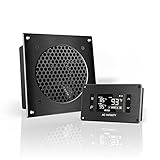
- An ultra quiet UL-certified fan system designed for cooling cabinets that requires minimal noise.
- Features an on board processor that provides a digital read-out of the cabinets temperatures.
- Programming includes thermostat control, fan speed control, and SMART energy saving mode.
- Dimensions: 6.3 x 6.3 x 1.3 in. | Airflow: 52 CFM | Noise: 18 dBA | Bearings: Dual Ball
The trade-offs include pressure management, phase separation, condensation, fluid compatibility, pump and control complexity, and maintaining the correct fluid inventory.
Two-phase immersion
Servers or selected components sit in a nonconductive fluid. Heat boils the fluid; vapor rises, condenses, and returns as liquid. The approach can reduce dependence on fans and conventional airflow management. It may require compatible seals, connectors, drives, coatings, materials, and service procedures. Boyd describes the basic immersion-cooling approach in more detail.
Single-phase immersion
Components are submerged in a nonconductive liquid that remains liquid during operation. Heat moves through the fluid to a heat exchanger or external loop. This can simplify heat capture and reduce airflow constraints, but it introduces fluid handling, filtration, maintenance, disposal, and hardware-compatibility requirements.
Hybrid cooling
The Eaton/Boyd-described concept combines direct-to-chip two-phase cooling for hotter components with single-phase immersion for lower-power components. The rationale is to match the cooling method to the thermal load rather than forcing every component into one architecture. That is a project concept, not evidence that all hybrid systems deliver the same results.
Digital twins and simulation
Project partners describe using NVIDIA Omniverse as a digital-twin environment to model and validate hardware before deployment. Computational-fluid-dynamics tools and flow visualization can examine temperature distribution, phase separation, cold-plate design, and immersion-tray behavior. Simulation can reduce design iterations, but it cannot replace full-scale testing with representative workloads and environmental conditions.
Best Value
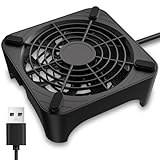
- 【Universal Compatibility】This USB cooling fan works seamlessly with Mini PC, PS5, routers, Apple TV, modems, PlayStation, receivers, Rokus, T-Mobile 5G Home Internet, Xbox Series, and other audio-video electronics. Whether cooling a gaming console, router, or streaming device, it eliminates overheating worries across your digital ecosystem.
- 【Powerful Cooling Performance】Equipped with a 120mm fan boasting 55.8 CFM airflow and 850RPM±10% speed, this USB PC fan delivers rapid cooling—dropping device temperatures by 20% in seconds. The 9-blade design ensures powerful airflow to tackle heat buildup in routers, mini PCs, and gaming consoles, preventing lag and performance drops caused by overheating.
- 【Ultra-Quiet Operation & Scratch-Proof Protection】 Designed for ultra-quiet and scratch-resistant cooling needs, this USB computer fan comes with 4 shock-absorbing pads and operates at just 18dB(A)±10% noise—whisper-quiet, quieter than library silence (30dB) and close to the sound of rustling leaves (20dB). It enables efficient device cooling without noise interference or surface scratches, letting you fully immerse in video, audio, and gaming. It’s perfect for home offices, living rooms, and gaming setups.
- 【USB-Powered & Space-Saving Setup】This USB powered fan features an integrated 530mm (20.87-inch) USB cable, connecting easily to chargers, mobile power banks, or laptops—no extra wires needed. With dimensions of 130mm×130mm×48.6mm (5.12×5.12×1.91 inches), it can be placed flat or upright, making it perfect for narrow spaces while keeping your setup tidy.
- 【Sturdy & Long-Lasting Durability】Made from premium eco-friendly ABS material, this USB fan (with a box fan-like structure) supports heavy-duty use and can withstand weights up to 11LB. With a lifespan of 40000 hours, it offers long-term cooling for your devices, ensuring stable performance and protection against overheating for years to come.
A closer look at the hybrid concept’s claims
Eaton and Boyd describe a containerized hybrid concept with ambitious figures including PUE below 1.05, more than 160 kW per rack, operation at ambient temperatures up to 40°C, zero water consumption, more than 99.99% availability, and a 12-year mean time between failures. These numbers should be read as project-level targets or design claims unless a specific independent test is cited.
“Zero water” also needs a boundary. It might mean no cooling-tower makeup water in the cooling system; it does not necessarily mean that the facility, electricity supply, manufacturing process, cleaning operations, or humidification use no water. Similarly, availability figures must identify whether they apply to the cooling subsystem, a modeled design, or an entire operating data center.
The project description is useful as a case study because it illustrates how a system might combine technologies. It is not a program-wide performance certificate.
Why liquid cooling is not a silver bullet
- Heat still has to leave the building: liquid moves heat more efficiently but does not eliminate heat rejection.
- Leaks become a design and operations risk: systems need detection, isolation, drainage, redundancy, and documented recovery procedures.
- Service changes: immersion may require draining or fluid-management equipment, compatible replacement parts, and technician training.
- Compatibility is broad: confirm effects on plastics, adhesives, seals, solder, coatings, cables, storage devices, and warranties.
- Two-phase control is demanding: boiling, vapor return, condensation, pressure, and fluid inventory must remain within limits.
- Average temperatures can hide hotspots: poor flow distribution or cold-plate design can leave local thermal problems even when system averages look acceptable.
- Mixed hardware complicates deployment: GPUs, CPUs, memory, storage, networking, and power electronics may need different cooling paths.
- Models have limits: a digital twin calibrated on a test rig may not predict contamination, aging, workload spikes, field defects, or maintenance behavior.
- Environmental claims need detail: identify the fluid, global-warming potential, safety classification, regulatory status, lifecycle impacts, and disposal route.
COOLERCHIPS versus current commercial choices
| Architecture | Main advantage | Main limitation |
|---|---|---|
| Conventional air cooling | Mature, widely supported, easy service model | Less effective at very high chip and rack densities |
| Rear-door heat exchanger | Raises rack capacity while retaining conventional servers | Still needs liquid loops and may not solve chip hotspots |
| Direct-to-chip liquid | Strong fit for GPU/CPU hotspots | Requires cold plates, manifolds, facility integration, and compatible hardware |
| Single-phase immersion | High heat capacity and fewer airflow constraints | Fluid handling, compatibility, and service complexity |
| Two-phase immersion | High heat-transfer potential | More demanding fluid, pressure, material, and safety requirements |
| Containerized liquid-cooled facility | Useful for edge, remote, or rapidly deployed capacity | Logistics, maintenance access, environmental exposure, and standardization |
| Air plus targeted liquid | Lower transition risk | Retains complexity from two cooling architectures |
What is commercially available today?
COOLERCHIPS itself is not a product that a data-center operator can order. Commercial relevance comes from technologies and engineering services that overlap with the program’s research areas.
- Boyd: liquid cold plates, pumped two-phase cooling, immersion cooling, coolant distribution, and custom thermal engineering. It is generally an engineering-led option for OEMs and data-center builders, not a self-serve small-server upgrade.
- Eaton: cold plates and integrated power and thermal-management expertise for facility-scale projects. The cited COOLERCHIPS figures are project descriptions, not universal product specifications.
- ZutaCore and Carrier: HyperCool direct-to-chip, waterless liquid cooling aimed at high-performance AI and data-processing workloads. Confirm current availability and supported configurations directly.
- HPE: vendor-integrated direct liquid cooling in selected HPC and AI systems. Availability varies by system generation, geography, and configuration; consult HPE for current specifications.
- Dell Technologies and JetCool: OEM-supported liquid-cooling paths using JetCool technology in selected solutions. Consult Dell and JetCool for supported systems.
These systems are typically quote-based, engineering, OEM, or project purchases rather than products with transparent online checkout pricing. A buyer should request a dated, configuration-specific proposal rather than rely on a headline performance number.
How to evaluate a liquid-cooling deployment
- Define the thermal load. Record current and expected chip, server, rack, and facility loads, including transient accelerator workloads.
- Set the measurement boundary. Ask whether quoted cooling energy includes pumps, fans, controls, chillers, heat exchangers, cooling towers, and outdoor heat rejection.
- Test the climate case. Require performance data for the actual site’s temperature, humidity, altitude, water availability, and worst-case season.
- Audit water claims. Separate cooling-tower makeup, treatment, blowdown, humidification, cleaning, and indirect water consumption.
- Review failure behavior. Ask how the system responds to loss of power, coolant flow, a pump, a valve, a heat exchanger, a control system, or heat rejection.
- Check serviceability. Verify safe server removal, leak isolation, draining or refilling procedures, spare parts, technician training, and maintenance intervals.
- Confirm compatibility and warranties. Obtain written support for every CPU, GPU, memory, storage, network, connector, seal, and cable in the proposed configuration.
- Calculate total cost of ownership. Include construction changes, distribution units, coolant, monitoring, training, maintenance, disposal, migration, and downtime.
- Assess environmental impact. Review fluid chemistry, global-warming potential, embodied carbon, lifecycle disposal, electricity carbon intensity, and local water stress.
- Demand independent evidence. Separate simulation, laboratory prototype data, pilot results, field results, and commercially supported specifications.
What success would look like
Success for COOLERCHIPS should not be judged by one laboratory efficiency record or one impressive rack-density claim. A meaningful result would be repeatable performance across climates and workloads; credible measurement of total cooling energy; predictable behavior during faults; manageable fluid and hardware compatibility; service procedures that technicians can perform safely; and lifecycle costs that make sense for operators and builders.
The program’s broader value is its coordinated approach. Chip designers, cooling engineers, modular-facility builders, software specialists, and testing organizations are addressing different parts of the same thermal path. That coordination can help promising concepts move from research prototypes toward maintainable commercial systems.
Quick wins for a faster PC:
Scan for outdated or missing drivers - takes under a minuteDriver Scan →Clear out junk files and repair common Windows errorsFree Scan →For construction and infrastructure teams, the practical lesson is to treat cooling as a first-order building-system decision. The right architecture affects floor loading, equipment rooms, pipe distribution, electrical capacity, heat rejection, redundancy, maintenance access, water infrastructure, and future expansion. A liquid-cooling proposal should therefore be evaluated as part of the complete facility—not as a replacement for a few air handlers.
Quick Recap
Product prices and availability are accurate as of the date/time indicated and are subject to change. Any price and availability information displayed on Amazon at the time of purchase will apply.

