Recommended Free Tools
ChotuKool was a real Godrej & Boyce product launched in India around 2010–2011—but it was not a miniature version of a conventional family refrigerator. It was a compact, top-opening, compressor-free cooling unit designed for small quantities of food and drink, unreliable electricity, limited space and lower upfront cost. Its frequently quoted launch price was about US$69, or roughly ₹3,250–₹3,500 at the time—not a verified current retail price.
The problem ChotuKool was designed to solve
Conventional refrigerators assume relatively stable electricity, a permanent place in the home, enough money for the appliance and its running costs, and a need for substantial long-term storage. Those assumptions did not fit many lower-income and rural Indian households.
As an Amazon Associate I earn from qualifying purchases.
Godrej’s research found that prospective users often wanted to cool only a few items, such as vegetables, drinks or small quantities of prepared food. Some households had unreliable power, limited floor space or homes that might change. Many did not need a freezer, and some needed cooling for approximately a day rather than storage for a large weekly shop.
That changed the design question. Instead of asking how to make a conventional refrigerator cheaper, Godrej explored what kind of cooling product would fit the actual circumstances of its intended users. The result became ChotuKool—often explained as “little cool.” The USAID Idea to Impact case study describes more than 600 women participating in prototype workshops and influencing details including the interior arrangement, lid, color and feature set.
#1 Best Overall

- STAYS COLD FOR WEEKEND TRIPS: Coleman TempLock foam insulation holds ice-cold temperatures for up to 36 hours — so drinks are just as cold Sunday afternoon as they were when you packed Friday night
- ROOM FOR THE WHOLE GROUP: Holds 11 standard 12 oz cans with 8 lbs. of ice, or up to 25 cans without ice; ideal for tailgates, camping trips, beach days, picnics, and group outings
- DOUBLES AS EXTRA SEATING: Reinforced lid with internal ribbing holds up to 200 lbs., so the Chiller pulls double duty as a cooler and a seat at the stadium, campsite, or trailhead — no chair needed
- EASY ONE-HAND CARRY: Wide-grip bail handle is built to support a loaded 16qt, so you can haul it solo to the campsite or tailgate without recruiting a second set of hands
- WIPES CLEAN FAST: Smooth lid surface is easy to wipe down with a damp cloth, so cleanup after meals, spills, sand, or dirt is quick and hassle-free
Not a scaled-down conventional refrigerator
ChotuKool avoided the architecture of a standard compressor refrigerator. It used a solid-state thermoelectric cooling module and a fan, with no conventional compressor and no traditional freezer compartment.
In practical terms, electricity passed through the thermoelectric module, which moved heat from inside the insulated cabinet to the outside. A fan helped dissipate that heat, while the insulation slowed warming when the power stopped. The principle is related to the thermoelectric cooling used in some electronic and portable cooling systems, but ChotuKool was a purpose-built appliance—not simply a computer fan placed inside a box.
The design also used a top-opening lid. Cold air is denser than warm air, so opening a top-opening cabinet generally allows less cold air to spill out than opening a front door. That was useful for a small unit intended to be opened intermittently, although frequent opening would still raise the internal temperature.
Historical descriptions commonly claim that the product used approximately 20 parts, compared with more than 200 in a conventional refrigerator, and consumed about half as much energy as a traditional refrigerator. Those are historical product and case-study claims rather than independently reproduced measurements for every model and operating condition.
How it handled unreliable electricity
ChotuKool was designed around a 12-volt DC supply. Historical sources describe compatibility with batteries and inverters, while later promotional descriptions also mention vehicle or car-charger compatibility and portable power sources. This made it more adaptable to intermittent electricity than a conventional mains-powered refrigerator.
However, “works during power cuts” did not mean “runs indefinitely off-grid.” The unit still required a suitable 12-volt source, battery, inverter or electrical connection. Battery runtime would depend on the battery’s capacity and condition, ambient temperature, wiring, load and how often the lid was opened. A generic battery should not be connected without checking the exact voltage, current, connector and charging requirements.
Some development-oriented descriptions mention solar-compatible 12-volt systems, but ChotuKool should not automatically be described as a self-contained solar refrigerator. A solar setup would need correctly sized generation, storage, charge control and wiring.
Crashes, No Sound, or Screen Glitches?
Random freezes, missing sound and display glitches usually trace back to one bad driver. Find and replace yours safely.Free scan · under a minutePC Slower Than It Used to Be?
A free scan shows the junk files, broken settings and background clutter dragging Windows down - then fixes them in one click.Free scan · Windows 10 & 11Rank #2

- Extra Large Capacity: The measure of Maelstrom 30 can soft cooler bag is 14.43*8.97*10.14 inch .This lunch cooler bag can easily hold 30 cans drinks of 330 ML (about 22L) to meet your storing needs.
- Insulated & 100% Leakproof: Keep cold for up to 24 hours. This soft sided cooler composes of 5 insulated layers, including oxford fabric, waterproof PVC layer, 210D liner and food-grade PEVA material. 5 layers design make this insulated cooler bag keep cold or warm for longer time.With the technology of seamless ultrasonic welding, the thick PEVA material ensures waterproofness.
- Multi-pockets & Bottle opener: Maelstrom large beach cooler bag has 1 main pocket to well store your drinks and food, 2 front zipper pockets to place your cell phone, 2 side pockets to store small items and 1 back pocket for storing the IPad. This travel cooler comes with a detachable bottle opener so that you can open your drinks anytime anywhere.
- 3 Carrying Ways: Detachable and adjustable straps, comfortable top handle allow you to hold Maelstrom collapsible coolers for travel by shoulder or by hand. You can also carry the large lunch box for men/women with your friends together with 2 side handles.
- Collapsible and Portable: This portable cooler can be widely used when you go camping//Beach/hiking/Grocery Shopping/Kayaking/Road Trips. You can fold the leakproof ice chest effortlessly when not in use, which is space-saving.
What could it store?
ChotuKool was intended for limited quantities, not a full family’s weekly groceries. Historical descriptions place its capacity at roughly 30–45 liters, with one Japanese Ministry of Foreign Affairs account specifying 43 liters. Other sources use rounded figures of 30 or 40 liters. These differences may reflect different versions, later variants or approximate reporting, so they should not be treated as one universal specification.
Early accounts describe a weight of approximately 7.8 kilograms. That made the unit substantially more portable than a conventional refrigerator and opened up uses beyond the home: shops, workplaces, roadside selling, transport, bedrooms, picnics and small offices.
Its likely contents included drinks, vegetables and small amounts of food. It was not designed to replace a full-size refrigerator for large quantities of meat, dairy products or prepared meals, and the lack of a conventional freezer was deliberate rather than an accidental omission.
How cold did ChotuKool get?
A Japanese government description gives a historical interior temperature range of approximately 5°C to 15°C. That is suitable for chilling drinks and helping preserve some produce, but it does not establish freezer performance. The upper end of that range is also warmer than the temperature many perishable foods require for robust, longer-term refrigeration.
Do not assume that a unit described as “cool” is safe for every food or for storage over several days. Actual performance would depend on ambient temperature, starting temperature, loading, lid openings, insulation and the condition of the thermoelectric module. It should not be used for vaccines, medicines or other temperature-sensitive medical products unless a specific model has validated temperature stability and is approved for that purpose.
How long did it stay cool without power?
Historical sources commonly describe roughly two to three hours of retained cooling during an electricity interruption. A later Godrej announcement says cooling could be retained for up to three hours without electricity.
That is an approximate historical claim, not a guarantee. The duration would vary with outside temperature, how full the cabinet was, how often the lid was opened and which version was being described. Insulation can slow warming; it cannot keep contents cold indefinitely without an energy source.
Rank #3
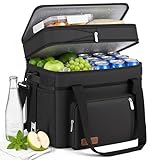
- 【Extra Large Capacity】 Size: 14.6” x 11” x 8.5”. Expanded size: 14.6” x 11” x 11.8”. Different foods can be placed on the upper and lower layers to prevent food from being piled up and squeezed. This cooler bag is large enough to store 60 cans of 330ml beverages, meeting all storage needs of a team under 12. Includes a bottle opener attached to this bag
- 【Three Ways to Carry】 Comes with side handles and a removable shoulder strap, this cooler bag can be carried by two people together, worn over the shoulder, or hand-carried by one person
- 【Collapsible Design】This portable cooler is suitable for beach, camping, hiking, travel, shopping, kayaking and road trips. You can fold this leak-proof cooler to save space
- 【100% Leak-proof & Insulated】Stay cold for 24 hours. This cooler bag consists of 5 layers, such as waterproof coating on the surface, oxford material, waterproof PVC layer, insulated foam and food-grade PEVA material. 5 layers design keeps drinks cold or warm longer. Adopts seamless hot pressing technology, ensuring 100% leakproof performance
- 【Not Easy to Deform】 Features a hard pad at the bottom and thickened insulated foam on all sides to keep the cooler bag upright. No deformation occurs even when fully loaded
Was it really a $69 refrigerator?
Yes—but only as a historical launch-era price. Contemporary coverage in December 2009 reported an intended price of approximately US$69, or about ₹3,250. A later Japanese government source reported a price of approximately ₹3,500. Exchange rates changed, and the dollar equivalent should not be interpreted as a fixed modern conversion.
The quoted amount may also have referred to the appliance itself rather than delivery, taxes, financing, power accessories, batteries or local distribution costs. It is therefore more accurate to say that ChotuKool was marketed at roughly $69 at launch than to say that it currently costs $69.
There is no reliable evidence here of a current official Godrej retail price or authorized inventory in 2026. Readers should not assume that an online listing—especially one using the ChotuKool name—is a current manufacturer-supported product.
User research changed the product
The most important innovation was not merely the thermoelectric chip. It was the decision to let user needs redefine what the product had to be.
Godrej initially considered scaling down an existing refrigerator design. Prototype research challenged that approach. Participants indicated that the freezer was not essential for the intended use, while portability, simple access, small size and compatibility with unreliable power mattered more. Engineers reportedly resisted removing the freezer at first, but testing showed that a cheaper appliance with the wrong features would still be a poor fit.
What’s actually slowing this PC down?
Pick the symptom - the matching free tool is one click away.
This is why ChotuKool is often discussed in product-design and development circles as an example of frugal innovation. It did not simply remove expensive features from a standard refrigerator. It changed the category from “small household refrigerator” to “portable, short-term cooling appliance.”
Distribution was part of the invention
Reaching the intended customers was as difficult as designing the appliance. Rural households were geographically dispersed, purchasing power was limited and conventional appliance retail did not necessarily reach them efficiently.
Rank #4

- COLD FOR 72 HOURS: Coleman TempLock foam insulation holds ice-cold temperatures for a full 3 days — set it up Thursday, roll it out Friday, and the last drink is still cold when you break camp Sunday
- WHEELS THAT HANDLE REAL TERRAIN: Impact-resistant wheels roll reliably over gravel, grass, sand, and uneven ground — not just smooth pavement — so a fully loaded 60qt gets where you're going without a fight
- ROOM FOR MULTI-DAY EVENTS: Fits 47 standard 12 oz cans with 30 lbs. of ice — or up to 94 cans without ice — enough to keep a large camping crew, multi-day tailgate, or outdoor festival fully stocked from first arrival to final night
- DOUBLES AS EXTRA SEATING: Reinforced lid with internal ribbing supports up to 200 lbs., giving you a convenient seat once you roll into the campsite, tailgate, festival, beach, or sidelines
- SECURE LID FOR TRANSPORT: Lid helps keep contents sealed while the cooler is upright, tilted, loaded into the car, or rolling across uneven ground, helping prevent spills and keep cold air inside
Historical accounts describe distribution experiments involving the Indian postal system, NGOs, microfinance institutions, self-help groups, local retail networks and women entrepreneurs. These channels could help with awareness, financing and local selling while reducing reliance on conventional urban appliance stores. The distribution model was therefore part of the product proposition, not an afterthought.
But a low sticker price did not automatically make the appliance affordable. The INSEAD ChotuKool case distinguishes theoretical affordability—the price appearing low on paper—from actual affordability, which includes household income, financing, transport, electricity, batteries, maintenance and repairs.
Quick wins for a faster PC:
Repair Windows errors before they cause bigger problemsFix Now →Fix the driver behind crashes, sound loss and screen glitchesFind Drivers →Clear out junk files and repair common Windows errorsFree Scan →What ChotuKool did well
- Reduced the upfront price compared with a conventional refrigerator at the time.
- Used less mechanically complex thermoelectric cooling instead of a compressor.
- Operated from a 12-volt supply and could be adapted to battery or inverter systems.
- Was light, portable and compact.
- Used a top-opening design suited to retaining cold air.
- Required cooling capacity for small quantities rather than a full household refrigerator.
- Was designed through research with intended users rather than assumptions about them.
- Created possible secondary uses in shops, workplaces, transport and beverage sales.
What it could not replace
- A full-size family refrigerator.
- A freezer for frozen food or ice storage.
- Reliable long-term storage for large amounts of meat, dairy or prepared food.
- A validated medical or vaccine refrigerator.
- An autonomous off-grid cooling system without an appropriate power setup.
- A universally affordable appliance once ownership and distribution costs were included.
- A compressor refrigerator’s cooling headroom in very hot conditions.
Did ChotuKool succeed?
The answer depends on what “succeed” means.
As a design and innovation case, ChotuKool clearly succeeded in demonstrating that a product for underserved customers could require a different architecture, not merely a lower price. It became a widely discussed example of frugal innovation and bottom-of-the-pyramid design. Godrej also experimented with distribution models designed for dispersed, lower-income customers.
That does not prove mass adoption, sustained profitability or long-term national market success. The available historical sources identify challenges including limited disposable income, consumer awareness, dispersed demand, service and distribution. No reliable 2026 sales figure or current market-status announcement establishes how many units were sold or whether the original product remains in production.
ChotuKool’s later positioning also changed. In a 2015 announcement, Godrej described a version as a “mobile food and beverage cooler,” emphasizing portability, customization and compatibility with vehicles and portable power. That suggests a shift from a narrowly rural-development product toward broader lifestyle, travel and commercial uses.
If you encounter a used ChotuKool
Because current official availability and replacement support are not established, buyers considering a used unit should verify:
Do these 3 things before closing this tab:
1Fix the driver behind crashes, sound loss and screen glitches2Clear out junk files and repair common Windows errors3Scan for outdated or missing drivers - takes under a minute- The exact model, production year and capacity.
- Whether the thermoelectric module actually cools the cabinet.
- The required input voltage, current and connector.
- Whether a battery, charger or inverter is included.
- The condition of the insulation and lid seal.
- Cooling performance at the local ambient temperature.
- Availability and cost of replacement modules, fans, controls and power adapters.
- Whether local service support still exists.
- The intended use—drinks and short-term cooling are not the same as safe long-term food storage.
- The total cost after transport, repairs, batteries and accessories.
Why ChotuKool still matters
ChotuKool’s enduring lesson is not that every household needs a $69 refrigerator. It is that affordability, power consumption, product architecture, distribution and user research must be considered together.
A conventional refrigerator may be the better choice for a household needing dependable, colder and larger-capacity storage. A portable thermoelectric cooler may be useful for drinks or short trips but may perform poorly in extreme heat. A modern 12-volt compressor cooler may offer stronger cooling, but it is generally heavier and more expensive. None of those products is automatically a direct substitute for ChotuKool’s original proposition.
ChotuKool was valuable precisely because it narrowed the problem. Rather than promising every function of a standard refrigerator at a fraction of the price, it asked what limited cooling could be delivered with less power, fewer parts, greater portability and a distribution system suited to rural India.
Quick Recap
Product prices and availability are accurate as of the date/time indicated and are subject to change. Any price and availability information displayed on Amazon at the time of purchase will apply.
The Tool Desk
Outbyte Driver Updater FREEFix the driver behind crashes, sound loss and screen glitchesFind Drivers →Outbyte PC Repair FREERepair Windows errors before they cause bigger problemsFix Now →
