Choose a jigsaw blade by compatibility first, not by tooth count or brand. Confirm the saw accepts the blade’s shank, then match the blade to the workpiece material and thickness. Only after that should you decide how clean the cut must be, which face should remain clean, and whether you need HCS, HSS, bi-metal, carbide, or a specialty construction.
The right jigsaw blade is chosen in this order: confirm the shank fits your saw, match the blade to the material, check the material thickness, decide how clean and in which direction the cut must be, then choose the blade construction and pack size. For most modern jigsaws, a T-shank blade is the broadest starting point—but T-shank and U-shank blades are different interfaces and should not be treated as interchangeable without confirmation.
As an Amazon Associate I earn from qualifying purchases.
1. Confirm the shank before comparing teeth
The shank is the portion that locks into the jigsaw. A blade can be the right length, tooth pattern, and material rating yet still be unusable if its shank does not match the saw’s clamp.
Free tools Windows power users keep installed
One-click scans. No signup required.
Check one of these sources before buying:
- the jigsaw’s instruction manual;
- the markings or instructions on the blade clamp;
- the tool manufacturer’s accessory specifications; or
- the packaging of a blade already known to fit the saw.
T-shank blades are widely supported by current Bosch, DEWALT, Makita, and Milwaukee jigsaws and accessories. DEWALT, for example, documents T-shank sets for Bosch and DEWALT jigsaws. That makes T-shank a useful general category, not a guarantee that every T-shank blade fits every tool.
U-shank blades remain a separate category. Some older or particular jigsaws use them, while many newer tools use a tool-free T-shank clamp. Do not buy by brand alone: a Bosch, DEWALT, Makita, or Milwaukee blade still needs the correct shank for the jigsaw.
2. Match the blade to the workpiece
Blade labels such as “wood,” “metal,” or “clean cut” are more useful than a generic claim that a blade is suitable for everything. The tooth form, pitch, body thickness, blade material, and recommended thickness range are designed around particular materials.
| Workpiece | Good starting point | What to check |
|---|---|---|
| Softwood, plywood, and ordinary woodworking | HCS wood blade | Tooth pitch, cutting length, stock thickness, and whether speed or finish matters more |
| Finished wood or laminate | Fine-tooth, ground-tooth, laminate, reverse-tooth, or two-sided-clean blade | Which face must remain clean and whether the blade cuts upward or downward |
| Sheet steel, pipe, or metal profile | HSS, bi-metal, or other explicitly metal-rated blade | Manufacturer’s thickness and profile-capacity range |
| Stainless steel or tough thin metal | Carbide-rated tough-metal blade where specified | Exact metal type and thickness; carbide is not automatically suitable for every metal job |
| Plastic, rubber, carpet, cardboard, or polystyrene | Dedicated specialty-material blade | The blade’s exact material list and thickness guidance |
Wood blades
High-carbon steel (HCS) blades are a common choice for softwood and general woodworking. As an example of how specific the selection should be, Bosch’s T111C is a T-shank HCS blade with a 3 mm medium tooth pitch and a documented recommended range of approximately 4–50 mm for thick woodworking materials. The important lesson is not to copy that range to another blade: use the specifications for the exact product.
For quick, rough cuts in thick wood, a coarser pattern and deeper gullets generally remove waste faster. For visible edges, plywood, furniture panels, or laminate, look for finer or precision-ground teeth and a blade specifically described for clean or splinter-controlled cutting. Makita’s 792729-9, for example, is documented as a T-shank HCS blade for splinter-free wood cuts, while DEWALT describes precision-ground teeth and deep gullets on products intended to combine clean and fast wood cutting.
Metal blades
Use a blade explicitly rated for metal rather than trying to make a wood blade do the job. Metal blades generally use smaller teeth and a construction intended to withstand the harder, more abrasive workpiece.
For a mixture of thick and thin metal, Bosch’s T123XF is an example of a bi-metal progressive-pitch blade with a documented recommended material range of approximately 1.5–8 mm and capacity for pipe or profile up to about 25 mm. These figures are product-specific, so they should be treated as a specification to compare—not as a universal limit for every bi-metal blade.
Stainless steel and other tough thin metals may call for a carbide-rated blade. Bosch’s EXPERT Tough Metal range distinguishes very fine, medium-fine, and larger tooth patterns for different tough-metal applications. Its T118AHM example is carbide and specified for approximately 1.5–3 mm material. Choose carbide only when the blade’s application table expressly covers the material and thickness.
Specialty materials
Plastic, rubber, carpet, cardboard, polystyrene, and similar soft or non-abrasive materials can behave badly under a conventional wood blade. Specialty blades may use knife-edge or serrated-edge designs and are normally assigned their own material and thickness guidance. If the blade package does not list the material you intend to cut, choose a product that does rather than relying on a generic “multi-purpose” description.
3. Use tooth pitch and TPI as part of a specification—not as the whole decision
Teeth per inch (TPI) is a convenient shorthand, but it is not a complete blade-selection rule. Tooth pitch is also expressed in millimetres, and the practical result depends on the combination of:
Rank #2

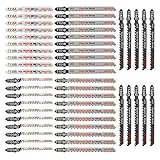
- 9-Type Blade Selection: This jig saw blades set includes T101AO ×4, T101B ×4, and T101BR ×4 for clean wood cutting, T144D ×4, T244D ×3, and T111C ×3 for fast wood cutting, T118A ×3 and T118B ×3 for basic metal cutting, plus T127D ×2 for aluminum
- T-Shank Compatibility: Standard T-shank blades fit the vast majority of modern jigsaws, providing a secure grip and stable cutting performance. These jigsaw blades are easy to install and remove for quick blade changes
- High-Quality and Durable: Made from premium HCS (high-carbon steel) and HSS (high-speed steel) for wear resistance, flexibility, and long service life. The wood blades resist breaking and metal blades stay sharp longer
- Controlled, Clean Cuts: Precision-ground teeth, fine-tooth profiles and reverse-cut designs support smooth results and help reduce splintering. Narrow scroll blades allow tight curves with improved control on plywood and laminate
- Easy Identification and Storage: Every jigsaw blade’s shank is clearly printed with the blade type for quick selection. Blades are supplied in a sturdy storage case to keep them organized, protected, and ready for use
- tooth pitch or TPI;
- tooth shape and whether the teeth are milled, ground, or progressive-pitch;
- blade material and body construction;
- blade thickness and cutting length;
- the material being cut; and
- the manufacturer’s recommended workpiece range.
Coarser teeth usually clear material quickly and can suit thick wood. Finer teeth are common for thin metal and finish-sensitive work, where a smaller tooth engagement can help produce a more controlled edge. But “more teeth is always better” is wrong: a very fine blade can cut slowly or clog in a thick workpiece, while a coarse blade can damage a thin or finished panel.
Use the manufacturer’s application table as the controlling specification. A blade’s stated thickness range is more meaningful than choosing a TPI number in isolation.
4. Choose the cut direction and the visible face
Most jigsaw blades cut on the upstroke, which can lift or splinter the material on the top face. Before cutting, identify which side will be visible and where splintering is acceptable.
- Standard up-cut blade: often useful when the cleaner face can be placed underneath, provided the workpiece is supported properly.
- Down-cut or reverse-tooth blade: can help keep the top, visible face cleaner, but may require more careful feed control because the tooth action behaves differently.
- Laminate or clean-cut blade: intended for finish-sensitive sheet goods; verify the product’s stated cutting direction and material range.
- Two-sided-clean blade: designed to address the problem of controlling which side of a jigsaw cut remains clean.
Blade choice cannot compensate for poor support. Clamp the workpiece, support the cut line, avoid forcing the saw, and make a test cut in scrap when the finish matters.
5. Select blade material for the workload
| Construction | Typical role | Qualification |
|---|---|---|
| HCS | Wood and other relatively non-abrasive materials | Choose the tooth pattern and length for the stock and finish required |
| HSS | Metal-oriented applications | Confirm the exact metal and thickness rating |
| Bi-metal | Metal blades combining a harder tooth strip with a more flexible body | Product construction and capacity vary; follow the manufacturer’s table |
| Carbide | Difficult or tough materials when explicitly specified | Do not assume carbide is the best choice for every metal or abrasive material |
Do not treat a manufacturer’s durability statement as a universal service-life promise. Blade life varies with material, thickness, cutting speed, orbital setting, feed pressure, workpiece contamination, and contact with nails or other fasteners. Comparative life claims only have meaning when the exact product, competing blade, material, and test conditions are known.
Rank #3

- Including jigsaw blades designed to make a variety of cuts in wood and metal
- Includes both Bi metal and HCS jig saw blades designed for long life and fast cuts
- T-shank Jigsaw blade set includes 3 kinds of blades: 6, 10 and 18 TPI (teeth per inch)
6. Check cutting length—not just the package’s overall length
A blade that looks long enough may still have insufficient usable cutting capacity. Compare the blade’s cutting length and stated material range with the full thickness of the stock, including any workpiece angle or profile that increases the effective depth.
Do these 3 things before closing this tab:
1Repair Windows errors before they cause bigger problems2Scan for outdated or missing drivers - takes under a minute3Clear out junk files and repair common Windows errorsA short blade in thick material can bind, overheat, or leave the saw shoe unable to control the cut properly. Conversely, an unnecessarily long, flexible blade can make it harder to follow a straight line. Product specifications for wood, metal, and carbide blades often list both length and recommended thickness; check both before ordering.
What should you buy for common jobs?
One general workshop purchase
Start with a T-shank wood-and-metal assortment if your saw accepts T-shank blades. An assortment is convenient for occasional work, but inspect its contents: it should include a useful wood pattern and a genuinely metal-rated pattern rather than several nearly identical general-purpose blades. It will not necessarily include long blades, fine-finish blades, laminate blades, carbide blades, or specialty-material blades.
If you are comparing packs online, a T-shank jigsaw blade set is a sensible search starting point. Confirm the shank and read the individual blade descriptions before buying; do not assume that every blade in a mixed set is suitable for every material or thickness.
Mostly softwood or plywood
Choose an HCS wood-blade pack. Select a coarser pattern for rapid rough cuts in thicker stock and a finer or ground-tooth pattern when the edge will be visible. Check the manufacturer’s thickness range and cutting length rather than choosing by pack quantity alone.
Quick wins for a faster PC:
Scan for outdated or missing drivers - takes under a minuteDriver Scan →Clear out junk files and repair common Windows errorsFree Scan →Fix the driver behind crashes, sound loss and screen glitchesFind Drivers →Finished wood, veneered board, or laminate
Choose a fine/ground-tooth or clean-cut blade whose description covers the material. Then decide which face must remain clean and whether an up-cut, down-cut, reverse-tooth, or two-sided-clean design is appropriate. A premium finish blade still needs firm support and a controlled feed.
Rank #4

- 【Universal Compatibility】These jigsaw blades compatible with over 90% of modern jigsaw saws. Secure grip with zero wobble, install or remove in seconds without tools, fully save your time and energy!
- 【Affordable 50 Pack - fast Harvests】Our jig saw blades set includes T101AO ×5, T101B ×10, and T101BR ×5 for clean wood cutting, T144D ×10, T111C ×5 for fast wood cutting, T118A ×5 and T118B ×5 for basic metal cutting, plus T127D ×5 for aluminum. You don't need to buy separate packs for different materials. In fact, it is an essential set of tools in your toolbox!
- 【T-Shank Handle Design】The precision-engineered T-shank locks firmly into your jig saw blades holder, preventing slippage during heavy cuts, change blades in seconds, keep your working without frustrating delays!
- 【High-Quality HCS & HSS Steel】Made from premium high-carbon steel (HCS) for wood blades and high-speed steel (HSS) for metal blades. These jigsaw blades stay sharp longer, resist breaking, and deliver clean cuts through hardwood, softwood, plywood, plastic, and thin metal!
- 【Wide Application】From cutting wood, plywood, laminate, acrylic, plastic to trimming aluminum angles, thin metal or PVC pipes, this jig saw blades set handles it all. Perfect for DIY home renovations, professional contractors, home woodworking projects and so on. It is an ideal gift for any DIY home woodworking lover!
Sheet metal, pipe, or profile
Choose a metal-rated HSS or bi-metal blade and match its recommended range to the material thickness. Progressive-pitch products can cover more than one thickness, but they are not a substitute for checking the application table. Secure the workpiece and follow the jigsaw and blade manufacturer’s guidance for speed, lubrication, and operating procedure.
Stainless steel or tough thin sheet
Consider a carbide tough-metal blade only where the product explicitly lists the metal and thickness. This is a dedicated purchase, not normally the role of a basic mixed assortment.
Plastic, rubber, carpet, or insulation-like soft materials
Buy a specialty-material blade with the exact material listed. A generic wood blade may cut, but it can produce poor control, tearing, melting, or an unsuitable finish.
What’s actually slowing this PC down?
Pick the symptom - the matching free tool is one click away.
Common buying mistakes
- Buying by brand instead of shank. Brand compatibility does not establish mechanical compatibility. Confirm T-shank or U-shank first.
- Using a wood blade on metal. Select a blade expressly rated for the metal and its thickness.
- Choosing only by TPI. Interpret pitch together with tooth form, construction, length, material, and the application range.
- Using a short blade in thick stock. Compare usable cutting length and recommended capacity, not only overall blade length.
- Assuming an assortment covers every job. Mixed packs are useful for general work but commonly omit specialty, long, very fine, carbide, or unusual-shank blades.
- Taking life claims out of context. Blade life depends heavily on the job and technique; do not convert a product-specific comparison into a guaranteed number of cuts.
Quick selection checklist
- Does the shank match the jigsaw clamp?
- What exact material are you cutting?
- What is the material’s full thickness?
- Does the blade’s recommended range cover that thickness?
- How much usable cutting length is available?
- Is the cut rough, fast, straight, curved, or finish-sensitive?
- Which face of the workpiece must remain clean?
- Is HCS, HSS, bi-metal, carbide, or a specialty edge appropriate?
- Does the pack contain the actual blade patterns you need?
Safe use still matters after the blade is chosen
Follow the operating and safety instructions for both the jigsaw and the blade. Secure the workpiece, use the tool’s recommended speed and orbital setting for the material, keep hands away from the blade path, and wear appropriate eye and hearing protection when applicable. Stop and replace a blade that is damaged, excessively worn, bent, or overheating rather than increasing feed pressure to force the cut.
Frequently Asked Questions
Are T-shank and U-shank jigsaw blades interchangeable?
T-shank and U-shank blades are different interfaces. Check the jigsaw manual, blade clamp, or manufacturer specifications before buying; brand matching alone is not enough.
Best Value

- Sold on Amazon
What jigsaw blade should I use for metal?
Use a blade explicitly rated for metal. HSS or bi-metal blades are common choices, while stainless steel and other tough thin metals may require a carbide-rated blade specified for that exact material and thickness.
What is the best jigsaw blade for wood?
HCS wood blades are a common starting point. Choose the tooth pattern and cutting length according to the wood thickness and whether you need a fast rough cut or a cleaner finished edge.
Does a higher TPI always make a better jigsaw cut?
Not by itself. Tooth pitch must be considered with tooth form, blade construction, blade length, material, and the manufacturer’s recommended thickness range.
The Bottom Line
For most modern jigsaws, first confirm that you need a T-shank blade. Then choose by material and thickness: HCS for general wood, fine or ground teeth for cleaner finished-wood cuts, HSS or bi-metal for metal, carbide for explicitly rated tough-metal applications, and dedicated specialty blades for plastic, rubber, carpet, or other soft materials. A T-shank assortment is a useful general purchase, but demanding or finish-sensitive work is better served by a dedicated blade pack.
Quick Recap
Product prices and availability are accurate as of the date/time indicated and are subject to change. Any price and availability information displayed on Amazon at the time of purchase will apply.

