Recommended Free Tools
Cement, lime and gypsum are different construction materials with different jobs. Cement is chiefly a hydraulic binder for concrete and many mortars. Hydrated lime is used in selected mortars, plasters and stuccos, especially where workability and compatibility with historic masonry matter. Gypsum is made into plaster and board products and is also added to Portland cement during manufacture. They should not be substituted by name alone: the specified product, substrate, performance requirement and local code determine the appropriate choice.
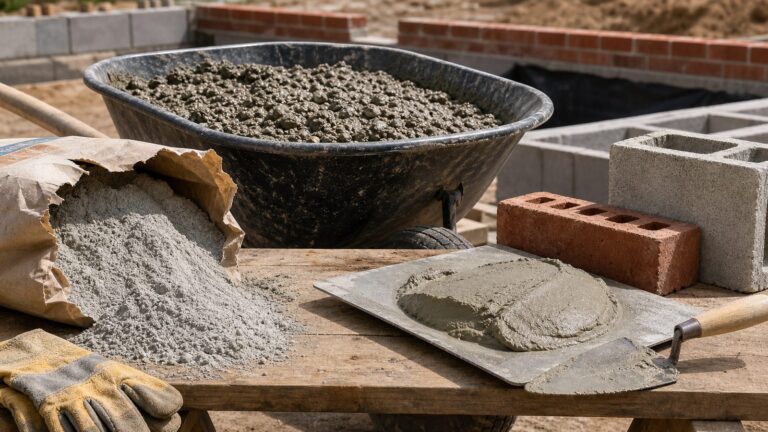
One essential distinction prevents many purchasing and mixing errors: cement is an ingredient, while concrete is the finished mixture of cement, water and aggregate.
| # | Preview | Product | Price | |
|---|---|---|---|---|
| 1 |

|
Tech Mix Portland-Limestone Cement, 15 Pounds | $30.99 | Buy on Amazon |
| 2 |

|
PORTLAND CEMENT 47LB | $51.62 | Buy on Amazon |
| 3 |

|
Tech Mix Portland-Limestone Cement, 30 Pounds | $55.99 | Buy on Amazon |
As an Amazon Associate I earn from qualifying purchases.
Quick comparison: cement, lime and gypsum
| Material | Main construction role | Typical supported uses | What controls the choice |
|---|---|---|---|
| Portland or blended cement | Hydraulic binder that reacts with water and hardens | Concrete, many mortars, pavements, floors, reinforced-concrete buildings, bridges, reservoirs, precast products, soil-cement and geotechnical work | Cement type, project specification, required strength development or sulfate resistance, and local availability |
| Hydrated lime | Ingredient in selected building mixes; contributes workability and other mortar properties | Some masonry mortars, plasters and stuccos; carefully matched repairs to older lime-mortar buildings | Construction-grade product, intended formulation, original masonry and historic-fabric compatibility |
| Gypsum | Mineral used in board and plaster products; additive in Portland cement manufacture | Gypsum panels or drywall, building plaster and cement manufacture | Whether the product is raw, calcined or manufactured board; panel type and thickness; applicable standards and code |
The table describes broad roles, not mix recipes. A structural or code-controlled project still requires the product and proportions named in its drawings, specification and local regulations.
Quick wins for a faster PC:
Scan for outdated or missing drivers - takes under a minuteDriver Scan →Clear out junk files and repair common Windows errorsFree Scan →Fix the driver behind crashes, sound loss and screen glitchesFind Drivers →What cement does in construction
Cement is the binder, not the concrete
The American Cement Association describes cement as the key ingredient that, when mixed with water, acts as glue binding coarse and fine aggregate to create concrete. Cement and water form a paste; sand, gravel or other aggregate make up the rest of the concrete mixture. Its FAQ gives a typical cement content of 10–15% of concrete by volume. That is a general description, not a proportion to copy for a project.
#1 Best Overall
- MULTIPURPOSE: Basic building material for crafts, pavement, sidewalks, reinforced concrete buildings, masonry units, and more
- MIX AND USE: Use to create concrete, mortar, and stucco mixes
- GREAT FOR DIY PROJECTS: Ideal for small crafts with forms and silicone molds
- HIGH STRENGTH: Solid once dry, dry in 48 hours
- LESS IS MORE: One bag yields approximately .16 cu. ft.
Concrete therefore cannot be replaced with a bag labelled cement. Cement is the powder that supplies the binding action; concrete is the engineered combination of cement, water, aggregate and, where specified, other constituents.
Why Portland and blended cements harden
Portland and blended cements are hydraulic. They react with water to form solid hydrates and can harden even under water. This property makes cement suitable for cast concrete and for many mortars where a water-resistant, load-transferring binder is required.
Common cement types and their broad uses
The American Cement Association’s cement-type overview identifies broad Portland cement categories:
- Type I: general use.
- Type II: intended for moderate sulfate conditions.
- Type III: used where high early strength is required.
- Type V: intended for more severe sulfate conditions.
These labels are not a substitute for an engineer’s specification. The right type depends on exposure, structural design, curing and the performance required; availability also varies by location. A supplier may not stock every type, and a locally available product is not automatically an acceptable substitute.
Where cement is used
General-purpose cement is used in pavements, floors, reinforced-concrete buildings, bridges, reservoirs and precast products. Cement also appears in many masonry mortars and in soil-cement or other geotechnical applications. The U.S. Geological Survey’s cement information treats it as a basic binder material; the American Cement Association also covers concrete and stucco applications.
For a small, non-structural repair, buy the cement product named for that application rather than assuming every Portland cement is equivalent. For structural concrete, foundations, retaining work, bridges or sulfate-exposed work, follow the project specification and use qualified design and inspection advice.
What lime does in construction
Hydrated lime is a formulation ingredient
Building lime is not simply a weaker version of cement. The U.S. Geological Survey’s Lime 2019 yearbook reports hydrated lime use in some building mortars, plasters and stuccos. In those formulations, lime contributes workability and other mortar properties. The specified formulation—not the word “lime” alone—determines how the finished material performs.
Use a product labelled and supplied for construction mortar, plaster or stucco. Industrial lime, agricultural lime and an unspecified mineral powder are not interchangeable with a building-grade hydrated-lime product.
Rank #2
Why lime is important in repair work
Some older buildings were built with lime mortars. Their repair requires attention to the original fabric and mortar characteristics. The USGS notes that modern Portland cement-based mortars are incompatible with old lime mortars. A harder or less compatible repair can damage historic masonry rather than protect it.
Before repointing, plastering or stucco repair on an older structure, identify the existing mortar and obtain advice from a conservation professional or masonry specialist familiar with lime construction. Match the repair material to the original substrate and the exposure; do not select modern cement mortar merely because it is readily available.
What the 2019 lime figure does—and does not—say
For historical context, USGS reported that 248,000 metric tonnes of the 251,000 metric tonnes of lime sold or used for U.S. building use in 2019 was hydrated lime. This is a 2019 U.S. market figure, not a current sales forecast, a performance ranking or a recommendation that hydrated lime belongs in every mortar.
What gypsum does in construction
Gypsum mineral versus gypsum products
Gypsum is used in manufactured building products rather than serving the same role as cement in ordinary concrete. The USGS construction-materials overview identifies drywall as a gypsum application. The Gypsum Association’s construction standards address gypsum panel products, including product types, uses, sizes and standards.
Do not treat raw gypsum, calcined gypsum and finished gypsum board as one interchangeable product. Calcined gypsum is used as a plaster-of-Paris source, while gypsum board is a manufactured panel with a defined core, facing, dimensions and intended application. A bag of raw gypsum is not a substitute for a code-compliant wallboard panel.
Gypsum board and plaster
Gypsum panels, commonly called drywall, are selected by product type, thickness, dimensions and use. The required panel may depend on location in the building and the performance specified for that assembly. Check the manufacturer’s documentation, the applicable standard and the local building code before installation. Product names alone do not establish fire, moisture, acoustic or structural compliance.
Building plaster is another gypsum-based product category. Its preparation and application differ from installing panels, so use the plaster product and substrate preparation specified for the work rather than grinding or re-purposing board material.
Gypsum as a cement additive
Gypsum also has a role before cement reaches the job site. A USGS report identifies uncalcined gypsum as an additive used in Portland cement manufacture. That industrial use does not mean gypsum can replace cement powder in a concrete mix. It is a controlled manufacturing ingredient, while the cement sold for construction is a formulated hydraulic binder.
Rank #3
- MULTIPURPOSE: Basic building material for crafts, pavement, sidewalks, reinforced concrete buildings, masonry units, and more
- MIX AND USE: Use to create concrete, mortar, and stucco mixes
- GREAT FOR DIY PROJECTS: Ideal for small crafts with forms and silicone molds
- HIGH STRENGTH: Solid once dry, dry in 48 hours
- LESS IS MORE: One bag yields approximately .5 cu. ft.
Can cement, lime and gypsum substitute for one another?
Usually not. Substitution must be evaluated by function, product form, substrate, required performance and governing standards.
| If the job requires… | Start by evaluating… | Do not assume… |
|---|---|---|
| A structural or general concrete binder | The specified Portland or blended cement and complete concrete mix | That lime or gypsum powder can supply the same hydraulic binding system |
| Masonry mortar, plaster or stucco | The specified cement-lime or other formulation, substrate and exposure | That any cement or hydrated lime can be added in arbitrary proportions |
| Repair of an older lime-mortar building | Existing mortar, historic fabric and a compatible specialist formulation | That modern Portland cement mortar is a safe universal repair |
| Interior partitions or ceilings | The gypsum panel or plaster type, thickness, assembly and code | That raw gypsum or a different panel type has the same approval |
| Portland cement manufacture | The controlled industrial additive specified by the manufacturer | That the additive role makes gypsum a replacement for cement on site |
How to choose the right material for a project
- Define the finished application. Write down whether the work is concrete, masonry mortar, plaster, stucco, a gypsum-panel assembly or historic repair. “Cement job” is too vague to select a product safely.
- Identify the substrate and existing construction. Record whether the base is new concrete, masonry, wood framing, metal framing, an existing plaster surface or historic lime mortar. Compatibility can rule out an otherwise common product.
- Read the specification and product standard. Confirm the cement type, lime designation, gypsum product type, thickness and required standard. The Gypsum Association’s building-code resources point to code and standard references that vary by jurisdiction.
- Match performance to exposure. For cement, check strength development and sulfate conditions. For lime repair, check compatibility and workability. For gypsum assemblies, check the performance and code requirements of the complete assembly rather than only the panel label.
- Verify the actual product. Read the bag, technical data sheet or panel marking. Confirm that it is construction-grade, within its shelf life where applicable, and intended for the stated use. A generic mineral name is not enough.
- Ask before substituting. Have the designer, engineer, building official or conservation specialist approve any change from the specified material. Availability or a lower price is not evidence of equivalence.
Common mistakes and how to avoid them
Calling concrete “cement” when ordering
Concrete is a mixture and cement is one ingredient. When ordering ready-mixed material or specifying a repair, state the concrete or mortar product and its required performance, not just “cement.” This avoids receiving a binder powder when a complete mix is needed.
Using the wrong cement type
General-purpose Type I is not automatically suitable for sulfate exposure, and a high-early-strength Type III is not selected merely because faster strength sounds useful. Use the type identified by the project documents and confirm local availability.
Adding lime or cement by guesswork
Lime changes a mortar or plaster formulation; it is not a universal additive for making a mix easier to use. Follow the specified formulation and manufacturer instructions. Guessing proportions can alter strength, curing and compatibility.
Repointing old masonry with modern Portland cement mortar
Because modern Portland cement-based mortars can be incompatible with old lime mortars, stop and obtain specialist guidance before removing or replacing historic joints. Preserve evidence of the existing mortar and match the repair to the building.
Installing a gypsum product without checking the assembly
Panel type, thickness, fasteners, joints and framing all affect the approved assembly. Check the applicable code, standard and manufacturer details; do not infer compliance from the word “drywall” alone.
Confusing gypsum’s factory role with a site substitute
Gypsum used as an additive during Portland cement manufacture is not permission to add raw gypsum to concrete or mortar. Use only the materials and proportions specified for the finished product.
Do these 3 things before closing this tab:
1Clear out junk files and repair common Windows errors2Scan for outdated or missing drivers - takes under a minute3Repair Windows errors before they cause bigger problemsBottom line for builders and renovators
Choose by job, not by name. Cement is the hydraulic binder in concrete and many mortars; hydrated lime belongs in selected mortar, plaster and stucco formulations and demands special care around historic lime work; gypsum is primarily a plaster and panel material, with a separate controlled role in cement manufacture. Confirm the exact product, substrate, performance requirement and local code before buying or substituting any of the three.
Quick Recap
Product prices and availability are accurate as of the date/time indicated and are subject to change. Any price and availability information displayed on Amazon at the time of purchase will apply.