Some links on this page are affiliate links: if you buy through them we may earn a commission, at no extra cost to you.
A gravel driveway is one of the most cost-effective driveway surfaces you can build, but it only performs well when it is treated as a drainage and compaction project. The common failure is simple: someone dumps stone over grass, spreads it flat, and expects it to behave like pavement. It will not. A dependable gravel driveway needs shaped soil, water control, enough base depth, angular aggregate, and compaction in layers.
For a typical U.S. homeowner in 2026, basic gravel resurfacing or a short DIY-friendly driveway may land around $1 to $3 per square foot. A professionally built new gravel driveway with excavation, base stone, grading, and compaction is more often $4 to $10 per square foot. Difficult sites with soft soil, steep grades, long haul distances, culverts, drainage work, or heavy truck access can exceed that. Material-only gravel often runs about $15 to $75 per ton nationally, with decorative or specialty stone costing more.
As an Amazon Associate I earn from qualifying purchases.
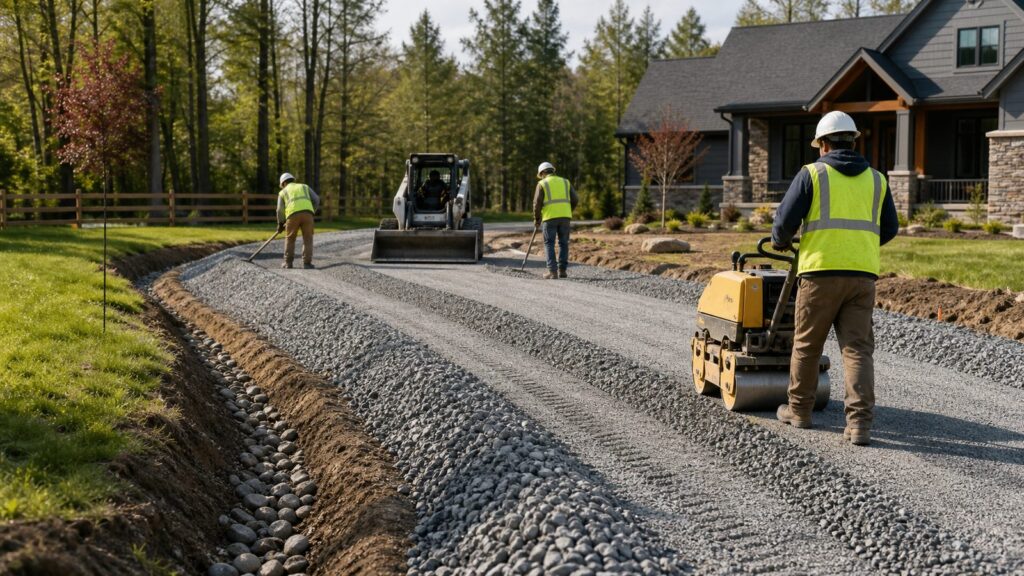
On our job sites, we approach a gravel driveway like a small private road. First we decide where water will go. Then we cut and compact the subgrade. Then we build the driveway in aggregate layers, usually 6 to 12 inches total for a durable residential section, adjusting depth for soil, slope, and vehicle load. That sequence matters more than the color of the top stone.
Start With the Driveway Layout and Use
Before ordering stone, decide what the driveway has to do. A short, straight, single-car driveway on firm sandy soil is a different project from a 400-foot rural driveway crossing clay, carrying delivery trucks, and draining toward a county road.
#1 Best Overall

- 【5OZ Driveway Fabric】-Our 5 Ounce Heavy Duty Geotextile made from High-Quality Polyethylene Material,tear-resistant, sturdy and durable.
- 【Large Geotextile Fabric】- Our commercial-grade driveway fabric is Length: 115FT,Wide:13FT, 5oz.,High-quality fabrics have significant advantages,such as high elasticity and durability.
- 【Excellent Permeable Textile】- The woven geotextile fabric is highly permeable and breathable, without worries about water pooling. It is ideal for french drains, garden planting, and landscaping,to provide convenience on the driveways.
- 【Safety and Sturdiness】-800 LBS Tensile Strength,The underlayment fabric is high-strength and stretchable with a large weight capacity. Will last many years and stands up to the toughest conditions,You can lay gravel, stones, big rocks on it to increase the stability and flatness of the road and prolong its service life.
- 【Wide Applications】-Can be used for many different projects including Landscaping, geotextile fabric is perfect for construction projects, Erosion Control,such as road stabilization, riprap, retaining walls, animal stables, patio landscaping, etc.
Typical residential driveway width is 10 to 12 feet for a single vehicle lane. If two vehicles need to pass, park side by side, or turn around, plan on 18 to 20 feet or more in the parking and turnaround areas. For long rural drives, we often keep the travel lane efficient and then widen only where it is useful: at the garage, a guest parking pad, a delivery truck pull-off, or a turnaround.
Do not guess at the apron width near the street. Local rules often control the allowed driveway width in the right-of-way, the culvert size, the entrance flare, and the slope where the driveway meets the public road. Some municipalities also regulate whether gravel counts toward impervious area, where runoff may discharge, and whether work in the right-of-way requires an inspection.
Quick wins for a faster PC:
Fix the driver behind crashes, sound loss and screen glitchesFind Drivers →Repair Windows errors before they cause bigger problemsFix Now →Plan for the heaviest vehicle, not the daily vehicle
A driveway that handles a sedan in July may fail under a loaded concrete truck, moving truck, propane truck, fire apparatus, or RV. The weak spots are predictable: the entrance apron, curves, steep sections, parking pads, and areas where heavy vehicles brake or turn. Those areas should receive a deeper base section, better drainage, and tighter compaction.
For a light-duty residential driveway on good soil, total aggregate depth might be 4 to 6 inches after compaction. For a more durable residential driveway, 6 to 12 inches is a better working range. Wet soil, clay, frost movement, steep grades, construction traffic, and long rural access roads push the design toward the deeper end.
Understand Gravel Driveway Cost in 2026
Gravel is usually the lowest-cost new driveway surface, but the range is wide because the driveway is mostly site work. Stone is only one part of the price. Excavation, grading, drainage, Geotextile fabric, compaction, equipment access, and hauling distance can swing the final number substantially.
| Project type | Typical 2026 cost range | What is usually included |
|---|---|---|
| Basic resurfacing or top-dressing | $1 to $3 per sq. ft. | New gravel over an existing usable base, light grading, spreading |
| New professional gravel driveway | $4 to $10 per sq. ft. | Excavation, shaped subgrade, base stone, top layer, grading, compaction |
| Material-only gravel | $15 to $75 per ton common national range | Stone only; delivery, placement, and compaction may be separate |
| Quarter-mile rural gravel drive, 12 ft. wide | About $15,000 to $60,000 | Large material volume, grading, drainage, hauling, equipment time |
| Asphalt driveway comparison | About $5 to $12+ per sq. ft. | Higher initial cost, smoother paved surface, periodic sealing |
| Concrete driveway comparison | About $6 to $15+ per sq. ft. | Higher initial cost, rigid slab, longer service life when well built |
A small 12-by-25-foot single-car gravel drive may be a few hundred dollars to around $900 in lower-scope estimates if the site is simple. A standard two-car driveway often lands around $600 to $3,600 depending on depth, prep, material, and local rates. Those smaller numbers usually assume limited excavation and a straightforward site. If the project needs a full road-base section, fabric, culvert work, ditching, or removal of a failed surface, budget from the higher installed range.
The Tool Desk
Outbyte PC Repair FREEClear out junk files and repair common Windows errorsFree Scan →Outbyte Driver Updater FREEScan for outdated or missing drivers - takes under a minuteDriver Scan →The cost drivers are practical: length, width, excavation depth, removal of topsoil or old pavement, subgrade quality, aggregate depth, stone type, delivery distance from the quarry, labor and equipment rates, compaction requirements, drainage improvements, edging, stabilization grids, permits, culverts, and apron work.
Choose the Right Gravel Layers
A long-lasting gravel driveway is usually built in layers. The layers may vary by region and quarry products, but the job of each layer stays the same: separate the soil, spread the load, drain water, and create a compact driving surface.
Subgrade
The subgrade is the existing soil after topsoil, roots, loose organic material, and unsuitable soft material have been removed. It must be shaped to the same crown or cross-slope you want in the finished driveway. If the subgrade is flat, wet, and rutted, the stone above it will eventually follow that shape.
Geotextile fabric
Geotextile fabric is not required on every driveway, but it is useful over clay, soft soil, wet areas, and previously rutted ground. It separates soil from aggregate so the base stone does not sink into mud and the soil does not pump upward into the stone layer. We use it where the soil tells us it will save future maintenance. Seams should overlap, and the fabric must be covered with enough aggregate so tires, grader blades, and rakes do not expose or tear it.
Free tools Windows power users keep installed
One-click scans. No signup required.
Base stone
The base layer should use larger angular crushed stone that spreads loads and provides structure. Depending on local supply, this may be a 2-inch minus material, 3-inch stone, or a comparable road-base aggregate. On soft sites, the base is where you spend money first. A pretty top layer over a weak base is still a weak driveway.
Intermediate layer
An intermediate crushed stone layer bridges the coarse base and the finer surface. It helps tighten the section, improves grade control, and reduces the amount of expensive top material needed.
Top layer
The driving surface should usually be angular and well graded, with enough fines to compact and bind. Crusher run, dense-grade aggregate, crushed limestone, and decomposed granite can all work depending on region and availability. Clean stone drains well, but it does not lock together as tightly. Rounded pea gravel looks attractive, but it rolls under tires and migrates unless it is confined with edging or stabilization grids.
Design Drainage Before You Spread Stone
Drainage is the difference between a gravel driveway that needs normal maintenance and one that fails every storm. Water trapped in tire paths causes potholes, rutting, washboarding, aggregate loss, and freeze-thaw damage. The driveway surface should shed water quickly, and the surrounding site should move that water away without sending it onto a neighbor, into a garage, or across a public road.
Rank #2

- Commercial Woven Driveway Fabric: This heavy duty geotextile fabric under gravel made of 5.2oz thickness high-density durable PP material, covers 1560 sq.ft (13x120ft) large coverage area for versatile use in driveways, landscaping and gardening. It’s tear-resistant, flexible enough to conform to uneven surfaces, and built to withstand heavy gravel, stones, and constant outdoor exposure for long-lasting performance
- 900 LBS Tensile Strength Landscaping Fabric: our ground cover weed barrier boasts 900 LBS tensile strength, engineered to handle extreme weight and stress. It reinforces soil stability, prevents driveway deformation, and stays flat under heavy loads—ideal for supporting gravel, rocks, or vehicles while extending your driveway or patio's service life
- Freely Cut & Use: This weed fabric size is 13x120ft (5.2OZ), it design with green guide lines, adopts a freely cuttable. You can easily cut the landscape fabric into the ideal size, or achieve expansion by combining multiple pieces to cover a larger area. The heavy duty weed blocker fabric meets the needs of various scenarios and avoids material waste
- Weed Control Fabric & Soil Protection: Garden weed barrier fabric heavy duty can block out sunlight, control weeds growth. While letting water, air, and nutrients reach plant roots. It keeps soil moist, reduces erosion, and eliminates harmful herbicides, creating a healthier, more productive growing environment for your garden, landscape, lawn, farm etc.
- Wide Application: This weed block road fabric is available for residential and commercial road construction projects: driveway stabilization, erosion control, retaining walls, French drains, garden weed barriers, greenhouse flooring, and more. Weed cloth for garden is the all-in-one solution for contractors, landscapers and DIY homeowners
A practical target for many gravel driveways is a 2% to 4% crown or cross-slope. Another field rule is roughly 1/2 inch of fall per foot of width on gravel road sections. For a 12-foot-wide driveway with a center crown, that can mean the edges sit about 3 inches lower than the centerline. The exact slope depends on the site, but the principle is fixed: build the slope into the subgrade and every aggregate layer, not just the final skim of gravel.
There are two common grading approaches. A crowned driveway is highest in the middle and drains to both sides. A cross-sloped driveway drains in one direction, which may be better when one side has a ditch, swale, or lower ground. Flat is the option to avoid.
Ditches, swales, and culverts
On rural or sloped sites, the driveway may need ditches or swales to intercept and carry runoff. Where water crosses the drive, use a properly sized culvert or cross-drain rather than letting water run over the surface. At the street, many counties and municipalities require driveway permits and culvert approval before work begins. That requirement can apply even when the driveway surface itself is gravel.
Culverts need correct diameter, slope, cover depth, end protection, and clean outlets. A crushed culvert, buried outlet, or undersized pipe will back water into the driveway base and create a soft spot that never fully stabilizes.
Recommended Free Tools
Step-by-Step: How to Make a Gravel Driveway
The exact process varies by site, but this is the sequence we use for a durable residential gravel driveway.
1. Mark the layout
Stake the driveway centerline, edges, apron, parking areas, curves, and turnaround. Confirm the finished width before equipment arrives. A 10- to 12-foot lane works for one vehicle, but curves and turns need extra width so tires do not chew up the shoulders.
2. Check permits and utility locations
Call 811 before excavation. Check local rules for driveway entrances, culverts, right-of-way work, stormwater discharge, and apron dimensions. If the driveway connects to a county or municipal road, do this before ordering materials. A required culvert or apron detail can change the budget and the excavation plan.
3. Strip topsoil and organic material
Remove grass, roots, loose topsoil, mulch, and organic material. Organic soil holds water and decays, which causes settling and soft spots. For a new driveway, excavation depth should account for the compacted aggregate section. If you want 8 inches of finished stone, you need enough cut to place and compact those layers while ending at the correct final elevation.
Do these 3 things before closing this tab:
1Repair Windows errors before they cause bigger problems2Fix the driver behind crashes, sound loss and screen glitches3Clear out junk files and repair common Windows errors4. Shape the subgrade
Grade the soil to the planned crown or cross-slope. Remove high spots, fill low spots with suitable compactable material, and avoid burying soft pockets under stone. If the soil is saturated, wait for drier conditions if the schedule allows. Saturated subgrade is difficult to compact and easy to rut.
5. Compact the subgrade
Use a plate compactor for small residential areas and a roller for larger drives. The subgrade should feel firm before fabric or stone goes down. If equipment leaves deep tire ruts, the soil is telling you the base design needs attention.
6. Install geotextile where needed
Roll out geotextile fabric over soft, clay-heavy, wet, or questionable subgrade. Overlap seams according to the fabric supplier’s recommendations, commonly 12 to 24 inches depending on conditions. Keep the fabric tight enough to avoid folds, and place stone carefully so equipment does not drag or tear it.
7. Place the coarse base layer
Spread the base stone evenly and maintain the crown or cross-slope. For heavier-use driveways, this layer may be 4 to 8 inches compacted, sometimes more at entrances, curves, steep grades, and truck areas. Do not place a thick, loose lift and assume the surface compactor will tighten the full depth. Thick loose stone bridges on top and stays unstable below.
Windows Errors? Fix Them Before They Spread
Repair common Windows errors and clear accumulated junk for a smoother, more stable PC - no reinstall needed.Free scan · no reinstallCrashes, No Sound, or Screen Glitches?
Random freezes, missing sound and display glitches usually trace back to one bad driver. Find and replace yours safely.Free scan · under a minute8. Compact in lifts
Compact each lift before adding the next. A practical lift thickness for small equipment is often 3 to 4 inches compacted, though the correct lift depends on material size, moisture, and compaction equipment. Add water lightly if the material is too dry to bind, but do not flood it.
Rank #3

- HEAVY DUTY ROAD FABRIC: Our woven polypropylene fabric is a true 4 oz, ensuring superior strength and durability for driveway and road stabilization. Don't settle for lighter weights when you can have the best.
- EASY INSTALLATION: Save time and money with our driveway barrier fabric. We stock a variety of sizes to minimize scrap, allowing you to cut one single piece to exact dimensions, making installation a breeze. NOTE: Due to shipping restrictions, this size shiped folded
- LONG-LASTING PERFORMANCE: Our heavy-duty road / Driveway fabric is built to withstand the toughest conditions and will last for many years. It is dimensionally stable and made to last up to 50 years if properly buried, providing you with lasting results.
- VERSATILE APPLICATIONS: Our polypropylene geotextile fabric has countless uses. Whether it's construction underlayment, gravel roads, sidewalks or driveway underlayment, paver and retaining wall projects, ground cover, weed barrier, or construction projects, our fabric delivers outstanding performance.
- SUPERIOR QUALITY: Choose Super Geotextile for the highest quality products on the market. We take pride in offering superior quality materials that are reliable, durable, and designed to meet your specific needs.
9. Add the intermediate layer
Place a smaller crushed aggregate over the base, shape it, and compact it. This layer fills voids, improves the driving profile, and creates a tighter platform for the surface course.
10. Add and compact the top layer
Finish with 2 to 4 inches of dense-grade crushed material, crusher run, crushed limestone, or another locally appropriate driveway mix. Keep the final surface crowned or sloped. Compact until the surface is tight and tires do not shove loose stone into ridges.
11. Dress the edges and drainage outlets
Blend shoulders so water can leave the driveway. Do not leave raised gravel berms along the edges; they trap water in the wheel paths. Open ditch outlets, protect culvert ends, and make sure runoff has a path away from the driveway structure.
What’s actually slowing this PC down?
Pick the symptom - the matching free tool is one click away.
Best Gravel for a Driveway
The best gravel for a driveway is usually angular crushed aggregate, not smooth river rock. Angular pieces lock together under compaction. A well-graded mix, meaning it includes different particle sizes and fines, creates a tighter surface for vehicle traffic.
Common driveway choices include crusher run, dense-grade aggregate, crushed limestone, crushed granite, road base, and decomposed granite in suitable regions. The best local option often depends on what nearby quarries produce reliably. Local availability matters because hauling can cost as much as, or more than, the material.
Pea gravel and rounded decorative stone can work for borders, garden areas, and low-traffic decorative zones, but they are poor primary drive surfaces unless confined. Under tires, rounded stone behaves like marbles. It migrates into lawns, collects at the apron, and can be difficult to plow in snow regions.
For steep driveways, loose stone alone may not be enough. Consider stabilization grids, larger angular aggregate, cross-drains, water bars, chip seal, asphalt, or another surface that can resist downhill migration and braking forces. A steep gravel driveway must be designed for erosion, not just traction.
When to DIY and When to Hire a Pro
A gravel driveway can be a reasonable DIY project when the scope is small, the site is dry and firm, drainage is already working, and you are refreshing an existing base. A homeowner with a compact tractor, skid steer experience, laser level or transit, and access to a plate compactor can often handle top-dressing, minor reshaping, and small parking pads.
Hire a pro when the project requires excavation, subgrade correction, culvert installation, ditching, steep-grade work, long rural driveway construction, heavy truck access, or precise drainage around buildings. Also hire a pro if the driveway connects to a public road and the permit requires approved apron or culvert work. Mistakes at the entrance can create liability, fail inspection, or wash aggregate into the road.
Equipment is the real dividing line. Shovels and rakes are fine for dressing the last inch or two. They are not efficient for cutting grade, moving 20 tons of stone, or compacting a structural base. One tandem dump truck can carry roughly 12 to 20 tons depending on local limits and material. Even a modest driveway can require multiple loads.
Independent reader supportYour contribution helps us test, update, and keep practical guides available for everyone.Maintenance: What a Gravel Driveway Needs After Installation
Maintenance is part of owning gravel. Expect periodic raking, regrading, pothole filling, weed control, edge cleanup, and top-dressing every few years depending on traffic, slope, rainfall, and snow removal. A well-built driveway needs less maintenance, but it is never maintenance-free.
After major storms, inspect low spots, ditch outlets, culvert ends, and tire paths. Early repair is cheaper than rebuilding a failed section. If you see standing water, exposed fabric, recurring potholes, or stone washing into the yard, address the drainage first. Adding more gravel to a wet low spot usually creates a thicker wet low spot.
For potholes, cut out the loose material, square up the weak area, add properly graded aggregate, and compact it. Filling the depression with loose stone without correcting the soft base usually lasts until the next rain or freeze-thaw cycle.
Rank #4
- HEAVY DUTY WOVEN DRIVEWAY FABRIC: True 4 oz woven geotextile with 200 lb rated tensile strength; strong enough for cars and trucks to drive on; stabilizes gravel driveways and roads
- UNDER GRAVEL: Lay this woven geotextile fabric under gravel or rock for separation and stability; helps avoid ruts and potholes in driveways, roads, paver bases and sidewalks
- LONG LASTING: Heat-sealed ends keep the edges from unraveling; dimensionally stable; made to last up to 50 years when properly buried
- EASY TO INSTALL: Save time and money; we stock many sizes to cut down on scrap, so you can use one single piece cut to exact dimensions; this size ships folded
- RIGHT FABRIC FOR THE JOB: Woven geotextile separates and stabilizes under driveways and roads; for French drains and water filtration choose our Super Geotextile Non Woven fabric
Common Gravel Driveway Mistakes
The biggest mistake is skipping excavation of topsoil and organic material. Grass and topsoil are not a base. They hold moisture, compress unevenly, and invite weeds. The next mistake is building the driveway flat. A flat gravel surface holds water, and water is what causes most rutting and potholes.
Another common mistake is using the wrong stone. Rounded gravel may look clean on day one, but it does not compact into a stable drive lane. For vehicle traffic, angular crushed aggregate is usually the better choice.
What’s actually slowing this PC down?
Pick the symptom - the matching free tool is one click away.
We also see homeowners try to fix mud by adding thin layers of clean stone. If the subgrade is pumping mud, the stone disappears into the soil. That is where excavation, geotextile fabric, and a proper base layer matter.
Finally, many projects underbuild the entrance. The apron takes turning, braking, plowing, delivery trucks, and public-road runoff. It is one of the first places to fail, so it deserves more base, better compaction, and careful drainage.
Gravel Driveway Build Checklist
Use this checklist before installation:
- Confirm driveway width, parking layout, turnaround, and apron dimensions.
- Check permits for driveway entrance, culvert, right-of-way work, and stormwater rules.
- Call 811 before digging.
- Remove topsoil, roots, and organic material.
- Shape the subgrade with a 2% to 4% crown or cross-slope where appropriate.
- Compact the subgrade before placing stone.
- Use geotextile fabric over soft, wet, clay-heavy, or rutted soil.
- Build enough aggregate depth: commonly 6 to 12 inches total for a durable residential section.
- Use angular crushed aggregate for structural and driving layers.
- Compact stone in lifts, not one thick loose layer.
- Keep shoulders and outlets open so water can leave the surface.
The Bottom Line
A good gravel driveway is not complicated, but it is unforgiving. The soil must be firm, the water must have somewhere to go, and the aggregate must be placed in compacted layers. Spend the budget on drainage, base depth, and compaction before decorative stone. That is how you get a driveway that holds shape under traffic instead of turning into ruts, potholes, and washouts.
For a simple resurfacing job, gravel can be a low-cost weekend project. For a new driveway, a long rural drive, a wet site, or any driveway that needs culverts and grading, professional site work is usually the better value. The driveway may look like rock on the surface, but its performance is built underneath.
Frequently Asked Questions
How deep should a gravel driveway be?
A durable residential gravel driveway is commonly 6 to 12 inches deep in total compacted aggregate. Light-duty resurfacing may use less, while wet soil, clay, steep grades, RVs, delivery trucks, or construction traffic usually need a deeper base.
What is the best gravel for a driveway?
Angular crushed aggregate is usually best for the driving surface because it locks together under compaction. Crusher run, dense-grade aggregate, crushed limestone, crushed granite, road base, and decomposed granite can all work depending on local supply.
How much does a gravel driveway cost in 2026?
Basic resurfacing or short DIY-friendly work often runs about $1 to $3 per square foot. A professionally built new gravel driveway with excavation, grading, base stone, and compaction is more often $4 to $10 per square foot. Complex drainage, poor soil, culverts, or long rural drives can cost more.
Do I need a permit to install a gravel driveway?
Possibly. Many local governments regulate driveway entrances, culverts, apron dimensions, right-of-way work, stormwater discharge, and road connections. Check local requirements before excavation, especially if the driveway meets a public road.
Should I put geotextile fabric under a gravel driveway?
Use geotextile fabric when the subgrade is clay-heavy, soft, wet, or previously rutted. It separates soil from aggregate, reduces pumping, and helps keep the base stone from sinking into the soil.
How do you keep a gravel driveway from washing out?
Build drainage into the driveway from the start. Use a crown or cross-slope, keep shoulders open, install ditches or culverts where needed, use angular compacted aggregate, and inspect low spots and outlets after major storms.
Quick Recap
Product prices and availability are accurate as of the date/time indicated and are subject to change. Any price and availability information displayed on Amazon at the time of purchase will apply.

