Some links on this page are affiliate links: if you buy through them we may earn a commission, at no extra cost to you.
Verdict: The Bluetti EB3A is still a capable compact power station, but it is no longer an automatic recommendation. Its 268.8Wh LiFePO4 battery, 600W inverter, 100W USB-C port, solar input, wireless charging and broad port selection make it useful for camping, construction-site electronics and short outages. Buy it when substantially discounted and when those features matter. Skip it for critical UPS duty, long-duration backup, high-wattage appliances or situations where newer charging and warranty provisions justify a modestly higher price.
What the Bluetti EB3A is
Launched in 2022, the EB3A is a small portable power station designed for electronics rather than household appliances. The U.S. version combines a 268.8Wh LiFePO4 battery with two 120V AC outlets, a 600W continuous inverter, 1,200W surge rating, USB-C Power Delivery up to 100W, USB-A, 12V DC outputs, wireless charging and solar charging. It weighs approximately 10.14lb and measures about 10.04 × 7.09 × 7.20 inches.
As an Amazon Associate I earn from qualifying purchases.
That makes it practical for keeping phones, laptops, lights, routers, cameras and other low-power equipment running. It does not turn a small battery into a whole-home generator: a 600W appliance can theoretically exhaust 268.8Wh in less than 30 minutes, and real runtime is shorter after conversion losses and reserve capacity are accounted for.
Specifications vary by region. European and other international versions use different AC voltages and outlet arrangements, and UPS specifications are not necessarily identical. Confirm the exact regional model before buying; a 220–240V version is not a substitute for a U.S. 120V unit. See Bluetti’s regional specifications and the EB3A manual.
Popular on Amazon

- [288Wh On-the-Go Power] - Only 9.4 lbs lightweight, carry it anywhere during storms! 288Wh capacity meets daily & outdoor needs—camping, road trips, beach visits, or home emergencies. Extend your smart green energy life to every corner of your ideal lifestyle with this compact entry-level power station.
- [600W Continuous & 1500W Surge Power] - Get a full 600W output—twice as much as others. When you need serious power, activate Power Lifting Mode for 1500W power (vs. the typical 600W). It runs everything from essential camping lights, speakers, and car fridges to critical devices like laptops and CPAP machines and even a small kettle or toaster—ideal for stormy days at home or outdoor trips.
- [50% Lower Power Consumption] - Upgraded UltraCell tech & smart cooling system cut power consumption by 50%. Enhances overall energy efficiency, extends device runtime. Excellent durability & environmental adaptability for extreme outdoor climates and long-term operation.(Standby power only 4.5W, DC 5W, AC 8W)
- [8 Charging Modes & 380W Fast Wall Charge] - Supports AC wall charge (380W/200W adjustable), solar, car charging, etc. 0-80% in 45 mins, 0-100% in 70 mins (battery-safe). Match PV60L solar panel for on-the-go recharging. Flexible charging solutions for city, wilderness, daily or emergency scenarios.
- [Reliable UPS] - Never lose data or stop your devices during winter storms/blackouts! 10ms ultra-fast UPS switch protects CPAP, laptops, routers—critical for home emergencies when power cuts suddenly.
Key U.S. specifications
| Feature | EB3A specification |
|---|---|
| Battery capacity | 268.8Wh |
| Battery chemistry | LiFePO4 |
| AC output | 600W continuous; 1,200W surge |
| AC outlets | Two 120V outlets |
| USB-C | Up to 100W PD 3.0 |
| Other outputs | Two USB-A, 12V car socket, two DC5521 ports, wireless charging pad |
| Solar input | 12–28V DC, up to approximately 200W under published conditions |
| Weight | Approximately 10.14lb / 4.6kg |
| Operating discharge temperature | Approximately −4°F to 104°F |
| Charging temperature | Approximately 32°F to 104°F |
What can it realistically run?
For planning purposes, estimate AC runtime with:
Runtime in hours ≈ battery capacity in Wh × conversion efficiency ÷ device wattage
Using an illustrative 85% efficiency assumption gives roughly 215–242Wh of usable AC energy from a full battery. These are calculations, not guaranteed measurements. Actual results depend on inverter overhead, temperature, battery condition, cable losses, the device’s true consumption and the station’s cutoff settings.
The Tool Desk
Outbyte PC Repair FREEClear out junk files and repair common Windows errorsFree Scan →Outbyte Driver Updater FREEFix the driver behind crashes, sound loss and screen glitchesFind Drivers →| Load | Estimated runtime |
|---|---|
| 10W router | Approximately 21–24 hours |
| 15W router and modem setup | Approximately 14–16 hours |
| 40W CPAP load | Approximately 5–6 hours |
| 65W laptop | Approximately 3–3.5 hours |
| 100W load | Approximately 2–2.5 hours |
| 300W load | Approximately 40–45 minutes |
| 600W load | Approximately 20–25 minutes |
Suitable uses include phones, tablets, laptops, LED lighting, camera and drone batteries, Wi-Fi equipment, small fans, televisions and compatible low-power camping gear. A CPAP may be practical, but runtime depends heavily on the machine, pressure, heated humidifier and tubing settings. Do not treat the EB3A as medically approved backup equipment.
Space heaters, kettles, hair dryers, toasters, induction cooktops, microwave ovens, large refrigerators and high-powered tools are poor matches. Motors and compressors may also require more startup power than their running wattage suggests, so the 1,200W surge rating is not a guarantee that every appliance will start.
Ports are the EB3A’s strongest feature
The EB3A offers more connection options than many small power stations. The 100W USB-C output can power many laptops and tablets while avoiding the extra conversion step of using the AC inverter. Actual charging speed depends on the computer, cable, USB-C power profile and workload. One independent review identified USB-C charging as a weakness during testing, so buyers should verify compatibility with their own equipment rather than assuming every laptop will charge at 100W.
AC, DC, USB and wireless outputs can be used together within the station’s total limits. The wireless pad may be slower or unreliable through thick cases or when the phone is misaligned. Compatible 12V equipment can be more efficient through the DC outputs than through an AC adapter.
Quick wins for a faster PC:
Repair Windows errors before they cause bigger problemsFix Now →Scan for outdated or missing drivers - takes under a minuteDriver Scan →Charging, solar input and heat
The EB3A supports wall, solar, vehicle and generator charging, as well as certain combined-input arrangements. Bluetti describes six charging methods, but the unit has one DC input, so users cannot combine every possible DC source simultaneously. AC plus solar and AC plus vehicle charging are the relevant combinations described by Bluetti’s support documentation.
The published solar input range is 12–28V DC and up to approximately 200W. A panel’s headline wattage is not a continuous promise: sunlight, orientation, shading, temperature, cable losses and panel operating voltage all affect output. Check the panel’s open-circuit voltage and connector polarity before connecting it, and keep the input within the EB3A’s limits. A panel rated at 200W will rarely deliver 200W continuously in ordinary outdoor conditions.
Also popular on Amazon
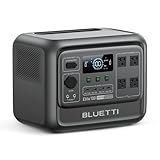
- [1800W Power for Everyday Essentials] - BLUETTI Elite 100 V2 features a 1024Wh capacity and 1800W rated AC output (2700W Power Lifting), easily powering up to 90% of everyday appliances. With 11 ports, it can charge multiple devices simultaneously—perfect for camping, emergencies, and home backup.
- [45-Minute Rapid Charging] – Powered by advanced 1200W TurboBoost AC fast-charging tech, this solar generator reaches 80% charge in roughly 45 minutes. Ultra-fast vehicle charging is also available: connect with BLUETTI Charger 1 to unlock up to 6x faster charging, so you can count on stable power wherever your road trips and off-grid journeys take you.
- [10ms UPS Backup & Whisper-Quiet] - Designed for home reliability, the built-in 10ms UPS switchover keeps Wi-Fi routers and PC running during outages. In silent mode it runs at just 30dB, 50% quieter than other 1kWh power stations —great for overnight camping or indoor use.
- [35% Smaller, 30% Lighter] - At only 25 lbs with a compact 17L design, the Elite 100 V2 is built for effortless portability. Grab it one-handed by the hidden handle for easy transport, from home to campsite and off-grid cabin.
- [Smart App Control] - Control your power station anytime, anywhere, the BLUETTI App supports Wi-Fi & Bluetooth connectivity that makes remote monitoring, managing power consumption, and OTA updates incredibly convenient. Equipped with ultra-safe LiFePO₄ batteries, it offers over 4,000 life cycles to 80%, providing a reliable 10-year lifespan for everyday use.
Charging time varies by input, mode and region. Fast-charging claims generally involve ideal conditions, a special charging mode or combined AC-and-solar input. They should not be interpreted as ordinary wall-charging time. The manual and current support page are the appropriate references for the exact regional configuration.
The active cooling fan can run during AC charging, high AC loads, simultaneous charging and discharging, fast charging or hot weather. Independent reviews reported roughly 46–48dB in particular test conditions, but that is not a universal operating specification. The sound may be acceptable outdoors yet intrusive beside a bed or desk. A quieter mode may reduce charging power rather than eliminate heat. Use the station on a hard, unobstructed surface rather than inside a bag or cabinet.
Free tools Windows power users keep installed
One-click scans. No signup required.
UPS and passthrough: useful, but not mission-critical
The EB3A supports a UPS/passthrough mode: with wall power connected, equipment can receive power through the station while the battery remains available. That does not establish zero-transfer-time operation, online-UPS behavior or medical-grade suitability. Bluetti’s U.S. documentation does not provide a clearly published universal transfer-time figure for the U.S. model, and the company’s regional specifications differ.
Independent coverage and owner reports describe occasional passthrough interruptions, clicking or repeated transitions into UPS mode, charging-related behavior and battery-percentage changes. These are documented observations and user reports, not controlled evidence that every EB3A has the same fault. They are nevertheless important if a computer, network storage device or other sensitive equipment depends on uninterrupted power.
How to test it with your own equipment
- Fully charge the EB3A and connect the equipment that matters.
- Enable AC output and confirm that the equipment operates normally.
- Remove wall power repeatedly under light and moderate loads.
- Repeat while the EB3A is charging.
- Watch for reboots, flickering, relay clicking, overload warnings or loss of output.
- Repeat after any firmware update.
Do not rely on this procedure to make the EB3A suitable for life-support or other critical medical applications. Avoid casually daisy-chaining it with another UPS or inverter; compatibility problems can cause clicking, instability or charging faults.
Battery life and maintenance
The LiFePO4 chemistry is a positive feature, offering better cycle-life expectations and thermal stability than many older conventional lithium-ion designs. Bluetti and independent coverage describe a rating of approximately 2,500 cycles to 80% capacity. That is a test-condition rating, not a promise that every battery will reach exactly 2,500 cycles or retain exactly 80% capacity.
What’s actually slowing this PC down?
Pick the symptom - the matching free tool is one click away.
Heat, deep discharges, prolonged storage at full charge, sustained high loads, high-power charging, calendar age and meter calibration all influence real battery life. Store the unit somewhere dry and temperature-controlled, avoid charging below the published temperature range, and do not leave it in a hot vehicle. Inspect the casing, ports and cables periodically. Stop using the unit if it swells, smokes, emits an unusual odor or becomes severely hot; do not open or repair the battery pack yourself.
App, firmware and common problems
The Bluetti app can monitor the EB3A and change certain settings. Firmware has been relevant to charging and UPS behavior, but firmware numbers vary by unit and update history. Check the current version directly in the app rather than relying on numbers quoted in old forum posts.
Also popular on Amazon

- [Charged in 1 Hour] - The AC180 packs a 1152Wh LiFePO4 battery, which can be fully charged in just 1 hour at 1440W AC input - always ready to go when you need it.
- [Power All Your Needs] - The AC180 boasts 1800W output and 8 outlets to handle almost anything you plug in. With a tap on the BLUETTI App, you can give it a boost to 2700W for your higher needs.
- [Solar Fast Charge] - With a 500W solar input, you can charge this solar generator in 2.8-3.3 hours using only solar energy. Add an AC source and you can reduce the time to 1 hour.
- [Reliable UPS] - More than an outdoor power source, the AC180 can also be used as a rugged home battery backup - providing emergency power to your essentials in 20 ms.
- [What You Get] - BLUETTI AC180 portable power station, AC charging cable, car charging cable, solar charging cable, user manual, 5-year warranty and friendly customer service.
For charging or output problems:
- Confirm the input source, adapter and cable are correct.
- Check the display for temperature, overload or other warnings.
- Disconnect all loads and try a normal AC charge from another outlet.
- Let the unit cool to its published operating range.
- Check the app for an available firmware update.
- Update only with stable power and according to Bluetti’s instructions.
- Retest with a small load before reconnecting expensive equipment.
- Contact Bluetti support if charging remains intermittent, the percentage behaves implausibly or the unit overheats.
A jumping battery percentage can result from meter calibration, firmware behavior, protection logic or a failing battery-management system; it is not by itself a diagnosis. If solar charging does not start, check panel voltage, actual sunlight, adapter polarity, shading, connector fit and whether an incompatible controller is in the circuit.
Independent reader supportYour contribution helps us test, update, and keep practical guides available for everyone.EB3A versus newer alternatives
The EB3A’s value depends heavily on the price gap. It is an older platform, while newer products may offer faster charging, longer warranties, more modern firmware and more clearly specified UPS behavior.
Do these 3 things before closing this tab:
1Clear out junk files and repair common Windows errors2Scan for outdated or missing drivers - takes under a minute3Repair Windows errors before they cause bigger problemsEcoFlow RIVER 2
The base EcoFlow RIVER 2 is a relevant comparison because it occupies the same small-power-station category. EcoFlow lists a five-year warranty and a 3,000-cycle claim to 80% capacity. It may be the better choice for buyers prioritizing a newer platform, warranty length and everyday simplicity. However, it is not a specification equivalent: the EB3A may be preferable if you need a 600W inverter, two U.S. AC outlets, 100W USB-C, wireless charging or its broader port selection. See the official RIVER 2 page.
Newer Bluetti models
A current Bluetti small-format model may provide faster AC charging, newer controls, updated firmware and improved UPS specifications. One 2026 review describes the Elite 30 V2 as a 288Wh, 600W model with 1,500W Power Lift mode, 140W and 100W USB-C outputs and a claimed 10ms UPS mode. Verify the official listing, regional availability, warranty and current price before treating it as a direct buying recommendation; specifications and availability can vary by country.
Jackery Explorer 300-class models
Jackery’s Explorer 300 name covers different generations and regional specifications. These products may appeal to buyers who value simple controls, broad retail availability and familiar camping use. Compare the exact model rather than assuming all Explorer 300 units have the same capacity, ports, inverter or battery chemistry.
Who should buy the EB3A?
- Campers and van users: Good for phones, lights, cameras, laptops and modest 12V equipment.
- Short outages: Useful for routers, modems, phones, lights and laptops.
- Construction and field work: Practical for charging tools’ small batteries, phones, inspection equipment and low-power lighting, provided heavy tools are not connected.
- Photography and events: The port variety and 100W USB-C output are useful for camera batteries, laptops and accessories.
- CPAP users: Potentially suitable for short use after calculating the exact machine’s consumption, but not a substitute for medically approved backup planning.
Who should avoid it?
- Anyone needing a guaranteed, mission-critical computer or medical UPS.
- Anyone running heaters, kettles, microwaves, hair dryers or other high-wattage appliances.
- Anyone needing refrigerator or household backup for many hours or days.
- Buyers who want expandable capacity or a current-generation platform.
- Buyers whose local price is close to a newer station with a longer warranty or better-documented UPS behavior.
Buying checklist
- Calculate your real load in watts and expected runtime in watt-hours.
- Compare usable energy, not only the advertised battery capacity.
- Check continuous output and startup surge requirements.
- Confirm USB-C wattage and compatibility with your laptop.
- Verify AC charging speed and solar voltage limits.
- Check UPS transfer behavior for your region and equipment.
- Compare warranty, support and retailer return terms.
- Confirm the model’s AC voltage and outlet configuration.
- Buy only if the EB3A is meaningfully cheaper than newer alternatives, unless its ports and 600W inverter are specifically valuable to you.
Final verdict
The Bluetti EB3A remains a versatile small power station rather than a bad product. Its LiFePO4 battery, 600W inverter, 100W USB-C output, solar capability and unusually broad port selection still make it attractive for camping, construction-site electronics and short outages. But its limited capacity, fan noise, aging platform and less-certain UPS behavior matter more in 2026 than they did at launch.
Buy it if the price is substantially below newer models and your priority is flexible power for non-critical electronics. Choose a newer unit if the price gap is small, you need a longer warranty or you care about refined UPS and charging behavior. Choose a much larger system for appliances, refrigeration or whole-home backup.
Quick Recap
Product prices and availability are accurate as of the date/time indicated and are subject to change. Any price and availability information displayed on Amazon at the time of purchase will apply.

