Do these 3 things before closing this tab:
1Repair Windows errors before they cause bigger problems2Scan for outdated or missing drivers - takes under a minute3Clear out junk files and repair common Windows errorsSome links on this page are affiliate links: if you buy through them we may earn a commission, at no extra cost to you.
A window heat pump is one of the least invasive ways to add electric cooling and heating to a single room, apartment zone, addition, garage office, or older home that central HVAC does not serve well. The best models in 2026 are not just window air conditioners with a heat button. The top choices use inverter compressors, manage condensate properly, fit the window securely, and keep producing useful heat as outdoor temperatures fall.
Here is the contractor-level answer up front: for serious heating in a cold climate, look first at true cold-climate saddle-style units such as the Gradient All-Weather 120V Window Heat Pump or the Midea Packaged Window Heat Pump. For mild climates, a lower-cost inverter window air conditioner with heat may make sense, but only after confirming whether the heat is produced by a heat pump or by electric resistance. If you only need cooling, a high-quality ENERGY STAR inverter window air conditioner is usually the smarter buy.
On our job sites, we treat window heat pumps less like a gadget and more like a small HVAC project. The unit has to match the room load, the window has to carry and seal the appliance, the circuit has to handle startup and continuous draw, and the condensate has to go somewhere acceptable. Get those details right and a window heat pump can be a clean, practical upgrade. Skip them and even an expensive unit can be noisy, drafty, underpowered, or unsafe.
Windows Errors? Fix Them Before They Spread
Repair common Windows errors and clear accumulated junk for a smoother, more stable PC - no reinstall needed.Free scan · no reinstallOutdated Drivers Are Slowing You Down
One free scan finds every outdated or missing driver and matches the right update for your exact hardware.Free scan · exact hardware matchAs an Amazon Associate I earn from qualifying purchases.
What Counts as a Window Heat Pump?
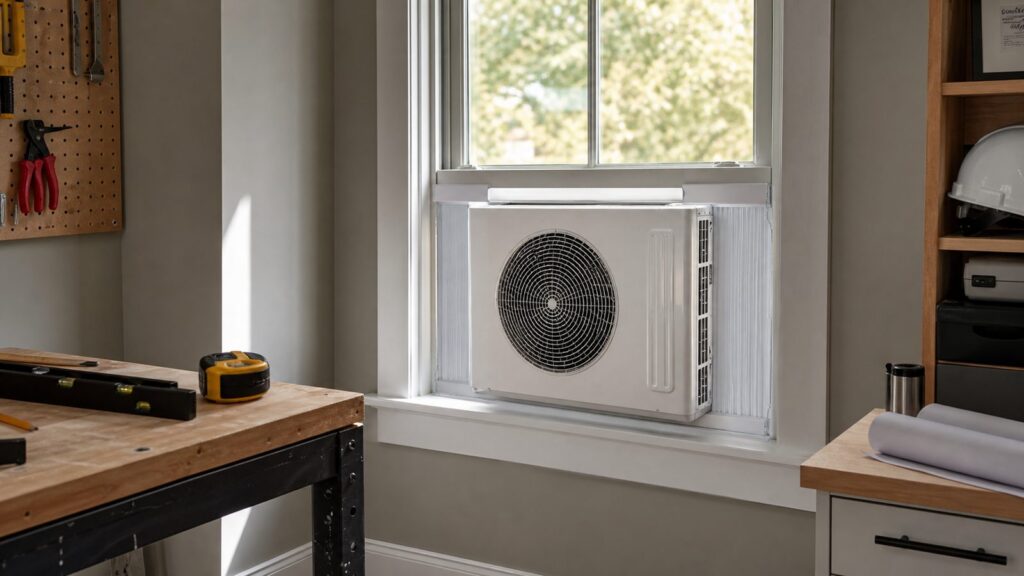
A true window heat pump is a self-contained appliance that sits in or around a window opening and moves heat in both directions. In summer, it works like a window air conditioner: it pulls heat out of the room and rejects it outdoors. In heating mode, it reverses the refrigerant cycle and pulls heat from outdoor air into the room.
That is different from a standard window AC with electric resistance heat. Resistance heat is basically an electric space heater built into the air conditioner cabinet. It can be useful for shoulder seasons, but it usually costs more to run and does not offer the same efficiency advantage as a heat pump. When shopping, do not rely on the phrase “with heat.” Ask these questions:
Popular on Amazon

- Multi-Season Comfort - Midea 8000 BTU window air conditioner with heat is better than standard ac units. It will beat the heat in summer with powerful cooling and dehumidification and keep you warm through the fall with supplemental heat. Best for large rooms up to 350 square feet. NOTE: heat pump function works when outside temp> 41°F.
- Easy To Use – This air conditioner and heat unit comes with an LED display, 5 Modes (Heat, Auto, Cool, Dry, Fan), 3 speed settings (Auto/H/M/L), 24-hr Timer, and ECO energy saver. The Swing button adjusts the louvers up/down to direct the airflow. Wireless control enabled window ac with heat unit from anywhere with the SmartHome App, or with your voice via Alexa and Google Assistant. All functions can be set via the control panel, remote control, and app or voice assistant.
- Save Energy Being Cool – Save on energy costs and enjoy ultimate comfort with this energy star certified unit. This energy efficient air conditioner unit is engineered with variable-speed inverter technology that will quickly cool your bedroom or apartment space while using considerably less electricity; up to 35% energy savings compared to the Energy Conservation Standard. Washable filter is easily accessed from front panel for regular cleaning to maintain peak performance.
- Ultra Low Noise Performance – This ac window unit operates at a noise level as low as 45 dBA. It’s such a quiet air conditioner that you will barely notice it, even when it’s on high. Enjoy your Zoom call, watch your favorite TV show, have a conversation. This ac unit for bedroom also creates just the right amount of white noise so you can get some rest.
- Install Specs – This window air conditioner is designed to fit double hung windows with opening widths of 24 to 38.5 inches. Lower sash must open sufficiently to allow a clear vertical opening of 14.5 inches. AC window unit measures 19.41"W x 22.17"D x 13.9"H. Included components: 8000 btu window air conditioner, remote control, installation kit. This ac heater combo window unit is as a close as you can get to a mini split a/c. You may like it so much you just might buy two!
- Does the unit use heat-pump heating, electric resistance heat, or both?
- What is the heating capacity at 47 degrees F, 17 degrees F, 5 degrees F, and the minimum rated outdoor temperature?
- What is the COP or efficiency rating at those temperatures?
- Does it plug into a standard 120V outlet, or does it require 240V?
- Is the unit ENERGY STAR certified or listed on a qualified product list for rebates?
Those answers matter more than the retail box’s square-footage claim. A room with leaky double-hung windows, a west-facing wall, poor attic insulation, and two exterior walls can need far more capacity than a same-size interior bedroom. We size these units with the same mindset we use for larger HVAC work: start with the real load, not the marketing label.
Best Window Heat Pumps by Use Case
There is no single best window heat pump for every home. A New England apartment, a Phoenix bedroom, a detached garage in Ohio, and a coastal ADU have different heating loads, humidity levels, electrical constraints, and installation challenges. The useful way to choose is by category.
Best Cold-Climate Pick: Gradient All-Weather 120V Window Heat Pump
The Gradient All-Weather 120V Window Heat Pump is one of the clearest examples of where this category is headed. It is built as a saddle-style window unit and is designed to provide both cooling and real cold-weather heating from a standard 120V circuit. Published performance figures list 9,300 BTU/hr of cooling, 9,000 BTU/hr of heating from 47 degrees F down to 17 degrees F, 7,200 BTU/hr at 5 degrees F, and 7,026 BTU/hr at -13 degrees F. COP values range from 4.04 at 47 degrees F to 1.59 at -13 degrees F.
Those numbers are exactly what a homeowner should look for. Heating BTUs at low outdoor temperatures tell you whether the unit can carry a room on a cold morning. Cooling BTUs alone do not answer that question. A 9,000 BTU heating rating at 47 degrees F is useful, but a rating at 17 degrees F and 5 degrees F is far more revealing for northern states.
The strongest fit for a unit like this is an apartment bedroom, home office, older upstairs room, enclosed porch conversion, or one-room electrification project where cutting refrigerant lines through the wall for a mini-split is not practical. It is also worth considering in multifamily retrofits where building owners need a lower-disruption alternative to full ductless systems.
The tradeoff is cost and availability. True cold-climate window heat pumps are still early-market products in 2026. Equipment pricing can sit roughly in the $1,400 to $3,800-plus range per unit, depending on source, program pricing, and model availability. That is much more than a standard window AC, but still usually below a professionally installed single-zone ductless mini-split.
Best Construction and Retrofit Pick: Midea Packaged Window Heat Pump
The Midea Packaged Window Heat Pump is worth watching for construction, affordable housing, and retrofit work because it is marketed specifically as a window-mounted cold-climate air-source heat pump. The format is also saddle-style, using a 120V/15A installation rather than requiring a typical mini-split condenser pad, wall bracket, refrigerant lines, and indoor head.
Key features to look for in this class include enhanced vapor injection compressor technology, self-contained condensate management, and long-distance airflow. In plain construction terms, that means the unit is trying to solve three real problems: maintaining heat output in cold weather, avoiding sloppy drain details, and moving conditioned air far enough into the room that the comfort does not stop three feet from the window.
For owners managing multiple units, this category has another advantage: repeatable installation. If a building has compatible double-hung windows, adequate circuits, and a consistent facade condition, crews can document a standard bracket, sealing, and condensate approach before ordering in bulk. We still recommend a pilot installation first. Install one unit, monitor noise, drain behavior, occupant comfort, and circuit load, then scale.
The Tool Desk
Outbyte Driver Updater FREEFix the driver behind crashes, sound loss and screen glitchesFind Drivers →Outbyte PC Repair FREERepair Windows errors before they cause bigger problemsFix Now →Best Budget Option: Inverter Window AC with Heat for Mild Climates
For warmer parts of the country, or rooms that only need light heating in spring and fall, a lower-cost inverter window AC with heat may be enough. Brands in this broader category include Midea, TCL, Whirlpool, LG, Frigidaire, GE Profile, Windmill, Soleus Air, and Friedrich. Many 8,000 to 12,000 BTU-class units fall around $300 to $900, with higher prices for inverter compressors, smart controls, U-shaped cabinets, saddle designs, and higher capacities.
The caution is simple: read the heating specs before buying. Some units that advertise heat are not cold-climate heat pumps. Some provide electric resistance heat. Some heat-pump models stop delivering useful heat once outdoor temperatures drop near freezing. That can be acceptable in Georgia, coastal California, or a shoulder-season sunroom. It is not the right primary heat source for a Vermont bedroom in January.
If you choose this route, prioritize inverter technology and ENERGY STAR certification. ENERGY STAR notes that most certified room air conditioners now include variable-speed technology, which improves efficiency, lowers noise, and keeps room temperature more stable than older single-speed units. In a room used daily, that quieter and steadier operation matters.
Best Cooling-Only Alternative: ENERGY STAR Inverter Window AC
If your home already has reliable heat and the problem is only summer cooling, do not overbuy. A cooling-only ENERGY STAR inverter window air conditioner may be the most cost-effective solution. Standard window AC equipment typically runs about $150 to $1,000 depending on capacity, efficiency, sound rating, brand, and features.
This is often the right choice for a second-floor bedroom, a guest room, a small office, or a workshop that only needs summer conditioning. You still need to check window fit, support, sealing, and electrical load, but you avoid paying for heating capability you will not use.
Window Heat Pump Cost in 2026
Costs vary sharply because this category includes everything from simple window ACs with resistance heat to early-market cold-climate heat pumps. The table below reflects practical 2026 U.S. planning ranges we would use before getting local quotes.
| Option | Typical 2026 Equipment Cost | Installed Cost Notes | Best Fit |
|---|---|---|---|
| Standard window AC, cooling only | $150 to $1,000 | $0 to $300 if the existing outlet and window work; more for brackets or difficult access | Rooms that only need summer cooling |
| Window AC with heat or supplemental heat | $300 to $900 | Usually plug-in, but verify amperage and whether heat is resistance or heat pump | Mild climates and shoulder-season heating |
| True cold-climate window heat pump | $1,400 to $3,800+ | May still be plug-in, but weight, support, sealing, and product availability matter | Cold-climate room heating and cooling without ductwork |
| Single-zone ductless mini-split | Often $3,000 to $8,000 per zone | Professional installation, refrigerant work, wall penetration, permits, and outdoor unit placement | Permanent year-round comfort, lower noise, and better aesthetics |
| Full heat pump system | Commonly $4,000 to $14,000 average | Depends on ducts, electrical service, equipment size, controls, and scope | Whole-home heating and cooling |
For a single plug-in unit, labor can be near zero if the homeowner installs it safely in a suitable first-floor window. A professional install can run roughly $100 to $300 for a straightforward job, then rise with heavy lifting, exterior access, support brackets, air sealing, custom trim, or storm-window conflicts. Electrical work is the bigger variable. A new dedicated 120V or 240V circuit can add several hundred dollars to more than $1,200. Panel upgrades, subpanels, load-management equipment, long wire runs, finished wall repair, and permits can push costs much higher.
In multifamily work, the math changes. A 2026 Boston housing discussion cited analysis that outfitting a two-bedroom apartment with window heat pumps would likely cost about $9,300, compared with roughly $14,000 to $20,000 for other heat-pump options. That kind of spread explains why housing authorities and building owners are paying attention. Window units are not as polished as ductless systems, but they can reduce installation disruption and capital cost.
Also popular on Amazon

- ✔ Fast Cooling & Heating: Dive into an all-season solution with our window AC and heater system, this 8000BTU unit featuring air conditioning, 4000BTU heating, dehumidifier & fan function for ideal climate control of room up to 350 square feet. Perfect choice for your room like home, office, or apartment
- ✔ Considerate Designs: This air conditioner & heater unit comes with an LED display, 5 modes (Heat, Auto, Cool, Dry, Fan), 3 speeds (Auto/H/M/L), 24H Timer and ECO energy-saver. Washable filter is easily accessed from front panel for regular cleaning to maintain peak performance. The swing button adjusts the louvers to direct the airflow. Easily create the perfect environment for multi-seasons
- ✔ WIFI-Enabled & Voice Control: Beside of the panel & remote control, seamlessly integrate with phone APP or voice control (works with Alexa/Google Assistant); Set routines for optimal temperature changes allows you to adjust your window air conditioner from anywhere so that you can enjoy endless comfort immediately once arriving home
- ✔ Simple Installation: Included with side panels and other installation parts save you a lot of assembly time. A detailed instruction manual makes assembly easily done in a short period (windows width: 26" - 36"; window height: 16")
- ✔ 100% Satisfaction: We do cover 1 year warranty on this ac unit, any questions about it, please don't hesitate to contact us at any time for getting a satisfied service. We are confident to stand behind our product and would like to guarantee you a best shopping experience with us
How to Size a Window Heat Pump Correctly
Most buyers start with the box label: 8,000 BTU for 350 square feet, 10,000 BTU for 450 square feet, and so on. That is a starting point, not a design. We have seen 300-square-foot rooms that needed more capacity than 500-square-foot rooms because of sun exposure, insulation gaps, ceiling height, air leakage, and occupant use.
For cooling, a small bedroom may need 6,000 to 8,000 BTU/hr. A larger bedroom, office, or den often lands around 8,000 to 12,000 BTU/hr. A big open room, top-floor space, garage conversion, or ADU may need 12,000 BTU/hr or more. Oversizing can short-cycle the unit, reduce dehumidification, and create temperature swings. Undersizing can leave the room clammy in July and cold in January.
For heating, ask for the cold-weather capacity. A unit rated for 9,000 BTU/hr of heating at 47 degrees F may produce much less at 17 degrees F unless it is designed for cold climates. The Gradient example is helpful because it publishes capacity at several outdoor temperatures: 9,000 BTU/hr from 47 degrees F to 17 degrees F, 7,200 BTU/hr at 5 degrees F, and 7,026 BTU/hr at -13 degrees F. That drop is normal physics, but you need to know it before relying on the appliance as primary heat.
A practical sizing check is to list the room’s worst conditions. Note the square footage, ceiling height, window area, wall exposure, insulation level, sun direction, number of occupants, electronics load, and whether doors stay open. In older homes, also check attic kneewalls, rim joists, and window air leakage. A better-sealed 10,000 BTU unit can outperform a leaky 12,000 BTU installation.
What’s actually slowing this PC down?
Pick the symptom - the matching free tool is one click away.
Window Fit, Support, and Air Sealing
Before ordering, measure the window carefully. Record the clear opening width, minimum sash height, sill depth, stool projection, exterior trim condition, storm-window track, screen location, and whether the sash tilts inward. A unit that technically fits the width may still fail because the sash cannot close correctly, the sill is too shallow, or a storm-window frame blocks the cabinet angle.
Most window heat pumps are intended for double-hung windows. Slider and casement windows need different products or custom infill panels. Security bars, deep exterior shutters, historic trim, and HOA facade rules can also stop a project. In rental housing, get written approval before installing anything that changes exterior appearance, drains water outside, or requires brackets.
Weight deserves respect. Many window ACs weigh 50 to 90 pounds. Larger heat-pump units and saddle-style appliances can weigh more. We prefer exterior support brackets where the manufacturer requires or recommends them, especially above the first floor. The bracket should bear on solid framing or masonry, not rotted trim, loose aluminum wrap, or soft sheathing. Inside, the sash needs to lock down securely so the unit cannot shift.
Air sealing is not a finishing touch. It is part of the HVAC installation. Use the manufacturer’s side panels where appropriate, then close gaps with compressible foam, backer rod, removable sealant, or rigid insulated infill panels. Avoid permanent adhesives on rental windows unless approved. In cold climates, poor side-panel sealing can create drafts, condensation, ice, and comfort complaints. On a windy wall, a sloppy install can make a premium unit feel cheap.
Electrical Load, Safety, and Permits
Most smaller window units use a standard 120V plug, but that does not mean every outlet is suitable. A 120V/15A circuit may already serve lights, computers, a microwave, or other receptacles. Add a heat pump running for hours and nuisance trips can become routine. Larger units may require 120V/20A or 240V circuits. Always match the manufacturer’s nameplate amperage, plug type, and dedicated-circuit requirements.
We also check outlet condition. A loose, painted-over, warm, cracked, or ungrounded receptacle is not acceptable. Extension cords are a hard no for permanent HVAC use. If the cord does not reach, the correct fix is usually a properly located receptacle, not a heavier cord snaked along the wall.
Permit rules vary by jurisdiction. A simple plug-in window unit may not need a mechanical permit. New electrical circuits, panel work, hardwired equipment, exterior brackets on multifamily buildings, facade changes, and common-area work often trigger permits or building approval. Some cities and states are also updating electrification and HVAC rules, so a 2026 project should be checked locally before purchase.
For multifamily or rental properties, document the unit weight, support method, window type, condensate path, electrical circuit, exterior appearance, and access needs before ordering multiple units. That paperwork saves money when an inspector, property manager, insurer, or HOA asks how the installation is controlled.
Quick wins for a faster PC:
Clear out junk files and repair common Windows errorsFree Scan →Scan for outdated or missing drivers - takes under a minuteDriver Scan →Repair Windows errors before they cause bigger problemsFix Now →Condensate, Defrost, and Cold-Weather Operation
Cooling mode removes moisture from indoor air. Heating mode can create frost outdoors, which the unit must manage through defrost cycles. That water needs a controlled path. Some units are designed for self-contained condensate management; others rely on drainage through the exterior side of the cabinet. Either way, the water cannot stain masonry, drip onto pedestrians, rot trim, freeze on a walkway, or drain into a wall assembly.
In cold climates, defrost behavior is part of comfort. During defrost, a heat pump may briefly reduce heat delivery or change fan operation. That is normal. What matters is whether the unit has enough capacity to recover and keep the room comfortable. This is another reason to look at heating output at 17 degrees F, 5 degrees F, and the minimum operating temperature.
Also ask about backup heat. Some window heat pumps may include electric resistance assistance; others may not. If the room is a bedroom or occupied workspace in a cold climate, plan for what happens during extreme cold, a power outage, or a unit fault. A window heat pump can be a strong room solution, but it should not be the only freeze-protection plan for plumbing in an unconditioned or poorly insulated area.
Independent reader supportYour contribution helps us test, update, and keep practical guides available for everyone.Efficiency, Rebates, and Tax Credits
Efficiency is where heat pumps earn their keep. Electric resistance heat has a COP of about 1. A heat pump can deliver several units of heat for each unit of electricity under favorable conditions. The Gradient performance data, for example, lists COP values from 4.04 at 47 degrees F to 1.59 at -13 degrees F. Even at very low temperatures, that is still above straight resistance heat, though the margin narrows.
Recommended Free Tools
ENERGY STAR’s room air conditioner guidance has shifted toward variable-speed technology, and the federal efficiency landscape is tightening. Amended federal room air-conditioner energy-conservation standards require compliance on and after May 26, 2026. That means buyers should avoid relying on old CEER assumptions or leftover comparisons from prior model years.
Also popular on Amazon

- Reliable Window Conditioner: Our powerful 23,200 BTU cooling capacity / 16,000 BTU supplemental heating capacity window ac unit can efficiently provide comfort all year long for any large space up to 1,500 Sq.Ft.
- All in One AC: Enjoy cooling, supplemental heating, dehumidification, and fan circulation; Supplemental Heating mode is meant to be operated when temperatures outside are between 23 and 76 degrees; Mode is supplemental and NOT meant as primary heat source
- Smart Remote: The remote takes the temperature of the room you are in, displays it on the LCD screen and sends a signal to your ac wall unit every 3 minutes for accurate cooling
- Powerful Cooling on a Budget: Our High Efficiency window AC Unit will give your electric bill a break by using the 'Energy Saver' or 'Sleep' mode
- Space Saving Design: Save your floor space with window air conditioners; Window installation kit included; Minimum window height: 19.5"
ENERGY STAR’s Version 7.0 room AC draft estimated room heat pump product classes could save roughly 343 to 925 kWh per unit annually versus baseline assumptions, depending on class and configuration. Real savings depend on your climate, thermostat settings, utility rates, runtime, and what the unit replaces. Replacing electric resistance heat in a frequently used room produces a different payback than adding comfort to a guest room used ten nights per year.
Federal tax-credit rules also require care. ENERGY STAR says qualifying air-source heat pumps can be eligible for a federal tax credit up to $2,000 for products purchased and installed from January 1, 2023 through December 31, 2032. That does not mean every window heat pump automatically qualifies. Verify the exact model, AHRI or ENERGY STAR eligibility, installation requirements, invoice language, and current tax rules before counting the credit. Many incentive programs require pre-approval or a specific qualified product list.
Window Heat Pump vs Mini-Split, PTAC, Portable Unit, and Central Heat Pump
A window heat pump is best understood as one option in a larger comfort toolbox. It is usually cheaper and less invasive than a mini-split, but it is also more visible, more exposed to window-fit problems, and often less quiet. The right answer depends on how permanent the solution needs to be.
Free tools Windows power users keep installed
One-click scans. No signup required.
| System Type | Pros | Cons | Best Use |
|---|---|---|---|
| Window heat pump | Lower installation cost, no ductwork, can provide cooling and heating, possible 120V plug-in models | Window fit limits, visible from inside and outside, weight and sealing issues, fewer cold-climate choices | Single rooms, apartments, older homes, additions, retrofit programs |
| Portable heat pump or portable AC | Flexible placement, no heavy window cabinet | Usually noisier and less efficient, needs hose venting, takes floor space | Temporary cooling or rental situations where window units are not allowed |
| PTAC or PTHP | Durable packaged format, common in hotels and multifamily | Requires wall sleeve, exterior grille, larger opening, more permanent construction | Apartment renovations, hospitality, purpose-built wall installations |
| Ductless mini-split | High efficiency, quieter indoor operation, better long-term comfort and appearance | Higher installed cost, refrigerant work, exterior condenser placement, permits | Year-round primary comfort for one or more zones |
| Central heat pump | Whole-home solution, integrated controls, can use existing ducts if suitable | Most invasive and expensive, duct condition matters, electrical upgrades may be needed | Whole-house heating and cooling replacement |
When a room is occupied year-round, we always compare the window heat pump against a single-zone mini-split. A mini-split commonly costs more up front, often around $3,000 to $8,000 for one zone, but may win on efficiency, noise, durability, resale value, and appearance. If the project is a rental apartment where wall penetrations are difficult, a window heat pump may be more realistic. If it is your primary bedroom for the next ten years, a mini-split may be the better investment.
When to DIY vs When to Hire a Pro
A handy homeowner can often install a standard plug-in unit in a first-floor double-hung window if the appliance is within lifting capacity, the manufacturer allows homeowner installation, the outlet is suitable, and the window is sound. Expect one to three hours for a careful install, including measurement, bracket setup, cabinet placement, side-panel sealing, sash locking, and a test run.
Hire a pro when the unit is heavy, the window is above the first floor, the sill or trim is questionable, the install requires exterior brackets, the room needs a new circuit, or the property is multifamily. Also bring in a qualified electrician if the breaker trips, the outlet gets warm, the receptacle is ungrounded, or the unit requires a different plug. Do not improvise around electrical requirements.
For construction projects, additions, garage conversions, and ADUs, involve the HVAC and electrical planning early. A window heat pump may be a good temporary or budget-conscious solution, but it can also affect egress, window placement, facade design, load calculations, and inspection signoff. It is cheaper to plan the outlet, support, and drainage before drywall than to retrofit them after finishes are complete.
Our Buying Checklist
Before buying a window heat pump, collect the details below. This is the same type of checklist we would use before recommending equipment for a room-level retrofit.
- Room size in square feet and ceiling height.
- Insulation quality, exterior wall count, window area, and sun exposure.
- Cooling BTU/hr and heating BTU/hr at multiple outdoor temperatures.
- Minimum rated outdoor heating temperature.
- Heat source type: heat pump, electric resistance, or hybrid.
- Voltage, amperage, plug type, and dedicated-circuit requirement.
- Window type, clear opening width, sash height, sill depth, and storm-window conflicts.
- Installed weight and required support bracket.
- Condensate and defrost drainage method.
- Noise rating, especially for bedrooms and offices.
- Warranty length, service access, filter cleaning, and replacement parts availability.
- ENERGY STAR status, rebate eligibility, and tax-credit documentation.
If a manufacturer does not publish cold-weather heating capacity, be cautious about using that model as a primary heat source. If a retailer cannot tell you whether the heat is heat-pump or resistance, assume you need more verification.
Bottom Line
The best window heat pump is the one that matches the climate, room load, window opening, electrical circuit, and expected runtime. For cold climates, true heat-pump performance at 17 degrees F and below is the key spec. For mild climates, a lower-cost inverter unit with heat may be enough. For cooling-only rooms, a standard ENERGY STAR inverter window AC often delivers better value.
From a builder’s perspective, the product choice is only half the job. Support the unit correctly, seal the opening well, manage condensate, respect the electrical load, and verify permit or landlord requirements before installation. A window heat pump can be a smart, lower-disruption comfort upgrade, but it performs like HVAC equipment only when it is installed like HVAC equipment.
Recommended Free Tools
Frequently Asked Questions
Are window heat pumps worth it?
They can be worth it for one room, an apartment zone, an older home, or a space without ducts. They are usually cheaper and less invasive than a mini-split, but they need the right window, electrical circuit, support, and air sealing.
Can a window heat pump heat a room in winter?
A true cold-climate model can heat a room in winter if it is sized correctly. Check heating capacity at 47 degrees F, 17 degrees F, 5 degrees F, and the minimum operating temperature. Do not rely only on cooling BTUs.
What is the difference between a window heat pump and a window AC with heat?
A window heat pump moves heat using a refrigerant cycle, while many window AC units with heat use electric resistance heat. Resistance heat works, but it is usually less efficient and is better suited to light supplemental heating.
How much does a window heat pump cost in 2026?
A retail window AC with heat often costs about $300 to $900. True cold-climate window heat pumps are more commonly around $1,400 to $3,800 or more per unit, with installation and electrical work adding to the total.
Do window heat pumps qualify for tax credits?
Some qualifying air-source heat pumps may be eligible for a federal tax credit up to $2,000 for purchases and installations from January 1, 2023 through December 31, 2032. Verify the exact model, ENERGY STAR or AHRI eligibility, installation rules, and current tax guidance before assuming a credit.
Is a window heat pump better than a mini-split?
A window heat pump is usually cheaper and easier to install. A ductless mini-split usually wins for permanent year-round comfort, quiet operation, appearance, durability, and resale value. For a room used every day, compare lifecycle cost before deciding.
Quick Recap
Product prices and availability are accurate as of the date/time indicated and are subject to change. Any price and availability information displayed on Amazon at the time of purchase will apply.

