Some links on this page are affiliate links: if you buy through them we may earn a commission, at no extra cost to you.
A good vintage meat grinder can be more than a farmhouse prop. The right one can still grind meat, clamp solidly to a work surface, and give a kitchen the kind of practical character that new appliances rarely have. The wrong one can chip a countertop, trap food in pitted metal, smear warm meat into paste, or become an expensive decoration that never should have touched food.
For most homeowners in 2026, the best vintage meat grinders are complete, lightly worn, clamp-on cast-iron models from brands such as Enterprise, Universal, L.F.&C., Keystone, Griswold, Climax, Alexanderwerk, and older Porkert-style grinders. Small decorative or as-is grinders often sell for about $10 to $40. Common complete working grinders usually land around $40 to $80. Larger, cleaner, restored, branded, or display-ready pieces commonly run $80 to $150 or more, with shipping often adding another $8 to $25 because cast iron is heavy.
As an Amazon Associate I earn from qualifying purchases.
From a builder’s point of view, the grinder itself is only half the decision. A working meat-grinding setup needs a strong clamping location, a cleanable prep surface, access to cold storage, a sink nearby, proper electrical planning if a powered grinder is added, and storage that keeps plates and knives dry. On our kitchen remodels, we treat vintage tools the same way we treat stone, tile, range hoods, or cabinet hardware: the piece can be beautiful, but it still has to work with the room.
What Makes a Vintage Meat Grinder Worth Buying?
A vintage meat grinder is worth buying when it meets the job you expect it to do. That sounds basic, but it prevents most mistakes. A grinder bought for open-shelf styling does not need to meet the same standard as a grinder that will process venison, pork shoulder, chuck roast, or sausage trim every winter.
#1 Best Overall

- COMPATIBLE WITH SIZE #32 MEAT GRINDERS: Designed to fit all standard size #32 meat grinder models compatible with brands such as Hobart, Biro, Enterprise, LEM, Tor Rey, and other compatible machines. These grinder blade and plate is a direct replacement for GP32-18 and GK32-S, offering reliable performance across commercial and home processing equipment.
- ENHANCES GRINDING PERFORMANCE: These meat replacement blade and grinder plate features 1/8" (3mm) precision-cut holes that ensure consistent meat texture and efficient processing smooth meat texture ideal for sausages, pâtés, and finely ground meat recipes. The raised-edge knife and precision plate work together to deliver smooth, clean cuts for professional-quality results.
- HEAVY-DUTY CONSTRUCTION: The blade grinder and plate is made from durable, high-quality steel engineered for long-lasting performance under frequent use. Designed to maintain sharpness and deliver steady grinding results for commercial kitchens and butcher shops.
- EASY INSTALLATION: The reversible plate and knife meat grinder parts design allow quick installation and cleaning after use. Compatible with regular maintenance routines to extend equipment life and maintain top-level grinding efficiency in any commercial kitchen or butcher operation.
- QUALITY PRODUCT: Manufactured by National Band Saw Company that ensures durable and dependable replacement parts for equipments. National Band Saw is not affiliated with any original equipment or parts manufacturers.
For display, the best grinder has a clean silhouette, stable clamp, attractive patina, and no loose flakes of rust or paint that will drop onto a counter. For actual food use, the standard is much higher. You want a complete grinder with a body, auger, handle, clamp, retaining ring, knife, and at least one plate that all fit properly. The surfaces that touch meat should be smooth, cleanable, corrosion-resistant, and free of deep pitting, flaking coatings, questionable paint, or heavy rust.
Many antique cast-iron grinders were tinned. That tin coating was there for a reason: bare cast iron and wet meat are not a great long-term pairing. If the tinning is worn through, flaking, blackened in food channels, or missing in patches, treat the grinder cautiously. It may be a beautiful piece for a pantry shelf, but not a food-contact tool unless a qualified restorer evaluates and restores it.
Size also matters. Small #00, #1, and #2 grinders are suited to light kitchen work or display. Mid-size #5, #10, and #12 grinders are more useful for a homeowner who wants to grind a few pounds at a time. Large #20, #22, and #32 units can handle heavier batches, but they are heavy, need a stronger mount, take more storage space, and can cost more to buy or restore. A large grinder on a thin island overhang is a countertop problem waiting to happen.
Best Vintage Meat Grinder Types for Different Kitchens
There is no single best vintage grinder for every home. The best choice depends on whether the kitchen is a showpiece, a working prep kitchen, a hunting household, a sausage-making setup, or a remodel where the homeowner wants vintage character without antique food-contact risk.
Best All-Around Choice: Enterprise #5, #10, or #12
Enterprise grinders are popular for a reason. They are common enough that buyers can compare condition, and many listings include enough photos to confirm whether the grinder is complete. In current marketplace listings, common Enterprise pieces are often seen around $16.50 to $54.95 before shipping, with an Enterprise No. 12 around $49.95 plus shipping and larger models such as a No. 20 listed around $129.77.
For a homeowner who wants a usable vintage grinder, an Enterprise #5, #10, or #12 is a sensible starting point. These sizes are large enough for real kitchen use without becoming an industrial display object. Before buying, confirm that the auger turns smoothly, the knife seats against the plate, the retaining ring threads on fully, and the clamp has enough bite to hold the grinder without wobbling.
Recommended Free Tools
Best Small Display Grinder: Universal or Keystone-Style #1 or #2
Small Universal, L.F.&C., Keystone, and similar clamp-on grinders are easy to place on a shelf, pantry counter, or breakfast nook display. These are often found in the $10 to $50 range depending on condition, completeness, and shipping. They look right in a traditional kitchen without overpowering the room.
For actual grinding, small units are slow. They can handle breadcrumbs, cooked scraps, or very small meat batches if restored and food-safe, but they are not the grinder we would design a serious prep station around. Their real strength is proportion: they give vintage texture without requiring reinforced storage or a heavy clamp block.
Best Heavy-Batch Option: #20, #22, or #32 Grinders
Larger grinders make sense for hunters, sausage makers, and households that process meat in bigger sessions. The advantage is capacity. The downside is weight, mounting force, cleanup time, and restoration cost. A #32 grinder can be impressive, but it can also be awkward in a standard kitchen cabinet and rough on a finished counter edge.
If you are buying a large grinder for food use, budget carefully. One collector example reported about $140 to retin a large #32 grinder, which can exceed the purchase price of many common grinders. That does not mean restoration is a bad investment, but it means the math has to be honest. A $60 rusty grinder plus $140 in retinning plus shipping can quickly cost more than a modern stainless manual grinder.
What’s actually slowing this PC down?
Pick the symptom - the matching free tool is one click away.
Best Practical Pairing: Vintage Display Plus Modern Food Grinder
For many remodeled kitchens, the best answer is two grinders: a vintage piece for character and a modern stainless or NSF-listed grinder for frequent meat processing. This avoids forcing an antique tool into work it may not safely do. It also lets the kitchen design support both display and production: the antique grinder can live on a shelf or counter, while the modern grinder stores near the prep zone and plugs into a properly placed receptacle.
When homeowners ask us what we would do in our own kitchens, this is often the answer. Keep the vintage piece visible. Use the modern grinder when food safety, speed, and cleanability matter most.
Vintage Meat Grinder Cost Guide for 2026
Prices vary widely because sellers mix usable tools, restored pieces, incomplete antiques, and decorative farmhouse items in the same category. Condition drives price more than age alone. A complete, clean, common grinder may be a better buy than a rare name with missing parts and heavy rust.
| Grinder Type | Typical 2026 Price | Best Use | Watch For |
|---|---|---|---|
| Small as-is vintage grinder | $10-$40 | Decor, light restoration project | Missing knife, missing plate, rust, loose clamp |
| Common complete working grinder | $40-$80 | Occasional use if food-contact surfaces are sound | Worn tinning, mismatched plate and knife, dull cutter |
| Larger branded grinder | $80-$150+ | Heavier batches, statement display | Weight, storage, clamp strength, restoration cost |
| Professionally restored antique | $100-$250+ depending on work | Food use with documentation | Verify what restoration actually included |
| Modern manual stainless grinder | Often less than a fully restored antique | Food use without antique coating concerns | Build quality, parts availability, clamp strength |
| Modern powered home grinder | Often far more than manual vintage units | Frequent grinding, sausage prep, larger batches | Electrical load, storage, noise, cleaning effort |
Shipping is not a small detail. Cast iron is dense, and $8 to $25 or more in shipping is normal. A $35 grinder can become a $60 purchase quickly. If you are shopping locally, bring a checklist and inspect the grinder in person. If you are buying online, ask for photos of the inside of the throat, auger, plate faces, knife, retaining ring threads, and clamp screw.
Price drivers include brand, rarity, size, completeness, pitting, rust, intact tinning, original finish, food-safe restoration documentation, sausage tubes, seller photography, shipping weight, and whether the item is sold as functional or decorative. The word “antique” does not guarantee quality. The words “farmhouse decor” do not guarantee the grinder should touch food.
Food Safety: When a Vintage Grinder Is Safe, Risky, or Decor Only
This is the section too many buying guides skip. A vintage meat grinder is food equipment if meat passes through it. That means the food-contact surfaces need to be durable, smooth, cleanable, corrosion-resistant, nonabsorbent, and able to resist pitting, chipping, scratching, distortion, and decomposition. Those principles are consistent with modern food-code expectations for equipment and utensils.
A grinder may be reasonable for food use when the tinning is intact or professionally restored, the metal is smooth, the parts fit tightly, there are no painted food-contact surfaces, and the grinder can be fully disassembled and cleaned. It becomes risky when you see deep pits, black residue in seams, flaking tin, unknown coatings, heavy rust, or parts that cannot be removed for cleaning.
Rank #2

- Replacement Meat Grinder Plate for virtually any #22 Meat Grinder. Precision machined and tempered for hardness in the USA.
- 3-1/4" diameter and grind plate holes that are commonly used for burgers, sausage, venison, and countless other meat products.
- Single Notch Reversible Hubless Meat Grinder Plate provides two sharpened sides to extend the life and value of this grinding plate.
- Works with electric and manual grinders.
- 100% Guaranteed. If for any reason you are not happy with this product, just send it back within 30 days. We will replace or refund your money immediately.
Paint is a major red flag. Many old grinders have been painted for display. That may be fine for a shelf, but paint in the hopper, throat, auger path, plate, or retaining ring should disqualify the grinder for meat unless properly stripped and restored by someone who understands food-contact surfaces. Be especially cautious with imported or unknown vintage metal items and coatings. Lead and other contaminants are not something to guess about in a kitchen.
Do not assume a rusty grinder can be treated like a cast-iron skillet. A skillet is a relatively simple surface. A grinder has threads, holes, channels, edges, and tight contact points where meat residue can hide. Seasoning over unknown corrosion or failing tinning does not make it food-safe.
For cooking after grinding, use a thermometer. Ground beef, pork, veal, lamb, and sausage should reach 160 degrees F. Ground poultry should reach 165 degrees F. Color is not enough. Freshly ground meat can brown before it is safe, and it can also stay pink after it reaches temperature.
How to Inspect a Vintage Meat Grinder Before Buying
Bring the same discipline to a grinder that you would bring to used cabinet hardware or a reclaimed sink. Looks matter, but fit and function decide whether the piece belongs in a working kitchen.
Confirm the Grinder Is Complete
A complete manual grinder should include the body, clamp screw, handle, auger, knife, grinding plate, retaining ring, and sometimes sausage tubes or extra plates. The knife and plate are not decorative extras. They are the cutting system. If one is missing or mismatched, the grinder may turn but still perform badly.
Free tools Windows power users keep installed
One-click scans. No signup required.
Ask for a photo with the grinder disassembled. If the seller cannot show the inside, price it as a project or walk away. replacement plates and knives may be available for common sizes, but uncommon brands and odd sizes can turn a cheap grinder into a parts hunt.
Check Wear at the Knife and Plate
The knife should sit flat against the plate. If the knife is badly rounded, the plate is warped, or the retaining ring cannot pull the assembly tight, meat will smear instead of cut. Smeared fat makes poor sausage texture and makes cranking harder.
Minor dullness can often be addressed, but severe uneven wear is a sign that the grinder may need more work than it is worth. For food use, factor sharpening or replacement into the true cost.
Look Inside the Throat and Auger Channel
Exterior patina can be charming. Interior pitting is different. Deep pits in the feed throat, auger channel, plate holes, or ring threads trap food and moisture. That makes cleaning harder and rust more likely.
Windows Errors? Fix Them Before They Spread
Repair common Windows errors and clear accumulated junk for a smoother, more stable PC - no reinstall needed.Free scan · no reinstallOutdated Drivers Are Slowing You Down
One free scan finds every outdated or missing driver and matches the right update for your exact hardware.Free scan · exact hardware matchLight surface discoloration is common. Heavy rust scale, flaking, and rough cavities are reasons to use the piece as decor only unless professionally restored.
Test the Clamp
The clamp screw should turn freely and hold square to the surface. A bent clamp, missing foot, or stripped screw will make the grinder wobble. Wobble is not just annoying; it increases the chance of counter damage and poor grinding.
Measure the clamp opening before buying. Many old grinders need a thick, square edge. Modern countertops often have eased edges, bullnose profiles, mitered waterfall panels, or unsupported overhangs that do not accept a clamp well.
Countertop and Cabinet Planning for a Manual Grinder
This is where a construction company sees the problem differently than an antiques seller. A clamp-on grinder was designed for thick tables, workbenches, and sturdy counters. Many modern kitchens have stone tops, decorative edges, overhangs, waterfall ends, and hidden support brackets. Those details look clean but may not like concentrated clamp pressure.
Quick wins for a faster PC:
Scan for outdated or missing drivers - takes under a minuteDriver Scan →Repair Windows errors before they cause bigger problemsFix Now →Fix the driver behind crashes, sound loss and screen glitchesFind Drivers →Manual clamp grinders can damage marble, quartz overhangs, thin laminate edges, butcher block, and finished wood if clamped directly without protection. We have seen clamp marks, small chips at eased stone edges, dark stains in unfinished wood, and flex in unsupported counter sections. The solution is simple if it is planned early.
Use a Removable Clamp Block
For homeowners who plan to use a manual grinder, we prefer a removable clamp block. A practical block is usually 1 1/2 inches thick or thicker, made from hardwood or laminated butcher-block offcut, and sized roughly 8 by 12 inches to 12 by 18 inches depending on the grinder. It should have enough depth for the clamp jaw and enough surface to spread force.
The block can be clamped to the counter with protective pads, mounted to a worktable, or designed to drop into a dedicated prep zone. On high-end stone counters, the grinder clamps to the block, not directly to the stone. This small detail can prevent a very expensive repair.
Choose the Right Counter Surface
For a serious prep station, prioritize durability and cleanability. Stainless steel, solid surface, quartz, and sealed butcher block can all work, but each has tradeoffs. Stainless is highly practical near meat prep and cleanup, though it shows scratches. Quartz is clean and durable but can chip at edges under point pressure. Butcher block feels traditional but needs sealing, drying, and disciplined sanitation. Marble is beautiful but soft, porous, and easy to stain; it is not our first choice for a meat-processing zone.
The Tool Desk
Outbyte PC Repair FREERepair Windows errors before they cause bigger problemsFix Now →Outbyte Driver Updater FREEFix the driver behind crashes, sound loss and screen glitchesFind Drivers →Rank #3

- Cozzini Cutlery Imports Replacement Meat Grinder Plate for virtually any #12 Meat Grinder. Precision machined and tempered for hardness in the USA.
- 2-3/4" diameter and grind plate holes that are commonly used for burgers, sausage, venison, and countless other meat products
- Single Notch Reversible Hubless Meat Grinder Plate provides two sharpened sides to extend the life and value of this grinding plate
- Works with electric and manual grinders
- 100% Guaranteed. If for any reason you are not happy with this product, just send it back within 30 days. We will replace or refund your money immediately
If a homeowner wants a vintage grinder visible on a marble island, we usually make it display-only or mount it to a separate board. The look stays intact, and the countertop is not asked to do the wrong job.
Plan Storage for Parts
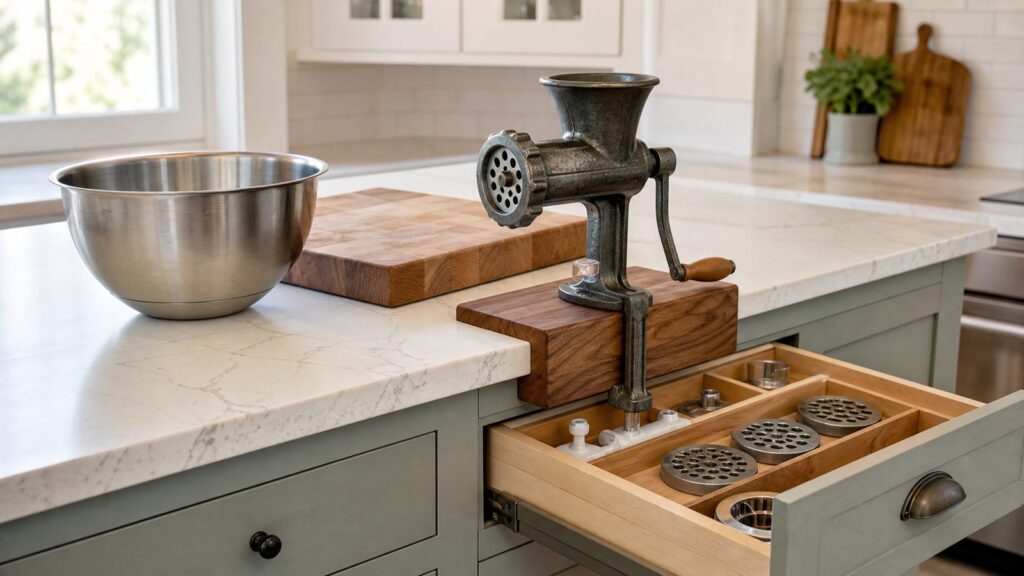
Grinding plates and knives are easy to lose and easy to rust. A shallow drawer near the prep zone with labeled dividers works better than tossing parts into a deep utensil bin. Store plates and knives dry, lightly oiled with a food-safe oil, and separated by grinder size. A #10 plate and #12 knife may look close enough in a drawer but perform badly if mismatched.
For a kitchen remodel, we often use a 6-inch to 9-inch drawer height for small appliance parts and a deeper base cabinet for the grinder body. If the homeowner also owns a powered grinder, add a tray or pullout that can carry 20 to 40 pounds without sagging.
Designing a Real Meat-Grinding Prep Station
A good prep station is about movement. Meat comes out of cold storage, gets trimmed, gets ground, gets packaged or cooked, and the tools get washed. The best layout shortens that path.
Do these 3 things before closing this tab:
1Scan for outdated or missing drivers - takes under a minute2Repair Windows errors before they cause bigger problems3Fix the driver behind crashes, sound loss and screen glitchesPosition the grinding station near a sink, trash pullout, and refrigerator or freezer path. A 36-inch-wide prep area is comfortable for most home grinding sessions. If the kitchen has room, 42 to 48 inches gives space for a cutting board, grinder, chilled bowl, scale, and packaging. For islands, keep the grinder away from casual seating edges. Raw meat prep and homework seating do not mix well.
Cold handling matters. Partially freeze meat before grinding, usually 20 to 40 minutes depending on cut size and freezer performance. Chill the auger, knife, plate, and bowl as well. Cold fat cuts cleanly. Warm fat smears, clogs plates, and makes the handle harder to turn.
Use a trash pullout or compost bin within one step of the cutting board. Add paper-towel access that does not require crossing the kitchen with messy hands. If the household makes sausage, plan landing space for casings, a stuffer, sheet pans, and finished links. A standard 24-inch base cabinet is often too tight for all of this unless storage is planned carefully.
Electrical and Permit Notes for Powered Grinder Setups
A manual vintage grinder does not need a permit. The construction work around the prep station might. If you add receptacles, move wiring, add a small-appliance circuit, install a prep sink, modify cabinets, or change countertops, local permit rules may apply. Electrical requirements vary by jurisdiction, and kitchens are one of the most closely regulated rooms in a house.
For powered grinders, plan receptacle placement before the countertop template. Most modern kitchen receptacles near counters require GFCI protection, and many jurisdictions also require AFCI protection. Kitchen island and peninsula receptacle rules have changed over recent code cycles, so do not assume an old island layout will pass current inspection after a remodel.
A powered grinder should not force a cord across a sink, cooktop, or traffic aisle. Place the receptacle where the grinder actually sits. If the grinder draws significant power or will be used with other small appliances, an electrician may recommend a dedicated or properly distributed small-appliance circuit. This is especially relevant when the same prep zone also serves a mixer, vacuum sealer, induction burner, or countertop oven.
On our projects, we coordinate grinder storage, counter landing space, and outlets before cabinets are ordered. Moving a receptacle on paper is cheap. Moving it after tile backsplash, stone counters, and finished panels are installed is not.
Independent reader supportYour contribution helps us test, update, and keep practical guides available for everyone.Restoration: What You Can Do Yourself and What Needs a Pro
Light cleanup is a reasonable DIY job. Food-safe restoration is different. The line between the two is the condition of the food-contact surfaces.
Free tools Windows power users keep installed
One-click scans. No signup required.
A homeowner can usually disassemble a complete grinder, wash off loose dirt, dry it thoroughly, inspect the parts, remove light surface grime, and store dry parts with a thin film of food-safe oil. That kind of cleanup may cost very little beyond brushes, towels, mineral oil, and time. Expect one to three hours for a basic inspection and cleaning if the grinder comes apart easily.
Professional help is appropriate when the grinder has worn tinning, flaking coating, deep rust, unknown plating, cracked castings, missing parts that need fitting, or a food-contact surface that cannot be cleaned smooth. Retinning is specialized work. A reported $140 retinning cost for a large #32 grinder is a useful benchmark, and smaller or simpler jobs may still cost enough to change the buying decision.
Do not grind meat through a grinder just because it “looks clean” after a scrub. If you cannot verify the coating and cannot clean every food-contact surface, use it for display. There is no shame in that. A decor-only grinder can still be a great kitchen detail when it is honestly treated as decor.
When to DIY vs. When to Hire a Pro
DIY makes sense when you are buying a display grinder, cleaning a lightly worn complete grinder, building a simple removable clamp board, or organizing drawer storage for plates and knives. These are small, controlled tasks. A careful homeowner can handle them with basic tools and patience.
The Tool Desk
Outbyte Driver Updater FREEFix the driver behind crashes, sound loss and screen glitchesFind Drivers →Outbyte PC Repair FREEClear out junk files and repair common Windows errorsFree Scan →Rank #4
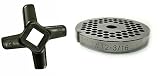
- COZZINI CUTLERY IMPORTS - Replacement Meat Grinder Plate for virtually any #12 Meat Grinder. Precision machined and tempered for hardness in the USA.
- QUALITY GRINDER PLATES - SAVE WITH KNIFE COMBO - 3/16" diameter grind plate holes that are commonly used for burgers, sausage, venison, and countless other meat products.
- REVERSIBLE, WITH TWO SHARPENED SIDES - Single Notch Reversible Hubless Meat Grinder Plate provides two sharpened sides to extend the life and value of this grinding plate.
- EASY TO CLEAN - Works with electric and manual grinders.
- FITS NEARLY ALL #12 MEAT GRINDERS - will fit these common machines. American 6212 Berkel E-012 Biro 8-12 Blakeslee CC20S Butcher Boy TCA12, TM12 Chop Rite 210 Enterprise 10, 211, 2512, 2612, 2712 Fleetwood M12S General D, H, P, MC-50 Globe-Stimpson 5412, 5511 Hobart 56, 200, 212, 612, 725, 4212, 4312, 4412, 4612, 4812, 5113, F230 Hollymatic 1000 Intedge C2HA, C2HDS, C3H, CSH Jupiter B63 Krefft R-70 Sanitary 100, 101, 600, 900, S612 Thunderbird TB300E, TX600 Toledo 5120 Torrey M-12 Univex MG8912
Hire a professional when the grinder affects the kitchen itself. That includes modifying stone countertops, adding a supported clamp location, changing cabinet structure, installing a prep sink, adding or moving receptacles, creating a stainless prep surface, or designing a heavy small-appliance pullout. Hire a qualified restorer for retinning or food-contact metal restoration. Hire a licensed electrician for kitchen circuit or receptacle changes.
As a rough planning guide, a protected clamp board is usually minor carpentry. Dedicated storage, a reinforced prep counter, a new sink, GFCI/AFCI receptacles, or a small-appliance circuit can move the work into normal kitchen-remodel pricing and local permit review. The grinder may cost $60; the station around it may be part of a much larger kitchen scope.
Common Buying and Design Mistakes
The biggest mistake is buying for food use based only on appearance. A grinder can photograph beautifully and still be missing the knife, have a mismatched plate, or contain pitted metal where meat will pass. Always check completeness before price.
The second mistake is clamping directly to a finished countertop. Stone, laminate, and butcher block all have limits. Use a protected board, a dedicated worktable, or a planned clamping edge. Do not test a vintage clamp on a new quartz waterfall panel and hope for the best.
The third mistake is ignoring workflow. A grinder displayed across the room from the sink may look good, but it will not be used often. A working grinder belongs near cold storage, trash, landing space, and cleanup.
The fourth mistake is storing parts wet. Grinder plates, knives, retaining rings, and augers need to be dried completely. Plate holes and threads hold moisture. Flash rust can start quickly, especially after washing.
The fifth mistake is trusting color when cooking ground meat. Use a thermometer. Ground meat and sausage need 160 degrees F, and ground poultry needs 165 degrees F.
Our Practical Recommendation
If you want vintage character and occasional light use, look for a complete Enterprise, Universal, Keystone, or similar #5, #10, or #12 grinder with smooth interior surfaces, intact tinning or documented restoration, and available replacement plates and knives. Expect to spend $40 to $80 for many common complete examples, plus shipping. Budget more for larger, cleaner, rarer, or restored pieces.
Recommended Free Tools
If you want a kitchen that processes meat regularly, pair the vintage grinder with a modern stainless or NSF-listed grinder and design the prep zone around real work. Give yourself 36 to 48 inches of counter space, a protected clamping or appliance location, nearby cold storage, a sink, a trash pullout, dry storage for plates and knives, and properly placed protected receptacles if using powered equipment.
If the grinder is rusty, painted, deeply pitted, missing parts, or coated with unknown material, make it decor-only unless a qualified restorer brings it back to a food-safe standard. The best vintage kitchen details are the ones that add history without creating avoidable problems.
Frequently Asked Questions
Are vintage meat grinders safe to use for food in 2026?
Some are, but not all. A food-use grinder should be complete, smooth, cleanable, free of heavy rust or pitting, and have intact tinning or documented food-safe restoration. Painted, flaking, deeply pitted, or unknown-coated grinders should be treated as decor only.
How much does a vintage meat grinder cost in the US?
In 2026, small as-is grinders often sell for about $10 to $40, common complete working grinders for $40 to $80, and larger, cleaner, restored, or branded pieces for $80 to $150 or more. Shipping commonly adds $8 to $25 or more.
Which vintage meat grinder brands are worth buying?
Common collectible and usable names include Enterprise, Universal, L.F.&C., Keystone, Griswold, Climax, Alexanderwerk, and older Porkert-style grinders. Condition and completeness matter more than the name alone.
Will a clamp-on meat grinder damage my countertop?
It can. Manual grinders can dent wood, chip stone edges, stress thin laminate, and damage unsupported overhangs. Use a removable clamp block or a properly supported work surface instead of clamping directly to finished stone or decorative edges.
Can you restore a rusty cast-iron meat grinder for food use?
Light cleaning is often DIY, but food-safe restoration may require professional retinning or coating evaluation. Many antique grinders were tinned, so treating them like a cast-iron skillet is not always appropriate.
Do I need a permit for a meat-grinding prep station?
A manual grinder does not need a permit. Electrical changes, new receptacles, prep sinks, cabinet modifications, and countertop work may require permits depending on local rules. Powered grinder setups should be planned with GFCI/AFCI protection and safe receptacle placement.
Quick Recap
Product prices and availability are accurate as of the date/time indicated and are subject to change. Any price and availability information displayed on Amazon at the time of purchase will apply.

