Some links on this page are affiliate links: if you buy through them we may earn a commission, at no extra cost to you.
Short answer: For a premium corded system, the Festool TS 60 K has the deepest listed 90-degree capacity in this group and the broadest system-oriented feature set. The Makita SP6000J1 is the more established corded-value direction when a 55-inch rail and compatibility with Makita and other guide-rail systems matter. DEWALT users should compare the corded DWS520 with the 60V MAX DCS520, Bosch 18V users have a compact option in the GKT18V-20GCL, and RIDGID 18V buyers get a ready-to-use pair of short rails with the R48630B.
This is a research-backed track saw guide, not a claim of hands-on shop testing. The specifications below come from manufacturer material, while the explicitly identified cut observations come from a published Fine Homebuilding test. No independent measurements of speed, accuracy, vibration, dust capture, noise, runtime, or durability were performed for this article.
Track saw recommendations at a glance
A track saw is a plunge-cut circular saw designed to run on a guide rail. The saw plunges into the workpiece while the rail guides it in a straight line, making the combination useful for breaking down sheet goods, trimming doors and countertops, cutting flooring, and making controlled entry cuts. Kreg describes this plunge-saw-and-guide-track combination as a track saw.
The Tool Desk
Outbyte PC Repair FREERepair Windows errors before they cause bigger problemsFix Now →Outbyte Driver Updater FREEScan for outdated or missing drivers - takes under a minuteDriver Scan →As an Amazon Associate I earn from qualifying purchases.
| Best fit | Model or system | Why it belongs on the shortlist | Important published details |
|---|---|---|---|
| Premium corded system | Festool TS 60 K | Deep capacity, integrated safety features, bevel capability, and extensive Festool rail and crosscut accessories. | 1,500 watts; 3,000 to 6,800 RPM no-load speed; 62 mm or 2-7/16 inches at 90 degrees; 1-3/4 inches at 45 degrees; -1 to 47 degrees. |
| Established corded value | Makita SP6000J1 | A capable corded saw with a 55-inch guide rail included in the J1 kit and broad rail-system compatibility. | 12 amps; 2,000 to 5,200 RPM; 2-3/16 inches at 90 degrees; 1-9/16 inches at 45 degrees; 48-tooth blade. |
| DEWALT platform | DWS520 or DCS520 | The corded DWS520 avoids battery commitment; the 60V MAX DCS520 gives existing DEWALT 60V users a cordless path. | DWS520K: 12 amps, 2-1/8 inches on-track at 90 degrees, 1-5/8 inches at 45 degrees, and a 59-inch track in the kit. |
| Compact cordless | Bosch GKT18V-20GCL | Small 5-1/2-inch format, close-to-wall access, and compatibility with Bosch 18V batteries and FSN rails. | 18V; BITURBO Brushless; ECO mode; overload protection; nine-pound listed tool weight; minimum wall distance of 0.4 inch. Bare tool does not include a battery or charger. |
| Value cordless system | RIDGID R48630B | Includes two short rails, a connector, a clamp, blade, riving knife, and wrench for a relatively complete starting setup. | 18V brushless; up to 5,000 RPM; manufacturer advertises up to 370 linear feet per charge with an AC840060 6.0-Ah MAX Output battery. |
| Integrated cutting station | Kreg Adaptive Cutting System | Best considered as a portable cutting workflow rather than merely a saw, especially when stops, scales, and panel support matter. | 62-inch guide track; 50-inch cutting capacity in the Saw + Guide Track Kit; optional project table with measuring scales and repetitive stops. |
These are fit-based recommendations from published specifications and identified external test material, not a universal ranking. A model that is ideal for cabinet panels may be a poor choice for a framing crew working far from an outlet, and a cordless saw that fits an existing battery platform may be cheaper to own than a nominally less expensive bare tool from another brand.
What to compare before buying
1. Cutting depth at the angle you actually use
Blade diameter is only a rough starting point. Compare the manufacturer-listed depth at 90 degrees and 45 degrees, then confirm whether the figure is measured on or off the rail. The guide rail occupies part of the saw’s usable depth, so the on-rail figure is the one that matters for real work.
#1 Best Overall

- Zero clearance track saw cutting system delivers precise, straight, splinter-free cuts.Power Tool Type Corded
- For use with track saw dual-edged tracks for perfectly straight cuts in both directions
- On-track cut depth: 2-1/8 (54mm) at 90 degree , 1-5/8-inch (41mm) at 45 degree ; depth scale accurately indicates exact depth of cut accounting for track thickness
- 12A, 1300W motor effortlessly powers through hard woods up to 2-1/8-inch thick
- Continuous Anti-Kickback mechanism and riving knife prevent kickback when engaged; Low profile blade guard allows saw to be used in confined spaces
The Festool TS 60 K lists 2-7/16 inches at 90 degrees and 1-3/4 inches at 45 degrees. Makita lists 2-3/16 inches at 90 degrees and 1-9/16 inches at 45 degrees. DEWALT lists 2-1/8 inches on-track at 90 degrees and 1-5/8 inches at 45 degrees for the DWS520K. Those numbers make the Festool the most attractive of these corded options for thicker material, but they do not establish faster cutting or better accuracy.
Do these 3 things before closing this tab:
1Scan for outdated or missing drivers - takes under a minute2Clear out junk files and repair common Windows errors3Fix the driver behind crashes, sound loss and screen glitchesThe Bosch GKT18V-20GCL uses a smaller 5-1/2-inch blade. That helps explain its compact body and close-to-wall capability, but it also limits maximum depth. In Fine Homebuilding’s published cordless track-saw test, the Bosch could not cut through 2x stock beyond a 25-degree bevel. That is an observation from that test, not a universal performance guarantee or a replacement for checking the saw’s current manual.
For ordinary 3/4-inch plywood and melamine, maximum depth is rarely the deciding specification. For doors, thicker solid stock, worktops, or bevel cuts through heavy panels, it becomes much more important. If you regularly cut material near the limit, leave some capacity in reserve rather than choosing a saw whose published maximum barely covers the job.
2. Corded versus cordless operation
A corded saw is usually the straightforward choice for a permanent shop, a production bench, or long sessions of sheet breakdown. It avoids battery-platform commitment, charging interruptions, and the extra cost of batteries and chargers. The trade-off is cable management and the need for a suitable outlet or extension cord.
A cordless saw is more convenient on a jobsite, in a driveway, or on a remote floor of a building. The complete cost is not the bare-tool price: include the required battery, charger, rail, connectors, clamps, and carrying case when comparing systems. Performance and runtime can also depend on battery capacity and output.
Outdated Drivers Are Slowing You Down
One free scan finds every outdated or missing driver and matches the right update for your exact hardware.Free scan · exact hardware matchWindows Errors? Fix Them Before They Spread
Repair common Windows errors and clear accumulated junk for a smoother, more stable PC - no reinstall needed.Free scan · no reinstallBosch identifies the GKT18V-20GCL as a one-battery 18V saw and recommends CORE18V high-power batteries for its BITURBO performance. That recommendation should be treated as part of the purchase decision, not as a minor accessory note. RIDGID’s claim of up to 370 linear feet per charge applies to the specified AC840060 6.0-Ah MAX Output battery and defined conditions; it is an advertised figure, not an independently verified runtime result.
For DEWALT owners, the important distinction is between the corded DWS520 family and cordless DCS520 models using the 60V MAX system. Do not assume a DEWALT 20V battery will operate a 60V MAX track saw. Verify the battery platform and the exact kit SKU before ordering.
3. The rail ecosystem and the complete setup cost
A saw and rail should be evaluated as one system. The rail length determines how many repositioning operations are needed, while connectors, clamps, anti-slip strips, splinter guards, parallel guides, and crosscut accessories determine how repeatable and convenient the workflow becomes.
Makita lists 55-inch and 118-inch rails, rail clamps, connectors, a rip fence, and replacement strips. The SP6000J1 kit includes a 55-inch guide rail, which is a meaningful advantage if you want to start cutting immediately. DEWALT lists 46-inch, 59-inch, and 102-inch tracks, along with clamps, a router adapter, and replacement friction strips. The DWS520K includes a 59-inch track, but exact contents should still be confirmed for the SKU being purchased.
What’s actually slowing this PC down?
Pick the symptom - the matching free tool is one click away.
Short rails can be easier to transport and are adequate for many crosscuts. Long rails reduce joins on full sheets but cost more and take more room to store. If you need cuts longer than one rail, budget for a track saw guide rail and a compatible connector rather than assuming that any rail can be joined to any other.
Some rails grip the work with anti-slip material and do not need clamps for every cut. Clamps remain useful on slippery laminate, narrow workpieces, angled cuts, repetitive work, or situations where movement would ruin an expensive panel. If that describes your work, compare compatible track saw clamps as part of the system rather than adding them after a problem occurs.
4. Cross-brand rail compatibility
Physical fit is not the same as complete compatibility. A saw base may ride on another manufacturer’s rail while the splinter strip, anti-tip feature, clamp, connector, or accessory interface does not work as intended. A mismatched rail can also place the saw’s zero-reference edge in the wrong position, undermining the purpose of the splinter guard.
Makita states that the SP6000J can attach to Makita and other guide-rail systems. Bosch documents compatibility with Bosch FSN tracks and accessories. Those statements should not be generalized to every combination of brands. Confirm the exact saw-and-rail pairing, including bevel stability and replacement strip availability, before building a mixed system.
5. Bevel range and stability
Published bevel ranges are similar but not identical. Festool lists -1 to 47 degrees for the TS 60 K, Makita lists -1 to 48 degrees for the SP6000J, and Kreg lists -1 to 47 degrees for its Adaptive Cutting System saw. The small difference at the upper end is less important than whether the saw locks securely, stays engaged with the rail, and maintains the correct reference edge during a bevel cut.
Negative bevel capability can be useful for flush or undercut work, but the practical result depends on the rail interface and the workpiece support. When comparing tools, look beyond the maximum number: check how the bevel scale is adjusted, whether the saw has anti-tip control, and whether the rail remains stable at the intended angle.
6. Dust extraction
Dust control matters particularly when cutting MDF, melamine, laminate, or interior-finish materials. Compare the port size and geometry with the hose and adapter on your extractor. Makita lists a 1-7/16-inch rear dust port; Bosch lists compatibility with several vacuum hoses and adapters; Festool publishes a 27/36 mm extraction connection for the TS 60 K.
A shop vacuum for a track saw can make indoor work substantially easier, but choose it by actual hose, adapter, and port compatibility. A manufacturer dust-capture statement is not an independent ranking of collection performance. Airflow, filter condition, blade geometry, material, plunge technique, and whether the rail seals against the workpiece all affect the dust that escapes.
7. Safety features
The systems use different manufacturer-described approaches. Festool’s TS 60 K includes KickbackStop technology. DEWALT describes a continuous anti-kickback mechanism and a riving knife. Kreg describes a riving knife and selectable anti-kickback protection.
These features are worth comparing, but they do not prove that one tool is universally safer. Kickback risk also depends on a supported workpiece, a clear blade path, correct depth setting, a properly installed blade, an unobstructed rail, and following the operating manual. Never remove a riving knife or defeat an anti-kickback feature to solve a setup problem.
Model-by-model buying guidance
Festool TS 60 K: premium corded capacity and ecosystem integration
The TS 60 K is a premium corded 6-5/8-inch plunge saw built around Festool’s guide-rail ecosystem. Festool lists a 1,500-watt motor, a 3,000-to-6,800-RPM no-load speed range, a brushless EC-TEC motor, a 62 mm maximum depth, a -1-to-47-degree bevel range, and KickbackStop technology.
The listed U.S. TS 60 KEB-F-Plus package includes a blade, splinter guard, hex key, and Systainer³ case. The rail is a separate configuration question, so check the exact package before assuming a guide rail is included. Festool also lists compatibility with its guide rails and the FSK crosscutting guide rail.
Quick wins for a faster PC:
Scan for outdated or missing drivers - takes under a minuteDriver Scan →Repair Windows errors before they cause bigger problemsFix Now →Fix the driver behind crashes, sound loss and screen glitchesFind Drivers →Choose it when: deeper listed capacity, premium system accessories, repeatable rail work, and integrated safety features justify the higher system investment.
Think twice when: you only break down occasional 3/4-inch panels, already own another rail ecosystem, or need a cordless tool for work away from power.
Makita SP6000J and SP6000J1: established corded choice
The SP6000J is a corded 6-1/2-inch plunge circular saw with a 12-amp motor, variable speed from 2,000 to 5,200 RPM, a depth stop, a rear dust port, and a listed 48-tooth blade. Its published capacity is 2-3/16 inches at 90 degrees and 1-9/16 inches at 45 degrees.
The SP6000J1 package adds a 55-inch guide rail. That makes it a more complete starting point than a saw-only listing, although the final package contents and price can change by retailer and date. Makita lists 55-inch and 118-inch rails, clamps, connectors, a rip fence, and replacement strips, and says the saw base can attach to Makita and other guide-rail systems.
Fine Homebuilding included the SP6000J1 in a published track-saw test. That establishes that it was part of that external comparison; it does not turn the present guide into a house test or transfer every result from that article to every material and blade.
Choose it when: you want corded operation, a useful included rail, variable speed, and an established accessory path without moving into the most premium ecosystem.
Rank #2
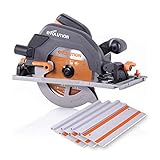
- Designed To Cut A Wide Range Of Materials Without Changing Blades
- Powerful 15 Amp, Hi-Torque Motor Accurately Cuts With An Adjustable 2 - 1/2 Inch Depth
- Includes 40 Inch Track, Ergonomic Soft Grip Handles, Dust Extraction Port & Adaptor, And Premium 7-1/4 Inch Blade
- 0-45˚ Bevel Tilt With Pivot For Compatible And Precise Cutting Capabilities
Think twice when: cordless portability, maximum corded depth, or a highly integrated portable cutting table is more important than the conventional corded setup.
DEWALT DWS520 and DCS520: choose by battery platform
DEWALT’s corded DWS520K lists a 12-amp motor, 2-1/8-inch on-track depth at 90 degrees, and 1-5/8-inch depth at 45 degrees. The kit page lists a 59-inch track, zero-clearance dual-edged tracks, anti-kickback protection, a riving knife, and a 1-1/4-inch dust port.
Free tools Windows power users keep installed
One-click scans. No signup required.
The cordless DCS520 models sit in DEWALT’s 60V MAX line. That can be a sensible route for a DEWALT user who already has the appropriate battery and charger, but exact kit contents differ among DCS520B, DCS520ST1, and DCS520T1 listings. Confirm whether a battery, charger, rail, bag, clamps, and other accessories are included rather than comparing the model number alone.
DEWALT’s track-saw category also lists 46-inch, 59-inch, and 102-inch tracks, clamps, a router adapter, and replacement friction strips. This makes the brand relevant for buyers who want to expand beyond the initial saw kit.
Choose the DWS520 when: you prefer corded operation or do not use DEWALT 60V batteries.
Choose the DCS520 direction when: you are already committed to the DEWALT 60V MAX platform and value jobsite portability.
Recommended Free Tools
Bosch GKT18V-20GCL: compact 18V cordless access
The Bosch GKT18V-20GCL is a compact 18V cordless model with a 5-1/2-inch blade. Bosch lists BITURBO Brushless technology, ECO mode, overload protection, variable speed, a nine-pound tool weight, and a minimum wall distance of 0.4 inch. It is designed for Bosch FSN tracks and accessories.
Bosch’s listed bare-tool package includes a blade, wrench, vacuum adapter, dust bag, and L-BOXX-3 case. Batteries and a charger are not included in that configuration. Bosch recommends CORE18V high-power batteries for BITURBO performance, so account for that battery cost and size when evaluating portability.
The smaller blade is the central trade-off. Fine Homebuilding’s independent test reported accurate but somewhat splintery cuts from the Bosch in its testing, praised its controls, and found that it could not cut through 2x stock beyond a 25-degree bevel. Those observations belong to that published test protocol; they are not independent measurements from this article.
Choose it when: you already own Bosch 18V batteries, need close-to-wall access, or value a smaller tool over maximum depth.
Think twice when: your work routinely involves thick stock, large bevel cuts, or a saw with a conventional 6-1/2-inch blade capacity.
RIDGID R48630B: cordless value with short rails included
The RIDGID R48630B is an 18V brushless 6-1/2-inch track saw listed by RIDGID as exclusive to The Home Depot in the United States. The package includes two 27-1/2-inch tracks, a track clamp, connector bars, a blade, a riving knife, and a wrench.
RIDGID lists up to 5,000 RPM and advertises up to 370 linear feet per charge with its AC840060 6.0-Ah MAX Output battery. Treat that runtime as a conditional manufacturer claim. Material thickness, blade condition, battery temperature, cut frequency, and the number of stops and starts can all change actual output. The battery and charger should be confirmed for the exact product listing.
Two short rails make the kit portable and give the buyer a way to make longer cuts by joining them. They also mean more attention to rail alignment than a single long rail would require. The included clamp and connectors improve the starting setup, but verify that the supplied rail length suits your sheet-good workflow.
Do these 3 things before closing this tab:
1Repair Windows errors before they cause bigger problems2Fix the driver behind crashes, sound loss and screen glitches3Clear out junk files and repair common Windows errorsPopular Woodworking reviewed the tool as a 2023 entrant and discussed its brushless motor, -1-to-47-degree bevel range, and included tracks. That review’s published MSRP and retail details are not a current price guarantee.
Choose it when: you already use RIDGID 18V batteries and want an included pair of short rails without stepping into a premium system.
Think twice when: you need a long single rail, have no RIDGID batteries, or want independently verified runtime data.
Kreg Adaptive Cutting System: buy the workflow, not only the saw
Kreg’s Adaptive Cutting System combines a plunge saw with a guide track and an optional project table. Kreg describes it for plywood, panels, and solid-wood boards. The system includes a 62-inch guide track with anti-chip and anti-slip strips, and the Saw + Guide Track Kit lists a 50-inch cutting capacity.
The Tool Desk
Outbyte PC Repair FREERepair Windows errors before they cause bigger problemsFix Now →Outbyte Driver Updater FREEScan for outdated or missing drivers - takes under a minuteDriver Scan →The project table is the reason to consider Kreg as a system rather than compare it only by motor or blade size. Kreg describes measuring scales and repetitive stops that can support repeatable crosscuts and a more controlled portable cutting station for large panels.
Choose it when: panel support, repeatable stops, measuring features, and a portable cutting station are central to the job.
Think twice when: you only need a basic rail-guided saw, already have a well-developed rail system, or would not use the table features.
Milwaukee M18 FUEL: relevant to M18 users, but verify before buying
Milwaukee documentation identifies an M18 FUEL 6-1/2-inch plunge track saw. The available official operator manual and product bulletin establish the product family, but the research used for this guide did not retrieve a sufficiently complete current U.S. product page covering every model number, rail compatibility detail, package configuration, and availability question.
For that reason, Milwaukee is a candidate for M18 users rather than a fully specified recommendation here. Check the exact model number, rail system, battery and charger requirements, included accessories, and current U.S. availability using the Milwaukee operator documentation and the current retailer or manufacturer listing.
Rank #3

- Premium Home Improvement Tools: Universal compatibility fits most circular saws in the market with blades up to 7-1/4”
- Multiple Length Settings: Cuts 50” out of the box, or extends to any length required with optional GuideRail extensions to rip entire sheets
- Sturdy Woodworking Tools: All-metal construction Increases rigidity and reduces the flex for a more accurate cut
- Versatile Carpentry Tools: The low profile lets you cut over 1-3/4" deep - enough to cut through common interior door thickness
- Straight-Edge Guide: The red cutting-strip acts as a guide and helps reduce splintering and chipping
Which track saw fits your type of work?
Breaking down plywood and sheet goods in a shop
Start with a corded saw unless your workflow strongly favors cordless mobility. The Makita SP6000J1 is a practical established direction because its kit includes a 55-inch rail. The Festool TS 60 K is the premium direction if deeper capacity, system accessories, and KickbackStop are worth the additional investment. Kreg is the better conceptual fit when the project table and repetitive stops matter as much as the saw.
Jobsite work without dependable power
Choose the cordless platform you already support. DEWALT 60V MAX users should compare the DCS520. Bosch 18V users should consider the compact GKT18V-20GCL if its smaller blade is adequate. RIDGID 18V users should look closely at the R48630B’s included short rails and clamp.
Cutting near walls or fixed cabinets
The Bosch’s listed 0.4-inch minimum wall distance makes it the compact-access specialist in this group. Still, check the actual rail position, blade exposure, and safe clearance for the cut. Close-to-wall capability does not remove the need to support the offcut and keep the cord or battery clear of the blade path.
Long rip cuts through full panels
Prioritize rail length and joining accuracy. A 102-inch DEWALT rail or 118-inch Makita rail can reduce the number of repositionings compared with short sections. Two 27-1/2-inch RIDGID rails can be joined, but the joint must be aligned carefully. Include the price and storage requirements of the rail system in the purchase decision.
Interior work where dust is a major concern
Choose a tool that connects cleanly to the extractor already on the job. Compare the Makita 1-7/16-inch port, Bosch’s listed hose and adapter compatibility, and Festool’s 27/36 mm extraction connection against your vacuum hardware. Use the correct blade and keep the filter and collection container maintained. Do not treat a manufacturer’s dust-capture claim as a measured ranking.
Blades, clamps, and accessories that affect the result
Blade selection
The supplied blade is useful for initial setup, but it should not be the only blade you ever consider. Tooth count, kerf, arbor size, diameter, and material application must match the saw and the cut. A blade intended for clean plywood work is not automatically the best option for framing lumber, laminate, or solid hardwood.
Before buying a 6-1/2-inch track saw blade or other replacement plunge saw blade, verify the exact diameter, arbor, maximum RPM, kerf, and the manufacturer’s compatibility requirements. A higher tooth count may favor a cleaner panel cut, while a more aggressive blade may feed more readily through construction material; neither choice is universally correct. Replace a damaged or dull blade rather than trying to compensate with excessive feed pressure.
Free tools Windows power users keep installed
One-click scans. No signup required.
Rail protection and splinter strips
The splinter guard is part of the rail’s reference system. After installing a new strip, trim it according to the manufacturer’s instructions with the saw set correctly for the intended cut. A worn or incorrectly trimmed strip can make the cut line appear accurate while allowing tear-out on the finished edge.
Rail strips are not automatically interchangeable. Match replacements to the specific rail and saw system, especially when mixing brands.
Clamps and work support
Anti-slip strips can hold a rail for many ordinary cuts, but clamps are valuable when the panel is slippery, narrow, angled, or expensive. The workpiece also needs support on both sides of the cut so the offcut cannot pinch the blade or fall during the plunge. On large sheets, use a stable sacrificial surface and plan the cut so the rail, saw, hose, and offcut all have room to move.
What a genuine shop test should measure
The title shop tested implies hands-on measurements. If a publisher later adds that claim, the test should document the protocol instead of presenting specifications as test results. A defensible comparison would include:
- Complete kit price and included accessories recorded on the same date and for the same geography, preferably the United States if the article is aimed at U.S. buyers.
- Each saw tested first with its stock blade, then with a standardized replacement blade where the saws can accept the same relevant specification.
- The same material batches: 3/4-inch plywood, melamine or laminate panel, solid hardwood, and thicker stock within every tool’s rated capacity.
- Setup time, cut deviation over a defined length, bevel accuracy, tear-out on both rail orientations, feed effort, dust leakage, noise, and battery consumption.
- Rail length, number of joined sections, whether clamps were used, vacuum model, battery size, blade tooth count, and number of repetitions recorded for every result.
- Measured results separated from subjective ergonomics and from manufacturer specifications.
- No long-term durability conclusion drawn from a short test.
Until those measurements exist, phrases such as best, fastest, quietest, most accurate, or best dust collection should be treated as unverified. This guide uses best only as a shorthand for best fit under a stated use case.
Purchase checklist
- Write down the thickest material and steepest bevel you actually cut. Compare on-rail capacity, not just blade diameter.
- Decide whether the job has reliable power. For cordless, price the battery and charger or confirm that your existing platform is compatible.
- Choose a rail length before choosing a kit. A short included rail may be convenient but inadequate for full-sheet rips.
- Confirm the complete SKU contents. Check for the rail, connectors, clamps, blade, case, battery, charger, dust adapter, and splinter guard.
- Verify rail compatibility. Do not rely on a rail looking physically similar to another brand’s rail.
- Match dust hardware. Measure the tool port and confirm the hose or adapter connection to your extractor.
- Budget for consumables. Include a compatible replacement blade and replacement splinter strips when estimating ownership cost.
- Check the current U.S. price and availability immediately before purchase. Promotions, package contents, warranty terms, and stock vary by date, retailer, and SKU.
Frequently asked questions
Can a track saw replace a table saw?
It can replace some table-saw tasks, especially breaking down large panels and making long straight cuts, but it does not provide the same workflow for repeated narrow rips, small parts, dadoes, or general stationary-shop operations. A track saw is strongest when the workpiece is large, the cut must begin within the panel, or transporting the material to a table saw is awkward.
Do I need clamps for every track-saw cut?
No. Rails with anti-slip strips can remain stable for many ordinary cuts, particularly on clean, flat panels. Use compatible clamps when the surface is slippery, the cut is angled, the workpiece is narrow, the rail cannot lie fully flat, or movement would be costly.
Can I use any brand’s guide rail with any track saw?
No. Some saws and rails may physically appear compatible, but splinter-strip alignment, anti-tip features, clamps, connectors, and accessory fit can differ. Makita specifically documents attachment to other guide-rail systems, while Bosch documents its FSN system; verify the exact pairing rather than assuming cross-brand interchangeability.
Quick wins for a faster PC:
Scan for outdated or missing drivers - takes under a minuteDriver Scan →Clear out junk files and repair common Windows errorsFree Scan →Fix the driver behind crashes, sound loss and screen glitchesFind Drivers →Is cordless performance equivalent to corded performance?
Not automatically. Cordless performance depends on the motor design, battery output and state of charge, material, blade, and operating mode. Bosch recommends CORE18V high-power batteries for BITURBO performance, and RIDGID’s runtime figure is conditional on a specified 6.0-Ah battery. Compare the complete platform and your work pattern rather than treating voltage alone as a performance rating.
What is the most important accessory?
For most buyers, it is the correct guide rail in a length that matches the work. After that, a compatible connector for longer cuts, a suitable blade, dust-extraction hardware, and clamps where the material requires them will usually affect workflow more than a minor difference in no-load RPM.
Frequently Asked Questions
Can a track saw replace a table saw?
It can replace some table-saw tasks, especially breaking down large panels and making long straight cuts, but it is not a full replacement for repeated narrow rips, small parts, dadoes, or general stationary-shop work.
Do I need clamps for every track-saw cut?
No. Anti-slip rails often hold position for ordinary cuts, but use compatible clamps for slippery, narrow, angled, or especially valuable workpieces.
What’s actually slowing this PC down?
Pick the symptom - the matching free tool is one click away.
Can I use any brand’s guide rail with any track saw?
No. Physical fit does not guarantee correct splinter-strip alignment, anti-tip operation, clamp fit, connector compatibility, or safe bevel stability. Verify the exact saw-and-rail combination.
Is cordless performance equivalent to corded performance?
Not automatically. Battery output, charge state, material, blade, and operating mode affect cordless performance, so compare the complete battery platform and not voltage alone.
The Bottom Line
The right track saw is the one whose depth, rail system, power source, and accessories match the work—not necessarily the one with the highest price or most features. Choose the Festool TS 60 K for a premium corded ecosystem and deeper listed capacity, the Makita SP6000J1 for an established corded setup with a 55-inch rail, DEWALT DWS520 or DCS520 according to your power preference and battery platform, Bosch for compact Bosch 18V portability, RIDGID for an accessible cordless kit with short rails, and Kreg when the complete portable cutting station is the priority.
Before ordering, verify the exact U.S. SKU, rail contents, battery requirements, compatibility, current price, and availability. Those details change more often than the saw’s headline specifications.
Quick Recap
Product prices and availability are accurate as of the date/time indicated and are subject to change. Any price and availability information displayed on Amazon at the time of purchase will apply.

