Do these 3 things before closing this tab:
1Repair Windows errors before they cause bigger problems2Scan for outdated or missing drivers - takes under a minute3Clear out junk files and repair common Windows errorsSome links on this page are affiliate links: if you buy through them we may earn a commission, at no extra cost to you.
The best lithium-ion tool is not a single drill, saw, or brand—it is the cordless battery platform that fits your work. Milwaukee M18 and DeWalt 20V MAX/FLEXVOLT are strong starting points for professional trade depth and high-load work; Makita suits buyers who prioritize balance and woodworking; Ryobi ONE+ offers the broadest practical value for homeowners and serious DIYers; and compact 12V systems are ideal when size and control matter more than sustained power.
That choice matters because batteries, chargers, bare tools, and specialty equipment are usually tied to one manufacturer’s platform. Choosing well at the beginning can save considerably more than comparing small differences between individual tool bodies.
As an Amazon Associate I earn from qualifying purchases.
Windows Errors? Fix Them Before They Spread
Repair common Windows errors and clear accumulated junk for a smoother, more stable PC - no reinstall needed.Free scan · no reinstallCrashes, No Sound, or Screen Glitches?
Random freezes, missing sound and display glitches usually trace back to one bad driver. Find and replace yours safely.Free scan · under a minuteQuick answer: which lithium-ion platform is best?
| Reader or workload | Best starting point | Why it fits |
|---|---|---|
| Professional contractor needing maximum trade depth | Milwaukee M18 or DeWalt 20V MAX/FLEXVOLT | Large professional ranges, high-output batteries, and extensive specialty equipment |
| Mixed construction and heavy-duty work | DeWalt 20V MAX with FLEXVOLT | A route from ordinary 20V MAX tools into higher-power 60V MAX equipment |
| Woodworking and finish work | Makita 18V LXT or 40V max XGT | Good tool balance and broad woodworking coverage; the systems are separate families |
| Serious DIY on a moderate budget | Ryobi ONE+ 18V | Wide selection of homeowner and specialty tools at generally accessible entry prices |
| Compact tools and overhead work | Milwaukee M12, Bosch 12V, or an equivalent compact system | Smaller tools and packs are easier to maneuver, with less sustained power |
| Heavy outdoor equipment | DeWalt FLEXVOLT, Makita XGT, Milwaukee M18, EGO, or Ryobi 40V | Higher-power systems are better suited to mowers, chainsaws, blowers, and other sustained loads |
These are platform-level recommendations, not claims that every tool in a range is the best in its category. Category performance, weight, battery cost, service availability, and the exact workload still matter.
What “lithium-ion” tells you—and what it does not
Lithium-ion describes the battery chemistry, not a performance class. Two lithium-ion tools can differ substantially because of their voltage, cells, electronics, motor, gearing, thermal management, accessory, and design.
Popular on Amazon
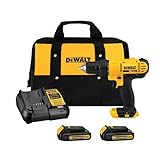
- Lightweight design fits into tight areas
- High performance motor delivers 300 unit watts out (UWO) of power ability completing a wide range of applications
- High speed transmission delivers two speeds (0-450 & 1,500 rpm) for a range of fastening and drilling applications
- 1/2' single sleeve ratcheting chuck provides tight bit gripping strength. Ergonomic handle delivers comfort and control
- Voltage indicates the electrical class of the system, but does not by itself prove which tool is more powerful.
- Amp-hours (Ah) describe approximate battery capacity. A larger Ah rating generally means more runtime, but also more weight and size.
- Watt-hours (Wh) provide a more useful energy comparison:
nominal voltage × amp-hours ≈ watt-hours. An 18V, 5Ah pack is approximately 90Wh under this simplified calculation. - Current delivery matters for high-load tools. A high-output 5Ah pack may perform differently from a standard 5Ah pack.
- Battery-management electronics control temperature, current, charging, and protection. Bypassing or modifying them creates safety risks.
“18V” and “20V MAX” commonly describe closely related voltage classes. The difference often reflects nominal voltage versus the maximum measured voltage of the pack. Neither label should be treated as a complete power ranking.
Brushless versus brushed motors
Brushless tools typically cost more, but their electronic commutation eliminates the routine brush wear found in brushed motors. In many designs they deliver better efficiency, longer runtime, lower maintenance, and stronger sustained performance. Brushless motors are particularly useful in drills, saws, grinders, impact tools, and other equipment that sees frequent or heavy loading.
That does not make every brushless tool automatically superior. Ergonomics, gearing, cooling, trigger control, battery output, durability, and accessory quality can matter just as much. A well-designed brushed tool may still be adequate for occasional household work, while an inexpensive brushless tool is not necessarily professional-grade.
Major cordless platforms compared
DeWalt 20V MAX and FLEXVOLT
DeWalt’s 20V MAX platform covers a broad range of construction, woodworking, fastening, outdoor, lighting, and jobsite tools. DeWalt states that the platform includes more than 250 products; treat that as a manufacturer-reported catalog figure that can change over time.
FLEXVOLT provides a path into higher-power equipment. DeWalt says FLEXVOLT batteries power compatible 20V MAX, 60V MAX, and 120V MAX tools. This makes the system attractive to remodelers, framers, and contractors who may eventually need large saws, grinders, rotary hammers, or outdoor equipment.
The trade-off is weight and cost. FLEXVOLT packs can be excessive for a drill or overhead fastening, and compatibility is not identical in every direction. Confirm the specific tool and battery requirements before buying.
Recommended Free Tools
Also popular on Amazon

- 【Power Drill Set】This power drill are perfect for DIY and home repairs
- 【20 V Electric Drill】This electric drill cordless has two Variable Speed (0-350/0-1350 rpm) and 18+1 torque settings
- 【Battery Drill Cordless】This cordless drill with battery and charger, 20 V 1.5 AH lithium-ion battery
- 【Compact Drill Design】The electric drill cordless is 2.5 pounds, power drills allow for easier protability
- 【Drill with Drill Bits】This drill set include 1*20 V Cordless Drill; 1*1.5 AH Battery; 1*Charger; 10*Bits(SL3-SL4-SL5-SL6-SL7-PHO-PH1-PH2-PH2); 1*Magneitc Bits Holder(60 mm); 10*Screwdriver Bits;
Milwaukee M18
Milwaukee M18 is strongly oriented toward professional trades, with tools for drilling, fastening, concrete, metalworking, woodworking, plumbing, electrical work, storage, lighting, vacuums, and outdoor equipment. Its specialty-tool depth is a major reason electricians, plumbers, HVAC technicians, and industrial users choose it.
Milwaukee’s battery range includes compact CP, balanced XC, and higher-capacity HD categories, along with standard REDLITHIUM, HIGH OUTPUT, and FORGE tiers. High-output and FORGE packs can be worthwhile for grinders, saws, rotary hammers, large impact wrenches, and outdoor tools, but they add cost and weight.
All M18 batteries are intended for M18 tools and chargers, not M12 equipment. Do not assume that a Milwaukee battery fits every Milwaukee cordless tool. Also verify model availability: the previously cited M18 two-tool kit 2697-22 is listed by Milwaukee as no longer available.
Makita 18V LXT and 40V max XGT
Makita 18V LXT is a strong choice for users who value balance, handling, woodworking coverage, and a mature construction range. 40V max XGT targets higher-output work.
The Tool Desk
Outbyte Driver Updater FREEScan for outdated or missing drivers - takes under a minuteDriver Scan →Outbyte PC Repair FREEClear out junk files and repair common Windows errorsFree Scan →LXT and XGT should not be treated as one interchangeable battery family. A buyer who starts with LXT and later needs XGT equipment may need to purchase a second battery and charger ecosystem. That switching cost is worth considering before choosing compact tools solely on price.
Ryobi ONE+ 18V
Ryobi ONE+ 18V is one of the most practical homeowner ecosystems, with tools ranging from drills and saws to inflators, lights, cleaning equipment, and other specialty products. It is especially appealing when breadth and initial value matter more than maximum daily-duty durability.
Also popular on Amazon

- 1/2" Driver-Drill with 2-speeds (0-600 and 0-1,900 RPM) delivers up to 480 in. Lbs. Of Max Torque
- 1/2" Driver-Drill features a compact design at only 7-1/4" long and weighs only 3.3 lbs. With battery for reduced operator fatigue
- Impact Driver with variable speed (0-2,900 RPM and 0-3,500 IPM) delivers up to 1,460 in. Lbs. Of Max Torque
- Impact Driver features a compact design at only 5-3/8" long and weighs only 2.8 lbs. With battery for reduced operator fatigue
- Ergonomically designed handles with rubberized soft grips provide increased comfort
Performance varies significantly between basic and premium ONE+ products. Serious DIYers should compare the exact model tier rather than treating every ONE+ tool as equivalent. Ryobi’s heavier outdoor equipment generally belongs to its separate 40V family.
Bosch 18V, Craftsman V20, and Kobalt 24V
Bosch 18V offers compact professional tools, strong ergonomics, measuring equipment, woodworking products, and specialized trade options. Its U.S. ecosystem is smaller in some categories, so check whether the tools you expect to need are available locally.
Craftsman V20 and Kobalt 24V can be credible value alternatives for homeowners. Compare current tool depth, battery availability, warranty service, retailer access, and local support rather than assuming a platform will remain strong because of one new product launch.
Choose by workload, not by brand loyalty
Use this decision sequence before buying:
- List the three tools you will use most. A platform with an excellent drill but no suitable nailer, grinder, vacuum, or outdoor tool may be a poor long-term choice.
- Estimate frequency. Occasional home repairs do not justify the same battery investment as daily construction work.
- Identify the hardest material. Concrete, structural fastening, thick stock, metal, and cutting require more output than ordinary drilling or screwdriving.
- Choose the voltage class. Compact 12V tools suit control and access; 18V/20V systems cover general construction; higher-voltage families suit sustained heavy loads.
- Check battery and charger prices. A bare tool is only a bargain when you already own a compatible battery and charger.
- Check local availability and service. A platform is less useful if replacement batteries, repairs, or your trade’s specialty tools are difficult to obtain.
A useful weighting is: tool selection 25%, performance under load 20%, battery availability and cost 15%, ergonomics 10%, durability and service 10%, total ownership cost 10%, warranty and repair network 5%, and outdoor or specialty expansion 5%.
Choose the right tool for the task
Drill/driver, hammer drill, and rotary hammer
A drill/driver handles wood, metal, and ordinary fastening. A hammer drill adds hammer action for occasional masonry drilling. A rotary hammer is substantially better for repeated concrete drilling and chiseling. Do not use a standard drill/driver for work that demands a rotary hammer, and do not choose a hammer drill merely because the label sounds more powerful.
Impact driver versus impact wrench
An impact driver uses hex-shank bits and is optimized for screws and smaller fasteners. An impact wrench uses square-drive sockets for automotive, structural, and heavy fastening. Manufacturer torque figures are not standardized across brands or testing conditions, and published tightening torque should not be treated as guaranteed real-world breakaway torque.
Also popular on Amazon

- Ergonomically Designed: Work in tight areas with a compact design that gets into tough spots
- Both tools are designed to fit into difficult to reach spaces
- Complete a wide range of applications with a high-performance motor that delivers up to 300 UWO, and an impact driver delivering up to 1,400 in-lbs of torque
- Both the DEWALT impact driver and drill driver feature integrated LED work lights with a convenient 20-second delay, ensuring enhanced visibility in dimly lit or challenging work areas
- One-Handed Loading - Keep one hand free with a 1/4 in. hex chuck that accepts 1 in. bit tips
Circular saw
Compare blade diameter, cutting depth, bevel range, blade visibility, weight with the battery installed, dust control, brake and electronic safety features, and whether the tool requires a high-output pack. Sidewinder and rear-handle layouts offer different balance and visibility. For demanding cuts, the battery and blade can affect results as much as the saw body.
Reciprocating saw, oscillating tool, grinder, and specialty tools
For demolition and pruning, a reciprocating saw’s vibration control, shoe design, trigger control, and battery balance matter. An oscillating multi-tool is valuable for trim, plunge cuts, grout, scraping, and repair work; compact batteries often make it easier to control. Grinders and rotary hammers are high-load applications where thermal management and high-output batteries deserve special attention.
Outdoor equipment needs a separate comparison
String trimmers, blowers, chainsaws, hedge trimmers, mowers, snow tools, and pressure washers can demand sustained power for much longer than a drill. A general 18V or 20V handheld platform may be adequate for a small trimmer or blower but unsuitable for the workload you expect from a mower or chainsaw.
Compare voltage family, battery count, deck or cutting capacity, runtime under the intended load, charging logistics, noise, weight, and local replacement-pack cost. Consumer Reports has reported that battery outdoor equipment can match or exceed gas performance in some categories, but results vary by product and workload; do not generalize from one mower, blower, or saw to an entire brand.
Free tools Windows power users keep installed
One-click scans. No signup required.
How to choose battery capacity and output
| Battery type | Best use | Main compromise |
|---|---|---|
| Compact/lightweight | Overhead work, drills, impact drivers, lights, small sanders | Less runtime and usually less sustained output |
| Standard | General construction and mixed DIY use | Middle-ground size, weight, and capacity |
| Extended-capacity | Longer intermittent work and high-runtime tools | Heavier and more tiring in handheld tools |
| High-output | Saws, grinders, rotary hammers, chainsaws, mowers, and large impact wrenches | Higher price and weight; unnecessary for light work |
Runtime cannot be reduced to “a 5Ah battery lasts X hours.” Continuous versus intermittent operation, material hardness, accessory sharpness, speed setting, temperature, battery age, motor efficiency, pack output, and user technique all change the result.
For a homeowner starter kit, consider a drill/driver, an impact driver if frequent fastening is expected, an oscillating multi-tool, a reciprocating saw or compact circular saw, a work light, two batteries, and a charger. For a contractor, begin with a heavy-duty drill or hammer drill, impact driver, circular saw, reciprocating saw, oscillating tool, grinder, work light, multiple high-output batteries, and a rapid charger, then add trade-specific tools. A smaller kit with stronger core tools and better batteries is often more useful than a large kit filled with low-tier models.
Also popular on Amazon

- EVERYDAY DRILLING MADE EASY: With all-metal gearing, this cordless drill achieves a max torque of 265 in-lbs. to breeze through common tasks—such as furniture assembly, picturing hanging, drywall drilling/driving, home repairs, and DIY projects
- SAME BATTERY, EXPANDABLE POWER: The same Power Share battery that runs this drill driver can conveniently be used with 140+ power tools, outdoor power equipment, and lifestyle products from the Worx Power Share platform
- INCLUDES 84-PC ACCESSORY KIT: Features the most useful bits for daily use, as well as essential hand tools to complete your power drill cordless experience—such as a hammer, tape measure, screwdriver, adjustable wrench, utility knife, and more
- COMPACT & LIGHTWEIGHT: At only 6.8" long, the electric drill cordless design is optimized for easy drilling/driving in tight spaces. And weighing just 2.54 lbs. (w/ battery), you can tackle long projects and overhead work without getting worn out
- SEAMLESS SPEED CONTROL: Quickly adjust the variable 2-speed settings [0-400 RPM/0-1600 RPM ] to use the cordless drill on a wide range of applications. Easily reverse direction for swift fastener removal
Estimate total platform cost
Do not compare only the advertised bare-tool price. Include:
- Starter kit with the tools you actually need
- At least one additional battery for rotating work
- Charger speed and the cost of a rapid charger
- Replacement battery cost and expected availability
- Two additional bare tools you are likely to buy
- Specialty tools required by your trade
- The cost of switching if the platform lacks a future tool
Prices, rebates, free-tool promotions, and kit contents change frequently. Verify the exact model number, included battery capacities, charger, brushless status, tool generation, seller, and availability on the manufacturer or retailer page immediately before purchase. Do not assume an older comparison article’s price or kit is still current.
Quick wins for a faster PC:
Scan for outdated or missing drivers - takes under a minuteDriver Scan →Clear out junk files and repair common Windows errorsFree Scan →Fix the driver behind crashes, sound loss and screen glitchesFind Drivers →Battery compatibility and safety
Battery compatibility is platform-specific. Similar voltage labels do not make batteries interchangeable across brands, and one brand may have multiple incompatible families. Milwaukee M18 does not mean M12; Makita LXT does not mean XGT; Ryobi ONE+ 18V does not mean Ryobi 40V.
Adapters and third-party packs can introduce fit, charging, thermal, warranty, and protection problems. They should not be treated as routine substitutes for the manufacturer’s battery and charger.
- Use the manufacturer-approved charger.
- Inspect packs for swelling, cracking, damaged terminals, odor, or unusual heat.
- Stop using a pack that becomes abnormally hot, vents, smokes, or shows physical damage.
- Keep battery terminals away from metal objects.
- Do not modify packs or bypass protective electronics.
- Avoid storing batteries in extreme heat, hot vehicles, damp areas, or locations exposed to impact.
- Follow the manufacturer’s manual for storage and charging conditions.
- Recycle or dispose of damaged lithium-ion batteries through an appropriate battery-recycling channel; do not place visibly damaged packs in ordinary household waste.
Common buying mistakes
- Choosing by advertised voltage alone
- Buying an obsolete kit because it appears in an older guide
- Assuming all batteries from one brand are interchangeable
- Buying too few batteries for continuous work
- Using a compact pack on a high-load tool
- Ignoring weight with the battery attached
- Comparing torque ratings as though they were standardized
- Treating Ah as a direct measure of power
- Buying unverified adapters or replacement packs
- Failing to check local battery and service availability
- Assuming a cordless tool is appropriate when corded or gas equipment better suits the workload
- Confusing a drill/driver, hammer drill, impact driver, and impact wrench
- Assuming brushless automatically means professional-grade
- Failing to verify charger compatibility
- Storing packs in hot vehicles or damp locations
Final recommendations
Choose Milwaukee M18 when professional trade specialization and high-load options are central. Choose DeWalt 20V MAX/FLEXVOLT for mixed construction work and a clear route into higher-power equipment. Choose Makita LXT or XGT when balance, woodworking, and handling are priorities, while remembering that LXT and XGT are separate battery families. Choose Ryobi ONE+ for broad homeowner and DIY expansion at a generally accessible entry cost. Choose a compact 12V platform when low weight and maneuverability matter more than maximum output.
If you already own compatible batteries, expanding that ecosystem is usually the most economical choice—provided it has the tools your future work requires. If you are starting from zero, spend more time comparing the next five tools and the next three batteries than comparing one headline drill specification. The strongest platform is the one that performs the hardest job you actually do, remains comfortable for the jobs you repeat, and will still have compatible batteries and service when you need them.
Platform features, model availability, kit contents, and pricing change. Manufacturer tool counts, compatibility statements, and charging figures should be checked on the linked U.S. manufacturer pages before purchase; manufacturer test claims are not independent performance tests.
Quick Recap
Product prices and availability are accurate as of the date/time indicated and are subject to change. Any price and availability information displayed on Amazon at the time of purchase will apply.

