Some links on this page are affiliate links: if you buy through them we may earn a commission, at no extra cost to you.
A hot tub foundation is not the place to guess. A filled portable spa commonly weighs 3,000 to 6,000 pounds, and large premium models can climb far higher once you count water, people, cover, cabinet, pumps, and accessories. Water alone weighs about 8.34 pounds per gallon. A 350-gallon spa adds roughly 2,919 pounds before anyone gets in.
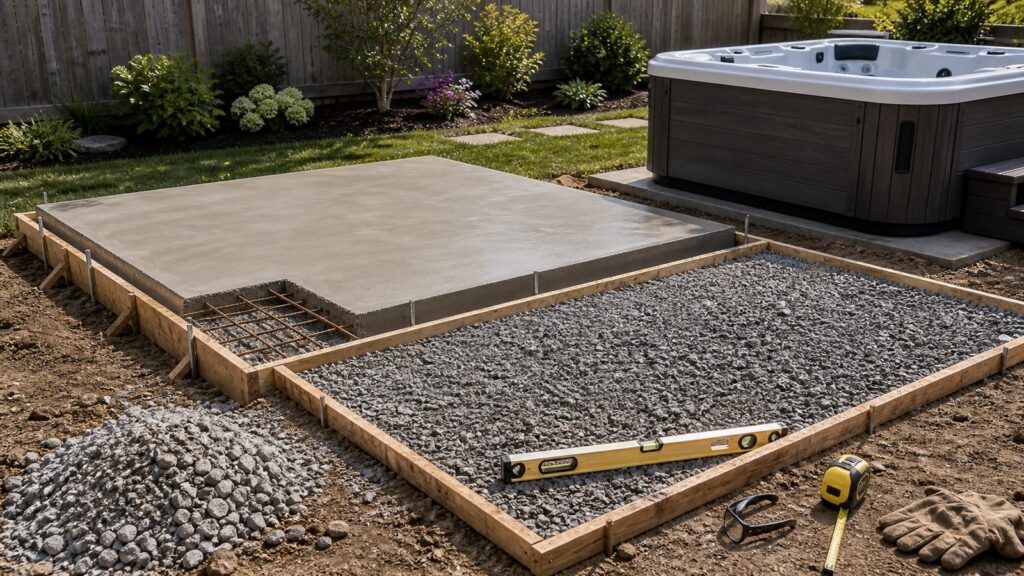
The best base material for a hot tub is the one that keeps the spa fully supported, flat, level, drained, and accessible for service. For most ground-level installations, a reinforced concrete slab is the best permanent answer. A compacted crushed stone pad is the best drainage-friendly option. Pavers are the best design-forward choice when the base is built structurally, not like a light walkway. Modular Spa Pads can work for small to mid-size tubs when the ground below is properly prepared. Decks and pier systems can be excellent, but only when designed for the actual load.
On our job sites, we start with the hot tub spec sheet before talking about finishes. The numbers matter: dry weight, water capacity, filled weight, footprint, required support, equipment-panel location, electrical disconnect location, cover-lift clearance, and drain access. If the base fails, the repair is never convenient. The tub has to be drained, disconnected, lifted, reset, and sometimes reinstalled after excavation or concrete work. Building the base correctly the first time is cheaper.
Recommended Free Tools
As an Amazon Associate I earn from qualifying purchases.
Quick Comparison: Best Hot Tub Base Materials
There is no single best hot tub base for every yard. Soil, slope, frost depth, drainage, budget, appearance, and the size of the spa all change the right answer. The table below gives a practical starting point for 2026 US projects.
| Base material | Best for | Typical 2026 cost | Key construction detail |
|---|---|---|---|
| Reinforced concrete slab | Most permanent ground-level installs | $6-$12 per sq. ft. for plain slab work; $1,500-$4,000+ possible with prep, access, permits, or upgrades | Usually 4 inches minimum on compacted subbase, reinforced and sized 6-12 inches beyond the spa |
| Compacted crushed stone pad | Drainage, budget, easier future removal | About $300-$900 DIY or $700-$1,800 professionally installed for many 10×10 pads | Use angular stone, geotextile where needed, edge restraint, and compaction in 2-inch lifts |
| Concrete pavers | Finished patios and visible outdoor living areas | Commonly $12-$26 per sq. ft.; premium work can reach $40-$50+ per sq. ft. | Needs a deeper compacted base and strong edge restraint for sustained load |
| Natural stone or flagstone pavers | High-end landscape design | Often $15-$31+ per sq. ft.; premium markets can exceed $40-$55 per sq. ft. | Decorative stone still needs a structural base and uniform bearing below the tub |
| Modular spa pad | Fast install for approved portable spas | $150-$600 for pad kit plus $100-$800+ for proper prep | Only as good as the level, compacted ground or gravel base underneath |
| Reinforced deck or pier system | Raised spas, slopes, view decks, difficult grades | Highly site-specific; reinforcement often adds thousands | Must be designed for actual loaded weight, footprint, lateral movement, and footings |
First, Calculate the Load
Before choosing concrete, gravel, pavers, or a deck, run the basic load check. Use the manufacturer’s actual numbers when available.
#1 Best Overall

- Protect the underside of your hot tub or spa and speed up installation with these 6 pack of durable base pad mats; Eliminates need to pour costly concrete and time consuming installation
- Equipped with a durable pad for spa placement to protect your portable tub; Each mat measures 32 by 48 inches; Comes with 6 pads with 8 by 8 measurements
- Hot tub mat is installed with a durable cushion between rough surfaced wood decks and concrete pads or create a new foundation wherever you want; Made of durable and high density polyethylene plastic
- Hot tub mat for inflatable tub quickly lock together with built in connectors for greater strength and reduced shifting; Add additional pads as needed to increase overall pad size
- Versatility allows it to be used under pool filter equipment and plastic sheds as well as under trash cans and inside the garage; Hot tub pad is easy to clean, just wash away dirt with any garden hose
Hot tub load = dry weight + water gallons x 8.34 + occupant allowance.
Free tools Windows power users keep installed
One-click scans. No signup required.
For example, assume a spa has a 900-pound dry weight, holds 350 gallons, and seats five adults. The water weighs about 2,919 pounds. If you allow 175 pounds per person, that adds 875 pounds. The operating load is about 4,694 pounds before accessories. If the spa footprint is 7 feet by 7 feet, that is 49 square feet. Divide 4,694 by 49 and you get about 96 pounds per square foot.
That number explains why an ordinary patio, old deck, or decorative gravel area may not be enough. Many residential decks are commonly designed around 40 to 50 pounds per square foot of live load. A hot tub can impose roughly 80 to 150+ pounds per square foot over a concentrated footprint, and it sits there continuously. Static load is different from a group of people walking around for a few hours.
Also remember that the base should support the whole bottom of the spa evenly. A base can be strong in the middle and still cause damage if one corner settles or the frame is supported only at a few high spots. Many manufacturers warn that uneven support can damage the shell or frame and affect warranty coverage.
1. Reinforced Concrete Slab: Best Overall Permanent Base
For most homeowners who want a long-term, low-maintenance hot tub foundation, a reinforced concrete slab is the first recommendation. It gives the spa a flat bearing surface, handles heavy loads well, can be formed to the exact size needed, and works with most manufacturer requirements when built correctly.
The Tool Desk
Outbyte Driver Updater FREEScan for outdated or missing drivers - takes under a minuteDriver Scan →Outbyte PC Repair FREEClear out junk files and repair common Windows errorsFree Scan →A typical hot tub slab is at least 4 inches thick, placed over a compacted subbase. For many standard portable spas on competent soil, that is enough when properly reinforced and drained. For very heavy tubs, weak soils, expansive clay, poor access areas, slopes, raised edges, or integrated patio work, the slab may need to be thicker or engineered. We do not treat 4 inches as a magic number. It is a common minimum, not a substitute for looking at the actual load and site.
As a practical rule, size the slab at least 6 to 12 inches larger than the spa footprint on all sides. Go larger if you want steps, a cover lifter, a service walkway, or a place to stand without stepping into mulch. A 7×7 spa often pairs well with a 9×9 or 10×10 pad. If the equipment panel is on one side, leave enough clear working room to remove panels and reach pumps, unions, valves, drains, and electrical components.
Concrete Slab Specs That Matter
A good hot tub slab starts below the concrete. Strip organic material, excavate soft soils, compact the subgrade, and install a compacted aggregate base. If the soil is clay or silty, a geotextile separator can help keep aggregate from pumping into the subgrade over time. Drainage should move water away from the house, away from the slab, and away from the spa equipment.
For the slab itself, use reinforcement appropriate to the project: welded wire mesh, rebar, or fiber reinforcement depending on local practice and design needs. A broom finish is usually the right surface because it gives better slip resistance when wet. Decorative smooth finishes can become slick unless they are textured or sealed properly.
Concrete is not automatically level just because it is concrete. Check the forms, verify slope requirements, and keep the spa bearing area flat and level. If a patio is intentionally pitched for drainage, the hot tub footprint may need a level thickened pad or isolated section so the tub does not sit twisted.
Concrete Slab Cost in 2026
Plain reinforced slab work commonly prices around $6 to $12 per square foot nationally, with many current patio and slab cost guides showing roughly $6.50 to $10.50 per square foot for basic work. Once excavation, reinforcement, access, finish upgrades, demolition, permits, and small-job minimums enter the quote, the range can widen to $8 to $25 per square foot.
For a straightforward 10×10 hot tub pad, many homeowners should expect about $600 to $1,200 for basic slab pricing. In the real world, small jobs often carry minimum mobilization charges, and quotes of $1,500 to $4,000+ are common when the crew has to remove an old patio, haul spoils, pump concrete, add rebar, deal with tight backyard access, or build in a high-cost metro.
2. Compacted Crushed Stone Pad: Best Drainage-Friendly Base
A compacted crushed stone pad is a strong option for many ground-level hot tubs, especially where drainage is the priority. It is more forgiving than concrete in freeze-thaw climates, cheaper to modify later, and easier to remove if the homeowner changes the yard layout.
Do these 3 things before closing this tab:
1Fix the driver behind crashes, sound loss and screen glitches2Repair Windows errors before they cause bigger problems3Scan for outdated or missing drivers - takes under a minuteThe key is using the right stone and building the pad like a structural base. Use angular crushed stone, not pea gravel or rounded river rock. Angular stone locks together when compacted. Rounded stone rolls under load and can shift, settle, or let the tub move. Decorative gravel may look finished, but it is not automatically a foundation.
Rank #2

- Handi-Spa Pads: Set of 3 pads creates a new foundation to protect the underside of your hot tub or spa with a durable cushion; Can also be used between rough-surfaced wood decks and concrete pads
- Reliable Strength: Made of weatherproof high-density polyethylene and tested to withstand 300 pounds of pressure per square foot; Floor underside is formed with built-in strength pockets for durability
- Connectable Design: Hot tub floor mat pieces lock together with built-in connectors to reduce shifting which eliminates the need to pour costly concrete and time-consuming installation
- Versatile: Ground mat suitable for under pool filter equipment, plastic sheds, under trash cans, and inside the garage; Avoid placing beneath gas heaters as it can pose safety risks
- Specifications: Each hot tub mat weighs 15 pounds; Dimensions (L x W x H): 32 x 48 x 2 inches; Add pads as needed to increase overall pad size (Additional pads sold separately)
For many hot tub pads, 4 inches of compacted crushed stone is a practical minimum. For heavier spas, poor soils, or slight slopes, 6 to 8 inches is often more appropriate. We typically excavate to remove organic material, compact the soil, install geotextile where the subgrade calls for it, place the stone in lifts, and compact each lift. Two-inch lifts are easier to compact properly than dumping all the stone at once and hoping the plate compactor reaches the bottom.
How to Build a Gravel Hot Tub Pad
A typical crushed stone pad includes a restrained perimeter, compacted subgrade, geotextile fabric on clay or silty soils, compacted angular aggregate, and a final screeded surface. The restraint can be pressure-treated lumber, concrete curbing, metal edging, or another durable border. Without edge restraint, the stone can spread under repeated loading and foot traffic.
The pad should be flat and level across the tub footprint. It should not sit in a bowl. If the surrounding grade drains toward the pad, correct that first with grading, a swale, a drain, or a different location. Standing water under a hot tub is a problem. It accelerates settlement, creates freeze-thaw movement, contributes to wood-frame rot, and makes electrical and service access worse.
Gravel Pad Cost in 2026
General gravel patio pricing commonly falls around $2.35 to $6.20 per square foot, but a hot tub pad costs more when it is framed, excavated 6 to 8 inches, compacted in lifts, and built with fabric and proper leveling. For a 10×10 pad, a material-heavy DIY build may land around $300 to $900 depending on stone depth, rental equipment, delivery minimums, edging, and fabric. A professional installation commonly runs about $700 to $1,800, with grading, hauling, access, and drainage corrections pushing the price higher.
Crushed stone is not the cheapest if it has to fix a bad site. If the yard slopes hard toward the house or the soil is soft and wet, the real cost is not the gravel. It is excavation, drainage, and stabilization.
3. Concrete Pavers: Best Finished Patio Look
Concrete pavers are a good hot tub base when the homeowner wants the spa integrated into a patio rather than sitting on a separate utility pad. Pavers can also handle freeze-thaw movement better than one large monolithic slab because individual units can move slightly. If repairs are needed, sections can be lifted and reset.
The failure point is almost always the base. A light pedestrian paver patio is not the same as a paver hot tub foundation. A hot tub is a sustained static load. If the paver base is shallow, poorly compacted, or missing edge restraint, the pavers can settle, separate, or tilt. Once that happens, the hot tub can lose uniform support.
For hot tub pavers, we want a compacted aggregate base, proper bedding layer, edge restraint, and drainage plan. The base depth depends on soil, climate, and load, but we build it more like a driveway or heavy-use patio than a garden path. The finished surface has to be flat, level, and continuous under the spa footprint.
Concrete Paver Cost in 2026
Installed concrete pavers commonly run about $12 to $26 per square foot in 2026. Broader contractor ranges can reach $15 to $50 per square foot depending on region, paver type, base depth, cuts, pattern, edge restraints, drainage, and access. A 10×10 hot tub pad often falls around $1,200 to $2,600 for standard concrete pavers. Brick, porcelain, or natural stone can cost more.
Natural stone and flagstone pavers commonly run about $15 to $31+ per square foot in patio cost data, and premium markets can exceed $40 to $55 per square foot. They can look excellent, but they are not a shortcut around structural prep. Decorative stones laid over soil are not a hot tub foundation.
4. Modular Spa Pad: Best Quick Base for Approved Portable Tubs
Modular plastic or composite spa pads can be useful when the tub manufacturer allows them and the site is already close to level. They are popular because the kit is relatively affordable, they install quickly, and they avoid a permanent concrete pour. For small to mid-size portable spas, they can be a practical solution.
Quick wins for a faster PC:
Scan for outdated or missing drivers - takes under a minuteDriver Scan →Repair Windows errors before they cause bigger problemsFix Now →Fix the driver behind crashes, sound loss and screen glitchesFind Drivers →The mistake is treating the pad kit as the whole foundation. Most modular systems still need firm, level, prepared ground below them. If the soil settles, the pad follows. If the pad is installed over grass, topsoil, mulch, soft fill, or poorly compacted dirt, the hot tub can still move.
A proper modular pad installation usually includes excavation, subgrade compaction, a thin compacted crushed stone layer or other manufacturer-approved base, and careful leveling. Read the spa manufacturer’s foundation requirements and the pad manufacturer’s load rating before buying. If the hot tub warranty requires continuous support or prohibits a certain base type, the cheaper pad is not cheaper.
Modular Spa Pad Cost in 2026
The pad kit itself commonly costs about $150 to $600. Site prep can add $100 to $800+ depending on excavation, gravel, compaction, edging, and leveling. It is genuinely economical only when the yard is accessible, stable, and close to level. For a large premium spa, swim spa, or difficult soil condition, get written approval from the manufacturer or use a more robust foundation.
Rank #3

- Large Hot Tub Protector Pad:This 85IN x 85IN large inflatable hot tub mat offers excellent support and cushioning for your pool or hot tub,protecting the bottom of your pool or hot tub from ground friction,stones or other sharp objects,and extending the lifespan of your pool
- High-density Thickened EVA Foam Pad:The hot tub bath mat is made of 1/2" ultra-thick high-density EVA foam material,featuring excellent noise reduction,anti-aging,wear resistance,heat insulation and cushioning performance.It is safe,non-toxic and reusable,more durable than other materials,helping you save money while protecting your swimming pool
- Anti-slip and waterproof design:The hot tub pad with a frosted anti-slip texture on both sides not only prevents slipping accidents and ensures your safety,but also keeps the mat in place without sliding.It also has an excellent water absorption performance,quickly drying the water and providing you with a safe and dry bathing environment
- Comfortable and energy-saving:Our thickened hot tub base pad features an interlocking design that can reduce heat loss,keeping the heat for a long time even in the cold winter and saving your operating costs.Compared to the cold and hard floor,our soft and elastic hot tub mat provides a comfortable touch and enhances your swimming pool experience
- Easy to clean and store:The dark gray waterproof and dirt-resistant spa floor mat is composed of 16 EVA pads and 1 small pump pad.Just wipe it with a damp towel and let it air dry,saving your time and energy.When not in use,you can quickly and easily remove the puzzle-like bathtub mat and store it,taking up no space at all(Note: There is a small color difference between the electronic screen display and the actual product color.)
5. Reinforced Deck Structure: Best Elevated Option
A hot tub on a deck can be beautiful and convenient, but it is also one of the easiest ways to underestimate load. An existing deck that feels solid under people may not be designed for a 4,000- to 6,000-pound spa sitting in one area year-round. Larger spas can be heavier. The question is not whether the deck looks strong. The question is whether the posts, beams, joists, ledgers, footings, connectors, bracing, and soil bearing were designed for that load.
As a rough check, many ordinary residential decks are designed around 40 to 50 pounds per square foot of live load. Hot tubs can impose roughly 80 to 150+ pounds per square foot over the footprint. That does not mean every deck fails. It means the deck needs load-specific design.
When possible, place the tub close to beams and posts rather than at mid-span. Better yet, design the deck around the spa from the beginning. That may mean larger footings, more posts, shorter joist spans, doubled or tripled beams, closer joist spacing, lateral bracing, corrosion-resistant connectors, and a service hatch or removable panels. If the deck is attached to the house, the ledger and lateral load path matter. Water, vibration, and people entering and exiting the spa add real-world demands beyond static math.
Deck Cost in 2026
Deck pricing varies too widely to give one honest number for a hot-tub-ready structure. Reinforcement can add thousands because it may require new footings, posts, beams, joist changes, bracing, permits, and engineering. If the deck is high off the ground, attached to the home, located over a slope, or carrying a large spa, involve a structural engineer or qualified deck contractor. Use the actual tub weight and footprint. Do not rely on a generic per-square-foot guess.
6. Concrete or CMU Pier and Footing Systems: Best for Slopes and Raised Installs
Some yards do not have a simple flat spot. On sloped lots, waterfront properties, mountain sites, and tight backyards, a conventional slab may require excessive excavation, retaining walls, or fill. In those cases, structural concrete piers, CMU supports, grade beams, or engineered footings may be the right foundation.
What’s actually slowing this PC down?
Pick the symptom - the matching free tool is one click away.
This is not usually the budget option. It is the right option when grade changes make a pad impractical or when the spa needs to align with a deck, patio door, retaining wall, or view. Costs are driven by frost depth, soil bearing capacity, excavation difficulty, drainage, retaining requirements, access, and structural design.
Footings must extend to proper bearing soil and below local frost depth where required. Drainage behind walls and around piers matters. Poorly controlled water can undermine footings, push retaining walls, and create freeze-thaw movement. On projects like this, we want a clear load path from the hot tub to the soil: tub frame to platform, platform to beams, beams to piers or footings, and footings to competent bearing.
Hot Tub Foundation Materials to Avoid
Some materials look acceptable on delivery day and fail after the first wet season. Avoid grass, bare dirt, mulch, sand-only bases, uncompacted fill, pea gravel, rounded river rock, decorative stone over soil, and old patios that have visible settlement. These surfaces move, hold water, compress unevenly, or fail to provide continuous support.
Also be cautious with existing concrete. An old slab may be cracked because it was thin, unreinforced, placed on poor soil, or pitched in the wrong direction. A few hairline cracks are not always a problem, but uneven settlement is. If one corner is low, the slab rocks, or water ponds under the spa location, fix the base before delivery.
Outdated Drivers Are Slowing You Down
One free scan finds every outdated or missing driver and matches the right update for your exact hardware.Free scan · exact hardware matchWindows Errors? Fix Them Before They Spread
Repair common Windows errors and clear accumulated junk for a smoother, more stable PC - no reinstall needed.Free scan · no reinstallDrainage, Leveling, and Service Access
A good hot tub foundation is flat, level, and dry. Those three words sound simple, but they drive most of the field decisions.
Flat means the tub has uniform bearing across the support area required by the manufacturer. Level means the waterline sits evenly and the shell is not twisted. Dry means rainwater, splash-out, snowmelt, and roof runoff are directed away from the spa and equipment area.
Plan the base at least 6 to 12 inches larger than the tub footprint. Add more room for steps, cover lifters, handrails, and a service path. The equipment side should be accessible without dismantling half the patio. A cover lifter often needs 12 to 24 inches behind or beside the spa, depending on the model. Some tubs need more. Check before you pour concrete or set pavers.
Document the base build with photos before delivery. Take pictures of excavation, geotextile, aggregate depth, reinforcement, compaction, forms, and final level. Those photos help with inspections, warranty questions, future service, and resale documentation.
Free tools Windows power users keep installed
One-click scans. No signup required.
Permits, Electrical, and Safety Notes
Hot tub rules are local. Some jurisdictions require permits for the spa, electrical circuit, bonding, barrier, slab, deck, or structural work. Others treat a portable spa differently from an in-ground pool, but still require electrical compliance. Before work starts, check your city or county building department and the current electrical code requirements for your area.
Rank #4

- EXTRA LARGE AND EXTRA THICK:This bath mat is 85 inches in diameter to keep floors clean and absorb spills when in use. It is 1/4 inch thick and has good water absorbency. This hot tub mat for inflatable tubs provides noise reduction as well as insulation and warmth. The insulation of the hot tub mat prevents most of the heat loss from the floor, so you can say goodbye to sky-high heating bills
- HIGH DENSITY EVA FOAM MATERIAL:The hot tub inflatable mat is made of high-density high quality EVA foam material, which is more non-slip, wear-resistant, durable, and more importantly, better insulated than other materials. The hot tub inflatable mat prevents friction between the hot tub and the ground, thus protecting the hot tub from sharp debris and prolonging the life of the hot tub
- COMPREHENSIVE PROTECTION:Advanced grey block interlocking design makes it easier to use and store, the interlocking hot tub floor protection foam is laid underneath your inflatable tub to protect your hot tub from rough surfaces and floor debris. Note:We have prepared a total of 17 hot tub mats for you (including 16 x outdoor foam floor tiles + 1 x small mat for pump), enough to meet your needs
- ANTI SLIP PROTECTION:Our square hot tub base pad is designed with a double-sided non-slip frosted texture that enhances friction and prevents accidents such as slipping or falling, ensuring your safety! And the square hot tub base pad is reusable, the best choice for your home hot tub
- MULTIFUNCTION:This amazing hot tub puzzle mat is specially designed for users, it can be used for a variety of purposes, no matter indoor: fitness equipment, yoga mat; or outdoor: swimming pool, hot tub, etc it can be easily managed. It is also very easy to remove and install, making it a must-have kit for your home
In practical terms, expect a dedicated electrical circuit, proper disconnect placement, GFCI protection, bonding where required, and safe working clearance around equipment. The disconnect usually cannot be so close that someone in the water can reach it, but it also must be accessible. Exact distances and requirements depend on adopted code and local amendments.
Decks, raised platforms, retaining walls, and pier systems are more likely to trigger structural review. In cold climates, frost depth can control footing depth. In planned communities, HOA rules may affect placement, screening, noise, drainage, and visible equipment. Do not schedule spa delivery until the base, electrical work, access route, and inspections are coordinated.
When to DIY vs. When to Hire a Pro
A careful homeowner can sometimes DIY a compacted crushed stone pad or modular spa pad for a smaller portable tub. The site needs to be accessible, mostly level, well-drained, and free of soft soils. The work still requires excavation, compaction, edge restraint, accurate leveling, and attention to the manufacturer’s base requirements. Plan on a weekend for a small pad if materials are delivered and the site is straightforward. Add time if you are hauling stone by wheelbarrow, cutting into sod, or correcting grade.
Hire a pro for concrete slabs, paver pads tied into larger patios, poor drainage, clay soils, meaningful slopes, retaining walls, raised installations, and any deck-supported hot tub. Also bring in a licensed electrician for the spa circuit and disconnect. A hot tub combines heavy load, water, electricity, and outdoor exposure. That is not the place to improvise.
For concrete, a pro crew can usually form, prep, and pour a simple pad quickly, but scheduling, curing, inspection, and access can stretch the project. Concrete often needs several days before light use and longer before full design strength. Coordinate the spa delivery date with the concrete contractor rather than assuming the pad is ready the next morning.
Our Recommendation
For a typical ground-level hot tub, choose a reinforced concrete slab if you want the most permanent, broadly accepted foundation. Choose compacted crushed stone if drainage, cost, and future flexibility matter more and the manufacturer allows it. Choose pavers when the hot tub is part of a finished patio and you are willing to pay for a properly built structural base. Use modular spa pads only when the spa and pad manufacturers approve the setup and the ground below is prepared correctly.
For decks, slopes, and raised installations, stop thinking in terms of surface material and start thinking in terms of structure. The right answer is a designed load path to competent soil. That may be reinforced deck framing, concrete piers, CMU supports, grade beams, or a combination of systems.
Quick wins for a faster PC:
Repair Windows errors before they cause bigger problemsFix Now →Fix the driver behind crashes, sound loss and screen glitchesFind Drivers →The base should be boring after the spa arrives. No settling corners, no ponding water, no blocked service panels, no warranty argument, no surprise electrical conflict. That is the mark of a well-built hot tub foundation.
Frequently Asked Questions
What is the best base material for a hot tub?
For most permanent ground-level installations, a reinforced concrete slab is the best overall base. A compacted crushed stone pad is the best drainage-friendly option, while pavers work well when installed over a structural compacted base.
How thick should a concrete slab be for a hot tub?
A 4-inch reinforced concrete slab on a compacted subbase is a common minimum for many portable hot tubs. Heavier spas, weak soils, slopes, or integrated patio designs may need a thicker or engineered slab.
Can you put a hot tub on gravel?
Yes, if it is angular crushed stone, properly contained, leveled, and compacted in lifts. Do not use pea gravel, river rock, mulch, grass, or loose decorative stone as the structural base.
Can you put a hot tub on pavers?
Yes, but the pavers need a deeper compacted aggregate base and strong edge restraint. A light walkway-style paver installation can settle under the sustained weight of a filled spa.
Can my existing deck support a hot tub?
Maybe, but it must be verified using the actual filled weight and footprint of the spa. Many residential decks are designed around 40 to 50 psf live load, while hot tubs can impose roughly 80 to 150+ psf over the footprint.
How much does a hot tub pad cost in 2026?
A 10×10 concrete pad often starts around $600 to $1,200 for straightforward slab pricing, but real project quotes can reach $1,500 to $4,000+ with prep, access, reinforcement, or permits. Gravel pads commonly run about $300 to $900 DIY or $700 to $1,800 professionally installed.
Quick Recap
Product prices and availability are accurate as of the date/time indicated and are subject to change. Any price and availability information displayed on Amazon at the time of purchase will apply.
Do these 3 things before closing this tab:
1Clear out junk files and repair common Windows errors2Scan for outdated or missing drivers - takes under a minute3Repair Windows errors before they cause bigger problems
