Some links on this page are affiliate links: if you buy through them we may earn a commission, at no extra cost to you.
A good glass wall clock should do three things well: tell time clearly from the places you actually stand, hold up to the room conditions, and stay safely on the wall. Style matters, but in kitchens, bathrooms, laundry rooms, mudrooms, and open-plan living spaces, the best clock is usually the one that balances glass type, size, movement noise, moisture resistance, glare control, and proper mounting.
For most homeowners, the sweet spot is a battery-operated quartz glass wall clock between 12 and 20 inches. Smaller 9- to 12-inch clocks work in powder rooms, laundry nooks, and compact kitchens. Larger 20- to 30-inch clocks make sense in open kitchens, great rooms, offices, and dining areas where the clock is viewed from 10 to 25 feet away. In full bathrooms, choose a water-resistant or bathroom-rated model and mount it outside direct shower spray.
As an Amazon Associate I earn from qualifying purchases.
Quick wins for a faster PC:
Repair Windows errors before they cause bigger problemsFix Now →Scan for outdated or missing drivers - takes under a minuteDriver Scan →Clear out junk files and repair common Windows errorsFree Scan →On our job sites, we treat clocks like any other finish detail: small item, real consequences if placed badly. A clock drilled through tile in the wrong spot can crack a backsplash. A heavy glass clock on weak drywall anchors can loosen after a few battery changes. A beautiful mirrored face under vanity lights can be unreadable because of glare. The best glass wall clocks are chosen with the room, wall, and daily use in mind.
What Counts as a Glass Wall Clock?
Glass wall clocks in 2026 cover a wide range. At the budget end, many are simple plastic or metal-frame clocks with a clear glass lens over the dial. These are practical, easy to read, and often cost about $5 to $25. In the middle of the market, you will find decorative glass-face clocks, printed glass clocks, frosted glass clocks, and contemporary models around $35 to $125. Larger metal-and-glass, mirrored, pendulum, art-glass, and designer clocks commonly run $125 to $400, with oversized or specialty square glass clocks reaching $400 and above. Some decorative listings extend toward $2,000 depending on size, brand, frame, movement, and construction.
Popular on Amazon

- ⌚️Ultra-thin transparent glass surface, high light transmission, simple fashion
- ⌚️Using metal pointers, light and stable to prevent rust
- ⌚️One-piece movement back cover, easy to hang and long service life
- ⌚️Simple Round shape creates a stylish and romantic atmosphere for the space
- ⌚️Thoughtful Gift: Thanks to its functionality and beauty, you can give it to your friends as a housewarming, Christmas birthday, anniversary, wedding, or Thanksgiving gift!
The key distinction is whether the glass is only a protective lens or part of the clock structure. A framed clock with a glass lens is often more forgiving in family spaces because the frame protects the edge. A frameless decorative glass clock may look cleaner, but exposed glass edges and fragile mounting points need more care. Tempered glass is preferable in high-traffic areas because it is stronger and safer than ordinary annealed glass. However, tempered glass cannot be cut, drilled, ground, or modified after tempering without shattering, so the hole pattern and dimensions need to be correct before purchase.
Best Glass Wall Clock Types by Room
The best clock for a kitchen is not automatically the best clock for a bath. Room conditions change the priorities. Kitchens need cleanability, contrast, and visibility from the cooking triangle. Bathrooms need moisture resistance and corrosion control. Mudrooms need impact resistance. Offices need silence and readability. Covered patios and sunrooms need better protection from temperature swings and humidity.
The Tool Desk
Outbyte Driver Updater FREEFix the driver behind crashes, sound loss and screen glitchesFind Drivers →Outbyte PC Repair FREEClear out junk files and repair common Windows errorsFree Scan →| Room | Best Clock Type | Typical Size | What to Watch |
|---|---|---|---|
| Kitchen | Glass lens or tempered-glass face, silent quartz movement | 12-18 inches; 20+ inches for open plans | Grease, steam, cabinet swing, glare from task lighting |
| Full bath | Water-resistant or bathroom-rated clock | 8-14 inches | Humidity, shower spray, battery corrosion, fogging |
| Powder room | Decorative glass or mirrored clock | 8-16 inches | Vanity light glare, tight wall clearances |
| Laundry room | Durable framed glass clock | 10-16 inches | Vibration, humidity, door swings, shelving |
| Mudroom | Tempered or framed glass clock | 12-18 inches | Backpacks, elbows, doors, impact risk |
| Home office | Silent glass clock with high-contrast dial | 10-18 inches | Ticking noise, monitor glare, eye-level placement |
| Sunroom or covered patio | Outdoor-rated or damp-rated clock | 14-24 inches | Humidity, temperature swings, UV exposure |
Kitchen Glass Wall Clocks: Readability Comes First
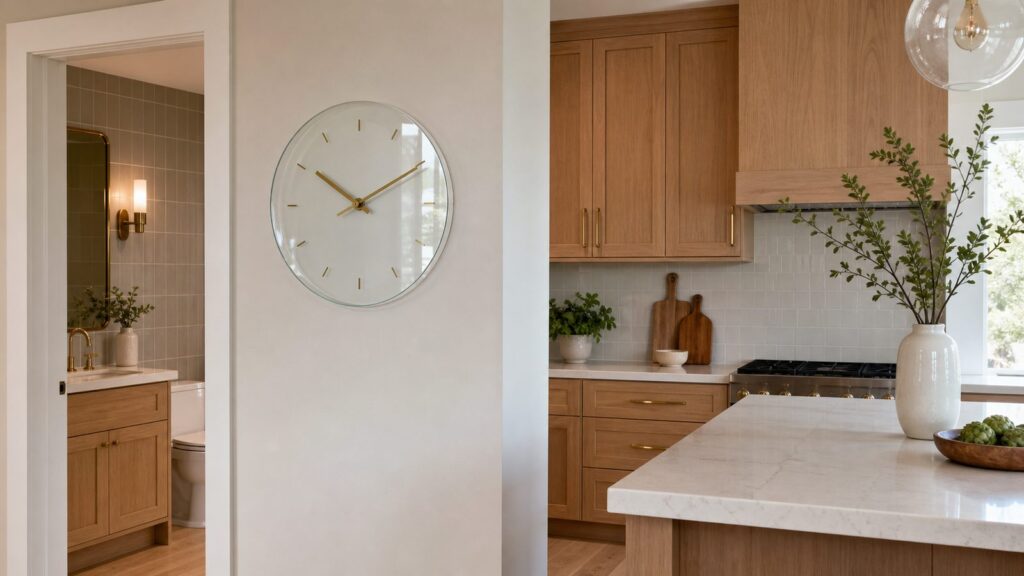
In a kitchen, the clock needs to work from the sink, stove, island, breakfast table, and doorway. That usually means high contrast: black hands on a white, pale, or clear face; white hands on a dark face; or bold numerals that can be read at a glance. A delicate gold-on-glass dial can look great up close and still fail from 12 feet away.
For many kitchens, 12 to 18 inches is the right range. A compact galley kitchen may only need a 10- or 12-inch clock. A larger kitchen with an island and dining zone may need 20 inches or more. In open-plan rooms, a 24- to 30-inch glass or metal-and-glass clock can work if the wall has enough visual space and the clock is mounted securely.
Where to Put a Kitchen Clock
Good locations include a wall near the breakfast area, above a kitchen desk, on a pantry wall, or on a side wall visible from the main work zone. Avoid hanging glass clocks where cabinet doors can strike them, where backsplash cleaning will constantly bump them, or directly above heavy steam sources. Near a range, grease and heat shorten the life of finishes and make the clock harder to keep clean.
During remodels, plan clock placement before tile, lighting, and cabinets are finalized. We often mark the proposed centerline on the wall and check it from the sink, island, and room entry. If a client wants an oversized clock, we add blocking while the wall is open. A scrap 2×6 or 2×8 installed between studs costs very little during rough carpentry and can save a lot of trouble later.
Free tools Windows power users keep installed
One-click scans. No signup required.
Bathroom Glass Wall Clocks: Moisture Is the Real Test
Bathrooms are tougher on clocks than most people expect. Even when a clock is not directly in the shower area, repeated humidity can fog the glass, corrode battery contacts, swell paper or MDF backers, and shorten the life of a quartz movement. For full baths, choose a product described as waterproof, water-resistant, sealed, or bathroom-rated. If the listing does not mention moisture at all, assume it is best suited for dry rooms or powder rooms.
A battery-operated quartz clock is usually the lowest-risk choice in bathrooms. It avoids cords, outlet placement, and hardwired electrical work in damp zones. Modern electrical rules around bathrooms are strict for good reasons, especially around receptacles, GFCI protection, and wet locations. A simple battery clock hung like decor normally does not trigger a permit. Running wiring, adding a receptacle, opening walls, or changing electrical layout is different work and should be handled under the applicable local code by a qualified electrician.
Best Bathroom Placement
Keep a bathroom wall clock outside direct shower spray and away from the strongest steam concentration when possible. Over a towel area, across from the vanity, or near the entry wall often works better than inside the tub or shower sightline. In small bathrooms, an 8- to 12-inch clock is usually enough. In a larger primary bath, 12 to 14 inches may be more readable without feeling oversized.
Check batteries proactively in bathrooms. Moisture can accelerate corrosion, especially in inexpensive clocks. We recommend checking the battery compartment every 3 to 6 months in full baths and replacing batteries before leakage starts.
Glass, Tempered Glass, and Safety
Tempered glass is stronger than ordinary annealed glass and breaks into smaller, less dangerous pieces if it fails. It is a good choice for family rooms, mudrooms, laundry rooms, narrow halls, and any spot where doors, elbows, sports bags, or cleaning tools may hit the clock. A framed glass lens is also useful because the frame protects the edge and gives the hardware a more stable body to support.
Also popular on Amazon

- MODERN DESIGN: 12-inch contemporary wall clock featuring a sleek glass face, perfect for adding sophistication to any room's decor
- SILENT OPERATION: Precision quartz movement ensures quiet timekeeping without disruptive ticking sounds, ideal for peaceful environments
- VERSATILE PLACEMENT: Suitable for multiple rooms including living room, kitchen, office, or bedroom with its neutral and elegant aesthetic
- CLEAR VISIBILITY: Glass face design provides excellent readability with clean, minimalist numbering for easy time checking
- EASY INSTALLATION: Wall-mounted clock comes ready to hang with included mounting hardware for quick and simple setup
Not every wall clock needs tempered glass. A small, framed 10-inch clock above a desk is low risk. A frameless 30-inch glass clock in a hallway is a different story. The bigger, heavier, and more exposed the clock is, the more we care about tempered glass, protected edges, and secure mounting.
Safety-glazing rules in building codes are mainly aimed at glass in hazardous locations such as doors, tub and shower enclosures, large panels near walking surfaces, and similar glazing conditions. A battery wall clock is generally treated as decor, not architectural glazing. Still, the principle is practical: glass near impact zones deserves more caution. If a glass clock is going near a door swing, stair landing, mudroom bench, or child traffic path, choose a safer construction or move it.
Size, Scale, and Sightlines
Clock size should be based on both viewing distance and wall proportion. For a quick rule of thumb, a clock above a small console, towel niche, or desk area should usually occupy about one-half to two-thirds of the available visual width. On a narrow backsplash wall, use less. In open rooms, use the distance test: if the clock is viewed from 15 to 20 feet away, a 9-inch dial will usually feel too small.
| Viewing Distance | Suggested Clock Diameter | Best Use |
|---|---|---|
| 3-6 feet | 8-10 inches | Powder rooms, laundry nooks, small offices |
| 6-10 feet | 10-14 inches | Bathrooms, compact kitchens, mudrooms |
| 10-15 feet | 14-20 inches | Most kitchens, breakfast rooms, larger offices |
| 15-25 feet | 20-30 inches | Open-plan kitchens, living rooms, dining areas |
| 25+ feet | 30 inches or larger | Great rooms and large feature walls |
Mounting height depends on the room, but most clocks look and read best with the center roughly 57 to 66 inches above the finished floor. In kitchens and laundry rooms, you may go higher to clear counters, cabinets, and shelving. Above a console, leave enough space so the clock does not feel jammed against the tabletop. Above tile, align the centerline with grout layout if possible so the installation looks intentional.
Movement, Noise, and Battery Access
Most glass wall clocks use battery-operated quartz movements. They are affordable, simple, and reliable. Silent sweep movements are worth the small premium in kitchens open to living spaces, bedrooms, home offices, and powder rooms near guest areas. A loud ticking clock may be tolerable in a mudroom and irritating in a quiet office.
Before buying, look at how the clock opens for battery replacement. Some decorative glass clocks are easy: lift off the wall, change one AA battery, rehang. Others have small rear compartments, fragile hangers, or exposed glass edges that make handling awkward. For oversized clocks, battery access matters because every battery change is another chance to twist the hanger or scratch the wall.
For square, rectangular, or oversized clocks, use two-point mounting when the clock allows it. A single center hanger can let a clock drift out of level after door slams, wall vibration, or battery changes. Two mounting points keep the clock level and reduce rotation.
Do these 3 things before closing this tab:
1Scan for outdated or missing drivers - takes under a minute2Clear out junk files and repair common Windows errors3Fix the driver behind crashes, sound loss and screen glitchesMounting Glass Wall Clocks on Different Walls
The clock is only as secure as the wall and fastener behind it. A 12-inch plastic-frame clock may weigh very little and hang safely on a picture hook. A 24-inch glass or metal-and-glass clock can require proper anchors, studs, or blocking. Always check the product weight and use hardware rated above that weight. We prefer a meaningful margin, not a fastener rated exactly at the clock weight.
Drywall
For light clocks, a quality picture hanger or screw-in drywall anchor is often enough. For heavier clocks, use a stud when the location allows. If the clock must be centered between studs, use anchors rated for the load and appropriate for the drywall condition. Old, damaged, damp, or patched drywall has less holding power than new board.
Tile, Stone, and Glass Tile
Tile installation is where small decor work can become expensive. Drilling ceramic, porcelain, stone, or glass tile requires the correct bit, low pressure, patience, and awareness of what is behind the surface. A rushed hole can crack a tile, chip a finished backsplash, or compromise waterproofing in a bathroom assembly.
In wet areas, avoid unnecessary penetrations through waterproofed shower or tub walls. If a clock must be installed on tile outside the wet zone, use the right anchor for the substrate behind the tile, not just the tile surface. For renters or anyone unsure about the wall assembly, consider a freestanding clock, shelf clock, or adhesive solution only if the clock is light and the adhesive is rated for the surface and humidity.
What’s actually slowing this PC down?
Pick the symptom - the matching free tool is one click away.
Also popular on Amazon

- Tone-on-tone bold sculpted raised numerals
- Quiet sweep (no ticking) second handle
- Protective glass lens
- Quartz movement
- Operates on (1) aa battery, not included
Brick, Concrete, and Masonry
Masonry can hold a clock very well with the right fastener. Use masonry screws or anchors sized for the clock weight, and drill with the correct bit. On older brick, the mortar may be softer than expected, so fastener location matters. For heavy glass clocks, we usually prefer fastening into solid masonry rather than relying on weak mortar joints.
Costs in 2026: Product, Hardware, and Professional Installation
Glass wall clocks have a wide price range because the category includes budget utility clocks, decorative glass faces, mirrored designs, pendulum clocks, and oversized statement pieces. For most kitchen and bath projects, the clock itself will cost less than many other finish selections, but installation can cost more than expected if tile drilling, ladder work, or professional help is involved.
| Item | Typical 2026 Cost | Notes |
|---|---|---|
| Basic small clock with glass cover | $5-$25 | Good for utility spaces, compact baths, rentals |
| Decorative glass wall clock | $35-$125 | Common range for kitchens, baths, offices |
| Large, mirrored, pendulum, or metal/glass clock | $125-$400 | Better for open rooms and feature walls |
| Oversized, specialty, designer, or custom glass clock | $400+ | Some decorative square glass listings reach much higher |
| DIY mounting supplies | $5-$25 | Hooks, screws, anchors, felt bumpers, batteries |
| Tile or stone drilling supplies | $10-$40+ | May include specialty bits and anchors |
| Handyman mounting | $50-$150 per hour | Often driven by trip minimum or hourly minimum |
For a single clock, a professional installation charge is often less about the time on the wall and more about the service minimum. National handyman pricing in 2026 commonly falls around $50 to $150 per hour, with many averages in the $65 to $125 per hour range. Thumbtack-style marketplace pricing often shows low-end rates around $45 to $50 per hour and high-end rates around $100 to $125 per hour. Metro labor rates, clock weight, wall material, ceiling height, hidden plumbing or wiring risk, and tile drilling can all change the final number.
If the wall is already open during a remodel, adding blocking for a future heavy clock is inexpensive compared with retrofitting later. It is usually absorbed into carpentry time and scrap lumber. That small step can prevent failed drywall anchors and gives the homeowner flexibility after paint, tile, or cabinets are complete.
When to DIY and When to Hire a Pro
DIY is reasonable for a light battery clock on painted drywall, especially if the clock weighs only a few pounds and uses standard hanging hardware. Measure carefully, use a level, choose hardware rated for the load, and add felt bumpers to keep the glass or frame from scuffing the wall.
Hire a pro when the clock is oversized, expensive, heavy, mounted high, installed over stairs, or going into tile, stone, brick, concrete, glass tile, or a waterproofed bathroom assembly. Also bring in the right licensed trade if the work involves adding an outlet, concealing wiring, hardwiring a clock, opening walls, or coordinating with plumbing and electrical behind the finish surface.
A simple battery clock usually does not require a building permit. Remodel work can. New receptacles, changed electrical circuits, wall openings, structural changes, or penetrations in waterproof assemblies may require code-compliant methods, inspections, or licensed trades depending on local rules. When in doubt, ask before drilling. Finding a stud is helpful; finding a water line with a drill bit is not.
Independent reader supportYour contribution helps us test, update, and keep practical guides available for everyone.Common Mistakes to Avoid
The most common mistake is buying by style alone. A clock can match the faucet finish, cabinet pulls, or mirror frame and still be wrong for the room if it cannot be read from the sink or island. Check contrast, numeral size, hand shape, and glare before committing.
Another common issue is bad placement. Avoid spots too close to cabinet doors, shower spray, towel bars, stove steam, and heavily cleaned backsplash areas. In bathrooms, do not assume any decorative glass clock can handle daily steam. In laundry and mudroom spaces, avoid fragile frameless clocks at shoulder or elbow height.
Mounting mistakes are just as important. Generic drywall anchors are not enough for every oversized glass clock. Tile and stone should not be drilled with the wrong bit. Square and rectangular clocks should not rely on a single hanger if two-point mounting is available. And every clock should remain accessible for battery changes without requiring risky handling.
Our Practical Buying Checklist
Before buying a glass wall clock, confirm the room, size, moisture exposure, weight, mounting method, and viewing distance. For a kitchen, prioritize a cleanable face, silent movement, high contrast, and a diameter visible from the main work zones. For a full bath, prioritize moisture resistance and protected placement. For high-traffic rooms, choose tempered glass or a framed glass lens.
Also popular on Amazon

- 1.[Size] - Black marble clock is 12 inches x 12 inches, HD glass, frameless round analog wall clock, decorative wall clocks for living room bedroom kitchen office.black clock wall decor living room office.
- 2.[Material] - Contemporary black and white wall clock made of tempered glass dial, metal hands, bright and clear color, frameless design.decorative clocks for walls.
- 3.[Silent] - Silent wall clock,no ticking sound,no noise,this abstract wall clock will not disturb you even when you are reading,working,thinking,chatting or sleeping.
- 4.[Battery Operated] -Powered by one single AA battery (not included), this black wall clock requires no cords or outlets. Easy to hang, and has a long performance on a single battery.For longer life please use ordinary carbon battery instead of high duty alkaline batteries.
- 5.[Beautiful Decoration] - The office wall clock clock keeps time accurately and stylishly, suitable for living rooms, bedrooms, kitchens, bathrooms, classrooms, guest rooms, offices, restaurants, cafes, dining room, libraries, or walls of any color.
Check the listed dimensions and weight. A 20-inch clock may sound moderate online but can dominate a narrow wall. A mirrored or art-glass clock may be heavier than expected. If the product uses tempered glass, remember that it cannot be modified after manufacturing. If you need a custom hole location, special mounting, or a nonstandard size, solve that before ordering.
Recommended Free Tools
Finally, look at the wall. Drywall, tile, stone, brick, and glass tile each need different fasteners and different levels of care. The right clock with the wrong anchor is still a bad installation. The best result is a clock that looks intentional, reads easily, handles the room conditions, and comes down safely when it is time to change the battery or repaint.
Bottom Line
The best glass wall clock is not simply the prettiest one. For kitchens and baths, choose a clock that fits the room scale, reads clearly from real working positions, resists the conditions of the space, and mounts safely to the actual wall material. Expect to spend about $35 to $125 for many good decorative glass clocks, less for basic utility models, and more for oversized or specialty pieces. Budget another $5 to $25 for ordinary DIY hardware, more for tile or masonry supplies, and $50 to $150 per hour if professional installation makes sense.
Handled well, a glass wall clock is a small finish detail that earns its place every day. Handled casually, it becomes glare, ticking noise, cracked tile, moisture failure, or a loose hanger. Choose it like a builder would: by room, wall, size, safety, and serviceability.
Frequently Asked Questions
Are glass wall clocks safe for kitchens and bathrooms?
Yes, when the clock is suited to the room and mounted correctly. Kitchens need cleanable, readable clocks placed away from heat, grease, and cabinet impacts. Full bathrooms need water-resistant or bathroom-rated clocks mounted outside direct shower spray.
PC Slower Than It Used to Be?
A free scan shows the junk files, broken settings and background clutter dragging Windows down - then fixes them in one click.Free scan · Windows 10 & 11Crashes, No Sound, or Screen Glitches?
Random freezes, missing sound and display glitches usually trace back to one bad driver. Find and replace yours safely.Free scan · under a minuteDo glass wall clocks need to be tempered glass?
Not always. A small framed clock in a low-traffic room may be fine with a standard glass lens. Tempered glass is a better choice for larger clocks, frameless designs, mudrooms, family spaces, halls, and areas where the clock could be bumped.
Can I hang a glass wall clock on tile backsplash or bathroom tile?
Yes, but tile requires the correct bit, anchor, and drilling technique. Avoid unnecessary holes in waterproofed shower or tub assemblies. For expensive tile, stone, glass tile, or large-format backsplash walls, professional installation is often worth the cost.
How much does it cost to install a wall clock professionally in 2026?
A handyman commonly charges about $50 to $150 per hour in the US, and a single clock may be billed under a trip minimum or hourly minimum. Heavy clocks, high walls, tile drilling, masonry, or concealed wiring and plumbing risk can increase the cost.
What size wall clock is best for a kitchen, bathroom, or living room?
Most kitchens work well with 12- to 18-inch clocks, while open-plan rooms may need 20 to 30 inches. Bathrooms usually need 8 to 14 inches. Choose based on viewing distance, wall width, and readability from the places you actually use the room.
Free tools Windows power users keep installed
One-click scans. No signup required.
Do I need a permit to install a wall clock during a remodel?
A battery-operated clock hung like decor normally does not require a permit. Permits or licensed trades may be needed if the work involves electrical wiring, new receptacles, wall openings, structural blocking, tile penetration in waterproof assemblies, or broader remodel work.
Quick Recap
Product prices and availability are accurate as of the date/time indicated and are subject to change. Any price and availability information displayed on Amazon at the time of purchase will apply.

